laila sharmeen

delightful, evocative  and lyrical

Laila Sharmeen is a storyteller who happens to be an artist. She  believes in changes. She is a visionary whose ideas of change  involve both the past and future, while remaining firmly rooted to  the present. Laila Sharmeen is delightful, evocative and  lyrical. She has the simplicity of a child  and the intensity of a…

bengal cartoons before the end of the raj

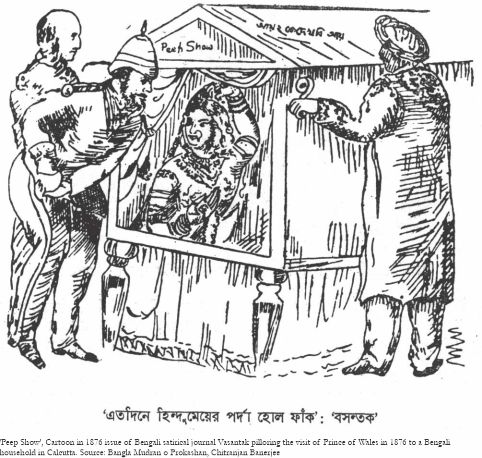
Cartoons, as they are now known, was introduced in Bengal in the 1870s  by the British expatriates emulating the famous London Punch. Soon this  new genre of art caught the imagination of educated Bengalis who found  a new medium to express their age old  talent of self-mockery.  Bengali  cartoonists pilloried the deficiencies and drawbacks of…

brick lane – will it be  the beginning of a  new conversation?

Let’s face it. Monica Ali did not write Brick  Lane to bring out an image of the  community that western audiences are not  used to imagining.  She highlighted the  stereotypes with some broad brush strokes and no intention to look for nuances.  The  settings she portrayed are probably cliché for us  Bangladeshis.  However, to unsuspecting…

beyond the world of apu

the films of satyajit ray

John Hood’s recent book claims to  give a comprehensive and impartial  analysis of Satyajit Ray’s oeuvre. Shamsad Mortuza’s book review  questions the ethos of judging films  while sitting on the cultural fence,  and challenges the notion of  neutrality. Apart from stating the obvious, the title  of John W. Hood’s recent book Beyond  the World of…

in conversation with tareque masud

Tareque Masud locates his films on the confluence of high and popular  art and urges for the rise of pre-modern Islamic culture as a response  to Islamomania. James Leahy caught up with Tareque Masud for an  intriguing interview. James Leahy: Obviously Matir Moina (The Clay Bird)  is deeply rooted in the culture of Bengal and…

1950’s to present

bangladesh’s cine-history in posters

Recently we went to the Bangladesh National Film Archives and sifted  through the dust-encrusted stacks of old cinema posters in their  collection. What we found was a gold mine, albeit a disorganized and  neglected one – hundreds of posters dating from the industry’s earliest  stirrings in the 1950’s to the present day. Some are painted…

south asian cinema and bharat muni

towards a new film aesthetics

The Natyasastra, or “Principles of Drama” as set forth in the ancient Indian  tradition, may guide us towards a better understanding of the unique  aesthetics of South Asian cinema.  “Popular” cinema, while looked down  upon by elitist critics, has many elements drawn from the Natyasastra, such  as an emphasis on “emotional arousal” over narrative.  Father…

bengali or muslim?

islam, identity and art  cinema in contemporary  bangladesh

In Bangladesh art cinema, the representation of Islam often conveys a  simplistic and clear-cut dichotomy between an ‘obscurantist’ version of  Islam and ‘modern and secular’ Bengali identity.  Zakir Hossain Raju  believes this is a reflection of longstanding and unresolved  identity  conflicts within the society. This essay is an effort to deconstruct how  Bangladeshi art cinema…

Load More