

bengali or muslim? islam, identity and art cinema in contemporary bangladesh
In Bangladesh art cinema, the representation of Islam often conveys a simplistic and clear-cut dichotomy between an ‘obscurantist’ version of Islam and ‘modern and secular’ Bengali identity. Zakir Hossain Raju believes this is a reflection of longstanding and unresolved identity conflicts within the society.
This essay is an effort to deconstruct how Bangladeshi art cinema represents and interacts with Islam and Muslim identity. A glimpse at the colonial and postcolonial trajectory of Bangladesh and its people demonstrates that the identity formation of Bengali Muslims was never a linear process. Along side the indigenization of Islam and continuous transformations of local cultural practices, British and Pakistani colonialism as well as the postcolonial State of Bangladesh played a crucial role in constructing community identities in East Bengal/Pakistan and in Bangladesh. Sociologist Tazeen M. Murshid states, The history of the region demonstrates that the process of identity selection was not constant; the cultural markers adopted were not fixed. … Here, nationhood has been defined and re-defined three times within a quarter of a century.
In this way, the Bengali Muslims of Bangladesh are always formulating new, emerging and conflicting versions of Bengali-ness and Muslim-ness, which are not pure concepts, rather are always on the move. Within this framework, films produced and circulated as ‘art cinema’ in the auteur tradition are engaged in constructing and reconstructing different identities for Bengali Muslims in contemporary Bangladesh.
Bangladeshi art cinema, to a large extent, locates Islam as an alien culture, a ‘foreign’ religion that entered Bangladesh through political-military aggression.
Following the cultural-nationalist pro-Bengali approach, the major tendency of Bangladeshi art cinema is to be anti-Islamic. Believing in an ‘authentic’ and anti-colonial but modern version of Bengali culture, they complain that Islam poses certain threats to the development and dissemination of such preferred notion of Bengali-ness. In other words, most art cinema films are committed to a definitive national-cultural modernity, a modernity that normalizes the ‘Bengali’ identity as modern and secular, and locates the ‘Muslim’ identity only as a religious category that cannot be placed within everyday cultural lives of Bengali Muslims. The dominant thrust of Bangladeshi art cinema is then to represent Islamic practices as out-of-date and stereotypical rituals.
find this tendency most visible in some wellknown films of Morshedul Islam and Tanvir Mokammel, two major art cinema authors in contemporary Bangladesh. One can argue that as representatives of western-educated urban Bengali Muslims who produce, watch and critique Bangladeshi art films, these two filmmakers utilized the discourse of art cinema to form a contrast between Islam and Bengali culture. Their films, produced and circulated during the 1980s-2000s and targeted to both national and global viewership, repeatedly show Islam as a singular and monolithic orthodoxy. These films theatricalize and exoticize Islamic practices as something outdated in contemporary Bangladesh, a rapidly modernizing and commercializing nation-state in the face of globalization. These cinematic texts thus create and maintain a clear-cut dichotomy between Islam and Bengali culture. bengali or muslim?: the conflict of identities in bangladesh Though large-scale conversion to Islam began in Bengal from the thirteenth century, the conflict between Islam and Bengali identity started only in the late nineteenth century. This dichotomy intensified because of the success of Islamic reform movements in rural Bengal as well as the subsidies provided by the British to Indian Muslims in order to turn them into a ‘community’. Historian Asim Roy argues that the comprehensive outcome of the Islamic reform movements in nineteenth century Bengal created a chasm between the Muslims’ ‘Islamic’ and ‘Bengali’ identities. The persistent and vigorous insistence on a revitalized Islamic consciousness and identity, with its corresponding denigration of Islam’s local roots and associations in Bengal, sapped the very basis of the syncretistic tradition and of the Bengali identity in general.
The proponents of a pro-British, anti-Bengali and anti-Hindu version of ‘Muslim’ identity in colonial Bengal promoted the incompatibility of Bengali-ness and Muslim-ness and enforced pan-Indian Islamic brotherhood upon Bengali Muslims. The upper-class, non-Bengali and Urdu-speaking Muslim leaders of Calcutta like Nawab Abdul Latif and Amir Ali led this process of identity formation of Bengali Muslims in the late-nineteenth century. The geo-ethnic and cultural self-identification of Bengali Muslims as ‘Bengali’ became negligible in this process, especially in a bid to get rid of the hegemonic umbrella of Bengali-Hindu identity. In a way, this pro-Arab notion of Muslim identity adopted by Bengali Muslims reinforced the hegemonic notion that Bengali identity can accommodate Bengali-Hindus only, a notion first established by modernist Bengali Hindus in colonial Bengal.
However, the emergent middle-class Bengali Muslims in the late nineteenth century were linked
not only with the agricultural lands, but also with the indigenized version of Islam in rural East Bengal. The Arab-looking, Urdu-speaking elite Muslims with a pan-Indian Islamic view did not accept these Bengalispeaking rural Muslims as their ‘real’ brothers, though they wanted to accommodate them under the umbrella of Muslim identity. Opposing both the Bengali-Hindu cultural modernity and the pro-Arab pan-Indian Muslim identity, the middle-class Bengali Muslims worked towards defining a modern cultural identity specifically for Bengali Muslims. They felt a strong affinity with their cultural roots, a sense of Bengali-ness principally and visibly expressed through the Bengali language as well as through religious affiliation with indigenized Islam. In this way, by the beginning of the twentieth century a category called ‘Bengali Muslim’ identity came into discussion.
However, the two conflicting identity discourses of ‘Muslim-ness’ and ‘Bengali-ness’ continued to be crucially incompatible with a viable identity for Bengali Muslims in different historical junctures of the twentieth century. In the search of a modern identity for Bengali Muslims, middle class Bengali Muslims then used the Bengali/Muslim dichotomy differently at different times. This conflict inherent in Bengali Muslim identity served as constituent to the Pakistan State in 1947 and, in a different form, it also acted as the driving force for establishing the State called Bangladesh in 1971. In a similar manner, as I outline below, the key art cinema films in contemporary Bangladesh promote and advocate for a fixed notion of Bengali identity by putting it against Muslim identity.
Islam and Bangladeshi art cinema: Bengali/Muslim conflict on screen
The art cinema as a national-cultural institution rigorously participated in the identity debate of Bengali Muslims during last few decades. Drawing on certain realist idioms the modernist Bengali Muslims shaped the discourses around Bangladeshi art cinema, an art cinema that is quite different than what is normally considered as art cinema in the West.
However, by recording and representing the culturalnationalist essence of Bangladesh through EuroAmerican cinematic narration, the Bangladeshi art cinema addresses the art-house audiences and critics in the West (the ‘global’ audience) and the westernized middle-class Bengali Muslims in Bangladesh. This art cinema, thus, is not (expected to be) appreciated by
the ordinary, average cine-goers in Bangladesh, some (if not most) of whom are strong Muslim believers and live in small towns and rural areas where indigenized Islam is very much part and parcel of their everyday lives.
The genealogy of Bangladeshi art cinema as a cultural institution closely linked to western modernity confirms that this cinematic discourse mainly reconstructs and reinforces the Bengali/Islam dichotomy on cinema screens. Most of these films represent Islam as anti-modern and arcane using the unresolved identity question of Bengali Muslims as their basis. By discussing a number of globally-circulated films of two major authors of Bangladeshi art cinema, Morshedul Islam and Tanvir Mokammel, I demonstrate the tendency of this cinematic mode in negating Islamic practices.

Both Islam and Mokammel entered filmmaking in the mid-1980s through what has been dubbed as the ‘short film movement’ in Bangladesh. This discourse
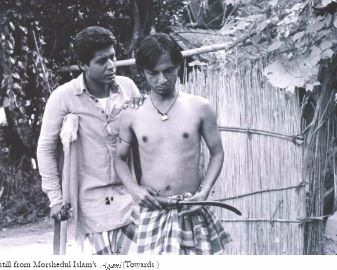
comprises short fiction and documentary films on 16 mm and video, produced in artisanal mode with low budget outside the popular film industry. Amid rapid globalization and the strengthening of Muslim identity through State mechanisms, film club activists fostered this cultural-nationalist stream of visual culture in 1980s-90s Bangladesh. Short films were shown outside commercial cinema theatres: among friends, local groups, especially among college students and cultural activists. Among the earliest films to come out of the short film movement were two short fictions, both on the failed expectations of the 1971 liberation war: Agami (Toward, 1984) by Morshedul Islam and Hulyia (Wanted, 1984) by Tanvir Mokammel. Islam and Mokammel, like other leaders of this film movement, received their education on film appreciation and production through watching European and American film classics. In an informal setting such as within film clubs, they watched and discussed classic films from Europe and the US as well as the Indian art films following Euro-American methods of cinematic narration. Therefore the films they produced during 1980s-2000s followed the textual forms of these foreign cinemas, especially of the Indian art cinema and Italian Neorealism. Using these western cinematic-textual norms, the films of Islam and Mokammel severely criticized the proIslamic tendencies of the postcolonial State in Bangladesh.
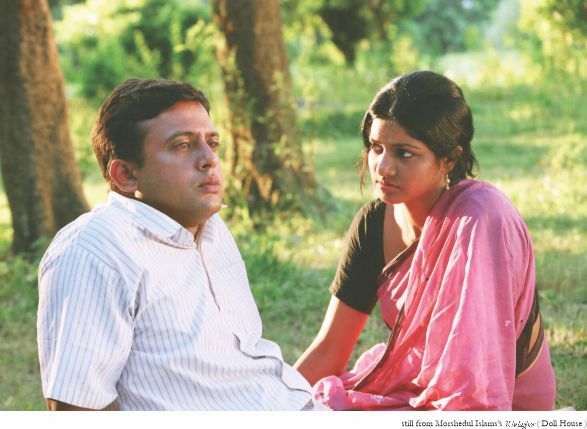
The 1971 liberation war and its cultural-nationalist ideals opposing pro-Pakistan discourse of Muslim identity come as a recurring theme in the films of these two authors. The first of these films, Agami started this trend. Morshedul Islam here visualizes the agonies of a liberation war veteran in 1980s Bangladesh using flash-back scenes. He juxtaposes how the Bengali-Muslim guerillas forgave and let the captive Razakars (pro-Islam Bengali Muslim supporters of Pakistan Army) flee during 1971 war and how the Razakars punish the liberation war veterans in the 1980s. Morshedul Islam’s later films: Suchona (The Beginning, 1988), Chaka (The Wheel, 1993), Bristi (The Rain, 1999), and Khelaghor (Doll House, 2006) continued such cultural-modernist rewriting of the contested history of nation and identity in Bangladesh.
Morshedul Islam’s Bristi can be read as a key text to understand how he positions Islam in contemporary Bangladesh. The story centres around a devout Muslim old man in rural Bangladesh, his young bride and the young man he has adopted as a ‘son’. The old and his religious and economic achievements have made him a powerful figure in the village. So nobody questions when he marries for the fourth time and brings a young bride to his home. However a clandestine love affair develops between the young bride and Hajishaheb’s adopted son, a young man who also follows Islamic teachings like his father. He also wears a beard, Muslim cap and long punjabi with pajama pants, understood as Islamic attire in Bangladesh.
There is a drought in the village and Hajishaheb concludes that Batashi, a poor divorced woman who recently became pregnant is responsible for the long lasting drought in the area. He presides over a village tribunal on the matter and as per the ‘Islamic teaching’, he puts forth the verdict that Batashi should be stoned to death for her extra-marital relationship.
When the village meeting adjourns, the rain comes and Hajishaheb takes it as Allah’s quick appraisal and returns home happily. He finds that his young bride is happily taking a shower under the rain. What he does not realize is that she has just had a sexual encounter with her lover, his adopted son, a message the viewers receive through parallel editing during the scene of the village trial.
Bristi reminds the viewers of Morshedul Islam’s first filmic endeavor: Agami. Though Islam made that film in 1984 almost fifteen years before he made Bristi in 1999, his portrayal of Islam and its apparent opposite, Bengali culture, are identical in both films.
The appearance, attire and mannerism of Hajishaheb and the leader of the pro-Pakistan Razakars in Agami is almost identical. Actually the same actor (Aly Zaker) was cast for both the roles. More importantly, we also find a similar village tribunal in Agami where the Razakar-leader imposes cruel verdicts on poor women accused for adultery using the rhetoric of Islam.
Similar to the suggestion of sexual relations between the young bride and the son of Hajishaheb in Bristi, Morshedul Islam also presented a playful love-making scene between a Bengali guerilla and his wife in a jungle in Agami.
Similar to films by Morshedul Islam, Tanvir Mokammel’s films too contributed to sharpen the Bengali/Muslim dichotomy on screen. Using various plots and narrative strategies, these films also portrayed the conflict between the secular-modern and communal-Islamic forces in rural Bangladesh.
Mokammel’s Nadi Naam Modhumati (A River Named Modhumati, 1995) reveals this conflict in the form of a familial conflict between a hardcore Islamic father and modernist son while his Chitra Nadir Pare (On the Bank of Chitra, 1999) portrays the migration of bitterly disillusioned Bengali Hindus of East Pakistan to West Bengal in India in the 1960s amid the increasing Islamicization enforced by the Pakistan State.
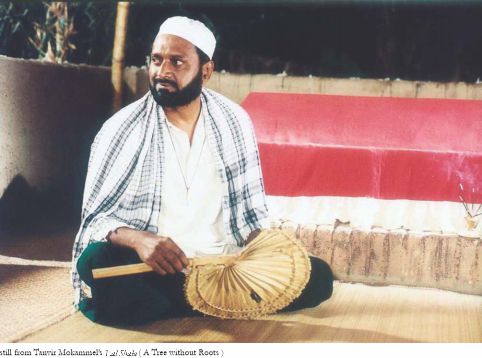
In 2001 Mokammel made Lal Shalu (A Tree without Roots), a feature film based on the highlyrespected Bengali novel of the same title, a novel that has been in the syllabus of the secondary and higher secondary schools in Bangladesh for many years. This film depicts the rise and fall of Majid, a hypocrite Mullah (Islamic priest) who creates a false mazar (shrine) of an imagined Pir (Muslim saint) in order to collect money and gifts from the villagers. He takes on a second wife (Jamila), a playful rural girl, who rejects his authority imposed in the name of Islamic wisdom.
Her rebellious acts unsettle Majid and expose his vulnerability and powerlessness, faults he had covered up earlier by preaching Islam to the ordinary rural Muslims. Mokammel used many symbols in Lal Shalu that portray Islamic practices as medieval and backdated. For example we see the shalu, the red cloth that covers the top of the false burial site of the so-called saint, in many shots (including some close shots) in this film. Like Bristi, here also we see the marriage between an aged Islamic practitioner (Majid) and a playful young woman unwilling to follow Islamic pedagogy. The Islamic ‘trial’ at the village level (for punishing unruly villagers) is also present in Lal Shalu that we saw both in Bristi and Mokammel’s first film Hulyia.
conclusion: ‘bengali-ness’ as battered but brave women?
The above glimpse at the major representational tendency of Bangladeshi art cinema discourse through the works of two major authors proves that middle class Bengali Muslims utilized art cinema to repeatedly stage and screen Islam as an orthodoxy that opposes the ‘modern’ identity of Bengali Muslims. Culturalmodernist art cinema authors like Morshedul Islam and Tanvir Mokammel clearly believe in straightforward separation between the Muslim and Bengali identity of Bengali Muslims. In their films they took a clear position on the side of Bengali identity and even tested its boundaries by emphasizing issues like sexual intercourse, an subject normally treated as taboo even among modernist Bengali Muslims.
These films present Islamic fundamentalists in a stereotypical fashion, imposing identical mannerisms and dress codes on them. The filmmakers also repeatedly portray scenes of innocent and powerless women who become victims of village tribunals, where they are subjected to Islamic rhetoric against which they can exert no objection. The character of the Islamic fundamentalist as an older/middle-aged man, who carries prayer beads and wears Islamic dress, and who cheats the ordinary villagers in the name of Islam, is omnipresent in the films of Morshedul Islam and Tanvir Mokammel. The Razakar-leader in Agami, Hajishaheb in Bristi, Majid, the hypocrite mullah and his opponent, another Pir, in Lal Shalu — all these characters basically represent an Islamic fundamentalist in different guises. These characters are built, in most cases, not as human characters with limitations and virtues. Rather they are shown as monsters who only plan and perform coercion, deception and evildoing to ordinary villagers using their Islamic clout.
As I have discussed above, their victims are mainly females and in most cases they are represented as innocent, youthful and playful girls who revolt against the restrictions imposed on them in the name of Islamic teaching. Hajishaheb’s young wife and Batashi, the girl to be stoned to death in Bristi, and Majid’s second wife Jamila in Lal Shalu represent these kinds of woman-as-victim-and-rebel characters. Unlike the Islamic fundamentalist men, these women characters are created more delicately and bear some resemblance to human characters in the real world: they are people who feel love and hatred and wish to live their lives according to their free will. Such opposition between Islamic fundamentalist men and freedomhungry women-victims is played out in Bangladeshi art cinema films so recurrently that I would argue that this opposition is actually used to establish the Bengali/Islam dichotomy on cinema screens. In this sense the women-victims symbolize the vulnerable state of Bengali culture in 1980s-2000s Bangladesh amidst increasingly pro-Islamic State power and the elite. However, this kind of oppressor-victim dichotomy brings a medieval feudalism to the cinema screen that to easily dismisses Islam and Muslim identity for being anti-modern and outmoded. Bangladeshi art cinema for the most part abstains from portraying the multiplicities of Bengali Muslim identities and fails to show how Islam has been localized to become a part of everyday life in Bangladesh. However, there are exceptions to every tendency, and in this case, there is at least one film that goes against the homogenization of Islam in Bangladeshi art cinema. This is Tareque Masud’s Matir Moina (The Clay Bird, 2002). Focusing on the world of a young madrasa student in 1960s East Pakistan, this autobiographical film visualized and presented Bangladeshi madrasas to the global stage.
Though I cannot provide the detailed reading of Matir Moina here that I did elsewhere3, I would like to point out that this is a film against the mainstream representational mode of art cinema based on Bengali/Islam dichotomy as visible in the texts created by Morshedul Islam and Tanvir Mokammel.
Matir Moina is one of the rare Bangladeshi art films that visibly and delicately represents Islamic education in the madrasa system in Bangladesh. The scriptwriter and director of the film, Tareque Masud, an important Bangladeshi art cinema author alongside Morshedul Islam and Tanvir Mokammel, contributed to the critique of Muslim nationalism and the formation of cultural-national modernity amongst Bengali Muslims through his earlier films in the 1980s90s. All these films by Masud obviously prove that his filmmaking career and vision is also linked with Bangladesh art cinema discourse and its clear-cut opposition between Islam and modernism. But we do not find black-and-white rivalry between Islam and Bengali identity in Masud’s film, Matir Moina. What we get is a discursive take on Bangladeshi madrasa education that he represents through cinema aesthetics mostly learnt from Euro-American films.
The madrasa-educated filmmaker Masud, with the collaboration of his American-born partner, Catherine, created a film that rather presents the divide between Islam and Bengali culture as minimal and propose alternative perceptions of Islam in rural Bangladesh. Unlike most Bangladeshi art cinema films, Matir Moina follows a different agenda in developing and neutralizing the conflict between Bengali culture and Islam, representing Bangladeshi heterogeneity, not as extremist institutions geared to Islamicizing Bangladeshi society.
would like to restate here that identities like ‘Bengaliness’, ‘Muslimness’, ‘Bengali-Muslimness’ and ‘Bangladeshiness’ have been constructed, questioned and redefined in East Bengal / Pakistan and Bangladesh repeatedly within last few decades. Each of these identities was imagined as natural and homogenous especially when these gained the status of a dominant discourse (e.g. Bengali identity in the 1960s). However, there were (and are) always overlaps and fissures between, and within, the identities.
Historian Rafiuddin Ahmed says, The experiences of the Muslims of Bangladesh … point to the uselessness of trying to identify a fixed criterion for a definition of the cultural boundaries of such a community:

Bengali Muslim may have seen himself primarily as a ‘Muslim’ the other day, as a ‘Bengali’ yesterday, and a ‘Bengali Muslim’ today.
In that case, one can say that the contemporary art cinema in Bangladesh is in search of a ‘fixed criterion for a definition of the cultural boundaries’ of Bengali Muslims or Bangladeshi Bengalis. One may ask: is this a useless exercise in this age of globalization when national borders are becoming meaningless, and identities are also becoming more and more hybridized and hyphenated? I would point out that still such cinematic representations are important for bringing Bengali Muslims closer to articulating a suitable identity framework.
The battered but brave women figures in art cinema films are then not only foils devised to forward narrative conflicts, rather these are cinematic signifiers of the ongoing transformation in the identity question of Bangladeshis / Bengalis in today’s transnational world order.
1. Murshid, Tazeen M. (1997), ‘State, Nation, Identity: The Quest for Legitimacy in Bangladesh’, South Asia 20.2, p. 7.
2. Roy, Asim (1983), The Islamic Syncretistic Tradition in Bengal.
Dhaka, Academic Publishers. pp. xvi-xvii.
3. Please see: Raju, Zakir Hossain (2007) ‘Madrasa and Muslim Identity on Screen: Nation, Islam and Bangladeshi Art Cinema in Global Stage’, in Malik, Jamal (ed) Madrasas in South Asia:
Teaching Terror?, London: Routledge.
4. Ahmed, Rafiuddin (2001), ‘Introduction–The Emergence of the Bengal Muslims’, Understanding the Bengal Muslims, ed. Rafiuddin Ahmed. Dhaka: University Press Ltd., pp. 3-4.
In Bangladesh art cinema, the representation of Islam often conveys a simplistic and clear-cut dichotomy between an ‘obscurantist’ version of Islam and ‘modern and secular’ Bengali identity. Zakir Hossain Raju believes this is a reflection of longstanding and unresolved identity conflicts within the society. This essay is an effort to deconstruct how Bangladeshi art cinema…