

early proscenium theatre and silent cinema in india understanding the scenic convention
The influence of the proscenium theatre in the creation of the first generation of actors and actresses in Indian cinema is immense. Such an influence challenges the hegemony of the west and helps us detect a film tradition of our own.
‘New forms of pleasures arrive with the development of the society. Among other forms of pleasure brought to this country by the British civilization were drinking and theatre. While liquor has opened up the fountainhead of evil, theatre has been created for social reform . . .’ 1
Tpopular theatre of late 19 and early 20 century and early Indian cinema explains how both mediums had shared, among other things, a common but powerful narrative mode of storytelling, a scenic convention that depended heavily on the concept of theatrical pictorial frame and an acting style that was unashamedly melodramatic. Proscenium theatre had indeed considered cinema an extension of itself and cinema’s interaction with theatre had created a new category of ‘theatrical entertainment’ that can be truly termed as ‘photoplay’, a technologically hybrid way of presenting plays or stories that could be narrated theatrically with the help of moving images. The use of twodimensional, realistically painted scenic backdrops along with real props helped the theatre director / filmmaker to visualize the cinematic frame — composition, mise-en-scene and camera placement in early cinema. Even theatrical set designing and stage décor had found a ready space in early studio productions while the conventions of theatre lighting had directly influenced studio lighting. Proscenium theatre had not only provided the first and second generations of actors and actresses to cinema, who brought with them their own distinct melodramatic style of performance, but also music and singing styles when sound film became a reality. The idea of special effects in cinema directly descended from spectacular stagecraft techniques which were abundant in mythological and pauranik plays. But the spectacular and melodramatic proscenium theatre and its convention of the pictorial stage had to surrender to cinema with the advent of talkies in the 1930s — a time when the technology of cinema became significantly standardized and perfected by the studio system. By that time cinema had inherited the best of popular theatre, reshaped it with photographic realism and continued in its own way to cater to the same audience who once patronized theatre. Popular cinema was destined to replace popular theatre by becoming ‘theatrical-like’ with new vigor and new cinematic gimmicks made possible by the new technology.
instrumental in popularizing calendar art in India. He is also considered by a section of film historians as a key figure in influencing film pioneers like D. G. Phalke and thus indirectly giving Indian cinema its distinct look.
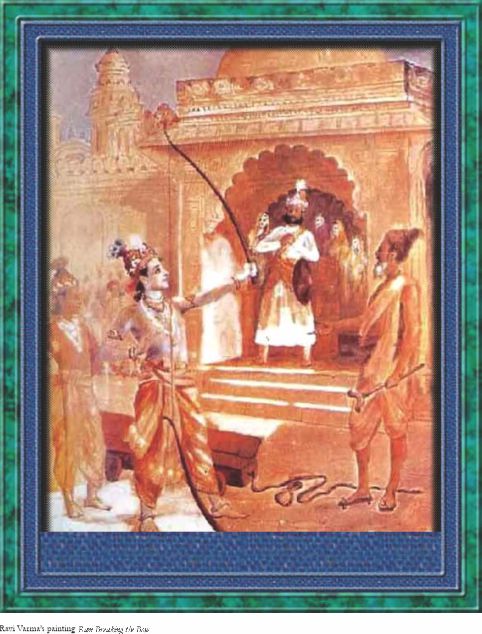
Varma is often projected as a catalyst appearing at a very crucial historical juncture in Indian visual and performing arts who successfully not only connected the past with the present, but also technology with mythology, and modernity with traditionalism. Varma’s use of western painting techniques in depicting mythological themes, an attempt that supposedly delineated an essentially pan-Indian aesthetic tradition, has been hailed as a path-breaking effort to revive through the arts a truly ‘Indian / nationalist’ spirit. This leads to the belief that Ravi Varma’s artistic expression is rooted in a grand narrative of traditionalism that is eternal. Some art historians argued that like Ravi Varma, who used his knowledge of western painting to paint scenes of Indian mythology, Phalke, his predecessor, too worked in the same spirit by taking advantage of the what Varma had attained in painting. Both worked within the same grand narrative. While one fixed dramatic moments in painting, the other used live characters to enact and narrate the same in the cinematic form. The danger of such theorization lies in its fundamentalist notion of invention of a tradition for visual arts in India, including cinema, that supposedly carried the legacy of Varma in a different medium altogether. However, the fact remains that Ravi Varma’s mythological paintings depicting emotional moments or different rasa-s evolved not out of his reading of the Natyashastra but of contemporary popular proscenium theatre. There is no proof that Ravi Varma had actually seriously studied the Natyashastra or books on Indian dramaturgy to develop his own artistic sensibility. On the other hand, the diary of his brother Raja Varma2 clearly shows that how, after a frustrating search throughout India for a pan-Indian model, Ravi finally found it in popular proscenium theatre — a pictorial reference and a source to visualize pauranik Indian themes that could be presented in a glossy spectacular manner and as a commercial venture. Commenting on Varma’s work art historian Tapati Guha Thakurta said,
Legends also took on a more compulsive narrative force, as painting begun to equate the thrill and drama of stage performances, with the same theatrical gestures and expressions of figures and the use of special lighting.
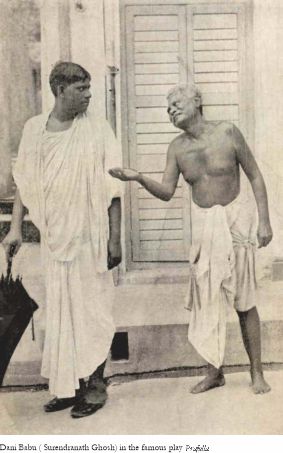
Plucked out of an ongoing spectacle of episodes, these scenes appeared like frozen tableaux, almost like stills from a moving film, arrested by a set of frozen gazes and gestures.3 Popular proscenium theatre of the late 19th and early 20 century was a spectacular form modeled on western proscenium theatre and was famous for its trick scenes and naturalistically painted backdrops. In Bengal proscenium theatre had faced colonial anger because it became a means for expressing anti-colonial sentiment through a new crop of realistic plays criticizing and satirizing the British. The introduction of the Prevention of Dramatic Performances Act of 1876, an act that did not spare the playwright, manager, director, actor, audience and owner of theatre, forced popular theatre to hide behind mythological and semi-historical plays that had apparently no relation to contemporary reality. These mythological and pseudo-historical plays were spectacular and lavish productions with lots of songs and dances where three-dimensional painted backdrops were used for the first time in India to infuse a much-desired scenic realism along with new stagecraft techniques to create magical effects very realistically. Of all proscenium theatres, the Parsee theatre excelled in several fields. It was first to hire European painters to draw naturalistic sceneries in western style for its productions. In Bengal service of the patuas or local artisans untrained in western techniques were often sought.4 Parsee theatre companies were backed by rich Parsee businessmen and could afford to spend money on costumes and effects, and to import theatre gadgets required for staging special trick scenes. It was the same desire for theatrical naturalism that had also encouraged popular theatre to hire the services of prostitutes to replace female impersonators. But in many cases early proscenium theatre had little or no respect for historical authenticity in scenic representation. Girish Chandra Ghosh, the famous actor-manager who revolutionized proscenium theatre in Bengal, had realized that the success of the spectacular proscenium theatre in India did not simply depend in mastering the western art of scenic design, but also on developing a keen sense history to give visual legitimacy to such representations as required by a play. Commenting on the lack of historical authenticity in visualizing a play he lamented, There exists a scene of a king’s court painted long ago. All the kings of the world have appeared in that court. The poto (patua / village artist) does not know what a palace should look like; dressmaker does not know about a king’s dress, the wigmaker has never seen a king. . .5
The emergence of silent cinema coincided with the development of popular proscenium theatre at the beginning of twentieth century when the theater-going public thronged the halls to see new spectacles staged by Marathi, Bengali and Parsee proscenium theatre companies. Stiff competition between rival theatre companies had engaged the actor-managers in inventing new gimmicks for every new play with freshly painted spectacular scenes and impressive sets, innovative special effects, glossy costumes, catchy dialogues with loads of songs and dances to enthrall the audience.
Theatre advertisements and reviews from contemporary newspapers illustrate the kind of spectacular scenes popular in those days:
Raja Rani: ‘Kashmir of the yesteryear was recreated in front of our eyes. It is not an ordinary affair that the producer did not try to fool us by showing Bengali houses as Kashmiri. . . .We are more than satisfied with the sets, dress and make-up. No other theatre has done it so faultlessly so far. . .’ 6
Shahjahan: ‘The pleasure garden of Kashiraj was beautiful, the boats, the lake — all very good.’ 7
Chandragupta: ‘The play was magnificent and special mention must be made of the opening scene where Alexander the Great meet Chandragupta on the bank of Indus.’ 8
Nabajouban : “The kind of scene of a fair shown in this play has never been attempted in this country. A huge fairground with rows of stalls whose roofs were made of hogla leafs. Birds are being sold at one place, painted earthen utensils are sold at another place; snake-charmers are playing… the fairground is full of various attractions and is drawing huge crowd. This is an amazing, wonderful scene.’ 9 Attempts in scenic visualization indeed helped the growth of spectacular theatre while some actormanagers went as far as using live animals on stage to enhance the impression of reality. In this respect, film had a significant advantage because of the camera’s inherent ability to capture details within a frame, a specificity that neither the filmmaker nor the theatre director could ignore. In fact, proscenium theatre started to pay more attention to scenic design by emphasizing on the details allowing the audience to appreciate theatre as a coherent realistic visual experience rather than merely enjoying the performance. Chandidas was one of such productions that illustrates cinema’s influence on theatre:
In the second scene we see Rami’s hut. A thatched roofed hut. A small dawa (place to sit) adjunct to the hut. A small courtyard bordered with rangchita (hedge); At one side of the courtyard there is a dochala room; a dhenki (wooden contraption used for husking) is already fixed there, at another side two huge earthen pots; there is a siuli plant nearby . . . The first scene of the third act: Rami’s courtyard.
The hut is completely brunt down. Only burnt and broken wall is seen. The place is full of brunt thatches and bamboo;
the siuli tree has also brunt down — only the leafless branches are seen. . .10
Or consider, for example, the ‘cinematic’ scenic design of Grihaprabesh:
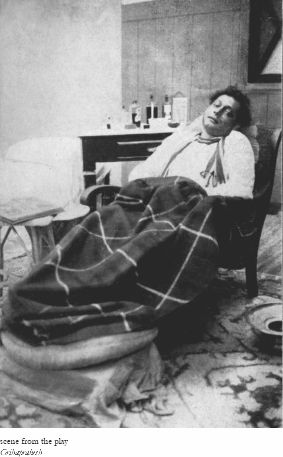
We have never experienced such details in scene designing except probably in Chirakumar Sabha . . .The clean section of Jatin’s incomplete house had a ceiling, floor, wall, balcony, door. Real objects were used instead of the traditional way of painting everything with colour on cloth, which created a believable realistic effect. The door fitted with a glass handle, window with glass, Venetian spring door designer glass, the wall with several electric lamps and switches, a model of the Taj Mahal in a glass case in Jatin’s room, painting of the Kutub Minar and Jumma Masjid and other historical architectures on wall, the stone table and medicines on it, the neat and clean bookcase, the clean bed of the sick person, the doctor’s chair, the ‘moras’ (low seats made of bamboo sticks) for the nurses, a clothe-hanger in the next room, a covered bed, a low table with food for the sick person, spirit stove and utensils for making food, the cup in the triangular hole in the wall. Hot-water bag. All of these created such a sense of realism on stage which was bound to touch the minds of the viewers.11
The art of visualization in proscenium theatre, as evident in the above examples, had evolved significantly by the time of the advent of early studio cinema. A handful of theatre directors, including Sishir Bhaduri and later Sambhu Mitra of Indian People’s Theatre Association, aimed for authentic scenic realism with cinematic details rather than glossy spectacles and mesmerizing trick scenes.
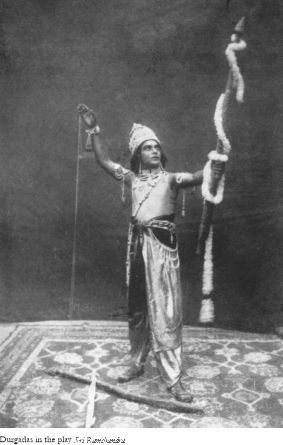
Cinema in its formative years looked forward to proscenium theatre which had thrived on its power of creating spectacular theatrical illusions complete with stunts, trick scenes and naturalistic sceneries – all essential elements of mythic, puranik or pseudo-historic plays. The budding film industry naturally found the proscenium theatre as a viable source from which it freely drew not only attractive stories and scenic design techniques but also the basic technique of ‘staging’ or organizing the action in front of the camera. In fact, starting from films like Pudalik (1912) and Raja Harischandra (1913) most of the silent Indian films were actually screen adaptations of popular plays whose framing, composition and overall dramaturgy were more theatrical than cinematic. The style of staging in silent cinema was marked by its static camera with little or no movement of the frame, scenes mounted as tableaux in which action usually took place at the centre of the frame, actors performed facing the camera that substituted the imaginary theatre spectators. The melodramatic acting style evident in early cinema also epitomizes the early filmmakers’ belief in theatre and theatrical representation, which they tried to retain faithfully in cinematic form. Early Indian cinema was primarily filmed theatre or photo-plays. During the first few decades it seldom ventured into adaptations from literature, which required a certain mastery in screenplay writing — an unfamiliar technique — and certain control on staging the scene cinematically. Makers of silent films, most of whom were actually theatre professionals, were more comfortable in using theatre actors and actresses freely because they knew the play texts well and had no problem in acting in front of the camera. From them cinema did not demand any special or modified acting style since the first generation of film directors believed melodramatic acting was the legitimate mode of cinematic performance. As a result these actors and actresses brought to cinema their own distinct acting styles marked by high theatrical gestures and postures, make-up and costumes. Dancing, singing, and other musical conventions prevalent in theatre were also introduced to cinema when sound film became a reality in India.
It was indeed theatre that had invented and successfully used techniques like fade in, fade out, dissolve and cross-cutting between scenes much before cinema. The spectacular stage presented magical effects with the help of new gadgets very realistically. The appearance and disappearances of such devices as divine characters, transformations, decapitation, and floating in air were very common tricks seen again and again in mythological plays. Some examples of visual effects or trick scenes are noteworthy:
Mayur Simhasan (1909): Man burnt alive
Cleopetra (1914) Colourful festival on a ship.
Reflection on water
Singhal Vijay (1915): Roaring sea, waves smashing on the shore
Apsara (1922): Garland from lord Siva’s neck flies and falls on the hunter and the hunter transforms to lord Siva
Sudama (1922): Boat crossing a roaring river. Sumati tries to commit suicide by jumping in a pond and water dries up instantly. Fairies transform a forest into a pleasure garden
Karnarjun (1923): Stone statue transforms into live character. Arrow pierces the eye of a bird.
Dushmasan could not disrobe Draupadi.
Brishaketu is cut into two.
Sri Krishana (1926): The prison bars melt to let Krishna escape. The Sudarshan cakra flies and cuts off the head of Sishupal. The headless body is seen shivering for sometime.
Sri Ramchandra (1927): Wooden boat turns into a gold one by the touch of Lord Rama. Lanka burns to ashes.
Moger Muluk (1927): Aurangjeb riding an elephant.
The elephant becomes unruly and puts to chain.
Fullora (1928): A disguised Mahamaya turns into goddess Durga with ten hands
Mantrashakti (1929): Station waiting-room and a train at a distance.
The idea of special effects in cinema had directly descended from these spectacular stagecraft techniques that were frequent in popular theatre. G. D. Phalke, who used special effects in mythological films like Raja Harishchandra or Kalia Mardan, had merely used the technological devices of cinema to create effects that had been created on stage regularly with the help of theatrical contraptions. The film Shiva Ratri (1921) for example, advertised five major special effect scenes titled as ‘Thrilling Miracles’. There were several flight scenes such as ‘ascent of sati’s spirit to heaven’, ‘the hunter’s spirit taken to Shiva Loka’ and ‘the descent of Goddess Parvati from heaven’. Another 1921 film titled Nala Damayanti, an adaptation from a very popular play had many stage trick scenes recreated on screen. There were several ‘transformation’ scenes, a popular stage technique, used in the film: goddess Kali transforming into a serpent, transformation of the king of serpents, a magic fire that transforms king Nala to Bhauk, etc.
There were also ‘aerial flight’ scenes and a scene in which swans brought the message of love.
The influence of popular theatre was however not limited to copying the trick scenes or using painted sceneries in a theatrical manner. The art of set design in theatre and the technique of stage décor had found a ready space in early studio-based productions while the convention of theatre lighting had directly influenced studio lighting. The studios faithfully adapted the convention of illuminating the pictorial stage in the silent era. Use of theatrical make-up needed to be modified to suit the ‘slow-speed’ orthochromatic film that failed to respond to low-key lighting or to all colours and hues equally and faithfully. One might add here that the first generation of sound recording equipments had a very limited range, which dictated a certain acting style with greater control on voice and modulation that needed ample training. Being professionally trained and experienced, many of the theatre actors had no problem in adjusting themselves to the technological specifications of early cinema. While theatre was nurturing cinema, providing it with its best actors, directors, dancers, singers, writers, scenic designers, dressers, make-up men, and lighting technicians, the technology of cinema had been perfected and standardized significantly, thus enabling the filmmakers to standardize the process of adaptation also. Popular cinema was destined to replace popular theatre by becoming ‘theatrical-like’ itself with a new vigor provided by the new technology. As a result, a new crop of sound films emerged that had quickly evolved a cinematic language, retaining the essence and power of the spectacular proscenium theatre while at the same time using filmic devices skillfully to give this cinematic visualization a distinct character. With the advent of sound around early 1930s proscenium theatre started to lose its glory and had to submit to the fast growing popularity of sound films – a new cinema which retained not only the best of proscenium theatre but also succeeded in casting its own magical spell on the audience.
- Amrita Bazar Patrika, 18th March 1872
- Diary of Raja Varma, OUP,
- The Making of a New ‘Indian’ Art, Tapati Guha Thakurata, Cambridge University Press, 1992, p 108
- In R. Kipling ‘s Kim there is a reference of a western painter accompanying traveling theatre troupe as a scenery painter.
- Girishchandrer Natya Chinta, Ed. Probodhbandhu Adhikari, Calcutta, 1978
- Sishir, 31st August, 1923
- Sishir, 15th November 1924
- The Englishman, 2nd November, 1923
- Naachghar, 8th August, 1926
- Naachghar, 3rd Year, 29th issue, 1932
- Naachghar, 2nd Year, 29th Issue, 1925
Biren Das Sharma is a film writer and archivist. He teaches Film Appreciation at the Satyajit Ray Film and Television Institute in Kolkata.
The influence of the proscenium theatre in the creation of the first generation of actors and actresses in Indian cinema is immense. Such an influence challenges the hegemony of the west and helps us detect a film tradition of our own. ‘New forms of pleasures arrive with the development of the society. Among other forms…