

laila sharmeen delightful, evocative and lyrical
Laila Sharmeen is a storyteller who happens to be an artist. She believes in changes. She is a visionary whose ideas of change involve both the past and future, while remaining firmly rooted to the present.

Laila Sharmeen is delightful, evocative and lyrical. She has the simplicity of a child and the intensity of a philosopher. Her work is dominated by a childlike scribbling. It doesn’t matter whether she is using etching, water-colour, mixed media or acrylic paintings; she seems to be playing with some secret codes of words that are intrinsically related to the stories of Bengali heart and psyche. She invites her viewers to decode the world (i.e. the stories) behind the words and lines that form her composition. Quite characteristically, she leaves out ample space in her work as if she wants the audience to fill in the blank with their imaginative inklings. While there is an urgency to return to a mythic past, there is also a foreboding of the future. Sharmeen’s Bengali past is foreshadowed by the presence of Madame Sosostris, the clairvoyant. Her love for her country, her desire for upholding the simplicity and beauty of Bengal before an international audience are problematised by her keenness to incorporate western ideas, particularly those of the high modernists. Her obsession with Baudelaire and Eliot perpetuates a surprisingly traditional misanthropy that demands careful analysis. I use the word ‘misanthropy’ with caution, particularly because she titles her work “Shantih, Shantih, Shantih”with a clarion call for peace: (albeit with an Eliotesque allusion to Datta dayadhvam Damyata).

Sharmeen is visibly perturbed by the materialistic greed and alienation of modern individuals. Her stay in the US has made her even more so. In her video installation, “Golden Stick/Silver Stick”, she thus romanticizes a sleeping beauty who is waiting for her saviour. “The model in the video actually represents me who does not want to wake up until there are better days,” a beaming Sharmeen explains. “The sleep of course is metaphorical of an incubation period.” Just in the traditional Bangle folktale in which the prince needs to change the position of the sticks in order to awaken the princess, the artist also longs for a change in society (no wonder, Lazarus is a dominant figure in her work). However, as a conscious citizen, she knows that her desired change can only come through by the ones who know the right code and the correct protocol of changes.
Sharmeen is keenly aware of many of the social changes of modern times that are not healthy or natural. They do not have the essentials for sustenance of humanity. The corrupt politicians and the religious bigots have contaminated her view of the world. At the same time, the artificiality of modern life is equally to be blamed. “I find the presence of the artificial garden ornaments in American lawns quite symbolic of their existence. Somehow the Americans have inculcated a sense of artificiality in everything that is normal. It is not an overstatement to say that America has become a plastic society.” No wonder, Sharmeen, who has returned from a series of group art exhibitions in the US, has gained a fresh perspective from her exhibitions at World Fine Art Gallery in New York and Sixth Annual Noho NY Artwalk and Armory Art Centre in Florida. The exhibitions have given her an opportunity to understand her own work as well as to redefine her scope as an artist. She presented her work alongside with 31 other artists from all over the world in an exhibition, titled, “The Edge! International All Media Exhibition, October 17, 2008–November 7, 2008.” Sharmeen seems to be quite proud of the reception that she has received of her video installations. “Madness and Civilization” has a Foucauldian touch in which she graphically portrays the blood of some freshly slaughtered pigeons. When asked whether she got any angry response from the animal rights group, she retorted by saying, “My purpose is to show the cruelty in the world. To say that cruelty does not exist will actually defeat the purpose of the animal rights activists.”
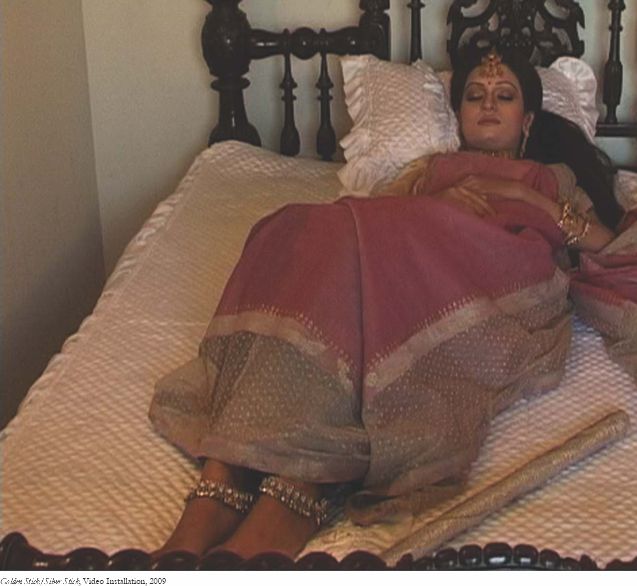
The installations “Golden Stick/Silver Stick” and “Madness and Civilization” present two different worldviews. While the former sleeps through the ills of life, the latter confronts the ills without compromising any of their intensity. The third installation, “Din-e-Elahi: Will You dance With Me” reinterprets Akbarnama and highlights religious tolerance as the only way to go forward. It is with the third installation, the sequence becomes clear. We begin to realize that behind Sharmin’s ‘misanthropy’ there is a deep faith in life. But that life has to be simple, and that has to have the imaginative warmth of the past and the rootedness to the soil. That is why she champions myth and folk motifs in her paintings. In this regard, Sharmeen is a traditional storyteller, who happens to be an artist. She uses her canvas replete with abstract expressionism to locate her niche in the world. Her story becomes the story of the Other. In her works, she becomes the flower girl of Baudelaire, the feminine self of golden Bengal incarnate, the Keatsian truth-beauty dichotomy that echoes Shtyam-SivamSundaram or Madam Sosostrise. She is a shape-shifter who both tells and withholds stories. The desire to tell a simple tale is complicated by her secret codes that are culturally located. She thus becomes an artist who experiments with both forms and themes. The digital frame of her video installations and the narrative frame of her paintings ultimately manifest her storytelling technique. Her artistic oeuvre lends strength, complexity and even darkness to Bengali culture. She both exploits and reinvents traditional fairy-tale narratives and explores ways to employ fairy-tale strategies in critiquing a contemporary society beset by dehumanization and alienation. That is why Laila Sharmeen is delightful, evocative and lyrical.
Laila Sharmeen is a storyteller who happens to be an artist. She believes in changes. She is a visionary whose ideas of change involve both the past and future, while remaining firmly rooted to the present. Laila Sharmeen is delightful, evocative and lyrical. She has the simplicity of a child and the intensity of a…