

post 1990s sri lankan visual arts ‘para-modern’ discourse on recent social and political history
Sasanka Perera showcases the Sri Lankan artists who have made bold attempts to dismantle modernist preconditions without being trapped by the postmodern condition.
Like much of the rest of South Asia, Sri Lanka also has a very long tradition in visual arts, particularly with reference to painting and sculpture mostly within the archaeological record relating to Buddhist temples and monastic structures. This is specifically a religious tradition which only changed to accommoth date more secular artistic ventures in the 19 century under colonial rule. In this brief essay, I will focus on a particular genre of influential visual art works emanating from the 1990s that emerged essentially as a commentary on recent social and political change with an emphasis on political violence and its aftermath. More precisely, these works have become a repository of historical and social commentary often based on the personal experiences, memories and explorations of the artists themselves. In some senses, these works seem to indicate a preoccupation with postmodern politics even though many of the artists engaged in producing these works have not carefully thought about or engaged with postmodern politics or theory. In this sense, one might loosely call this entire discourse a ‘para-modern’ discourse simply to illustrate the interest of these artists to dismantle certain modernist preconditions and move to another domain of art-making that is not exactly postmodern either.

In order to contextualize these works, it is neces sary to take into account the socio-political context within these works and detect the dynamics that generated them. These works, which are now collectively called the ‘Art of the 90s’, are not autonomous texts, but they provide specific meaning and location via the histories, politics and society in which they are generated. Two violent political eruptions have significantly influenced the Sri Lankan political and historical landscape since the early 1980s. These are the anti-state rebellion launched by the Janata Vimukti Peramuna in the late 1980s, and the Tamil separatist rebellion that emerged in the early 1980s.
Without their personal and collective experience in these domains of violence, the artists of the 1990s could not have created these works. It is within this basic frame of reference that I look at Sri Lankan visual arts of the 1990s as a repository of violent memories by focusing on the work of a number of selected visual artists.
Precisely because of this general background, many of these artists, irrespective of thematic orientations of their work emerged as a “group of people living with memories of violence, dispossession and despair, on the one hand, and on the other, as the casualties of the alluringly strange beauty and the evasive nature of urban culture” (ibid).
Nevertheless, inspiration and motivation based on personal and collective experiences in the execution of this genre of work did not mean that they constituted a homogenous body of work. In most general terms, while some of these works represented a preoccupation to reorganize chaos into a sense of order, while others were concerned with presenting “perplexity as a rational consciousness” (ibid). Yet others presented chaos and perplexity in a surreal and mythic imagery (ibid).
In general, much of these works could be accommodated within the following two broad categories:
Weerasinghe identifies two significant and broad thematic preoccupations in the art of the ’90s:
Works that investigate the self and individuals’ sense of being who have been victimized and made frustrated as a consequence of organized violence.
Works that investigate the allure as well as the frustrations of the city as an artistic expression (Weerasinghe 2004: 15-40).
The last decades of the 20 century in which much of the work I am concerned with have been produced, “stands out as a period of extraordinary revitalization of art in Sri Lanka, which paved the way for a diverse and multifaceted practice of visual arts in the country” (Weerasinghe 2005: 183). This phase marks the most dynamic period in contemporary art even though much of this dynamism took place in the backdrop of extreme socio-political and economic upheavals specifically marked by the militarization of the inter-ethnic conflict involving segments of Sinhala and Tamil people, as well as the attempted insurrection staged by the JVP and the counter terror campaign of the state unleashed to contain that situation.
One way in which this period can be characterized is to suggest that it paved the way for the emergence of a “whole new generation of artists equipped with a range of new ideas and concepts of art, themes for artistic investigation and, especially, with an understanding of the idea of the artist as a political individual”.
Reformulating Landscapes, Cityscapes and the Ordinary: De-contextualizing Contexts in Meaning Construction;
Personal Experience of Violence as Narratives of Memory.
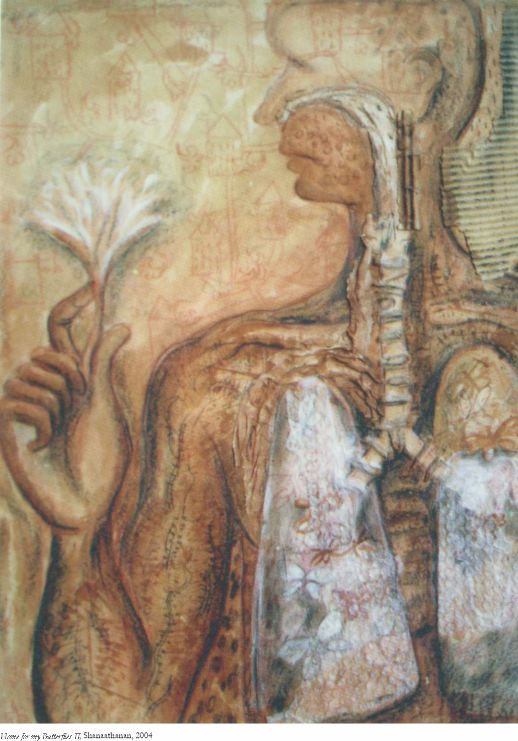
As a process of catharsis or as a process to reclaim and narrate painful personal and collective memories, the art of the 1990s made a visible impact upon recent Sri Lankan art history in particular and political history more generally. This becomes even more important when one considers the fact that–except for a handful of academic tracts– the violence and pain of the recent past as well as appeals for and expectations of justice in this context remain largely un-addressed, and certainly not publicly acknowledged. In that sense, these works not only constitute a component of recent art history but also a larger set of narratives of the social and political history of the recent past. It is in this context that some observations on the role of contemporary art by of Miguel Angel Corzo and Roy Perry become relevant to the Sri Lankan context as well. When Angel Corzo wondered “if we accept the notion that arts reflects history, then contemporary art is, in some way, a monument to contemporary civilization. It is the cultural heritage of our time…(Perry 1999: XV) and when Perry observed that “if we do not preserve the art of today for tomorrow’s audience, their knowledge and experience of our culture will be, sadly, impoverished” (ibid), they were clearly hinting at the communicative and historiographic dynamics of contemporary art. However, this perceived and anticipated role of art runs into a set of crucial problems in the Sri Lankan context.
One is the absence of a dynamic and formal art historic narrative process. Second, the absence of a formal, publicly accessible and continuous system of art acquisition, preservation and presentation in state or private sectors means that these artworks could disappear from both the memory of individuals and the public as well as from the unprotected collections of artists themselves where they at present remain.
Unlike many countries, Sri Lanka does not have a public or private system of galleries and art museums where such practices could have been institutionalized. The state has since the 1950s maintained a Department and Ministry of Culture, within which the National Art Gallery is also institutionally located.
However, since Independence national governments have shown no serious interest in selective preservation of contemporary and particularly alternative art.
Clearly, this becomes an even more sensitive issue, when it comes to the kind of work I have referred to in this chapter. As pointed out by Webb, the attention any national government would pay to art “is predicated on the fact that what is turned into art signifies what is perceived as worthy of attention” (Webb 2005: 3). In many countries where such things as national art collections have been institutionalized, the emphasis has been to select and preserve art that perceivably indicate a sense of national cultural identity, a sense of authenticity. This is because in such national contexts, art is seen as ‘vehicles of social meaning’ in the sense articulated by Cesar Grana (quoted in Webb 2005), which “both represent and realize ‘the world’; and as a corollary can confirm (or deny) the stories of nationhood (ibid). This general observation has partial relevance to what has happened in the Sri Lankan context. That is, in addition to the almost complete absence of a system of galleries and museums, the state’s understanding of art is based upon a very restrictive notion of culture and heritage, which since the time of independence has privileged traditional forms of art and craft associated with the domain of Sinhala culture. In that same context, contemporary art has almost no sense of value, particularly within state and national systems of cultural reckoning.
It is in the context of such a highly selective system of privileging art that Webb’s following comment makes sense: “not just any art could become metonymic of nation, of course. The art selected to inscribe national identity, tended to be works that relied on orthodox images” (Webb 2005: 30). In addition to this restriction, the art of the 1990s is not considered worthy of attention given their rather gloomy subject matter to which the state also has a significant degree of culpability. Similarly, the few private collections have also preferred a similar mode of selection, and in the event they did opt for contemporary art, they tended to be works that more clearly represented the modernist credo of artmaking, and clearly include works that claimed to be political.
In the long run then, these significant systemic, policy and perceptive absences could mean that the contribution of works such as the art of the 1990s would over time not be part of history or memory.
They would have gone beyond history and memory into oblivion thereby making the future’s understanding of our times, our culture, our fears and our collective being impoverished, marked by serious absences.
Bibliography
Corzo, Miguel Angel 1999. ‘Introduction.’ In, Miguel Angel Corzo ed., MortalityImmortality: The Legacy of 20thCentury Art. Los Angeles: The Getty Conservation Institute.
Perry, Roy A. 1999. ‘Present and Future: Caring for Contemporary Art at the Tate Gallery.’ In, Miguel Angel Corzo ed., Mortality-Immortality: The Legacy of 20th Century Art. Los Angeles: The Getty Conservation Institute.
Webb, Jen 2005. ‘Art in a Globalized Dtate’. In, Caroline Turner ed., Art and Social Change: Contemporary Art in Asia and the Pacific. Canberra: Pandanus Books.
Weerasinghe, Jagath 2004. ’90 Pravanathawa saha Samakaleena Drushya Kala Bhavithaya.’ In, ArtLab, Volume 1 (2004), 5-43.
Weerasinghe, Jagath 2005. ‘Contemporary Art in Sri Lanka’. In, Caroline Turner ed., Art and Social Change: Contemporary Art in Asia and the Pacific. Canberra: Pandanus Books.
Sasanka Perera teaches Sociology at University of Colombo and is Chairman of Colombo Institute, Sri Lanka
Sasanka Perera showcases the Sri Lankan artists who have made bold attempts to dismantle modernist preconditions without being trapped by the postmodern condition. Like much of the rest of South Asia, Sri Lanka also has a very long tradition in visual arts, particularly with reference to painting and sculpture mostly within the archaeological record relating…