
bengal cartoons before the end of the raj
Cartoons, as they are now known, was introduced in Bengal in the 1870s by the British expatriates emulating the famous London Punch. Soon this new genre of art caught the imagination of educated Bengalis who found a new medium to express their age old talent of self-mockery. Bengali cartoonists pilloried the deficiencies and drawbacks of the colonial administration but mostly reserved their choicest barbs for the fellow Bengalis and their double standards. Uproariously humorous at times, stunningly cynical at others, Bengal cartoons provided an excellent indicator of Victorian and Imperial sensibilities and the Bengali’s response to the social and political realities of the time.
Long before the introduction of cartoon in the country, Bengal had a thriving literary tradition of parody and caricature that was effectively employed as a weapon of social criticism. As early as 1825, BhabaniCharan Bandhopadhay came out with his satirical masterpiece Nabo Babu Bilash, lampooning the hedonistic lifestyle of the nouveau rich of Bengal.
Subsequently, TeckChand Takkur (1856), Kali Prashonna Sinha (1862) and Michael MadhuSudan Dutta further built on this tradition, ridiculing the Europeanized bhaddarlok families of Bengal , who under the guise reforming Bengali society indulged in all kinds of excess.
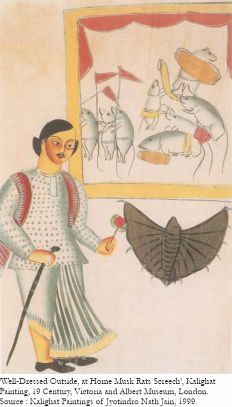
These examples of literary parodies have their graphic counterparts in the famous Kalighat pots dating back to the 1820s. The Kalighat painters viewed the western educated Bengali as a living caricature who had just begun to climb the ladder of upward social mobility. This reminds one of a Kalighat rendition of a famous Bengali proverb ‘ baire konchar patton, bhitore chhunchor ketton’ (while he(Babu) shows off the pleats of his expensive dhoti outside, at home musk-rats move about at will). These drawings found their echoes in some of the latter day Bengali cartoons, particularly those of Gaganendranath Tagore. It was against this backdrop that the cartoons were introduced to Bengal, which proved a fertile ground for the growth of this new medium of art.
The English comic magazine Punch (which had coined the word ‘cartoon’) became the model for the locally published comic magazines, owned both by the British and the locals. The London Punch spawned a whole array of imitators in the major cities of India where sizeable number of English educated locals and Europeans resided. The much borrowed formula consisted of imitating the Victorian respectability of Punch and the techniques of famous cartoonist William Hogarth, Gillray and Rowlandson. In the initial period imitation or copying was not considered a deadly sin, and venomous humor with a tinge of racial overtone was a common feature.
The British owned comic magazines in India following their prototype in London, were always mindful of the ‘Empire’s civilizing mission’; their duty to respond to the call of the ‘White man’s burden’ fostered a self imposed responsibility of showing the natives the light of civilization. Their cartoons portrayed the Bengalis as ignorant but an unending source of mirth and ridicule. The Bengali cartoonists, on the other hand, conscious of their position as a subject race and mindful of the advantageous of complying with the colonial masters, refrained from poking fun at the Anglo Indian lifestyle. Instead, they concentrated on scathing self parody and social comment. The new found weapon -cartoon- was mostly used not as an attack on their alien rulers but as a technique to expose the hypocrisy of the English educated Bengalis and their half baked Anglicization.
It was the British expatriates, themselves, who started parodying their way of living in India, particularly their lifestyle surrounded by scores of domestic aides, well appointed bungalows, pomp and grandeurs. J.P.
Atkinson’s Curry and Rice (1859) caricaturing the fancies and foibles among the outstation mems and sahibs is a case in point. Of all the comic magazines, the Indian Charivari also known as the Indian Punch, published in Calcutta in 1872 by British expatriates, earned a high reputation for its well executed cartoons and its remarkable wits.
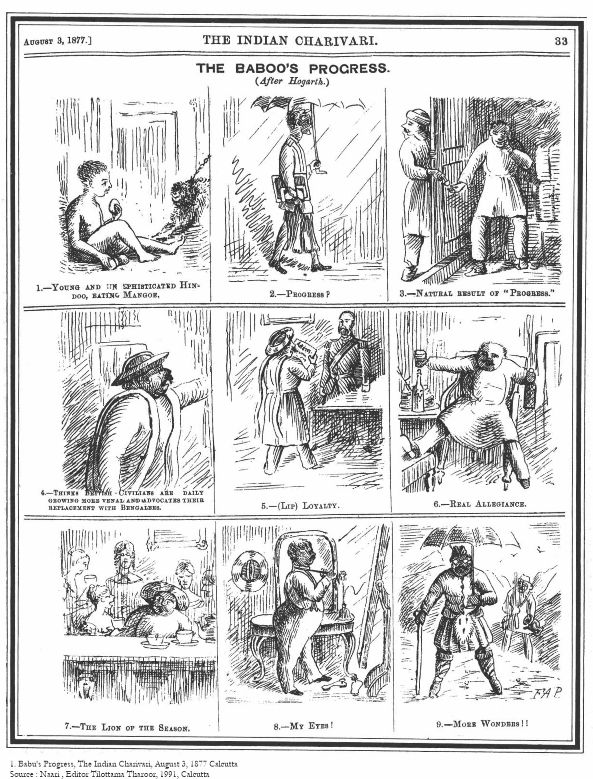
Its witty caricature of Bengali peculiarities was no doubt imaginative but the magazine’s hallmark was undisguised arrogance ridiculing the desire of the Bengali society to reach their rulers in intellect and culture. Queen Victoria’s proclamation of 1859 dangled out promise of equal treatment to all subjects which prompted the English educated Bengalis to compete for higher positions in the Indian Civil Service (ICS). Indian Charivari found such ambition on the part of the Bengalis as quite amusing. Following Hogarth’s cartoon A Rake’s Progress and Harlot’s Progress, it came out with its own version of Babu’s rd Progress (in its 3 August 1877 issue), depicting the various stages in the development of an educated Bengali as he journeyed through life. It, however, conveniently forgot that the caricatured Babu was essentially a creation of the British administration itself.
Initially, the Bengali cartoonists avoided illustrations with political overtones. As the nationalist movement gradually built up, they started focusing on the political issues of the day. However, their most effective and popular cartoons remained those that ridiculed human follies and vices. The Bengali cartoonists were brilliant in their piercing observation, scathing sarcasm and simple but penetrating illustration. Curiously enough they chose the same object of ridicule as the Indian Charivari namely the ‘Bengali Bhodrolok’, (literally the ‘gentleman’ class).
This phenomenon is explained by Pratha Mittar as an attempt by the Bengali artists to engage themselves in what he called playful games of self mockery. According to Mittar, caricature (a prime device for parodying contemporary manners), gave this lively self absorbed milieu a weapon to turn on itself. He also held the view that the most successful Raj cartoons were therefore, social not political.
One of the most renowned early Bangali comic magazines was Basantak, published in 1874 in Calcutta and edited by PranNath Dutta who together with his brother provided the illustrations. Basantok’s preferred victims were colonial high officials (Ashley Eden, Richard Temple, Stewart Hogg etc) and their Bengali allies. Basantak in no time earned a reputation for savage invective mostly directed at the elites of Bengal and their reformist organizations .
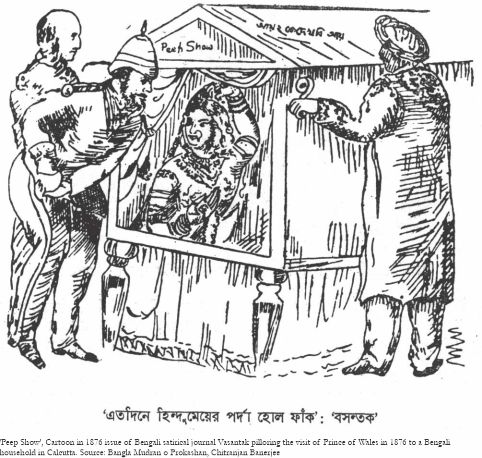
Compared to Indian Charivari, Basantak’s cartoon appeared to be refined and more subtle in caricaturing it’s both English and local victims. It seemed to have sincerely practiced the principle ‘less is more’ as it exercised economy in using lines in its drawings. Basantok had a famous cartoon documenting the controversy surrounding the visit of Prince of Wales in Calcutta in 1876 when the Crown Prince was graciously received by the ladies of a Calcutta household creating a social uproar in the conservative Hindu Bengali society. The Hindu ladies who received the Prince of Wales and the master of the house were accused of violating the standard of the traditional Hindu norms. The farce and parody involved not only the British administration or the visiting royal dignitary but also his Bengali host and female members of his house came out in quick succession. Basantok’s cartoon depicting a peep show pilloried what it called the disappearance of the tradition of the women’s sanctity for having admitted a foreigner into the zenana. Basantok in another cartoon criticized the promulgation of Dramatic Performance Ordinance of 1876 as an overkill on the part of the British administration to stop any dramatic performance prejudicial to the British interest. Basantok compared this action with that of killing a mosquito by a cannon gun. The Basantok lasted only two years but it left behind a hoard of cartoons of enduring delights.
(2)
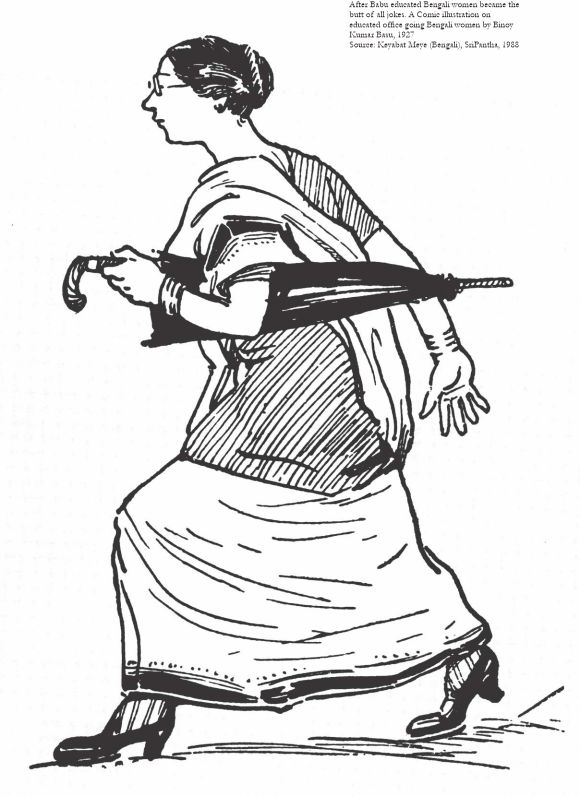
After the Bengali Babu, the educated Bengali women became the object of satire. The issues of the female education in 19 century Bengal and the emergence of educated women were both targets for parody by local English comic magazines as well as by vernacular journals published in Bengal. From the very beginning the Bengal reformers who advocated female education made clear that the aim of women’s education in the 19 century was not to make women independent or equal partners of men but to make them more capable wives and mothers; marriage remained the central focus of the life of Bengali women and while men’s education was related to employment female education had no such function.
But as female education spread out of Calcutta and many educated women took up employment in offices and other establishments, there was an uproar in the conservative circle decrying what they perceived to be the negative impact of female education. The educated woman became a figure of fun and a subject of numerous satires in Bengali prose and drama. The Bengali cartoonists followed the literary trend and portrayed educated women in the negative, pointing out the odds of marrying an educated woman. Jatin Sen and his contemporary Benoy Ghosh became famous for lampooning the educated women and their prospect of their social mobility both in their cartoons and in their illustrations for various magazines and novels.
It seems that Bengali cartoonists developed certain fondness in undermining Bengali women. Numerous cartoons showed timid clerks working under powerful female bosses or women smoking in public. Yet, the cartoonists kept their choicest slurs for the affectations of the Bengali educated young man, their love of poetry, their exotic hairstyle and their perceived lack of manliness. In addition, there were numerous cartoons on hen-pecked husbands, pompous academics, hypocrite zamindars and so on. Jatin Sen’s humorous illustrations of Rajshekhar Bose’s brilliant satirical works Gaddalika ( 1924), Hanumaner Swapno ( 1927) gave a new dimension to the inventive parodies of Bengali life. Sen’s witty sketches are still mentioned in the same breath with Bose’s text.
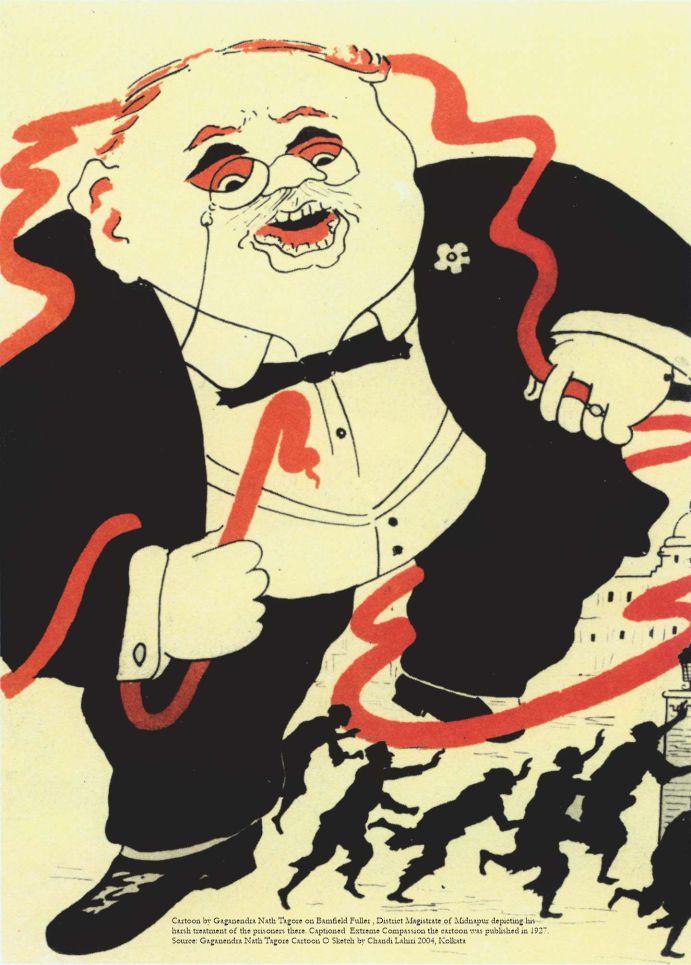
Cartoons as a running commentary on social change and as a corrective to social inertia continued to be a favourite theme of the printed media of Bengal. It is with Gaganendranath Tagore (a nephew of Rabindranath Tagore) that Bengali cartoons reached the level of high art. A self taught artist, he was a pioneer in introducing the technique of wash in cartoons producing a large number of colored lithographs that appeared in portfolios titled Birup Bajra ( Play of Opposites), Adhbut Lok (Realm of the Absurd) and Naba Hullor ( Reform Scream). No other artist was better able to capture the double standard of a colonized society then Gaganendranath Tagore .
The most important of his cartoons date from 1915 to 1922. Some of his political cartoons such as ‘Peace restored in Punjab’ were distinguished by the artist’s deep political concern and unfailing courage in the face of the colonial rule. But, in critics estimate, his most successful ones are the social satires.
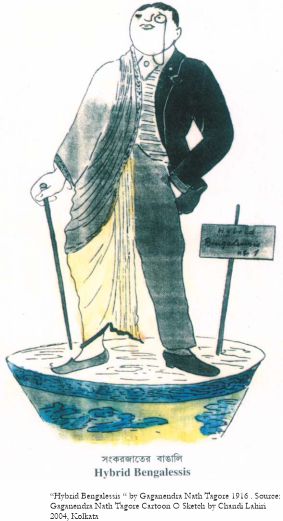
Hypocrisy, particularly religious, got severe treatment from Gaganendranath Tagore. He mocked the anglicized Bengalis, i.e. the Bengali elite, the Bengali officials behaving as brown sahibs, and those Bengalis who ape European manners out of context. His use of two words captions further enhanced the quality of his cartoons .
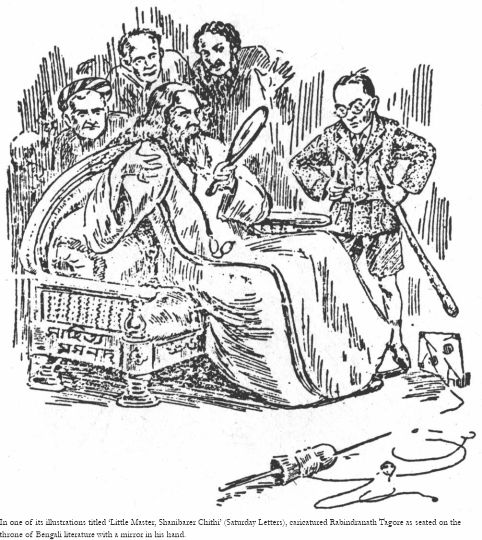
Shanibarer Chithi (Saturday Letters), a dreaded weekly satiric magazine, appeared in 1927 with all its zeal to purify the literary and intellectual domain of the then Bengali society. Though conservative, it had no sacred cows and anyone in its editor’s view was eligible for satire and caricature. It was more feared than respected for its venomous stings customized for each victim that included the icons of Bengali literature such as Ishwar Chandra Vidhya Sagar, MadhuSudan Dutta, Kazi Nazrul Islam and Noble laureate Radindranath Tagore .
In one of its cartoons, the magazine caricatured Rabindranath Tagore as seated on the throne of Bengali literature with a mirror in his hand, while three of his illustrious predecessors Vidhya Sagar, Bankim Chandra, and MadhuSudan Dutta looked on in amazement. Tagore’s disciple, Birbal alias Pramatha Choudhury, stood near by with a club in his hand ready to scare away Tagore’s illustrious predecessors.
The illustration titled, Little Master, predictably led to vehement criticism as an example of bad taste. new group of cartoonists emerged with the rise of an educated middle-class Muslim community in Bengal in the 1930s. A number of Bengali periodicals, journals and newspapers owned and edited by Muslim intellectuals provided a platform for these budding artists. Journals such as Shaugat, Mashik Mohammadi, Azad, Ittehad employed cartoons as an effective tool in creating awareness among the Muslims against prevalent social and economic ills.
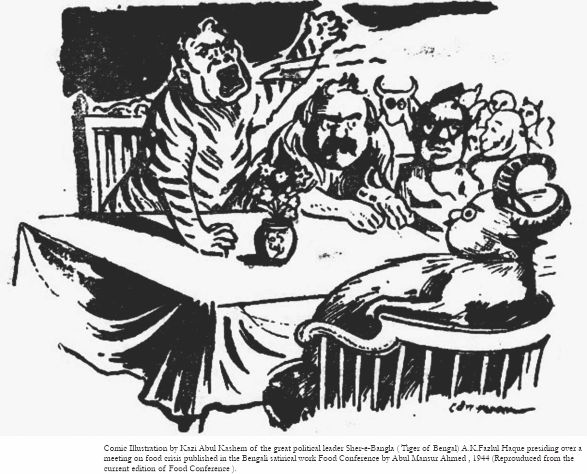
Zainal Abedin, Quamrul Hassan and Kazi Abul Kashem were among the artists who enriched these journals through their satiric illustrations and cartoons mocking the religious bigotry in Muslim society, rampant hypocrisy of the religious and educated class and failure of the then political leaders of Bengal to respond to the demand of the day. Zainal Abedin’s illustrations of the Bengali satire Aaina (The Mirror, 1935) written by the famous politician, editor and author Abul Mansur Ahmed reflected the artist’s deep social consciousness. Similarly, Kazi Abul Kashem, who first appeared as a cartoonist in Shaugat in 1937 under the pseudo name Molla do Peiaza left behind enduring comic illustrations of the satire Food Conference (1944) of Abul Mansur Ahmed, flaying the major political leaders of Bengal. Quamrul Hassan,
also known as Veemrul, drew a series of cartoon for the Daily Azad and Weekly Ittehad published in Calcutta that instantly brought huge popularity for the artist. Quamrul Hassan’s subsequent cartoons drawn during the heroic independence war of Bangladesh has become a part of the nation’s proud legacy. These drawings show how cartoons have come a long way from the days of the Raj. Mahboob Alam is a former ambassador of Bangladesh.
Cartoons, as they are now known, was introduced in Bengal in the 1870s by the British expatriates emulating the famous London Punch. Soon this new genre of art caught the imagination of educated Bengalis who found a new medium to express their age old talent of self-mockery. Bengali cartoonists pilloried the deficiencies and drawbacks of…