
brick lane – will it be the beginning of a new conversation?
Let’s face it. Monica Ali did not write Brick Lane to bring out an image of the community that western audiences are not used to imagining. She highlighted the stereotypes with some broad brush strokes and no intention to look for nuances. The settings she portrayed are probably cliché for us Bangladeshis. However, to unsuspecting Anglo Saxon eyes, it is a newly discovered picture of the closed world of those people who famously brought curry to their lives. Since moving to London four years ago, my interaction with East London has been frequent through my community work, but still not enough to say that I am an insider. However, I am close enough to understand the undercurrents and different dynamics that grip the community. There are so many layers and so many different political dynamics in this community that fitting it all in a canvas of broad brush strokes would seem too crass, especially for the people who belong there. Monica Ali unconvincingly did exactly that, only to get the scorn of the community. Little did she care, as the book went on to become short listed for the Man Booker prize amid wide adulation from the English critics. Never in the history of Britain has there been a book that has been received with so many cheers and jeers at the same time. To turn that book into a sensitive film would have been no mean task, even for many seasoned screenwriters and directors. But Sarah Gavron’s first feature film Brick Lane not only handles that job deftly, it also introduces some tough questions for today’s Britain in its uniquely understated way.

Just as the haunting French background score blends in perfectly with the rich photography from rural Bengal, this story of Nazneen transcends the geographical boundary of its characters. This could be the story of any immigrant in any landscape.
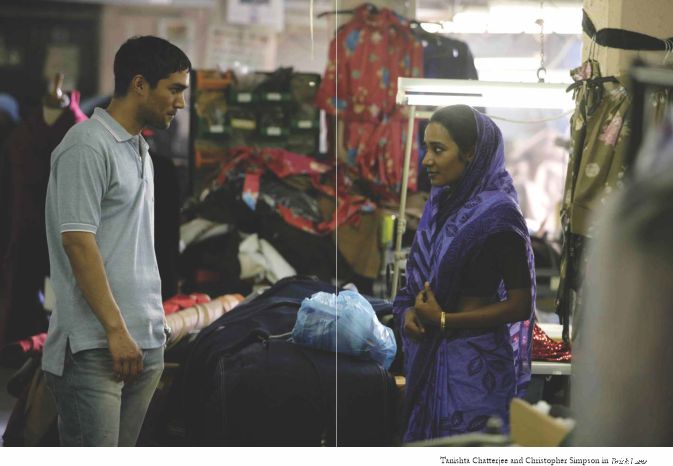
Director Gavron successfully manages to make it more about the journey of one woman rather than making a heavy social commentary about race relations or the status of women in South Asian society. This is precisely what makes it a tender and humane film acted with utmost sweetness. It won’t shatter any prejudices or stereotypes, but what it will do is make people think twice about the characters that they see so regularly in the streets of East London. Brick Lane is the story of Nazneen (Tanishtha Chatterjee) who, leaving behind a beloved younger sister, arrives in London from Bangladesh at 18 for an arranged marriage to an older man, Chhanu (Satish Kaushik). Tanishtha practically carries the film with her understated and beautiful portrayal of Nazneen.
Even though Brick Lane is all about her struggles, transformation and eventually getting liberated, the main surprises of the film are the two male characters — Chhanu, the overbearing and often insecure much older husband of Nazneen, and Karim, the young and rebellious second generation British Bangladeshi who falls in love with Nazneen. The story does not make any judgment on the characters, nor does it make any black and white representation of their lives. Rather, it quietly sets up the context of different social and political changes as a trigger for various transformations that the characters go through.
Although much of the transformation that Kareem’s character goes through is clearly depicted, much remains unsaid and open to the audience’s interpretation. Christopher Simpson puts up a fantastic act of a Confused-East-London-Born-andBrought-up-British-Bangladeshi-Boy with amazing aplomb. The swagger, the fake self-confidence and the couple of lines of Bangla with Syheti accent were simply amazing. The identity crisis of today’s East London-based deshi youth who often see themselves as the victim of racial and systemic discrimination is very real. Similarly real is their tendency to embrace political Islam as the answer to this injustice. This choice is as much a reaction to discrimination as it is a revolt against their parents’ generation, whose provincial Bangladeshi fixations and politics their children can barely relate to.
Chhanu’s character is very much representative of this older generation that is stuck in a limbo. As Chhanu recites Tagore and often reminisces of his days in Bangladesh, his teenage children hardly care or can relate. As I hear recent interviews in local Bangla TV of hundreds of people getting swindled by money transferring agents while sending money to build their dream homes back in Bangladesh, the stories of lost immigrant souls like Chanu are depressingly real.
Caught between the two worlds, they want to hang on to their past desperately only to avoid confronting the present. The end result is a rude awakening which often does not have a happy ending. film. An American friend not so familiar with the context was bothered by the fact that there were not enough dramatic elements to cause the transformation of Nazneen. The British friend, who first got a taste of the Asian subculture reading Ali’s book, thought the movie left out a lot from the book. But most of the Bangladeshis I talked to, who had been perturbed at Ali’s lack of depth in portraying the characters in the book, were happy at the outcome of the film, which they thought gave some contexts to the characters. Lines from the book such as “[Nazneen’s mother] had been ripening like a mango on a tree” might seem exotic to Westerners, but had a hard time pleasing any Bangladeshi with good sense. The criticism of the outsider status of the book’s author was equally, if not more applicable with regards to the film’s main cast, director, and screenwriter. However, this was tackled cleverly. The movie’s message focused less on one specific culture and more on one woman’s journey to freedom. That is where the allwomen team of the main creative partners — the writer, the screenplay writer and the director — could have perhaps all identified with the subject of the film. In tackling the issue of authenticity of the characters, the director decided to have a strong assistant director in Ruhul Amin, who was born and brought up in the local community. The research that went into the film also clearly showed. Starting from the characters costumes to the sets, there was hardly anything that I could find fault with. Although the casting of Bollywood actor Satish Kaushik to play Chhanu raised some eyebrows among the native Bangla speakers for his Hindi-accented Bangla pronunciation, his acting ability in portraying the struggle and denials of this complex character hid that weakness well. The movie shooting, however, was still met with strong suspicion. It was greeted with community protests, newspaper articles and a column fight between leading intellectuals among other things.
vocal lobby from the community held rallies and said the film portrayed the community in a negative light. Blogs were buzzing with some of these protestors calling the film a conspiracy by non-Sylheti Bangladeshis to hurt the Sylheti community’s restaurant business in Brick Lane. Journalists pointed out that there were only two women in a protest rally of about 70 people. Perhaps, that number is a preview to how this film will be greeted among the community — by complete ignorance. I doubt many of the real Nazneens will have a chance to see this film, and that may not be out of choice. However, beyond all the chatter and controversy and mock protests, for the people who understood the nuances of this little gem of a film, it ought to be the starting point of a new dialogue — both inside and outside the British Bangladeshi society. The ever widening gap between identity crisis among today’s young British Bangladeshis, which is often making them take shelter in political Islam, is a crisis that is haunting mainstream Britain. The communities are more ghettoized than ever before. Lack of trust between racial groups is at an all time high, and it seems there is no end in sight. The film can be the eginning of a conversation about these different cultures opening up to each other — not with a patronizing attitude, but more with a view towards bridging the ever increasing gap by giving some context to the stereotypes often made in the society.

For people living inside the Tower Hamlets Borough, the majority of them Bangladeshis, this film’s main take away remains the state of women, the often neglected segment that gets regularly sidelined and overlooked in that society. In a recent survey commissioned by the government sponsored NHS, it was shown that a large segment of Bangladeshi women from the borough suffers various forms of chronic mental depression and a large segment is not even aware of it. Yet, like Nazneen, these women quietly go on with their day-to-day lives, pulling in more than their fair share in the household. The dialogue needs to start and it should start now — before it’s too late. The criticism and threat of violent protests by a vocal minority has also raised questions about how and by whom, we, as British Bangladeshis, like to be represented in the mainstream media. In the first week of their release, Bollywood mega films Om Shanti Om and Sawaria far surpassed Brick Lane in the box office. However disappointing that may sound, the silver lining lies elsewhere. As part of a focus group audience, I saw the many months earlier with a select group of British-Bangladeshis. At the end of the film, director Sarah Gavron asked us all pointed questions to get a sense of whether the film was realistic. Amid everyone’s laughter, a young thirty-something woman said that the most unrealistic part of the film was the lack of cooking shown in a film set in a Bangladeshi household. She then animatedly described how it reminded her of her younger years spent at the council flats of Tower Hamlets. She went on to very articulately explain many other typical restrictions that the women faced in the council. Months later, when I saw that same face on TV in a live television show, I immediately ecognized her. It was Rowshan Ara — the nominee from the Labour Party for the Parliamentary Elections. The emancipation of the Nazneens of Brick Lane may not happen in the near future. But they now have a voice to represent them in mainstream politics. This new stream of second generation politicians are now representing that hope — a hope that one day it will be possible to convert the dialogue generated by Brick Lane into noise — a noise that will be loud enough to break some long shut windows. And that’s no mean achievement for a film.
Let’s face it. Monica Ali did not write Brick Lane to bring out an image of the community that western audiences are not used to imagining. She highlighted the stereotypes with some broad brush strokes and no intention to look for nuances. The settings she portrayed are probably cliché for us Bangladeshis. However, to unsuspecting…