

beyond the world of apu the films of satyajit ray
John Hood’s recent book claims to give a comprehensive and impartial analysis of Satyajit Ray’s oeuvre. Shamsad Mortuza’s book review questions the ethos of judging films while sitting on the cultural fence, and challenges the notion of neutrality.
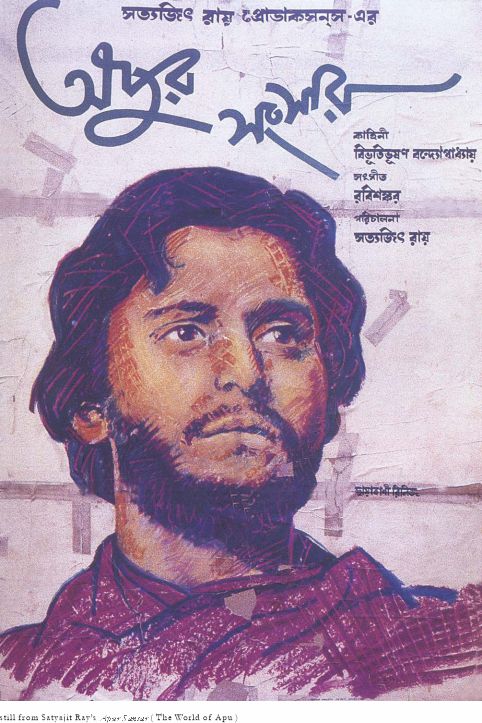
Apart from stating the obvious, the title of John W. Hood’s recent book Beyond the World of Apu: the Films of Satyajit Ray (Orient Longman, 2008) is tinged with a wry criticism of Bengali bhadralok.
While these bhadraloks, posited by Hood as ‘the educated middleclass who consider themselves pillars of culture and the thinkers of India,’ canonize Ray as a ‘cultural giant,’ they have hardly seen any film
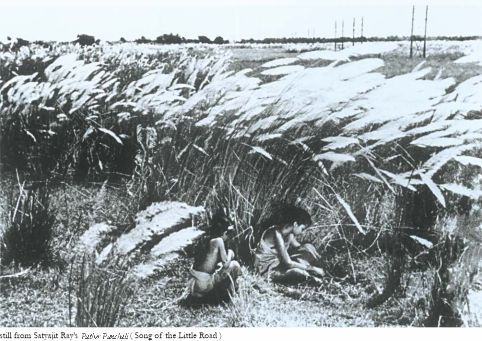
beyond Pather Panchali, just as they showcase complete works of Tagore without actually reading them. As an Australian, dividing his time between Kolkata and Melbourne, Hood rubs salt on the injured pride of Bengali middle class. I am not in a position to judge whether there is a settling of a personal score at work in these lines or not. However, I do feel that the criticism of the middle class is harsh and uncalled for as it is probably true for many other cultures.
However, that does not take the credit from Hood’s criticism of Ray, which has neither attributed Ray with theories nor written about him in a language that is only communicable in the circle of film pundits and samizdat. Here is a book that closely analyses each of Ray’s feature films, and provides thought provoking ideas and challenging motifs. For Hood, any appreciation of Ray is never complete without a thorough study of all of his films. Therefore, an objective, yet informed, criticism is necessary that will go beyond the world of Apu and grapple Ray’s greatness and weaknesses alike. Indeed, Hood’s book attempts to live by examples.
Buddhadeb Dasgupta, writing the foreword of this book, endorses Hood’s claim by lauding his fresh approaches to Ray. For Dasgupta, much of Ray criticism is either guilty of reiterating academically rehearsed jargons or of upholding the granted greatness of Ray’s towering personality and his contribution to Indian films. But Hood has not shied away from stating that Ray too was the maker of some ‘bad’ films. This, Dasgupta maintains, can be construed as ‘neutrality’ on the part of the authorcritic.
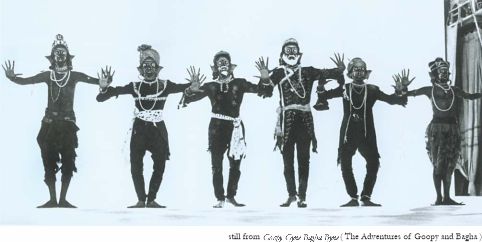
Personally, I don’t think author-function can be neutral, and to expect Hood to be neutral is equally fallacious. Hood’s choice of ordering the films offers an example. Instead of categorizing the films in chronological order, he has opted for a thematic arrangement–which, by design, is arbitrary and subjective. Hence Hirak Rajar Deshe is bracketed along with other films for the young adults: Goopy Gyne Bagha Byne, Shonar Kella and Joy Baba Felunath. While Hood sounds logical in arguing that Ray treats young audience with respect and never considers them as gullible, the malleability of the audience is an underlying theme in many of Ray films (e.g. Nayak or Ganashatru). Then again, if we are to believe that the fairy-tale elements qualify Goopy Gyne Bagha Byne and its sequel Hirak Rajar Deshe as films for the young adult, then the reworking of the Midas myth and the formation of an urban legend in Parash Pathor should also classify it as a children’s film. Hood’s regard for certain films and disregard for certain others are indeed subjective. No wonder, he even goes to the extent of terming Hirak Rajar Deshe ‘negligible’, and regrets that ‘an important aspect of social philosophy had to be conveyed in such a negligible film’ (453).
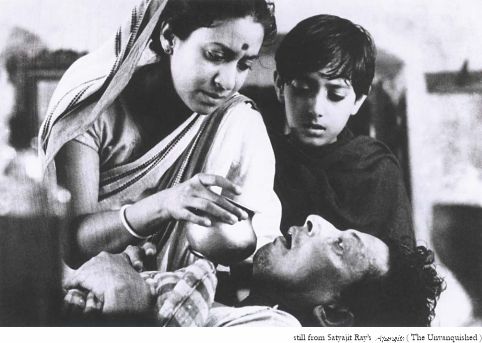
Hood’s subjective assessment is equally visible in his claim that the last three films of Ray (Ganashatru, Shaka Proshakha and Agantuk) are inferior because of their verbosity and their lack of visual magic mani-fested in great films like Charulata or Devi. Hood even thinks the ailing condition of Ray contributed to the weakness of these last three films, and they do not actually do justice to his reputation. Ganashatru, for example, is a literary adaptation of Ibsen’s An Enemy of the People. Hood seems to have problem with the didactic, albeit prophetic, ideological position of the film in which the ills of the society must be put right in order to avoid the consequences of such ills.
The strength of Hood’s analysis is his details. By the same token, it can be counter-argued that the devil is in the detail. While Hood closely looks at particular films and considers them one at a time, there is little tendency to make inter-textual connection or discourse formation. There are many missed opportunities in Hood’s criticism that would have added to his stated desire to achieve a comprehensive understanding of all Ray films. In Mahapurush, the urge of one disciple of the supposed time-traveler to buy cheap iron from 1914 is echoed in Parosh Pathor with the desire to transform iron cannon-balls into gold. But by compartmentalizing these films, he was driven by a challenge to justify his own classification.
The prominence of themes like the duality of holy and unholy, the opposition between science and superstition, the battle between the old and the new, the dichotomy between art and life, game and gambling, or the rich and the poor as the dominant image that loom large in almost all Ray films are thus ignored. Hood refrains from making such overarching comments, and focuses more on detailed analysis of the films. The only place where he comes close to making some general statements is in his chapter titled ‘Some Final Remarks’.
Hood begins his polemic survey of Ray films with The Apu Trilogy. He brushes aside the issue of Ray’s international success that supposedly comes through a marketing of poverty for a global audience in order to credit Ray for his power of capturing social reality. It soon appears that Hood is not interested in examining how the classic literary landmark of Bibhutibhusan is translated into celluloid; he is more concerned about the mastery of Pather Panchali as a film. The guava picking episode at the very beginning of the film is a case in point. While performing her ritual before a tulsi (basil) plant in the family courtyard, Mrs Mukharjee notices Durga in her orchard. “The mean mindedness of the woman is quickly indicated by Ray as he cuts to a shot of the luxuriant jungle surrounding the house–lush and green, even in black and white–and then reveals Durga as a little girl, quite at home among the trees and bushes” (13). Hood does not make any comment on the juxtaposition between the holy plant and the orchard. A village girl plucking
a fruit from a tree is natural, but for her rich neighbor, who seemed devoted in her faith in the supernatural power of the holy basil plant, this natural act is an index of other crime/sin(s). She uses this stealing of guava as an opportunity to slur her distantly related neighbour. Indeed, literary appreciation is not Hood’s priority; his film narrative is more interested in examining shots and angles that externalize inner reality. In fact, Hood makes this obvious in his chapter on Ray’s treatment of Tagore through Tin Kanya, Charulata, and Gharey Bairey. He admits, “I have discussed all these films, not according to their worthiness or otherwise as cinematic representations of Tagore, but as cinematic works of art by Satyajit Ray. As literature and cinema are two categorically distinct art forms, there seems to me to be little point in denying the independence of the one and insisting on its deference to the other” (7-8).
Some of Hood’s remarks are sharp, and demand further exploration. For instance, commenting on the anachronistic juxtaposition of the annexation of the kingdom of Oudh by the British East India Company in 1856 and the Bengal famine of 1943, subjects treated in Shatranj ki Khilari and Ashani Shanket, Hood remarks that Ray distinguishes history from period.
Hood adds, Ray “certainly does not exploit history but treats it with cautious restraint. Nevertheless, he is first and foremost a filmmaker, who makes no claim to being a historian; thus, the works must be assessed as cinema, not as history” (9).
quote Hood in detail to show his agenda of distinguishing other disciplines of art. Whether, cinema is a composite art or a genre of its own is a matter of critical debate, which is beyond the scope of this review. However, it can be safely said that Beyond the World of Apu, as the blurb mentions, is a ‘resource book for students of film studies’. If you are planning to supplement your experience of Ray films, this book is for you. It also contains a very useful filmography, chartering Ray’s work. Shamsad Mortuza is an Associate Professor Department of English, Jahangir nagor University, Bangladesh.
John Hood’s recent book claims to give a comprehensive and impartial analysis of Satyajit Ray’s oeuvre. Shamsad Mortuza’s book review questions the ethos of judging films while sitting on the cultural fence, and challenges the notion of neutrality. Apart from stating the obvious, the title of John W. Hood’s recent book Beyond the World of…