

young french artists embark on life
Henry Meyric Hughes describes the unusual experience of chairing the jury for the Diploma examinations for the six-year course at the École des Beaux-Arts in Paris and the exhibition which he curated there of the sixteen candidates who were awarded distinctions for their work. The exhibition, entitled ‘Plus que vrai’ (More than true) encapsulates many of the issues which are of concern to young artists in many parts of the world today—most notably, the rapprochement between art and life, the crossover between ‘high’ and ‘low’ and the pervasive influence of the mass media. Many of these artists, who are aged twenty-five to thirty and at the start of their professional career, combine elements of the formal languages of the 1960s and 1970s (especially, Minimalism and conceptual art) with traditional craft skills and borrowings from the fields of architecture, fashion and design

It may seem strange to want to write about a graduate show from a French art school, however eminent, in a magazine like Jamini, but I felt that the experience leading up to this was sufficiently unusual to be worth recounting in some detail. Last year I was invited by the Director of the Ecole Nationale Supérieure des Beaux-Arts (ENSBA), in Paris, to chair the jury for the Diploma examinations, in the company of two artists (Valérie Favre, from Berlin and Marie-Ange Guilleminot, from Paris) and another curator, Jean-Marc Prévost, from the French Ministry of Culture. Little could have prepared any of us for the experience of spending three concentrated sessions of studio visits, in February, June and December, involving one hour or more with each of a hundred students, examining and discussing their work, in the presence of their teachers. The conversations we had, and the situations we got into, exploring cellars with a torch, witnessing a rock resurrection or being invited to judge a real-life dog show, would themselves take up the space of a lengthy article, but what I would like to concentrate on here are both the exceptional nature of the exercise, in that these young artists were presenting their work for examination for the first time in five or six years, at the end of what one might describe as a BA and MA course combined; and the quality of the work itself. These graduands were already on the brink of a professional career, and their work, for all its variety, seemed remarkably in tune with the spirit of the times. This realisation only dawned on me gradually, perhaps, in the course of preparing the current exhibition of sixteen students with congratulatory diplomas (out of the 102 we had examined), but it was no less forceful for that.
Reminded, as I was, like the executive editor of Jamini, of Raymond Williams’ insistence that ‘art is embedded in the quotidian’, I chose as a title for the exhibition the somewhat ambiguous proposition that the work on display would be ‘Plus que vrai’ (‘More than true’) or, as I imagined, poised somewhere between a true and an imagined reality. In fact, the varied work in the exhibition represented no more, and no less, than the sixteen most interesting ‘positions’ that we, as a jury, had discerned in the course of our visits, but it seemed increasingly clear to me that these individuals working in a wide range of different idioms and media, somehow spoke in interesting ways for their generation and for the times in which we live. My own analysis of the fruits of our selection runs along the following lines:

Most of the artists in ‘Plus que vrai’ are in the age group from twenty-five to thirty and received their formative experiences in the decade from 1995-2005, whilst their teachers were formed in the very different, though still surprisingly influential, ferment of the 1960s and 1970s. There were plenty of competent painters and a few really good ones, though only one of these made it through to the final selection—perhaps, because of the difficulty of finding something really fresh to say in this traditional medium. The straightforward sculptors were few and far between, as well, though many graduates working in a variety of media also included traditional sculptural techniques in their practice. Photography and video played their part—often side by side, in the work of the same artist—but installation seemed to be the most favoured medium, and many young artists attempted a crossover into related fields of fashion, design, architecture, music and even advertising and public relations. The language of these young graduates is coloured by the minimalist and conceptual work of an earlier generation, but rooted in individual experience and is refreshingly free from dogma. Internationally, artists of all ages are looking again at the prospects for artistic renewal, arising out of the rapprochement of art and life, which began in the 1960s, with Pop Art and Fluxus. For French speakers, and now for readers in English translation, this is neatly encapsulated in the phenomenon described by Nicolas Bourriaud, one of the two Directors of the Palais de Tokyo, in Paris, as ‘Relational Aesthetics’ and rooted in what the late French art critic, Pierre Restany, described as the central achievement of May 1968: ‘the general concept of tolerance’, characterised as ‘… a poetic colouring of everyday life, in which the gratifying sensation of “truth” is substituted for the formal criteria of “beauty”‘. We read a lot about post-modernist theory and the end of the ‘grand narratives’ (Jean-François Lyotard), but the fascination with modernity continues, in its celebration of diversity, irrespective of hierarchical values. The writings of the Situationist International, with their virtually untranslatable notions of ‘dérive’ and ‘détournement’, and of the ‘Society of the Spectacle’ (Guy Debord) count for a great deal. The reality of advanced industrial society is now perceived as something infinitely complex and contradictory, and one of the prime functions of art can be to offer resistance. Artistic atavism becomes an alternative option to passive consumption; signs of equivocation and metaphors abound. Technology offers the means, not only of disseminating information, but of questioning its veracity—hence its attraction for many of the artists in the show. Finally, it would be all too easy to forget the encroachment of humdrum reality into young people’s lives. Even in the West, today’s students and young professionals are increasingly dependent on earning a meagre livelihood from casual employment, which involves them in a host of menial tasks and brings them into contact with the most miserable and marginalised elements of society. This means that they are likely to be more than usually aware of the ways that issues such as health, housing and immigration, but also consumerism and the mass media, impinge on the lives of ordinary people. They themselves are privileged, only to the extent that they are empowered with the ability to think for themselves and to communicate their thoughts and feelings to others. This is not to say that all, or even most, of them are directly engaged with social or political themes—their awareness of the potential traps is sufficient for them to guard against this–but all of them share a desire, and an ability, to communicate something with a certain degree of urgency, by the means that seems least likely to betray their professional and personal integrity. As Damien Hirst once put it, ironically: ‘Sometimes I feel I have nothing to say, I often want to communicate this’. Or as the Fluxus artist, Robert Filliou announced more programmatically, as long ago as 1970, it is time to incorporate art into the structure of everyday living. It is in this sense, above all, that art has the capacity to be ‘more than true’. Turning now to some of the individual artists in the exhibition, I note: Karen Benbenisty’s (b. 1977, Israel) ‘contemporary relics’, such as her intricately elaborated polystyrene cup, in the video ‘Love will tear us apart’ (2004), straddle different cultures and temporal perceptions: ‘as with light and shade one is in front, the other behind’ (Tao Te Ching). Decorative elements belonging to a Judaeo-Arabic tradition with which she readily identifies are recontextualised, in fragmentary form. A boat constructed out of hundreds of loofah serve as a metaphor for displacement, given the uncertain origins of the loofahs plant and the ability of its seeds to survive months in the sea, before taking root in countries as far apart as the Indian subcontinent, Africa and South America.
Elise Delattre (b. 1978, Clamart, Hauts-de-Seine) adopts a conceptual approach to her work, where the form of the presentation itself assumes a therapeutic function, related to her need to exorcise painful memories of her childhood and upbringing on a farm. In ‘Feedback’ two ‘endless screws’, in protective sheaths, pass grain from one silo into the other and back again, without purpose or effect, other than ultimately to destroy the ‘goods’ they purport to convey. At a deeper level this installation relates to the artist’s own emotional and sexual disturbances and evocation of a dream, in which she imagined herself ‘in a cerebral state, most profoundly engrossed in fathoming the depths of my large intestine’.

Cyril Dietrich (b. 1977, Paris) combines a fiercely intellectual approach to making his work with a strong visual imagination and sensory appeal. The planning of his installation, ‘The Three Gorges’ (2005) involved careful observation of the climate and the active collaboration of a swarm of bees, to create a series of pixellated honeycombs, portraying scenes of the recently completed project on the Yangtse River, in China. The complex imagery created by the alternating patterns of full and emptied cells of wax and the translucent quality of the materials combine to create seductive, yet elusive images of a feat of civil engineering, whose very nature is likely to undermine the ecology and social cohesion of the community it is intended to serve.
The ‘reality’ that Nazim Djemai (b. 1977, Leningrad) captures with his lens is a carefully constructed illusion, or rather an exclusively photographic reality that suggests more than it states and conjures up both presences and moments that are just outside the frame. Thus a trick of lighting and of spatial distortion converts the shadow of a woman’s head, photographed from the front, into a spooky evocation of Pinocchio in profile. And the ‘cosmic’ series, for all that this appears to be photographs of the starry heavens, is an exercise in illusionism, where we discover, on close examination, that the images are made with the simplest of materials, somewhere between the artist’s darkroom and the kitchen sink.
Fabrice Parizy (b. 1978, Château-Thierry) explores the framework of human existence and the activity by which it is shaped. In one of his public art projects, he introduced strips of blue plastic into the interstices between some rural buildings, as a means of drawing attention to their contiguity and offering symbolic protection against the erosive action of the elements. His contribution to ‘Plus que vrai’ (‘25,189 litres’) is a large white wooden cube, whose uppermost surface had been hollowed out and painted turquoise blue, to create the illusion of a perfectly formed circular, hemispherical swimming pool when viewed from a vantage point, above.
Yann Paolozzi (b. 1977, Paris) garners ideas, images and materials relating to his urban existence. He sorts and archives everyday trivia, from bus tickets to date stamps and randomly introduces these elements from his life into his art, in the manner of the eclectic collagists that he admires, from Kurt Schwitters to Robert Rauschenberg, and beyond. The centrepiece of his installation in the entrance hall to ‘Plus que vrai’ was an immaculately constructed life-size replica of a 1950s Dodge tourer, made out of white-painted wood and silver foil. The surrounding walls were stacked high with used rubber tyres, onto which he had painted pop-style images of female models and weightlifters, along with and the jumbled insignia of roadside consumerism.
Like many other artists in the exhibition, Hélène Tilman (b. 1979, Draguignan) also takes her own life and her everyday environment as the subjects for her work. Her photographs of her family and of the immigrant community to which many of her friends belong serve as an outlet to her own deep feelings of insecurity and alienation. Many of her subjects bear scars on their face—whether real or made up. Tilman professes not to know, or care very much, about the status of her work, as ‘art’. It has to stand up, as an expression of truth – about the experience of psychological and physical pain, and about the dreams and sufferings of the ‘wretched of the earth’, who live on the margins of society and social acceptance.
Jean-Baptiste Bouvet (b. 1980, Caen) came the closest of all the artists in the exhibition to creating pieces of ‘sculpture’, but his painted constructions of cardboard and wood have a provisional air, as if they are somehow caught in the process of becoming (or disappearing), at the moment when the presence of the viewer is required to ascertain and complete their physical presence. His chief goal seems to be to recuperate elements of early modernist practice, on a seemingly arbitrary basis, as a means of freeing himself from dogma and reinvigorating an outworn tradition with elements of humanity and creative tension.

Yu-Cheng Chou (b. 1977, Taipei) seems to start from the supposition that nothing is more real than the impenetrable surface of the ‘Society of the Spectacle’. The values he parodies are Western, materialist and ephemeral, and are best articulated in the black arts of persuasion (advertising, packaging and design). His ‘BIO-ART’ project presents the activities of a fictitious biotechnical firm, whose ‘products’ hold out the promise of a better lifestyle. Even nature, it seems, is no longer allowed to be natural and only exists, when it has been suitably endowed with health-giving properties, proclaimed by labels affirming that they are ‘organic’, ‘pure’, ‘without colouring’ and ‘100 %’! Accordingly, his gelatinous ‘sculptures’ emit the hallucinogenic glow of an artificial paradise.
Erwan Malle relates how he used to help his father with house clearances, after someone had died and describes how they would enter a room plunged in total darkness, when no one else was around, throw open the shutters and let the light flood in through the windows, so that all the furnishings were thrown into sharp relief. The clearance work itself would be an act of premeditated violence, in which everything would be thrown hastily into boxes and reduced to inchoate matter—furniture to wood, mirrors to glass, and so on, until nothing recognisable remained. His installation in the exhibition is derived from a photograph evoking just such a moment. The scene is whited out by a dazzling light and peopled once more with memories of time passing, and past.
Yoko Mizoguchi (b. 1978 in Aichi) plays on the differences between two kinds of ‘reality’ and the need to bring them into harmony with each other. The Japanese word for the frontier between two things, two moments or two extremes is ‘sakainé’, and as a foreigner living in a largely monolithic culture, she sees herself as ‘saikané’. Her double glass flask, ‘Passive Desire’, with ivy growing out of both ends from a shared root ball in the middle, is the perfect embodiment of ‘saikané’. So, too, is the visual mediation she attempts, in another piece, between the formal constraints of the classical French garden and the freedom of the Japanese garden, with its respect for nature and organic growth.
Nicolas Pol (b. 1977, Paris) is a painter working on the borderline between figuration and abstraction, who is unafraid to mix a variety of dissonant or anachronistic styles in a single image. His paintings are bold and ambitious: strident colour is used to block out whole sections of canvas, in the manner of commercial illustration, but it is also trickles, runs and spurts onto the surface in moments of abandonment. Even the figurative passages are sometimes so impulsively painted that they teeter on the brink of illegibility. Yet the suggestion of reality is never lost, and his predilection for images of transport and machinery brings him, like Yann Paolozzi, into the orbit of sixties ‘Pop’.
Guillaume Vellard (b. 1978, Versailles) plays on the tension between art and life, truth and make-believe, reality and fiction, in the mostly discreditable accounts that he would have us believe, of his intimate relations with women. If we may question the veracity of his videos, we must also acknowledge the legitimacy of the medium itself. Vellard is fully aware that the ‘truth’ is conditional upon the manner of its telling. He quotes Terry Gilliam with approval, in confessing that there is nothing more exasperating than to see the reality of his dreams crumble before his very eyes, the moment that he tries to approach it in cinematographic terms. To him, it seems as if his aim in life is to search for the Paradise Lost that he has never known.
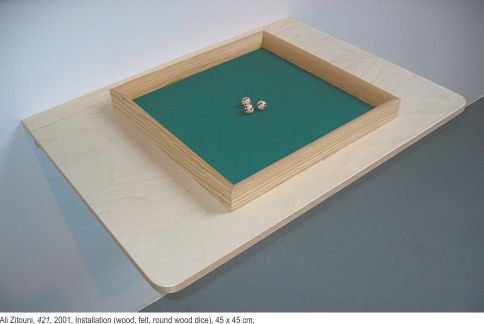
Abdelaali Zitouni (b. 1974) is a master of the visual and conceptual paradox who deliberately undermines conventional language, in order to construct a punning reality of his own. ‘421’ is a game of combinations, with three dice and a board, the 421 possible outcomes of which are notched up on the wall behind. The simplest of propositions are taken literally and turned on their head. Thus, in order to ‘paint himself in his own light’ he sat in the dark in front of an infra-red camera, which was linked by a projector to a screen. He then filmed himself with the camera and went on to paint the image of the face that appeared on the screen in front of him, with the aid of the dullish green glow that was given off in the process.
Henry Meyric Hughes is an independent curator, consultant and writer on art. He is President of the International Association of Art Critics (AICA), in Paris and President of the International Foundation Manifesta (IFM), in Amsterdam
Henry Meyric Hughes describes the unusual experience of chairing the jury for the Diploma examinations for the six-year course at the École des Beaux-Arts in Paris and the exhibition which he curated there of the sixteen candidates who were awarded distinctions for their work. The exhibition, entitled ‘Plus que vrai’ (More than true) encapsulates many…