

michelle nikou not wanting to get caught up in style
Michelle Nikou (born in Adelaide in 1967) grew up in small-town rural South Australia—in Yankalilla, on the Fleurieu Peninsula. She gained a Bachelor of Arts in 1989 from the South Australian Art School and a Graduate Diploma in Visual Arts from the university of south Australia in 1990. Nikou’s work began to gain attention after the mid-nineties

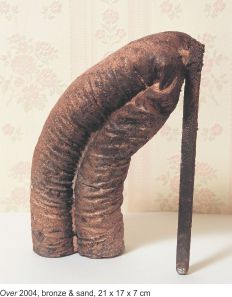
I am seeing a number of new Michelle Nikou works for the first time. They have been lined up arbitrarily, and about a metre apart near the foot of a stretch of well-lit gallery wall, three or four of them—and to the right are two more, on neighbouring plinths, close up to the wall. One (Over), a phallic, ‘bananary-shaped’ object, stands on its plinth, aided by a kind of crutch that is, in fact, part of the sculpture. The other, a metre-long plank of metal, leans against the wall. There are other objects, too, but these are what I note first. On the metre-length of metal there seems to bubble at one spot a kind of fungal growth.
At floor level, closest to the plinth, is an elongated, undulant curve—like a cartoon depiction of a sea serpent, but short. Just one hump. Like all the others it is cast in metal. And, while the shape can register as cheerful movement, it is raised off the ground by two tiny stands, over which, in fact, it seems draped. So the ‘movement’ quoted is frozen, almost as if its up-and-down, roller-coaster silhouette is the result of droop in casting or in cooling off. The stands—as is usual with many of Nikou’s pieces—are the still-attached results of the casting process. Like launch-pad scaffolding or umbilical cord: it would be usual to take these off. They are called ‘runners’ or, sometimes, ‘sprus’ and Nikou regularly leaves them attached. This work, I find out later, is called Languish.
* * * * *
The body of Languish is smeared, to irregular, greyish effect, with white paint. A brush, we can feel, might have been cleaned on it. The spru ‘legs’ or runners remain dark. This treatment of the surface lends the whole an air of accident, of the object’s being a purely contingent survivor, a chancer, a happy fact: modest, cheerful, a little abashed? It doesn’t look like Art, like a statement, something declarative. Maybe it is something hummed, as it makes its way jauntily along the foot of the wall—or, alternately, it is seen as stranded, propped, motionless, a discard.
Next in line is a capital letter ‘A’. It stands on a diminutive metal fez—one of these same base-cup runners—on its right leg. The base is fluted. ‘A’s other, ‘leading’ foot kicks out on the left into space.

Beside ‘A’ is what looks to me like a platform-style sandal, something ancient—from Herculaneum, or classical Rome–but others more in the know are referring to it as ‘the toast-rack’. The loops of thonging I thought might serve to bind foot to sole evidently divide absent pieces of bread. The platform is raised, not on a heel and a ridge under the ball of the foot—but on the same ‘runners’ or ‘sprus’ from which the hot metal has been cast or poured. Rack is its given name. Interestingly, the curves have reminded others of barbeque ribs.
As a line these objects appear graphic, rococo, gaily witty shapes against the white wall and concrete floor. This is an aspect of Nikou’s work not available via photographs of individual pieces, an impression of variousness and of family resemblance that is not just a product of, say, working in series. It makes clear their formal appeal and the degree to which they come of involvement with materials and with shapes and volumes at least as much as from pursuit of any cerebral theme.
Each piece in this sequence has strong graphic presence as shape or silhouette. The ‘traditional’ material—cast and treated bronze metal—might almost seem a reference to historical sculpture. Their energy and gaiety suggest to me the between-the-wars period of modernist sculpture, when objects were typically of the small to medium size that suited the commercial galleries of the time—a retreat from public, monumental sculpture and from large allegorical meanings and sentiments. Also a time when painting (Cubism, Matisse) was in the driving seat and sculpture was confined to a more decorative role: think of Archipenko, Lipchitz, Laurens, Brancusi.
Scale is an important and telling issue in Nikou’s work. The scale is small. To a degree it says something about the artist’s development. To another it is both an aspect of her themes and a formal strategy. It is not usual practice among contemporary sculptors to work at this size. Larger works are the norm, and in fact installation has been the realm of ambitious sculptural work for some time.
For the classic Minimalists of the 60s and early 70s a work should aim to be near to, but not more (or too much less) than human height. This applied to their early cubes and boxes particularly. It gave the work, as intended, an existentially confronting presence of equality with the human—not towering above the viewer, not too easily held within his or her view. The work should confront, but not overwhelm. Exceptions are easy enough to find of course, but I refer to the boxes and cubes of Robert Morris, or Serra’s One-Ton Prop, for example.
If there is a handy rule of thumb for Nikou’s pieces it might be that they should be perceived as smaller than ‘Art’ yet bigger than inconsiderable. Thematically, this will be seen to relate to their opposition to reigning discourses and to hierarchies of size (where size is taken to equal importance). Their themes are often a counter-discourse to that of humanism, the patriarchal, and to the universalist and idealizing editorial. Formally, this relates to the artist’s close involvement with the objects as material, form and shape and serves to draw the viewer closer to these often ‘homeless’ objects. It makes for an engagement and intimacy outside the rhetorical space normatively constituted by viewer and art, in which the viewer (any viewer) is constituted—and to a degree responds—as a Kantian sovereign individual (stripped of particularity) who observes a proposition-making condensation of form and meaning. A Nikou piece, typically, having gained any sovereign individual’s attention, begins to make its appeal to that person’s quite specific (at least non-rhetorical) curiosity. Correspondingly, their natural viewing distance, it could be argued, is the intimate one of an arm’s length or less—within reach of our hands.
As it happened, on this day the placement of the works was perfunctory and purely arbitrary: they had been quickly carried (not all by the artist) from another room and placed for simple ease of viewing and discussion.
In any case, their placement is never ‘established’, especially not so as to obviate closer scrutiny. The metre-length plank, for example, in the course of discussion, is moved to the floor, then replaced on the plinth and, finally, set lying flat. Other works are sometimes wall-mounted, then seen later standing up, on the same base that had formerly attached to the wall. The works mostly do not aim at enhanced authority or coherence thru their orientation to space. (So much for modernism.) They hanker after the status of ‘things’ more than to be distinctly or unequivocally ‘art’. And as you home in on any one of them you find yourself getting ‘curiouser and curiouser’. The furze of imperfections that clump together at one point along the metre-length piece, for example, seems basically to function as just that, as an interruption to, or vitiating of, the simple shape’s perfection and coherence, an aberration. We must move closer.
The attached ‘feeders’—the sprus or runners—of the casting process have a related effect. The runner remains attached. It cripples, handicaps each item with a generic imperfection. This makes them ‘family’. It also states ‘representation’, ‘art’, facsimile—a falseness, even—so that the objects are in some ways ghosts of their originals.
* * * * *
Over, the object that I have been calling ‘phallic’, reminds me, for that reason, of an early, startling Giacometti piece, Woman With Her Throat Cut (1932) and, in a more obvious way, another, also of the early 1930s, Giacometti’s Nasty Object. This latter is a cruel phallus with a thorn-like spike in the end, while the scene-of-violence piece is a schematic representation of a female figure lying spreadeagled, partially skeletal, partially diagrammatic. It is shocking because it is subject matter so rarely represented outside the histrionic history painting of the Baroque and Romantic periods and because Giacometti’s piece comes with none of their edifying scaffolding. I am reminded of Alberto Giacometti for a number of reasons: his Nasty Object has the perfunctory, direct quality Nikou’s work employs. It is the way forms are openly examined and found interesting—for the way they lie, fold, find their place—that reminds one of Woman With Her Throat Cut. Finally, the finish and small scale of many of his classic works—the thin, etiolated, elongated figures—catch the light similarly, and have an initial graphic register that resembles that of many Nikou pieces—and they similarly draw you closer, reel the viewer in, to a close encounter with their material presence.
Nikou’s Over is limply propped up, a gourd splitting open, ripe, leaning upon its prop, like an old roué on his cane. So the cane seems a comic masculine register in keeping with the joke on vulnerable male sexuality. Closer up, the form seems less phallic and more akin to an ear of corn or a banana, some pod about to burst or deliquesce: the visual conundrum is the softness and near fluidity of the original and the solidity we know it has as a cast object. The surfaces operate illusionistically to mimic the organic. Over is bronze—and my reading of it is ‘wrong’—or it recedes at any rate, becoming a supportable reading or meaning, but not authoritative, not an absolute and sure identification—because the closer view reveals the work to be one of Nikou’s familiar draft-stopper snakes, cast as usual in bronze but bent in the middle and doubled back upon itself: an examination of the shape when treated this way.
The plastered and painted surface treatments given Nikou’s works are often much tested and mulled over. Casual, brushy, the grey whitewashing that the serpentine Languish has been subjected to has a number of effects. It counters the piece’s formal autonomy. Rather than appearing as a 3-D object with an organic or purposive-seeming shape and mass, a closer view has us attend to its surface, a surface broken into bits—interesting in their own right (as passages) and detracting from a view of the object as whole and coherent. The distressed, brushed, stained surface acts also as a commentary on the object, as inflection added to it. In both ways what would be the piece’s traditional formal coherence or integrity is lessened, even ‘insulted’, rendered passive. This effect of the painterly surface would be anathema to traditional modernism and to Minimalism alike. As would be the anthropomorphising readings the work seems happy to invite.
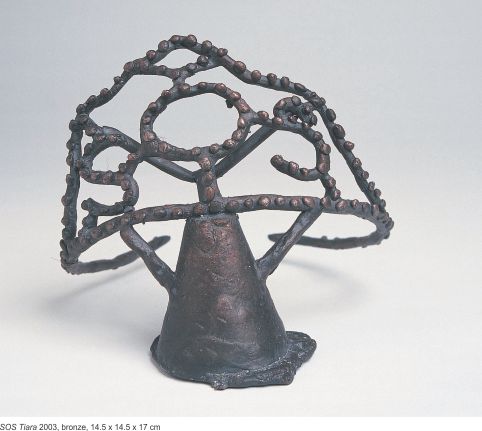
Within teaching institutions stylistically reductivist practices are now normative, an orthodoxy derived from Minimal Art, that art schools both articulate as something of a basic grammar and encourage students to subvert or act against. The models for this anti-form reaction date almost from the first days of Minimalism itself: Eva Hesse (1936—1970)’s reaction against the movement’s main manner in the 1960s, Louise Bourgeoise (1911— )’s re-emergence in the 1970s and 80s, and art povera, the contemporaneous 60s movement and sensibility emanating from Italy. Their effects have been reinforced by their subsequent revivals and reconstruals as punkish, as ‘Bad’ art, as grunge, the abject etc. Nikou’s work seems to stand in some proximate relation to both these lexicons or syntaxes of contemporary work, though not at all programmatically. Nikou regularly features the properties of the material in classic enough Minimalist way—note the poured metal, the drooping shapes that have obviously formed as the material hardened. The retention of the mechanisms through which the metal was poured, usually to double as stands for the piece, has something of both Modernism’s and Minimalism’s desideratum of ‘truth to materials’ and the Minimalist and Conceptualist liking for making evident ‘process’. But it tells, as well, against formal coherence, and these runners can read as excrescence, making Nikou’s practice more compatible with the informal trends derived from such as Hesse, art povera, and grunge-art assemblage.
The works often exhibit a silhouette that stands in no relation to the work as closely experienced physical object. The initial appearance might be almost rococo. Take for example the curlicue shapes of the toast-rack/sandal. Or the cheerful vitalism with which the letter ‘A’ puts its best foot forward, kicking airily to the left while the work is weighted and stabilized by the minuscule plinth on which it is balanced. Some of Nikou’s works from this period have a Parisian modernist 20s/30s poise. It is a curious jumping between eras and pleasurably chameleon.
* * * * * * * * *
Nikou has cast a number of small boxy shapes. They catch the eye as disconcerting and tantalisingly un-art-like. Too small to be Minimalist homages to the cube, not so small as to signal ‘craft object’, they are also strangely familiar. These are bronze-cast tissue boxes, their surfaces roughened with residually attached plaster, irregularly blackened and discoloured.
Their detached lids—oval lozenge shapes—are wall-mounted and are much harder to recognize: the penny drops only when we see the nearby boxes, minus their lids. We hardly see the lids in real life. Detached from the boxes that they seal, they are normally disposed of. Nikou presents them in a constellation (cast in lead)—spent shells, or a brave or humiliating, or merely factual, tally. In a sense the lids’ presence recalls the boxes: full volumes, hollowed, possessing a degree of mystery, soliciting use—in every way the ghosted opposites of the small oval lids pressed and removed from the receptacles but evoking them, like smoke implying fire. It is partly that our hands know them so well. We’ve opened so many die-cut packages and contemplation of these lids that we normally give no thought to recall this haptic knowledge, makes it press for some satisfaction now as we view.
Nikou’s boxes alert us to an interest that boxes never have, except perhaps for children. As sculptural object the size and shape and hollowness of each box is interesting, intriguing, curious. Cast as they are, their weight and solidity is sensed, read from their appearance: the particular darkness and mystery of their volume can be gauged. It tempts us to handle the object, verifying what we know intuitively. We tend not to do this with art objects and this small allure of mystery remains.
For such small objects they have a strange aura (which, amusingly, they share with Robert Morris’s boxes)—it is gravitas. The cast tissue boxes seem generic, somehow sourced to an ‘idea’ (the platonic, original, ideal tissue box). The ‘thingness’ they thus isolate seems, on some register, a source of dignity—and it lends this to these objects’ metonymical sadnesses, griefs. (I am taking the boxes to refer to a past of suffering: each box a measure of sadness, grief, consolation—or a reproach, record, reminder, silent witness. Unnervingly, they may indicate futures.)
The surfaces of these boxes present a range of beautiful tones, like fire-damaged factory sites, corrugated tin burned and blistered, charred and weathered. Here surface becomes an expressive vehicle. More correctly, the surfaces allow and lend expressive form to any investment we find we make. The industrial finish is also a kind of joke or sarcasm about the boxes—and our feelings about them—because it is a brutalist industrial finish, its hardness the opposite of the softness any real tissue box offers and promises.
Such casting and selection of ordinary objects is hardly unprecedented. A number of oeuvres and artists’ names could be cited–and specific well-known works. None seem quite the same as Michelle Nikou’s various series of artworks.
* * * * *
Asked about the art/craft distinction, Nikou’s response is very interesting.
The distinction would have it that, basically, art is to do with exploratory, iconoclastic, mould-breaking discovery and ‘idea’—that it is conceptual, or conceptually driven. Craft, by contrast, is about the level of (traditional, conventional) skill involved in delivering a known, predictable product: the production of beautiful bowls for example.
Nikou joins a number of artists whose work confounds the distinction between art and craft one way or another while operating distinctly under the notion of Art. Based in Adelaide, Fiona Hall and Hossein Valamanesh are two such. Hall has moved from photography to staged, large-format photographs of tableaux she manufactured herself, thence to objects that utilize and further develop the same extraordinary skills she has acquired in the earlier phases of her career. These works are conceptual, yet also delight because of their hybrid and inspired mix of technique and vision. Valamanesh makes sculpture, installations and wall pieces. Typically his work makes great play with earthen textures and colours, barks, leaves, sand. Its conceptual deployment means that it treats important themes (of displacement, identity, cultural shift) that lift it well above the charm of mere good taste. Michelle Nikou might be yet another—though her link with craft is more tenuous: merely that her early training was in craft media rather than, say, in painting or sculpture as such.
Asked if she ‘cared’ about the Art/Craft distinction Nikou replied, ‘I don’t care at all’, quite aggressively. They are not categories that interest her. Nikou’s current work presents itself as standing between both categories, unwilling—and, indeed, unconcerned—to invoke the protection of either. Where it strays too far to one or the other side then that is because the artist won’t flatter either category or its assumptions by recognizing it. More probably it is that Nikou has spent many years freeing her mind of the strictures enfencing both areas of practice in an attempt to operate freely between and beyond them.
Nikou’s work has begun to gain particular attention after the mid-nineties. Since 1998 she has exhibited solo in Adelaide at Greenaway Galleries and in Sydney with Darren Knight on a more or less alternating basis.
* * * * *
The works Nikou makes typically stem from a world ‘out of sight’ or below the threshold of attention and commentary. Alternatively, they voice the unspoken counter-commentary that accompanies our lives, that is shared as comic recognition of the truth, of the real in everyday life–in relationships, in patterns of emotional response to living. ‘Don’t pass the ball to me,’ says one work.
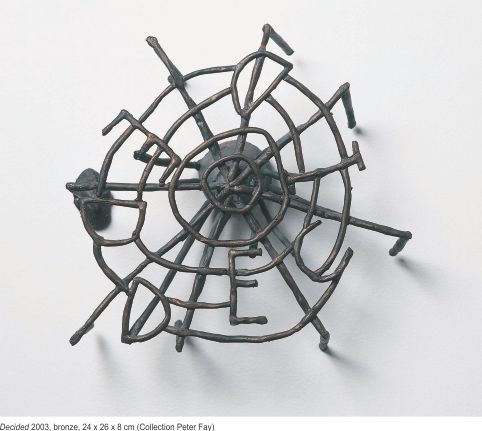
Almost a distinct subset within Nikou’s work are the pieces made of, and featuring, letters. These utilize similar techniques of manufacture. Their construction is more intricate. It is also clunkily deliberate—and almost forgetful, it seems, of the word chosen: the letters of a word are fitted together, often in ways that reduce instant legibility, ignoring it or forgetting it as a consideration. Some of the word pieces suggest states, like Decided. Others are injunctions (like Choose), or dilemmas.
Half Of Everything, the necklace of half-eaten biscuits, is also part of a Nikou family of objects. This would include the potato necklaces, the spoons with gunk on them (remains of food, perhaps chewed, or perhaps the residues of cooking), the tissue-box lids, the boxes themselves. This is the class we create if we look to records of ritual or of repeated, necessary consumption: life measured in coffee spoons, grief measured in tissue boxes, comfort or celebration or relaxation measured in biscuits.
The necklaces are obviously a craft ‘form’. They are probably never going to be worn, though who’s to say? Their irregularity removes them from the slickness of current design—yet it is not an attempt to achieve the hand-crafted look as a desired end. It does, again, slow the eye and bring us close to the object as physical, material, made thing—but also close to the experience, the meaning, of real biscuits. The meaning of biscuits? It brings us to a recall or recognition of individual biscuits as solace, or small pleasure—a recognition from experience, not a recognition of the same thing as ‘sign’ or symbol. This latter reading we will have passed through earlier: it is not irrelevant at all, but were the work to remain at that level it would be mildly kitsch joke only.
‘I’m with him now’ are the words upon a toilet roll cover. This is the delimiting tyranny of any shared life—comic and tragic at the same time–and it is realism. It has the finality of a sentence, a verdict accepted, taken into the soul. And it reminds one of melodramatic statements of status achieved or, irrevocably, altered: ‘Reader, I married him’ is the most famous in this line—and they are typically from women’s literature, women’s films, or popular novels, even Mills and Boon. That the sentence is appliquéed on a toilet-roll cover is masterly: so domestic, so unexciting and unglamorous, so every day. Dutiful—and very much of the ‘woman’s sphere’, at least as traditionally assigned. Is it humiliating, mere realism, or despair? Is it the thought behind the public face that must be put on things? Nikou’s detachment, the cool of her irony, is deadly and hilarious.
* * * * *
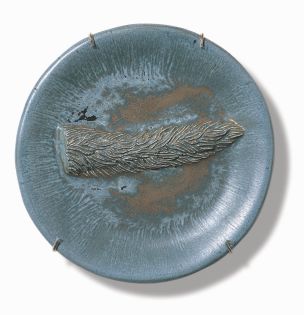
Michelle Nikou’s productions are typically of small size: they speak sotto voce, unemphatically. They have a ‘refusnik’ aspect: a refusal of many of the rhetorical supports or framework(s) of High Art, of Renaissance humanism, of the Enlightenment inheritance.
Nikou’s work constitutes a refusal of master narratives, of narratives that rest upon too many assumptions. It is literalist/existentialist in manner—and it quotes (rather than speaks in its own voice) only fragments of discourse. These fragments are of the quotidian discourse of lives lived below the level of the Master Narrative, counter to it, oblivious of it, cynical toward it. Or they are fragments of emotional response—quoted—or maxims, or captions. They are quoted as more real than the Master Narratives, are quoted ironically, quoted sarcastically, as abject and inadequate, but irrefutable.
Many pieces are calibrations. They calibrate marks, milestones that might chart and measure a life—in particular, but not always exclusively, a female life—I’m with him now (Untitled[Love has pitched his mansion…]), for example, the tissue boxes, the curtain rings. There is a rosary of necklace biscuits, another of potato shapes, or of chews (like sleeps, like meals). Necklaces are chains of course. It is possible to see much of Michelle Nikou’s work as series, links in a chain—as tellers of time, markers of stages, of duration and repetition—and as prayers, rituals (viz the masticated ingestions on spoons, or linked as a necklace).
The objects sometimes seem to interrogate us, ask after the fun that was afforded—by the contents of the opened box, by the occasion (the festive party cake moulds)—while, question asked, they stand as melancholy or dispassionate memory.
Ken Bolton is a poet and art critic. He works at the Experimental Art Foundation in Adelaide, Australia
Michelle Nikou (born in Adelaide in 1967) grew up in small-town rural South Australia—in Yankalilla, on the Fleurieu Peninsula. She gained a Bachelor of Arts in 1989 from the South Australian Art School and a Graduate Diploma in Visual Arts from the university of south Australia in 1990. Nikou’s work began to gain attention after…