
subodh gupta transitory indecisions and fluctuating monuments
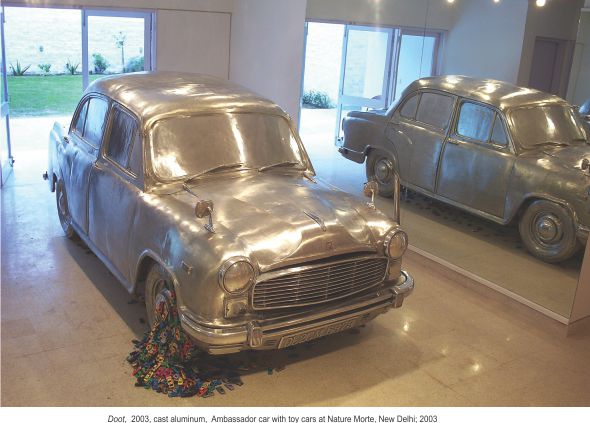
Subodh Gupta’s recent works portray objects and images of indecisive moments and cultural fluctuations. During the past decade, his art employed certain clichéd emblems of India: the cow, stainless steel kitchen articles, the scooter, cow dung cakes, his own persona as a man from a village in Bihar. All along, Gupta’s purpose was two-fold, to edify such emblems and to critique them. Since his aim is to elevate and castigate, his predilection is usually for images and objects which already possess an internal hybridity and appear to be comically confused themselves. Such is the case with the humble scooter slung with milk-cans for delivery, a boxed Japanese television wrapped in an Indian bedspread or the Ambassador car, that symbol of official India now loved only by foreign tourists. Throughout his works in sculpture, painting, photography, video and performance, Gupta investigates the inherent anomalies of representation as it is called upon to construct identities both personal and of a wider body politic
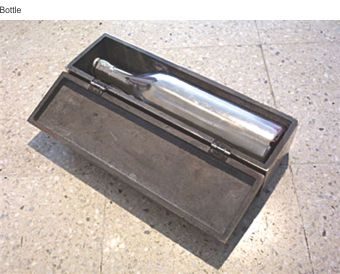
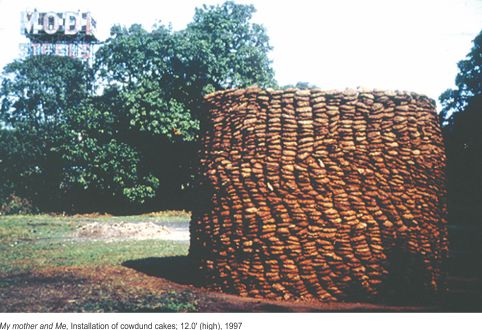
Gupta seems to flow fluidly between different mediums, concocting a web of overlapping concerns in the process. His basic role could be said to be that of a sculptor, for even in two-dimensional works he is most often concerned with images of objects in space while in video works he foregrounds his own body within a controlled mise en scene. His primary sculptural vocabulary takes clues from the commemorative, and is often reminiscent of the charmingly naïve figures of concrete which stand stoically in the middle of roundabouts in small towns all over India (in that he is inspired by both the statue and the swirl of activity surrounding it). Gupta often makes monuments out of common objects by casting them in different materials and often combining them into ensembles; anti-monuments which perhaps portray the hopes, dream and struggles of the common Indian today. In one work, ‘The Way Home II’ (1999), the artist placed a life-size cow, cast in fiberglass and painted white, within a circular field surrounded by a combination of steel kitchen utensils and ersatz country-made pistols. Here, violence lay camouflaged and dormant within the bosom of domesticity, the symbol of a transcendent purity inaccessible and immobile at the centre. ‘My Mother and Me’ (created at the Khoj Workshop in India in 1999) was an architectonic form assembled entirely from cow-dung cakes, a Utopian structure that fused the ancient practices of the rural village with Modernism. Gupta’s self-portrait, its background smeared with cow-dung, blinks the word ‘Bihari’ in fairy lights, a tongue-in-cheek parody of the ambitions of the hopelessly downtrodden to actualize their ‘Bollywood Dreams.’
‘Saat Sumundar Par’ (‘Across the Seven Seas’) is the title given to a recent series of large-scale oil paintings that capture a mid-migratory point, the no-man’s-land that is the airport today. When viewing Gupta’s paintings we are forced to ask ourselves if the journey is at its very beginning or is it reaching its close? Are the subjects coming, going, or hung in the purgatory of delayed departures or early arrivals? An interstitial point both in space and time, the airport signifies both exhilaration and anxiety, the tedious boredom that accompanies the most extreme physical dislocation. Today, the airport is only barely the domain of the elite it once was, and is more akin to the train station or bus depot used by the masses. Air travel has long had a history of danger, but since September 11, 2001 the airport has come to symbolize a point of extreme vulnerability, of heightened security, interrogation and racial profiling. It has indeed become a worm-hole of sorts where one squeezes through the dangerous space of the social in between the safe havens of family, friends and familiarity.

Gupta paints the markers of this transgression, the precious cargo that accompanies the passenger. The paintings themselves present a synthesis of schools: a Pop or Photo-Realist style is used to depict objects that harbour Surrealist tendencies, a Conceptualist pedigree and a Formalist’s combination of materials. The people and backgrounds are rendered in a blocky, two-dimensional shorthand while only the objects of Gupta’s ultimate interest, the trolleys with luggage, are fleshed out completely, painted in a realistic manner, as if to say that we are nothing more than the commodities we drag around with us: ‘I Pack Therefore I Am.’ Poised upon a wheeled trolley are suitcases and packages that represent a life condensed, the most necessary objects (both in terms of quotidian function and symbolic strengths) are swaddled into vinyl boxes or trussed into bulging bundles. These packages remind one of Man Ray’s cloaked sewing machine and the Surrealists’ infatuation with mummified objects that Christo later amplified into an architectural scale. Masquerade, buried treasure, camouflage, espionage and concealed weaponry all come to mind. The fact that these objects of both fantasy and mystery can be discovered among the familiar things illustrates the startling transference of the psychology of Surrealism, its slow bleed into and complete colonization of the Real. This may have been instigated by the Fine Arts but the foot soldiers who finally accomplished the task were the disciplines of Advertising and Pop Culture.
In an exhibition held in New Delhi in 2003, Gupta accompanied this series of paintings with sculptures of cast-bronze airport trolleys and luggage that had been cast in aluminum, their arrangements flexible and constantly shifting, much as the spontaneous the choreography which takes place at airports. Chance and random juxtaposition are exploited (all the works being based on the artist’s own preliminary photographs) so as to create monuments of a transient nature. Likewise, a sculpture depicting packages hoisted upon the luggage rack of a taxi connotes not only tourism and the economy of its infrastructure but also the flight abroad of families and their eventual, perhaps only temporary, return to India. This focus on the Indian who emigrates to another country is a recurring theme in the popular cinema and those that do so and gain success in their respective fields are publicly celebrated as still belonging to India and lauded as its finest exports. In this mix are complex feelings of insecurity and frustration, nationalist pride and materialistic yearnings. Gupta cannily spotlights the simple articles that symbolize a myriad of social and psychological conundrums such as these. His sculpture entitled ‘Colgate’ is the aluminum casts of simple sticks of neem, an herbal wood traditionaly used in India for medicinal purposes and dental hygiene. In recent times, neem has become the point of contention between an ancient system of Indian knowledge and its attempted appropriation by foreign corporations, with all the messy conjunctions of money, power and legal wrangling that comes with such turf.

By continuing to focus on emblems of everyday India, symbols which straddle rural and urban scenarios, Gupta flirts with the sentimentality which still propels much of what registers as contemporary art in India today. The majority of India’s commercial art galleries and public exhibition spaces are stocked with works that depict scenes of village India. Most often these scenes are idealized versions of Rajasthani women dressed in elaborate clothing and jewelry, bullock-driven ploughs in verdant fields, bucolic landscapes dotted with temples, or seascapes including palm trees and fishing boats. The styles in which these pictures are painted are usually a saccharine-coated Realism (with plenty of sparkling highlights and feathery brushstrokes) but they also veer into the atmospherically Impressionistic or even the geometricized Cubist. What they share is a continuing belief (or simply a last-ditch hope?) that the true India is found in its villages, a concept embedded in the principles espoused by Mahatma Gandhi and exploited since by both politicians and the mass media. This is the type of imagery overwhelmingly favoured by India’s bourgeoisie and nouveau riche for the walls of their homes. A wide variety of artists create such imagery at a wide spectrum of prices, some more self-consciously modern or even post-modern than others. What they all have in common is a flat-out refusal to render anything of the contemporary realities of rural and agrarian India today. Nothing of the social situations of these places is allowed into their canvases, not a speck of corruption, nor of pollution, or of the struggles with industrialization and development or the tensions between tradition and modernity. What is produced, in effect, is an indigenous Orientalism, one that portrays a rural ideal that is superficial and sanitized, one which serves to widen the rift in any actual understanding that might take place between the cities and villages of India today.
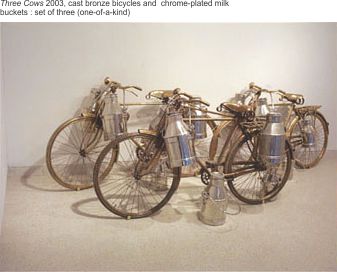
Subodh Gupta’s project, then, is bold in its attempt to directly confront these loaded points where the city collides with the village, when the contemporary cannibalizes the traditional. In the urban landscape, the doodh-wallah or milkman, replaces his bicycle with a scooter, that poor relation of the motorcycle, and slings it with the same cans of hot broth fresh from the cows’ udders. A more rapid distribution is facilitated but the elegance of the delivery (not to mention the honour of the deliverer) is greatly compromised. Or take Gupta’s video entitled ‘pure’ in which the artist is subsumed in a thick skin of cow-dung (as he has also employed in performance works) that renders him abhorrent and monstrous. Indian culture is obsessed with ritual and symbolic purity; it transfers this obsession from the realm of the sacred onto the secular and extends it into its relations with the outside world, while Hinduism traditionally embraces cow-dung as a purifying element. Gupta dives into these contradictions greedily, enthusiastically stirring up issues relating to development and notions of progress, racism and discrimination by skin tone (as operative inside India as it is elsewhere), caste-based politics, even globalization, and the continuing subjugation of the Third World by the First. Gupta’s formative years were spent participating in traveling Hindi-language theatre groups, as both actor and set-designer, and this foundation has led him to experiment with forms of expression which are reminiscent of the cathartic use of the body by the Viennese Actionists (see Gupta’s work ‘Vilas,’ in which he poses nude and greased, confronting the camera and, by extension, the long, sordid history of marketing the Kama Sutra).

But I have digressed from the subject of the village stereotype. For his most recent exhibition (at The Showroom in London in 2004), Gupta’s newest video and photographic works take him home to his village in Bihar, examining the train journey to and fro and the environs of the house itself. With an eye now astutely tuned to the proclivities and sensibilities of an international art world, Gupta has shot details of his family’s house, recognizing the aesthetics that could be mined from the most banal details, and their similarities to ‘avant-garde’ art practices, effectively collapsing completely any distinction between the poles of the local and the global. Gupta confronts sentimentality coldly, dispassionately calculating the visual residue of his biographical background for an art audience that is hungry for symbols of authenticity and identity, seemingly stripped of irony while knowing that to be wholly improbable. The artist’s overall project ricochets off the sentimentality in which most Indian contemporary art steeps itself, addressing an international platform (for the majority of his works do not register as ‘art’ to most Indians, unaware as they are of the history of Duchamp’s Readymade, the Surrealists’ use of the found object or even Pop Art and therefore completely unable to decipher his objectives), disemboweling a home-grown Orientalism to throw it back into the face of a globalising culture industry. For this reason, Gupta’s focus on the airport terminal is doubly pertinent. Sentimentality achieves its most palpable dimension at this liminal point, where whole families gather so as to participate in the ‘darshan’ (the concept of ‘seeing and being seen’ operative with Hindu deities) of the first or last sight of a loved one as they return or depart, all within the harshly cold and brittle surroundings where this amputation takes place (akin to the hospital from where we both enter and leave this world), almost completely devoid of the picturesque styling or ethnographic details that help to constitute an identity both personal and national. The extreme anxiety propagated by the airport environment is evident by contrast with a photograph by the artist entitled ‘I Go Home Every Single Day.’ Shot on a platform of New Delhi’s main train station, this theatrical tableau of waiting travelers mixes an assortment of poses and body languages with personal effects and public services. The result is a scene of relaxed conviviality, of a space, which though transitional, is also comfortable and welcoming.
What the critic Geeta Kapur has said of the South Indian sculptor Ravinder Reddy can also be applied to Subodh Gupta: ‘If India had not produced a sculptor [such as this] we would be asking why.’ The strength of Gupta’s mature works of the past decade has been the seemingly effortless, perhaps self-consciously naïve, élan with which they straddle the rural and urban contexts of India, bridging the local and the global for an international context. His simultaneous experiments without regard to the categories of artistic mediums and his consistent use of potent materials and symbols has been both courageous and prescient within the rather stultifying arena of India’s contemporary art market. Gupta’s exposure to and participation in an international art scene has only honed his perceptions of India and its culture further, enabling him to excavate significant gems that have been compacted by both time and repetition. Meaning, both personal and collective, is mercurial, and to grab hold of it for even a fleeting moment takes perseverance and insight.
Peter Nagy is an artist and curator who writes frequently on the subject of contemporary art for a wide variety of publications. He is the director of Gallery Nature Morte in New Delhi
Subodh Gupta’s recent works portray objects and images of indecisive moments and cultural fluctuations. During the past decade, his art employed certain clichéd emblems of India: the cow, stainless steel kitchen articles, the scooter, cow dung cakes, his own persona as a man from a village in Bihar. All along, Gupta’s purpose was two-fold, to …