

young british-asian artist or not?
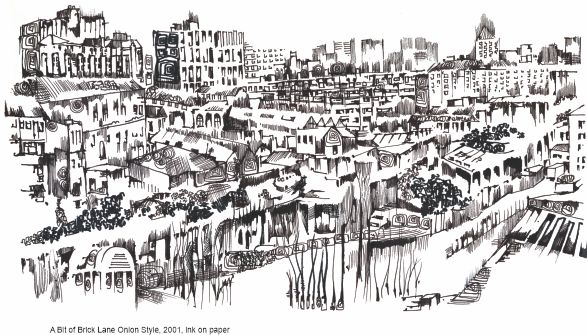
When I was asked to write an article about Asian women artists working in London I could initially only think of one other Bangladeshi artist apart from myself. There are probably others scattered over the sprawling capital but if one thinks in terms of a cohesive movement with Asian women artists engaging in discourse about their work, such a movement simply does not exist. The first serious attempt to create such a movement was in 1999. This article will describe the evolution of what I would tentatively describe as a Young British Asian art scene within the Brick Lane area, making principal references to my own work. Brick Lane, of course, is in the heart of the East End of London and home to a large Bangladeshi diaspora consisting mainly of the Sylheti community

In terms of the Asian scene, and what was widely coined as ‘Asian cool,’ 1999 was a seminal year. Brick Lane was already considered a vibrant multicultural area with its blend of Bangladeshis, Somalis and young trendy folk. With the Truman Brewery situated in the centre of Brick Lane, a workplace for musicians, DJ’s and designers, the area became a hot bed of creativity with its combination of independent galleries, avant-garde cafes and retro fashion boutiques, all coexisting in close proximity. 1999 was also the year that The Whitechapel Art Gallery hosted the 000 exhibition, the first showcasing of British Asian art. Running in conjunction with the 000 show was a Bangladeshi festival consisting of a series of cultural events and exhibitions across the whole of London. Although 000 aimed to promote British Asian artists, the premise of the show was flawed from the outset. If artists are promoted on the basis of their ethnicity and gender rather than solely their work the danger is that the artist will become typecast.
My work also featured in the 000 show at the Whitechapel; in fact, it was my first major group show. The curators selected a text panel and my MA film. The work that they selected was not what I would have chosen. I wanted to exhibit my dildo series but the curators refused; in retrospect I feel they were afraid that the works would have attracted too much publicity. I was also asked to read a piece of my writing with other Asian writers such as Hari Kunzro, author of The Impressionist. Since 000, and without the aid of an agent, I have exhibited in over forty shows, both group and solo and screened my films in London, New York, Paris, Bangladesh, Kuala Lumpur and Frankfurt. I curated some of these shows myself because I believe wholeheartedly in the autonomy of the artist. I also have a clear idea of the path I wish to take. Contrary to popular perception, there isn’t one definitive way to be an artist. The days of working in a single medium are over. It is almost impossible to make a living solely through the sale of paintings alone. Modern day artists need to be able to paint, draw, film, photograph, edit and write. More and more artists are working across media. Technology has empowered the artist and dramatically reduced the cost of making films and doing video work.
For sure, the current London art scene is still very much biased towards installation and conceptual work. Since Saatchi began moulding the art scene in the 1980s with the creation of artist rock star equivalents like Damien Hirst and Tracey Emin, artists are feeling more and more inclined to perceive themselves as marketable products. The question however is: which path do you want to take as an artist? How do you want your work to evolve? Does the artist wish to be promoted as a personality or simply focus on the work itself? Does the artist exploit her ethnicity or try and create work that escapes facile labelling? It is a common quandary that many Asian women artists most probably face.
I did not have an art school training in the conventional sense: in fact, I studied at the London School of Economics, completing my BSc and MSc before embarking on an MA in directing and screen writing and then finally enrolling for a BA at Chelsea School of Art and Design. Indeed, I dropped out of Chelsea to pursue art full time in 1999. Being the only Bangladeshi artist at the college and with clear ideas about my art, I felt impeded by the heavy prescriptive methods of my teachers. My experience of 000 was rather than feeling part of a collective, I felt the artists were more concerned with self-promotion. Since 000 there have been no other similar showcases for Asian talent. With fully assimilated English speaking British Asians already on the scene perhaps there is no need to categorise artists according to ethnic tags. It is for the artist to push their work rather than the colour of their skin in order to be noticed. 000 was a token show, something that seemed politically correct rather than artistically and creatively excellent. Post 1999, the interest in ‘Asian cool’ has waned.
After this experience I realised that it was a trap to see myself principally as a Bangladeshi artist and that the only way forward was to focus on concept-based work that could not be categorised as Asian art. The art should speak for itself and breathe independently without exposition or categorisation. Ideally, the viewer should be unaware of the ethnic origin and gender of the artist. In fact, such knowledge intrudes, blurs and obscures the meaning of the actual work.
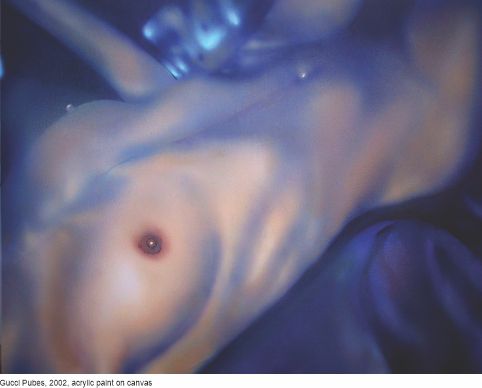
My first major ventures were a series of headless figurative nudes, heavily influenced by Francis Bacon and the work of Nicky Hobberman, a Young British Artist who paints floating, luminous macabre portraits of children. This phase was experimental and strongly aesthetic. The paintings sold well but afterwards I asked myself: where am I going with this?
I followed this series with psychological portraits of my mother and myself. The concept behind the work was to complete a series of portraits that traced the changing relationship between mother and daughter in real time until they were both deceased. Exhibiting the whole series in chronological order to show the physical ageing process and the shifts in mental make-up remains a life-long aim. Rather than use a pencil to create these drawings I began to experiment with varnish and pastel. I developed this style by chance when I came across a small photo of an old woman in The Guardian newspaper and was totally captivated by her haunted look and I wanted to discover a new way to capture the intense mood and emotion of the image. The varnish created a surface not too dissimilar from tracing paper and using pastel as opposed to pencil allowed me to create a series of expressionist marks that mutated into an eerie realism.
The most controversial piece I have made was a series of dildo drawings that feature meticulously drawn dildos in various scenarios such as a ‘dole queue of dildos.’ The piece is a play on Saatchi’s 1979 Tory election campaign, which depicts a dole queue fading into infinity with the caption ‘Labour isn’t working.’
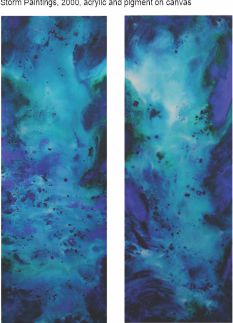
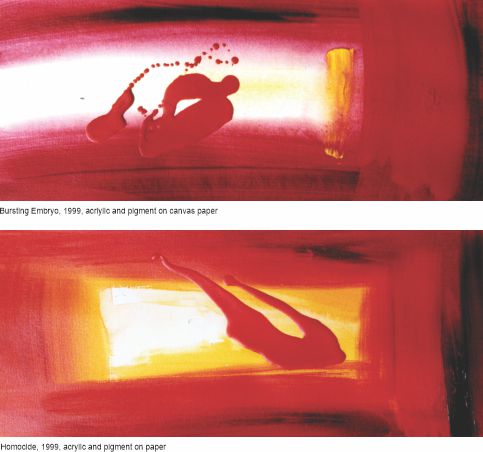
An abstract series came next, focusing on the pure expressive nature of paint. Balancing colour with light, mixing raw pigments to create a level of luminosity and shifting from figurative realism was a liberating departure. These abstract works took relatively little time to create but many had to be discarded before I achieved that elusive equilibrium.
Rothko and Pollock were the main influences for these works. Using encaustic methods created another level of abstraction. Throwing wax onto a finished painting not knowing whether the random gesture would destroy or enhance the work created an element of the unpredictable. Asking my little sister to interpret the paintings and come up with titles such as ‘Bursting Embryo’ and ‘Homicide’ created additional layers of meaning. I was then commissioned to create a series of storm panels on permanent exhibition at the Kobi Nazrul Centre on Hanbury Street, inspired by the poem ‘Beware my Captain’ by Nazrul Islam.
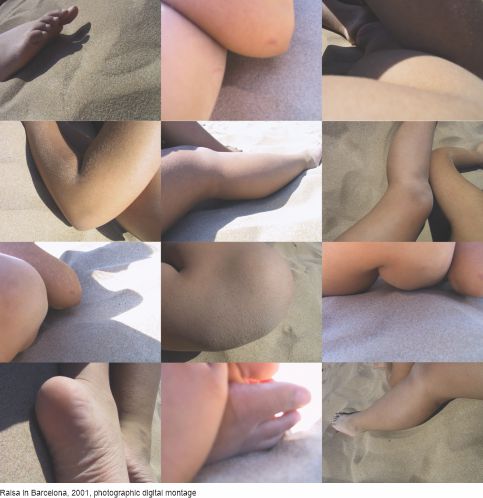
I then became fascinated with photo realism and engaged in various photo realist painting montages of figures and landscapes. Photo montage was a natural progression for me after creating sequence based work. I created one piece for a New York group show depicting abstract compositions of my little sister’s body taken on a sunny Barcelona beach. With the exception of this last piece I made most of my work in a studio off Brick Lane.
However, I began to feel increasingly isolated from people and the art world. Consequently, I began to wonder how I could reintegrate myself into the elusive art scene without losing my autonomy. My answer was to set up a company called Pigment Explosion in 2000 coupled with a website designed to showcase my work. (A few years later I created Hedge galleries, a gallery that aimed to display the work of other young Asian artists working in Bangladesh and London). The company was initially set up to conceive art projects. At the time I was not sure what form these projects might take but I began with live art events, which took place in venues off Brick Lane such as ‘The Brickhouse,’ a raw space that is part of a converted warehouse opposite the Truman Brewery. The events consisted of live painting, live projected visuals, an exhibition of my paintings and live music. The paying public could dance, gaze at the visuals or watch me paint. What they wanted to do was entirely up to them. After four of these events I decided to stop because they were becoming commercial and too much of a logistical exercise in terms of organisation and promotion.
It was at this point that my work shifted towards concept and project-based work. Since I was working across all media it made sense to conceive projects that combined all these aspects. Up until this point I was making work that could not be categorised in terms of gender or ethnicity. As a Bangladeshi I have always felt an affinity with Bangladesh, although I was born in the UK. This affinity was very much linked with smells, colours and light. There were also issues of identity; I would often ponder on notions of ‘home.’ Where is my home, England or Bangladesh? Where do I fit in on this sprawling planet?

My practice quickly evolved into a clear dichotomy. There was my studio-based work that escaped all manner of categorisation and then there was my concept and project based work that crossed all media and had an educational and philanthropic aspect. I never aspired to be an artist just making work for myself; such a premise seemed far too self-indulgent. With a degree from the London School of Economics and an interest in emerging Third World democracies it seemed to make perfect sense to create projects in developing countries starting with my mother’s country of origin, Bangladesh.
My first major project was ‘From Briarwood to Barishal to Brick Lane.’ It entailed me painting and photographing from rooftops in New York, Bangladesh and London and e-mailing the images to a school in London. I also shot a film about the Bangladeshi diaspora in London, New York and Bangladesh and created an anthology of the same title, which contained many of the paintings, drawings and text that featured in the film. All three projects overlapped and blended into one cohesive whole. More films (totalling eleven to date) and other multi-media projects followed. As a result, I created a model of working that could in theory be applied to any country and any ethnic group. For example ‘Old Meets Young’ was a film/photography/drawing/text project, which involved me taking photos, executing fine portrait drawings and writing up the stories of elderly Bangladeshi folk at St Hilda’s community centre off Bethnal Green Road in London. They were the first Bangladeshis to come to the UK. Many of these folk were dying and with them their stories of why they came to the UK, their dreams and aspirations. The project also involved the production of a film, with the same title, shot in Bangladesh and London and an educational component with school kids. The idea was to bridge the growing gulf between first and fourth generation Bangladeshis and create a lasting documentation of these stories. The same concept can be applied to any ethnic group such as Chinese, African or Somali and be equally as potent. As a direct consequence of that project I created a book of their stories, photos and portraits, funded by the Arts Council.
In my practice I found that ideas evolved and developed into other projects, and rather than remain confined to working in Bangladesh, I entered new terrains. The reason for this was also because of the strength of the concept. If the concept was solid, clear and effective it could be replicated anywhere in the world.
The kind of practice that I have described above is quite rare in the sense that it allows the artist complete autonomy. Although forced to work within constraints and stipulations of large organisations such as the Arts Council and the British Council, it is still possible to negotiate within those parameters and create work that is socially acute and aesthetically challenging. Gender and ethnicity can be utilised to enhance artistic practice rather than shackle it. The advantage of not going down the traditional artistic route of getting an agent and relying on exhibitions is you are not tempted to repeat yourself. An artist can often be the victim of his own success and the work can become formulaic because of a desire to conform to commercial expectations. Exhibiting artists are also expected to have a definitive style, something that is recognisable and marketable. Labels are often required so that the paying public can comprehend and digest what they are looking at. Running Pigment Explosion has allowed me to bypass this process. I have a variety of different styles and refuse to adopt one way of working. I am shaping and determining my trajectory and no one else is impinging on it. The nature of my practice is unique and works for me.

Since 000 I have maintained a solid relationship with the Whitechapel Art Gallery. I was artist in residence in 2003 and they have invited me to screen my films and engage in talks with other artists such as Turner prize winner Rachel Whitread. My film ‘Connecting Faith’, commissioned by the British Council, was recently screened at the National Art Gallery in Kuala Lumpur, September 2004. The fashion designer Matthew Williamson used one of my New York cityscapes as a backdrop for his show in New York, September 2000. In terms of current projects I am working on a classical painting commission, a series of abstract paintings for the Clifton in Bristol, a new film that explores issues of image and skin colour among young British Asian girls, funded by a National Lottery grant, my third book ‘Hidden,’ which traces the stories of battered women (these include Asian women residing in refuges in East London) and a British Council film project, which involves a photography/text dimension and the creation of four films, shot in London, Bangladesh, Indonesia and Malaysia. The project is called ‘Connecting Kids’ and explores the lives of street kids in Bangladesh and Indonesia and severely disadvantaged kids in London and Malaysia. UNESCO Paris will screen the final film and exhibit the photos in February 2005 and the British Council has asked me to transform the project into a tri-lingual book publication. ‘Connecting Kids’ evolved out of voluntary work I did in Bangladesh with street kids and orphans. Regarding my personal practice I am working on a series of drawings, which Tracey Emin, when she saw them referred to as ‘brain’ drawings. I execute them mainly on the bus or tube. And finally several film projects that explore sexuality and repression.
It seems that the key to having a lasting and meaningful artistic practice is simply having your eyes open and being imaginative rather than conforming and being constrained by factors that attempt to shape you into something that you are intrinsically not. Finally, I wouldn’t categorise myself as a Young British Asian Artist, all I ever wanted to do was to create and that is essentially what I am doing.
Sanchita Islam is an artist, writer and filmmaker based in London.
website: www.pigmentexplosion.com
When I was asked to write an article about Asian women artists working in London I could initially only think of one other Bangladeshi artist apart from myself. There are probably others scattered over the sprawling capital but if one thinks in terms of a cohesive movement with Asian women artists engaging in discourse about…