

celebrating a master
A Saga of Man and Nature: The Art of Zainul Abedin, 12 December-January 7 at Bengal Gallery, the National Museum, and Shilpakala Academy, Dhaka, Bangladesh
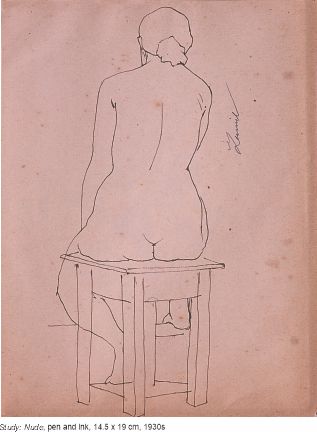
We are quick to turn our luminaries into icons, preferably bedecked with high-sounding sobriquets, and then pretend that we need do nothing more than go through certain adulatory rituals on their birth and death anniversaries. In the case of artists, writers and thinkers, such idolatry perniciously diverts our energies from the crucial labours of scholarship—dull, grey, meticulous, in Foucault’s famous formulation—and imaginative criticism. Thus any schoolchild in this country knows the name of Zainul Abedin and his bespoke honorific, Shilpacharya, ‘the Master Artist’, but even as we celebrate his 90th birthday we do not have a single full-length study devoted to his life and works. The volume on Abedin in the Shilpakala Academy’s ‘Art of Bangladesh’ series is an 80-page album of reproductions prefaced by an unexceptional essay and a 4-page chronology of his life. The most readable essay on Abedin that I have seen is still the Pakistani critic Jalal Uddin Ahmed’s brief introduction to the volume of reproductions of the artist’s early works brought out in 1958 by the Pakistan Government’s Directo-rate General of Films and Publications. The catalogue raisonne of the massive exhibition jointly organised by the Bengal Foundation, the National Museum and the Shilpakala Academy to mark Abedin’s 90th birthday has the virtue of pictorial comprehensiveness, since it contains reproductions, albeit tiny ones mostly, of all the works in the show; but the accompanying essay is off-puttingly clumsy in its original Bengali version.
Still, the exhibition itself is a landmark in our cultural life: for the first time it offers art lovers an opportunity to look at virtually all the works of the master preserved in public and private collections in this country—an impressive total of 574. One could make the caveat that a disproportionately large number of these are studies and sketches; had the show been properly curated a carefully chosen selection of these would have been on view. But I for one am glad to have the opportunity to see them all and to choose my own favourites among them. It’s heartening that every phase of Abedin’s artistic career is represented in the show.
The broad outlines of Abedin’s life—memorable though not very long—are well known. One can conveniently divide it into three phases: his childhood and adolescence, spent in the greater Mymensingh district; his Kolkata years, 1932-47; and the Post-Partition years, spent mainly in Dhaka. Born on 29 December 1914 in Kishoreganj, the son of a minor Police official, Abedin had a peripatetic childhood, spent in the various thanas where his father was posted. However, when a family home was built in Mymensingh town in 1926, his mother could live there permanently with her children, thus ensuring continuity in their schooling.
But Abedin’s mind wasn’t much on curricular matters. He spent as much time as he could sketching by the Brahmaputra river, and his favopurite haunt in town was the photographic studio of Premranjan Dasgupta, where artistically inclined youths gathered for ‘adda’; among them was Ashish Ghatak, brother of the film maker Ritwik Ghatak. Thus, even in his small mofussil town Abedin found a congenial milieu that provided him with encouragement. Abedin’s innate talent, nurtured through his own efforts, had developed considerably by this time. He won a prize in an art contest sponsored by the Bombay Chronicle, and (literally!) drew the admiring attention of his headmaster by submitting some sketches in lieu of exam answers. The headmaster urged Abedin’s parents to allow him to go to Kolkata to study in the art school there.

Abedin had a conspicuously successful student career in Kolkata. He topped the list in the art school’s admission test as well as in the final exam six years later. The practical instruction in the school was in a European academic style that Jalal Uddin Ahmed describes as semi-romantic. It involved much outdoor sketching, which Abedin relished, and favoured the picturesque, the typical and the exotic when it came to subject matter. Hence, among the early works on show, the splendid landscapes (his native Mymemsingh, Dumka in the Santal Parganas), the typical figures (caught in the act of reading or peeping or resting or carrying a pitcher or puffing on a hookah, or a mother with her child, to give some examples) and the mellow primitivism of his tableaus of Santal men and women. When, halfway through art school, Abedin had to choose a field of specialization he rejected the Principal’s suggestion that he take up ‘Indian Art’ (i.e. Oriental Art) and opted for Fine Art or Painting. Syed Manzoorul Islam in his entry on Abedin in the ‘Banglapedia’ rightly draws attention to a watershed in the painter’s career when ‘dissatisfaction with the Orientalist style that seemed to him heavily mannered and static, and the limitations of (the) European academic style led him towards realism.’ (One should point out that by Orientalist is meant the style of the Bengal School, which derived from Abanindranath Tagore.) The finest expression of Abedin’s realism—indeed, of his individual talent—is in his drawings and sketches. The significance of this in the cultural context of Bengal, and South Asia as a whole, will become obvious if we take note of the ‘metaphysics’ of drawing as John Berger outlines it in his Selected Essays and Articles: The Look of Things (Penguin, 1972): ‘A drawing is an autobiographical record of one’s discovery of an event—seen, remembered or imagined. A “finished” work is an attempt to construct an event in itself. It is significant in this respect that only when the artist gained a relatively high standard of individual “autobiographical” freedom, did drawings, as we now understand them, begin to exist. In a hieratic, anonymous tradition they are unnecessary.’ (Italics mine) We should remember however that Berger is ‘talking about working drawings’ and not ‘linear designs, illustrations, caricatures, certain portraits or graphic works which may be “finished” productions in their own right.’ The literary-minded among us will find an analogy between drawings and what D.H. Lawrence has dubbed ‘the poetry of the present’ in his essay on Whitman in Studies in Classic American Literature. Both are spontaneous responses to life, registering every quiver of the poet’s/artist’s sensibility as something striking impinges on it.

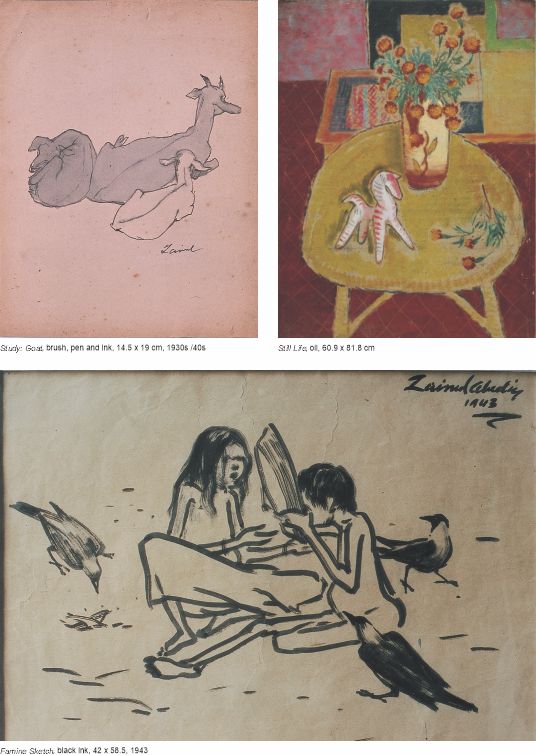
The most moving and artistically powerful spontaneous response of Abedin’s sensibility was of course to the horrors of the Bengal Famine of 1943. Precipitated by callous and short-sighted wartime controls on the rice trade, the famine affected the poorest sections of the rural population. Thousands of starving men, women and children trekked to Kolkata in the hope of finding succour, and lay dying on the streets. Zainul revealed himself as a powerful, socially committed artist in a series of brush-and-ink drawings on cheap wrapping paper, which was all he could afford in those stringent war years. The background is filled in minimally or not at all, so the wretched figures of the famine victims draw the viewer’s undivided attention. The lines are swift, gestural, the figures not simply realistic but expressionistically distorted, so that what strikes us is not pathos but horror. To look for adequate analogies for their psychological impact one has to turn to the works of someone like Goya.
Disturbingly, the famine sketches possess a trans-historical dimension that ought to be highlighted. We come across those haunting figures even now, on our city streets, at our country markets. They may not be famine victims—mercifully—but a lifetime of malnourishment has reduced them to the same skeletal decrepitude. The famine sketches thus continue to fulfil an essential function of art—to scourge our social conscience. The famine drawings made Zainul famous throughout the subcontinent and brought him to the attention of foreign art connoisseurs. In Kolkata they brought him into close contact with Communist intellectuals and writers; they were in fact first shown at an exhibition on the famine organised by the Communist Party and reproduced in the Party’s newspaper. At another show sponsored by the Anti-Fascist Writers’ and Artists’ Association, some of these drawings were the chief attraction. Twelve of the drawings were reproduced in Darkening Days of Bengal by Ila Sen, which was suppressed by the colonial administration.

Very different from the revolutionary humanist internationalism of the Communists was the sectarian politics that eventually split the subcontinent. This, too, had its cultural aspect, especially for the Muslim minority, which was trying to affirm a separate identity. In 1946, following the vicious communal riots, an exhibition of Muslim artists was held at the Islamia College (now the Maulana Abul Kalam Azad College), with Abedin as the central figure.
After Partition, Zainul and his recently wedded wife moved to Dhaka. Over the next thirty years, till his death of lung cancer in 1976, he played a dual role, as his country’s leading artist and as a visionary teacher and builder of institutions. He was the moving spirit behind the Dhaka Government Institute of Arts (later the Government College of Arts and Crafts, and currently the Institute of Fine Arts under Dhaka University), which was set up in the teeth of opposition from religious bigots, and the Museum of Folk Arts in Sonargaon. Interest in folk art led him to advocate a ‘Bengali modernism’, fusing modern art and our folk tradition.


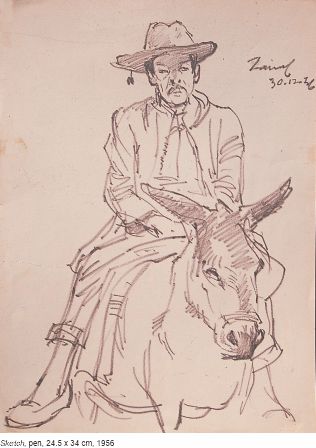
There were other activities (a stint with the central government in Karachi and another at Peshawer University), as well as foreign trips and sojourns. He studied at the Slade in London and exhibited there and in other European cities, drawing appreciative attention; visited various countries, e.g. Mexico, Japan, the Soviet Union and Palestine, and was busy with his sketchbook wherever he went. Some of the results, fine portraits and sketched landscapes and scenes, are in the show. The Bangladesh movement once again brought out the socially and politically committed artist in Abedin. He publicly renounced the civic honour bestowed on him by the Pakistan government, led protest marches, and celebrated the freedom fighters in his art.

Efforts have been made to divide Abedin’s artistic career into phases on the basis of style, by Jalal Uddin Ahmed for instance. I am not sure if this is a wholly fruitful exercise. It is perhaps better to identify certain trends in Abedin’s art, and indicate when each was dominant. The defining moment for Abedin, as I have indicated, was his rejection of the European academic style on the one hand, and the eclectic Oriental style of the Bengal School on the other, and his commitment to realism. A revisionary moment came with his espousal of a ‘Bengali modernist’ fusion incorporating our folk tradition. This may be interpreted as an attempted reconciliation with the Bengal School. Abedin himself, however, did not produce anything superlatively impressive in this mode; it was his younger contemporary, Quamrul Hasan, who excelled in it. Throughout his career Abedin kept working in the realistic manner, which in his most powerful works is charged with expressionist brio. Besides the famine sketches I would mention the rebellious cow of which he made several versions. (The smaller ones, I think, are more satisfying, for their lines have more zip.) This recalcitrant creature is as distinctive to us as the bison on the cave wall at Altamira.
Abedin’s realism is at its most moving when it is personal expression, which, it’s worth pointing out, can go hand in hand with social commitment. His attempts at a public art in this mode, as in the large scroll paintings of the cyclone devastation at Manpura or ‘Nabanna’ (‘Harvest Festival’) are monumental achievements, but lack the intensity of his finest works notably famine sketches.
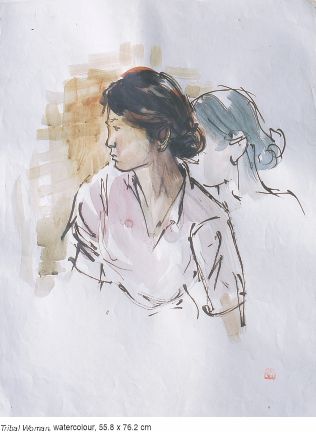
The paintings in oil, too, are by and large less satisfying. They tend to idealize the human figure, whether in the realistic mode as in ‘Struggle’, in a romanticised mode as in ‘Bathing’, or a Folk-inspired mode as in ‘Beauty Regime.’ In Abedin’s oil paintings one also misses the build-up of pigment, which produces the medium’s distinctive impression of solidity. Since spontaneity is the hallmark of Abedin at his best, it is not surprising that the watercolours leave a happier effect. All in all, however, the great lesson Abedin has to teach the present generation is the importance of draughtsmanship; sadly, it’s a lesson not many will take to heart in this age of installations and conceptual art.
The exhibition has a lesson for the art critic as well. It brings home the importance of highlighting what is distinctive and of continuing relevance in the master’s work. This critical activity needs to be contextualised through research into the life and times of the artist, a task that should be begun at once—before those who knew him intimately are all gone. This is the least we can do to preserve the memory of someone we have named the Shilpacharya.
Kaiser Haq is a member of the Jamini editorial board
A Saga of Man and Nature: The Art of Zainul Abedin, 12 December-January 7 at Bengal Gallery, the National Museum, and Shilpakala Academy, Dhaka, Bangladesh We are quick to turn our luminaries into icons, preferably bedecked with high-sounding sobriquets, and then pretend that we need do nothing more than go through certain adulatory rituals on…