

an overview modern nepali art
The Nepali painter Chandra Man Maskey was admitted to the Calcutta Government School of Art in 1918. With him the concept of art in Nepal started changing. He brought in western techniques of painting to Nepal more comprehensively than the artists who had got a chance to visit Europe in the second half of the 19th century. But he also worked with the indigenous Newar artists of Kathmandu whose family name is Chitrakar or painter, and whose art shows the influence of earlier painting traditions of the subcontinent—from pre-Mughal art to the religious and court paintings of later times
The westernization of Nepali art does not mean the loss or complete rejection of tradition; but it certainly made for a departure. Modern Nepali artists created their own milieu. Their ‘modern’ is basically a western concept; but they exploited western education only to broaden the range of their skills in painting. So, their identity as artists should be sought within their own cultural and folk environments.
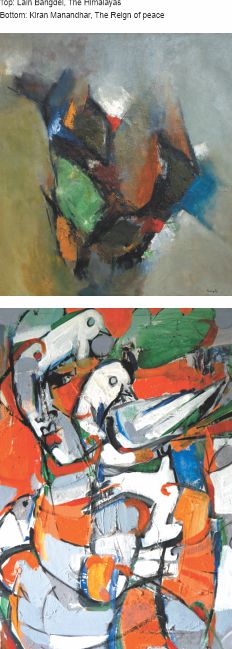
The exhibition of the paintings of Lain Bangdel (1912-2002) in the oldest college gallery in Kathmandu in 1962 marked a turning point in the history of Nepali art. It is perhaps the beginning of the contemporary or modern period in Nepali painting.
Bangdel’s initial training was in the Calcutta Art School. Later, he got exposure to western schools during study visits to Spain. His exposure to western art and experience of western galleries, schools and exhibitions and other activities was a very significant event for Nepali art.
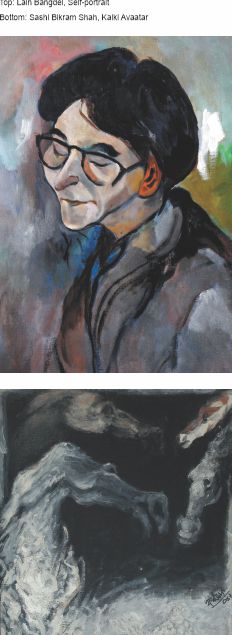
Bangdel’s paintings were Western in their orientation. The paintings of the ‘blue period’ of Picasso’s influenced his early works. The cultural basis of subcontinental and Nepali art saw a new configuration in his work, which was alien, complex and challenging. But in his abstract canvases viewers saw new possibilities, and hope for freedom and expression, since for the first time in painting Nepali viewers encountered vivid presentations of human drama.
In the paintings displayed at the exhibition in 1962 an unusual twilight of consciousness was created by the artists. The colour schemes and brush strokes gave the paintings a new pattern. Colours, not images, sprang to the eyes of the viewers and influenced the mind through their emotional appeal. Abstraction in terms of the use of colours and patterns left a lingering impression in the minds of Nepalese viewers for a long time.
Since the sixties Nepali paintings have developed in varied ways. The traditional forms of art, portrait making, narrative and spiritual paintings represented a different world altogether. A new generation of painters, most of them trained in Indian and Bangladeshi art colleges, used the techniques and media now universally recognized as occidental.
Modern Nepali artists have experimented with all levels of presentation—themes, media, treatment of the subject. Though most of them follow the well-defined paths, mostly rigid in the classical modernist sense, some deliberately disrupt it. They do not violate the concept of balance in art, but there appears to be a violation of the balanced placing of images and colour bands and mass.
In traditional Nepali art lines were very important because they were set in a defined system. But in modern Nepali paintings artists use lines expressively. Visible lines are charged with the artist’s passion. The invisible lines represent an entirely new phenomenon. Bands of colour and the modality of form make up invisible lines. As a result, modern paintings have become the vehicles of the artists’ feelings, their problems, frustrations and hopes in the changing context of the country and culture.
Colours are used expressionistically. The modern Nepali artist’s palette has greater variety than that used in Eastern Indian Monastic paintings of the earlier periods. But in recent times Nepali artists do not seem to preserve the uniqueness of their tradition in terms of the use and combination of colour. In delineating cultural motifs using traditional forms and colours, the main thrust of any combination arrived at by artists is expressionistic and not rigid and defined.
The symbolism in modern Nepali paintings is unique. Universalism in the choice of motifs plays an important role, but the most important feature is that the artist is divided between rejection and acceptance of tradition—its values and techniques. In some very well-known paintings, the tension itself is the subject matter.
Modern paintings create motion not necessarily by referring or responding to the outer events affecting the life of the artist, but by creating an internal, psychological reality. Therefore, modern Nepali paintings do not necessarily depict the events and times of a transitional Nepali society. But they are certainly expressions of the modern Nepali artists’ response to changing times, values and norms.
A total of 250 paintings showing 50 years of the late Lain Bangdel’s works were exhibited at the Arts Council, Kathmandu in April 1991. This exhibition was organised at a time when many modern Nepali artists had already assimilated the influence of western art. But these paintings very significantly spanned a creative period of half a century since Bangdel’s work is very important in understanding the modes of Nepali modernism in art and its commonalities with modern movements in Nepali literature.
The Nepali artist’s perception of modernity is evident in Bangdel’s paintings. His ‘blue’ paintings show the influence of western art on his work 50 years ago. Picasso’s paintings done during the period between 1899 and 1904 had a direct influence on young Bangdel’s works. But I do not consider Bangdel’s early works only as emulation of Picasso’s works. They very interestingly show the euphoria of a young Nepali artist at his first exposure to these works in Paris. Bangdel exhibited all his works making it possible for viewers not only to see the evolution of his art but the extent of the western influence on him.
Bangdel was the first Nepali artist to get full exposure to western schools of art. His training in Paris and London in the fifties and his assimilation of the western forms and styles became manifest in his works. His works today are as modern as they were forty years ago when he held his first exhibition in 1962. An interesting feature of modernism in Nepali art since Bangdel’s 1962 exhibition is that Nepali motifs speak in them through the artist’s treatment of the mediums and modes.
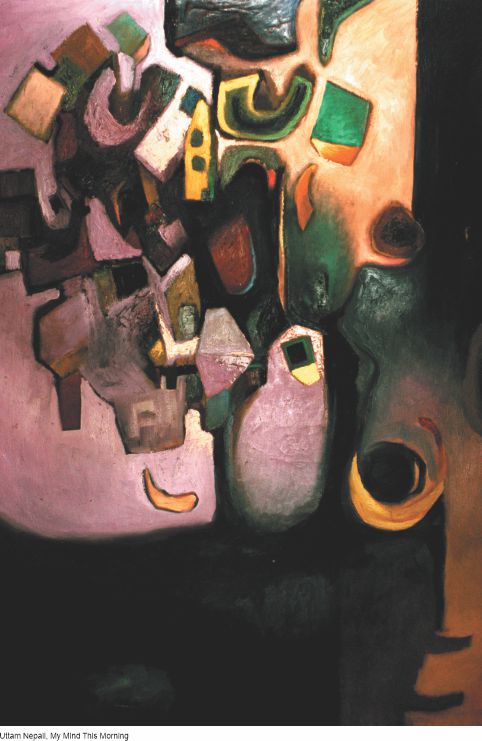
Uttam Nepali is another artist who changed his style from 1960 and became an abstract painter. However, in his abstract paintings he combines the techniques of the oriental tradition of art that he learned in Lucknow, India, as well as the modernist forms that had appeared quite recently in India.
Nepali’s exhibition of paintings under the somewhat descriptive title ‘Poet, Poetry and Paintings’ at the Fine Arts gallery in 1975 presented his desire for the assimilation of not only oriental and modernist forms but also paintings and poetry. He used contemporary modernist poets’ lines on his paintings and centred a canvas on the sense conveyed by a poem or created an interpretation of the tension between language and painting.
His paintings, predominantly executed in acrylic and oil, present consummately the theme of what he preferred to call human mind and portraiture. A retrospective exhibition of his entire output was held in April 2004 at Sangita Thapa’s gallery, where Bangdel had his show 13 years earlier in April 1991. The exhibition presented interestingly a rainbow of the changing styles of modern Nepali paintings.
SKIB, the acronym of Shashi, Krishna, Indra and Batsa represents a very significant phase in Modern Nepali art. These four artists launched a movement in paintings in 1971 with a view to inspiring young artists and opening a new channel of communication with artists using other media and methods. Their personal involvement in art activities coupled with their experimentation created a unique atmosphere in Nepali paintings characterised by such features as the gatherings of artists, interactions, exhibitions and, above all the pedagogy of art.
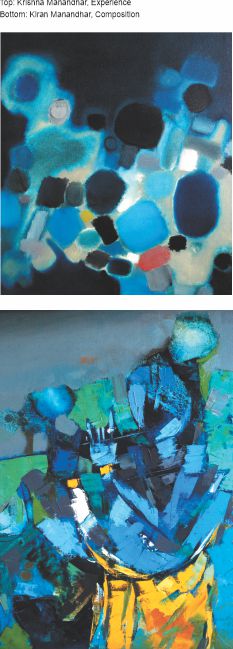
Shashi Shah studies the unique dramatic modes of culture in a somewhat surrealistic style. There is a vision of the apocalypse in his paintings; Krishna Manandhar has created a changing pattern of experiences in different modes of experimentation over the decades; the late Indra Pradhan’s paintings combine charm with the fragmentation of experience and the disintegration of values with the creation of new hopes in pleasant combinations of forms and media; Batsa Gopal Vaidya views the occult and sacramental subjects with a modern artist’s openness and readiness to experiment. In short, SKIB created a major impact on modern Nepali art. All four artists are prolific and receptive to new ideas and concepts.
Manuj Babu Mishra is an artist of the modern generation whose subject is invariably the apocalypse linked to overtly topical subjects. His style is unique and he works as a recluse in his studio in Baudha.
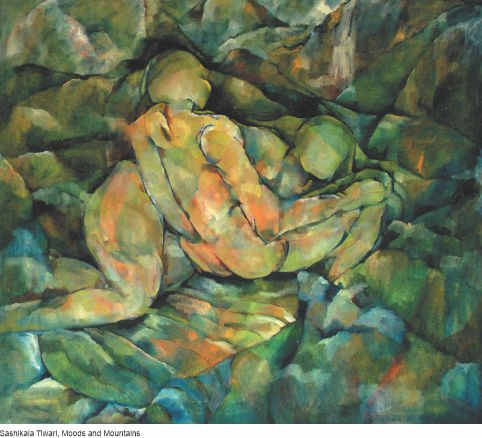
Shashikala Tiwari is the first modern woman artist of Nepal. The predominance of blue and green in her paintings is an important feature of her style. In most of her well-known canvases blue is used to mark a positive experience. Negative concepts associated with blue such as the blue mood, the dejected mind, and the world of misery, however, sometimes stand at odds with her use of colour. She, nevertheless, manages to use blue as an effective symbol of nature and even of optimistic moods.
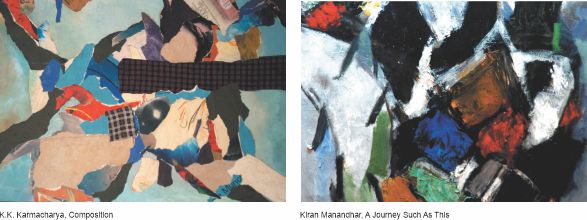
Kiran Manandhar belongs to a younger group of Modern Nepali artists which has been active since the early seventies. Though he made his mark much later, he has already staged over a hundred exhibitions both at home and abroad. Manandhar has been departing from the styles of his predecessors and contemporary senior modern artists in a very significant way. He does not, however, ignore the effectiveness of Nepali modernist painting. But as in postmodernist literature and art where there is a tendency to create pluralistic styles, tones and an admixture of various levels in the works involving various genre-specific forms, we notice in his paintings a movement designed towards making multiple openings in the choice of motifs and mediums, even though the zest for merging levels is kept in check. He still remains modernistic in outlook.
The most obvious example of this tendency is Kiran’s desire to project a multiplicity of perspectives, and his use of rejected but diverse materials. Unlike his immediate predecessors and senior contemporaries, his projection of shifting moods rather than a focus only on estrangement and alienation, proves that Kiran is pioneering postmodernism in Nepali art.
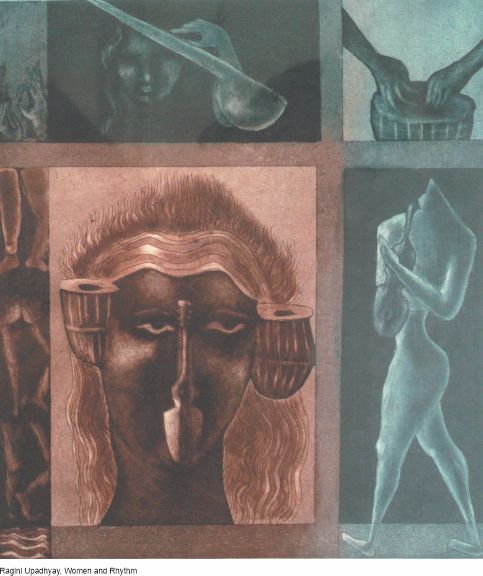
Ragini Upadhyay dramatises the myth of politics in her paintings in an important manner. In an exhibition organised at NAFA in February 1995 she projected a new style that emphasises that politics is a myth as well as a reality. It is a very ancient game, but also a living reality that affects not only the life of individuals but also life on this planet. In her paintings Ragini has captured the archetypal pattern of the political game by combining the ancient with the modern, and perpetual impulses with the local and temporal. She has also combined literature with art, especially by using children’s literature to dramatise comic yet sinister aspects of politics and politicians. She is a very prolific artist who has made many experiments with her intaglio works. Her major theme continues to be women.
The Australia-trained Ashmina Ranjit’s experiments in her works bring her style closer to postmodernist forms. She is very well-known for her installation works. She depicts the raw pain, violence and bloodshed in the land. The ephemeral works of this talented artist has had the effect of a theatrical performance without a reusable text.
Sharad Ranjit is well-known for his landscapes and realistic portraits of characters. His love for transparency, his charming and articulate use of colour, balance and space, especially in his Himalayan landscapes, have resulted in striking abstract illusions.
Ramesh Khanal’s paintings are experimental, especially in the use of colours. Madan Chitrakar’s paintings combine graphic forms and expressive use of colours and lines. Shankarraj Suwal, Shyam Chitrakar, Gopal Kalapremi of Biratnagar, Karna Maskey of Dharan and other artists of this generation not mentioned here for reasons of space all use controlled methods of paintings with rich palettes of colours. Ratan Rai’s graphic style and drawings have received a highly appreciative response from viewers. Buddhi Thapa’s paintings deal with the theme of mandala and ecology.
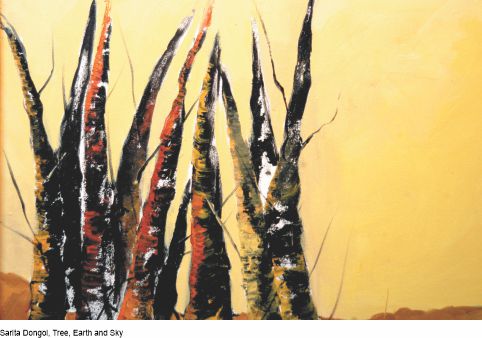
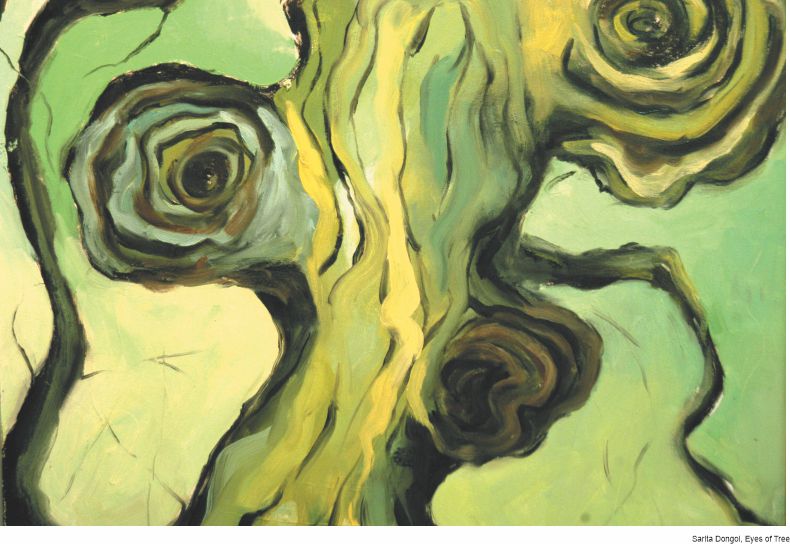
Women artists of the younger generation have been showing greater maturity with each passing day. Shova Wagle treats her paintings with great care and love. Sarita Dongol executes eco-paintings. In her paintings there is a dominance of blue, and criss-crossing lines are used to create an expressive rebellion against the depletion of forests which is synonymous with the exploitation of woman; Sunila Bajracharya creates woman’s expressive sombre image by making dark bands, with a woman’s locks as the central focus, thus making the brownish canvas remarkably expressive; Pramila Bajracharya creates textured canvases in varied styles.
This is a short survey of Nepali art. In this country where there is a long tradition of art, it is but natural for us to see paintings as the strongest genre in the realm of art. But the Nepali artists’ ambivalent approach towards the modernist forms could be both a strength and unnecessarily problematic. The modern painters of the younger generation appear to meet this challenge by combining tradition with modernity and thematic obtrusiveness with stylistic experiments.
Abhi Subedi is a poet-playwright and professor of English at Tribhuban University, Kathmandu.
The Nepali painter Chandra Man Maskey was admitted to the Calcutta Government School of Art in 1918. With him the concept of art in Nepal started changing. He brought in western techniques of painting to Nepal more comprehensively than the artists who had got a chance to visit Europe in the second half of the…