

within and outside ethnicity
A new generation of British artists of Indian origin are renegotiating their relationship with their twin heritage. Particularly interesting for their distinctive representations of India are the Singh twins and Chila Kumari Burman
One of the main characteristics of the visual arts of the Diaspora is its heterogeneity. Hence, to address it and subject it to analysis would require a degree of familiarity with each individual situation or else one could end up making generalized statements that fail to account for the sheer diversity of artistic approaches resulting from differing social, economic and cultural transnational connections. My essay therefore will examine one particular aspect of representation of the Diaspora art. I propose to investigate the recent explosion of visibility and access accorded to the art of British-Indian artists in their country of origin.
Often made visible through the official channels of embassy-sponsored exhibitions or supported by national institutions in India, the exhibitions serve the purpose of familiarizing an Indian audience with art practices clearly classifiable as of ‘diasporic’ origin, on account of their subject matter and manner of execution. If at one point, works of artists like Henry Moore, Gillian Ayers, Howard Hodgkin and Stephen Cox were offered to the Indian viewers through the channels authorized to make British Art visible, of late the emphasis has been on showcasing the works of British-Indian artists through such channels. Recent expositions have presented such artists Amrit and Rabindra Singh as the ‘Singh Twins’ who studied Contemporary Western Art at Liverpool University College of Chester; Desmond Peter Lazaro, a British artist of Indian/ Burmese descent who trained with a traditional Pichhvai painter of Rajasthan for eleven years, and Anish Kapoor the internationally renowned sculptor. In fact the twins were accorded an unprecedented two person show at the National Gallery of Modern Art, New Delhi in 2002. Anish Kapoor is also scheduled to have a large scale exhibition at the same venue. This, incredibly, is an honour that has never been accorded to Indian artists of the same generation. While pondering over this recent prominence given to artists of the Indian Diaspora, one cannot help but recall that the last British artist to be accorded a large show at NGMA was the venerable Henry Moore. Can one then conclude that perhaps this change in direction reflects an attitudinal shift within the establishment ? If so, what could be the reasons for this shift?
Quite clearly there seem to be two discernable phases related to the representation of British Art in India. While artists like Henry Moore made works that were detached from the realm of the social and were sealed off from any specific context, the current selection includes artists who have sought to seek their ‘roots’ by temporarily retracing the journey made by their ancestors. A utopian project, a common response of many artists of the Diaspora, this notion of return is often rendered through a visual language that adheres to received notions of ‘Indian tradition’. This invocation of tradition is quite often defined in terms of a geopolitical boundary whereby every other space becomes a space of passage and transition until a space that purports to replicate elements of the original homeland is achieved through a reconstruction elsewhere.
Of course one is encouraged to an extent by this recent development, for the art of the Diaspora has largely been ignored by mainstream western art institutions. But its current visibility seems to coincide rather too tidily with the multicultural agenda of their adopted country. Focusing on the ‘otherness’ of the artist within the mainstream British Art, these manifestations tend to highlight the ethnicity of the artist and their work, perpetuating the idea that their practice is somehow located within an alternative stream. Much has been written about the phenomenon of multiculturalism, and as the debates pertaining to the politics of multicultural representation have unfolded over the last decade, particularly through the pages of journals such as Third Text 1(Third Text Critical Perspectives on Contemporary Art & Culture, Routledge. ed Rasheed Araeen and Ziauddin Sardar) one has become rather weary of art practices that adhere to the prescribed rules of multiculturalism where artists often collude with cultural authorities in upholding their stereotyping agenda.
In the wake of partition and soon after India became an independent nation several artists from the subcontinent migrated to Europe in a bid to make a place for themselves within the mainstream of international modernism. By choosing to address an audience comprising members of the former colonizing power in a language comprehensible to them, artists like FN Souza, SH Raza, Ram Kumar and Avinash Chandra embraced the universalizing notions of modernism. Fundamentally committed to the expressive potential of painting, they sought to break free from tradition. Hence in the early works of these artists, one rarely sees a cultural dependency on any ‘indigenous’ source even though this first generation of migrant artists often dealt with the experience of uprooting and displacement. As immigrants and travellers who had acquired their visual language by training in colonial art academies in India but had forged their bonds with fellow artists in the margins of the institutes, the act of painting was resolutely embedded in notions of artistic selfhood. The self as a unique and unitary entity was firmly entrenched in the concept of ‘originality’.
Most of these artists arrived in Europe hoping to put behind them the collective trauma of partition. While some of them stayed on, many departed soon thereafter to return to their homeland. The puzzling question as to why they chose to return has bothered many an Indian critic. As their initial departure was a voluntary one, rather than a forced exile, one cannot help but think that perhaps the aspirations of these migrant artists came into direct clash with the aspirations of the ‘insiders’ who were products of the dominant culture. The two options left open to artists of the Diaspora as a survival tactic were either to assert their ethnic identity by engaging with ‘tradition’ or else radically overturn the expected norm and place before viewers a counterargument to challenge the expected stereotypes. While many of these issues have already been dealt with in the writings of Rashid Araeen, his arguments at times appear to be rather reductive. Rather than recognizing that meanings can be mobile, depending on contingencies, the terms of the debates set up by him have at times been far too essentialist and antagonistic. Resting on the modernist principle of ‘significant’ artists marked by individual brilliance, Rashid’s strategy has been to demand their inclusion in the mainstream narrative of art history instead of negotiating and asserting their difference—as opposed to stereotyping and homogenization—as a viable strategy for self-definition.
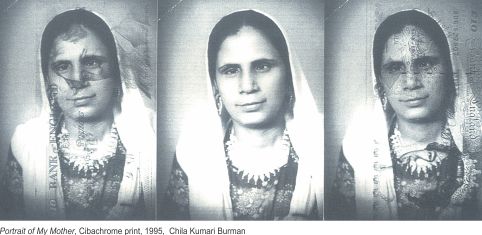
It would therefore be interesting to look at the works of artists who belong to the second generation of the Diaspora and who had no say in their relocation to a different land—artists who have strategically used their ‘difference’ to comment on their lives as members of a minority community. It would help us to establish how simultaneous cultural formations can also be conceptually at odds with each other, a product of community as well as personal politics. As examples I have used the works of the Singh Twins and Chila Kumari Burman to illustrate my analysis. While the Singh Twins have been showing their work fairly regularly in India, Chila Kumari Burman has exhibited hers only during the Khoj International Artists Association’s residency programme in 1998. Chila as well as the twins were born in England and therefore their social space is one that is inherited at birth unlike the migrant artists of the 1950s. Like the Singh twins, Chila too is from Liverpool and comes from a Punjabi working class background. Whilst the twins were educated in Liverpool, Chila trained at Leeds and the Slade School of Fine Art in London. Despite the similarity of their background, their works reveal radically different viewpoints. Even though Chila has received far greater critical acclaim than the twins, it is the work of the twins that has found favour within the establishment and has with equal ease made an entry into the commercial circuit of galleries in India. Till she was invited to the Khoj residency, Chila had never encountered contemporary Indian art even though she had made several journeys over the years to her ancestral home in Punjab, while the twins’ encounters with their contemporaries in India have been fairly prolonged. Their obvious disapproval of contemporary art practice in India, expressed in many an interview, stems from their view of contemporary Indian art as being a ‘clone of what the West had to offer’. Their own style, derived from the miniature technique that was their ‘natural inheritance’ has, over the years, become a curious manner of staging a resistance to ‘corrupting’ western influences. On the other hand, with her training in martial arts, Chila revels in breaking stereotypes of Asian women as passive, sanctimonious, and repositories of traditional values through her eye-popping photographs and installations influenced by popular culture.
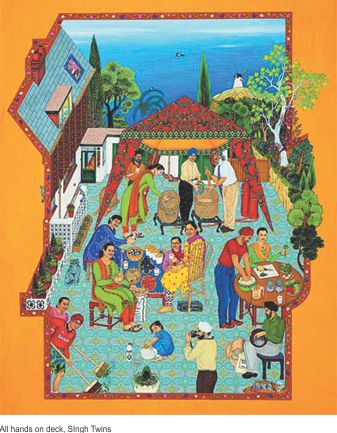
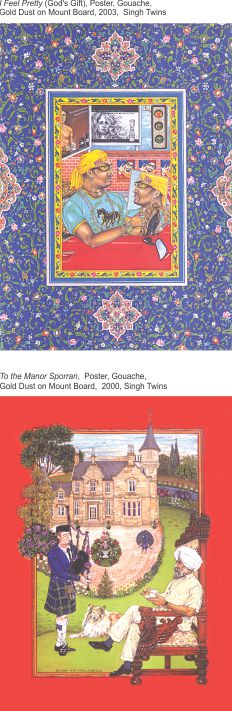
The Singh Twins, reflacting the current face of multicultural Britain, have had a fair degree of success in the United Kingdom. Their work is essentially a humorous take on life in Britain as members of a minority community. With its gentle criticism of the host country’s ethos, the work has acted as a pressure valve to let out the ire stemming from a minority community’s sense of being marginalized. Its endorsement by the British establishment then does not come as a surprise. Often used as a tool for self-flagellation by the British, it allows a public viewpoint to develop, whereby the social structure in Britain is seen as a tolerant and benevolent one that ‘allows’ criticism and alternative viewpoints to develop. By easing the passage of such work into the museum and gallery spaces in India it creates a perception of the former colonizing power as a broadminded and self-critical society ‘willing’ to recognize its own flaws. All Hands On Deck a painting composed in 1997 by Rabindra Kaur, is one such work. It stands out as a work extolling ‘Asian values’. The painting, done in a quasi-miniature style, depicts the artist’s family in a domestic setting, preparing for a marriage feast in their backyard. Quite obviously alluding to the compositional structure of a Persian miniature, the work’s depiction of the collective activity of cooking is loaded with details giving it a lexical character. The alimentary preferences of a community, its method of cooking, and the social hierarchy within the family are all made visible for the viewer. Working firmly under patriarchal control (the father is seen stirring the cooking pot), the family enacts a scene of work and the reward of prosperity, peace and happiness that goes with it. The moral ambivalences of the family’s new home, symbolized by a cardboard box which has a Union Jack painted on it, are flung aside into a heap of garbage, denoting the strength of a ‘model minority’s’ capacity to withstand the pressures of external ‘corrupting influences’ by bonding together. In the words of the artist ‘the work emphasizes the importance of family as a training ground for learning the mutual responsibilities and duties that form the basis of a stable society’.
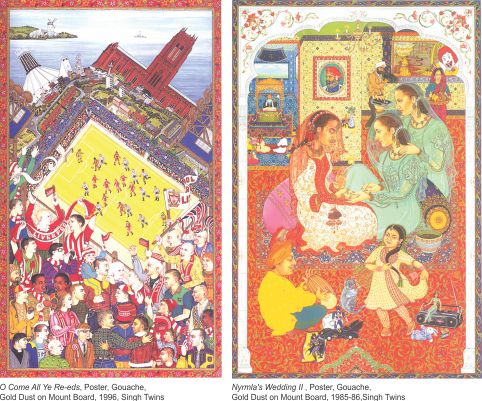
Family values, responsible behavior and hard work in the face of discrimination and socially induced racial segregation then become the measure of a minority community’s adaptability in a multicultural society. Another painting O Come All Ye Re-eds painted in 2002 by Rabindra Kaur shows the fruits of this capacity to adapt. Portraying fans of the Liverpool football club watching a game at Anfield, the painting presents a buoyant image of a racially integrated society brought together through the ‘new religion of football’. Team sport and all its attendant symbolism of coordinated work and set functions within a hierarchy to achieve a goal, becomes a perfect symbol for the enactment of a metaphorical representation of social harmony.
It is hardly surprising therefore that the paintings of the twins have found a great deal of support within the institutional frame. In sum, it seems that the cultural environment these paintings evoke feed rather well into the social and political targets of a multicultural policy of creating a brown petit bourgeoisie society.
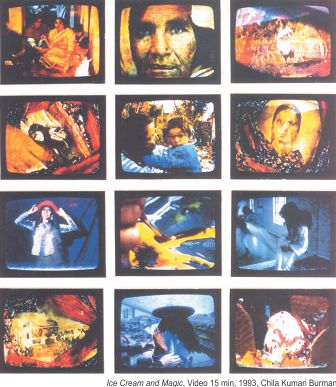
The sheer audacity and sauciness of the works of the critically acclaimed artist Chila Kumari Burman on the other hand present an entirely different view of multicultural Britain. Through her work Chila challenges the stereotype of the chaste, demure Asian woman confined to the domestic sphere by the limits imposed on her by a patriarchal community. Chila’s name itself invokes a moment of diasporic transformation. Originally a Singh, her father changed the family name to Burman to avoid stereotyping and Sheela became Chila in an act of misspelling on an official form. This act of renaming, of changing identities has inadvertently informed Chila’s work since the 1980s when she became an activist of the Black Artists’ Movement. Constantly transforming herself to take on different guises where one identity does not necessarily invalidate the other, Chila’s works plunge the viewer into an unmappable journey of shifting stances.
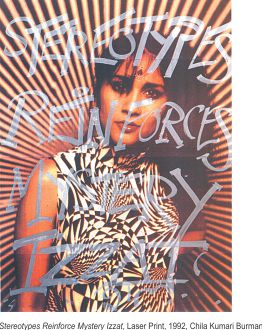
Executing her work using cheap, inexpensive reproduction technology like photocopiers and laser printing and discarding the evidentiary function of photography, she collages and crops and paints over and decorates her images to give them the ‘in your face’ presence of advertising imagery. Unlike the labour-intensive technique of miniature painting where value is placed on labour itself, the quick fix methods employed by Chila give the works a sense of immediacy and spontaneity. During the Khoj workshop in 1998, for example, Chila produced a series of body prints by smearing her body with vermilion paint and imprinting it on paper which she later decorated with bindis and other cosmetic aids. In her early work the bindi as a mark of her ‘Indianness’ is often combined with stances taken from the Japanese martial arts of Shotokan that she avidly practices. These photographic images of Chila, clad in a sari, striking an aggressive pose with her body honed to physical perfection are an early example of a purposefully wrought transnational image of womanhood unfettered by its ‘reproductive role’. Another work, an installation by Chila at Andrew Mummery Gallery titled ‘Hello Girls’ parodies the Wonderbra billboard advertisement ‘Hello Boys!’ that apparently caused several road accidents in England. With the slogan emblazoned across an image of a scantily clad model wearing a Wonderbra, the advertisement is an explicit invitation for the male gaze to take in a product meant for the physical comfort of women. Chila turns this billboard campaign around with a brazen display of undergarments made up of fabrics and photographs where the cupped shapes of the garment, emptied of their human presence serve the more formalistic role of being reduced to mere shapes.
The qualitative difference between the works of the Singh twins and Chila Kumari Burman suggests that varied intellectual, political, gendered and social inheritances play an important role in defining the diverse art practices of the Diaspora community. It would therefore be difficult to conceptually conflate these varied and multiple forms of expression into a single generic category. While one kind of expression may find it easier to attain institutional support, the more exciting, edgy practice too finds a way to filter into public consciousness through support groups and self-initiated activist platforms.
Shukla Sawant is currently an Associate Professor of Visual Art at the School of Arts and Aesthetics, Jawaharlal Nehru University. Trained as an artist in India, Paris and London, she has exhibited widely at home and abroad. Her research interests focus on south and southeast Asia.
A new generation of British artists of Indian origin are renegotiating their relationship with their twin heritage. Particularly interesting for their distinctive representations of India are the Singh twins and Chila Kumari Burman One of the main characteristics of the visual arts of the Diaspora is its heterogeneity. Hence, to address it and subject it…