
take six
At the Venice Biennale this year, the curators had made a deliberate choice– to stay clear of the love affair with technology.They chose instead to invite visitors ‘to accomplish a journey from the belief that art still holds a promise of transformation’. Rosa Martinez, curator for ‘Always a Little Further’ at the Arsenale site of the Biennale hoped that the works would connect romanticism and the enlightenment. She also referred to Proust’s motto, ‘ The real dreamers are the ones who go out to try to verify something’
In this context, the work of Pakistani artist Shahzia Sikander, now living in New York stood out for its capacity to alter space, to dream and to encourage reverie.
Trained as a traditional miniature painter at the National College of Arts in Lahore, Sikander has established herself as one of the finest young painters in the international art world today. The Museum of Modern Art is currently exhibiting her work in their ‘New Acquisitions’ section. Over the past five years her work has been exhibited at the ‘Musee des’Arte Moderne’ in Paris, in the ‘Biennale de Sevilla’, at the Brisbane Triennale, and at the Whitney Museum of Contemporary Art in New York. She is the youngest living Asian artist to have been honored with a solo exhibition at the Hirshorn Museum in Washington DC and was featured in the ‘ Drawing Now ‘ Exhibition at MOMA two years ago. The Aldrich Museum Connecticut held an exhibition titled ‘Nemesis’ which included a suite of her drawings titled ’51 ways of looking’ in 2004. The drawings demonstrated clearly the formal accomplishments of the artist and her formidable intellectual depth. Transitions of many kinds mark Sikander’s meteoric career. From painter of meticulously crafted miniatures she has moved to mixed media wall mounted installations to video works which employ drawings and paintings through digitally achieved images.
A phenomenally energetic artist, Sikander constantly reinvents herself. Hammad Nasar states that we need to ‘recognize that miniature is culturally specific shorthand for a sensitivity – an attitude over and above the skill and content that the genre is associated with’.( Nasar, Hammad – ‘Congested Legacy, Congested Future’ Beyond Borders Catalogue National Gallery of Modern Art, Mumbai, 2005) Certainly Shazia Sikander’s work can no longer be labeled miniature painting. The demanding regimen of her early training at NCA may have provided the rigor she was primed for, and laid out certain parameters for her to explore, but it was the ‘sensibility’ that Nasar refers to which blossomed and which subsequently defined ‘difference’. New territories of meaning unfold as Sikander turns her eye and mind to towards investigating formal components in the traditional miniature through technological means.
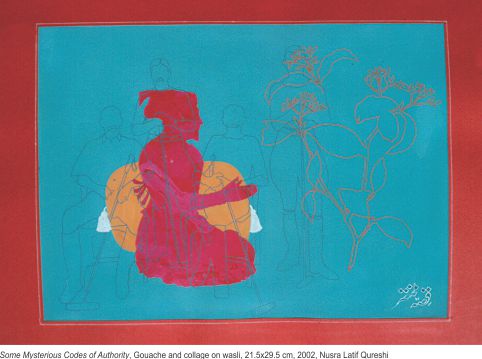
Nusra Latif Qureshi, now a resident at Melbourne, Australia, studied at the NCA in the same department as Shahzia Sikander. As a student Qureshi has looked at the history of images and the imperatives which condition our responses to the them. With great care she studied the structures and iconography of the mughal and post-mughal eras. Her thesis project was a series of works on Pakistan’s contemporary political history rendered in the iconographic language of the Mughal Darbar. She has continued to pull miniature painting icons out of their original contexts and has given them new roles. As Anna Sloar puts it ‘Qureshi redirects the elements of traditional miniature painting to explore the roles that images play in the overlapping and competing claims to the past that constitute historical memory”. ( Sloan, Anna – ‘The Way I Remember Them’ Paintings by Nusra Latif Qureshi, Smith College Museum of Art Catalogue, North Hampton, MA, 2004)
It is not only the Moghul sagas that engage Qureshi, she also depicts, the British empire, although hit is a shadowy presence, and challenges the interpretations of ‘our’ histories. As an individual artist, she has her own ‘take’ on the postcolonial envelope which limits our view of ourselves.This layering of images is mysterious and engaging as it sets up visual conversations between many icons and images which is intriguing to unravel. Her works have been exhibited extensively in North America, Europe, India, Japan and Australia for the past five years. The Smith College Museum of Art in the US gave her a solo exhibition in 2004. Qureshi’s works are part of the ‘Kaarkhana’ exhibition at the Aldrich Museum in Connecticut which opened in August 2004 and will be exhibited at the Asia Society in 2006. The Honolulu Museum of Art will host her work in a group show in October 2005.
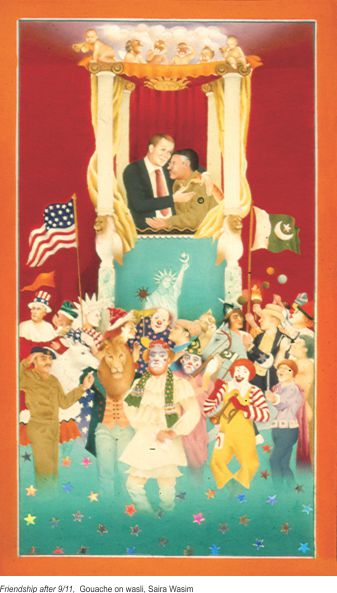
Saira Wasim, much younger than Nusra Latif Qureshi, has also emerged from the miniature department and had her work exhibited at the Whitney Museum of Contemporary Art two years ago, a rare honor for a Pakistani artist now settled in Chicago. Saira Wasim uses a ‘photo realistic style to parody a double target—backward to mimic the Mughal adoption of Western naturalism, and currently to mock the media obsession with celebrities’, according t Virginia Whiles (‘Manouvering Miniatures’! Contemporary Art from Pakistan. Khoj International Artist Workshop, New Delhi, 2001) Wasim’s waspish sense of humor defines her selection of themes and narratives which poke fun at political expediency, social hypocrisy, and the persistence of duplicity in the public arena. It was perhaps her series titled ‘Friendship after September 11th’, which brought her paintings to public attention; it depicted George Bush embracing General Musharraf with gusto, bringing in Pakistan’s rulers out of the diplomatic cold. Wasim has targeted the pomposity and self- righteous religious leaders in Pakistan . She makes fun of sanctimonious clerics, highlighting their political aspirations and their petty differences.
Saira Wasim’s paintings have featured in Fukuoka, New York, Berlin and Paris in the last four years. She has lectured on the miniature tradition and its contemporary practice in campuses across the US for the past year.
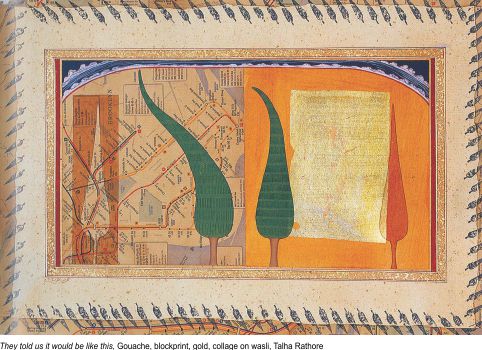
Another artist in the ‘Kaarkhana’ show which will be seen at several museum venues after its run at the Aldrich Museum in the US is Talha Rathore, living in New York with her husband Fasiullah Ehsan, also an artist. Rathore’s US career took off three years ago with exhibitions at the UN in New York, the WORLD Bank in Washington DC, and at the Bose Pascia Gallery in New York. The connection with the Bose Pascia led to appearances in several shows in India where she had her first solo exhibition at the Gallery Espace in 1998. She had spent three months in a UNESCO sponsored residency at the Sanskriti Kendra in New Delhi. Rathore went on a bursary at the Hong Kong Art Center in China. Managing to cope with motherhood and her studio practice in New York has been a struggle for Rathore. The situation post 9/11 situation was emotionally demanding. Rathore’s new works are a response to the great divides which threaten the world as she perceives it. The miniature surface (wasli) is constructed out of a New York subway map which she divides with a lusciousness of color and vibrant images, usually that of trees, symbolizing hope and rebirth. Rathore uses block prints around the edges, punctures the surface with a silken thread, and adds a gold leaf to recall pageantry and pomp.
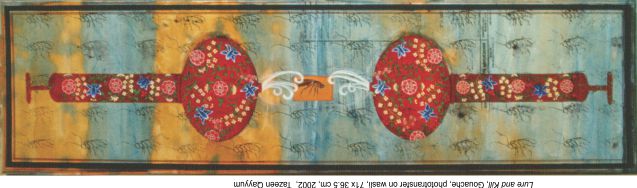
Rathore’s works will be part of the exhibition in Honolulu Museum of Art which will honor women miniature artists from Pakistan in October 2005. Her work has been exhibited recently in Morocco, India and Britain.
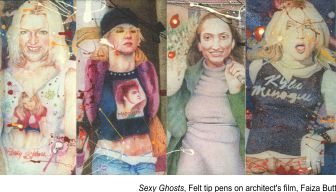
Faiza Butt left for London as a student at the Slade School of Fine Art in 1995 and stayed on to make the city her home. Always a keen observer of social phenomena her work was concerned with patriarchal rituals and issues of gender discrimination in Pakistan. These concerns were always voiced in images laden with irony and guile. Preferring water-based mediums like tempera and watercolor, Faiza Butt wove these into paper collages. In Britain she was struck by the ‘cultural pockets that co-exist alongside the native culture, yet remain in complete isolation’ (Artists’ Statement). Juxtaposing images of young Asians together with pop icons like Madonna and Beckham Faiza Butt explores the dreams of the diaspora. She sympathizes with the predicament of the young, as she refers to the divides that exist between high and low culture and between native and alien. At the Slade school, Faiza Butt encountered the gender-based supremacy of art mediums. She rebelled against the influence of abstract expressionist like Richter, Pollack and Kandinsky. She chose to ‘draw’ her paintings with felt-tip pens to construct photographic images in meticulous dots on architects film mounted on acrylic sheets. She then splashed enamel paint onto this delicately finished surface to ‘scar it and mock the cliches of abstract painting practice’. Faiza Butt has exhibited her works in galleries and museums in Britain as well as in India and Pakistan.
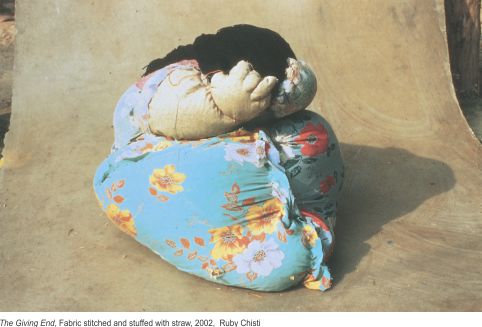
Ruby Chishti, who lives in California, commenced her professional career as a sculptor with the exhibition ‘The Eye Still Seeks’ at the Ivan Dougherty Gallery in Sydney Australia in 1999. Awarded a residency by the South Asian Arts Organization ‘Shisha’, she spent three months at the Harris Museum in Preston in the UK in 2001. Her work was seen in the show ‘Threads, Dreams, Desires’ at the museum as part of a group of museum exhibitions from South Asia to mark the Commonwealth Games in Manchester. Trained as a painter at the NCA in Lahore, Ruby Chishti apprenticed with the master sculptor Shahid Sajjad in Karachi. An artist with the ability to be equally expressive in paint, metal, wood, clay or fibre glass, Ruby Chishti spent years away from her studio to care for a paralyzed mother. She returned to her practice finally in the late 90s but found conventional materials too remote from her emotional experiences. Exploring alternatives she became fascinated by domestic crafts like doll making fast becoming extinct due to the popularity of plastic toys in the global market. Using old quilts, clothes, sacking, plastic bags and other discarded materials, Ruby Chishti transformed them into lonely figures imbued with vulnerability and emotional fragility. Apart from the Harris Museum in Manchester her works have been exhibited most recently in Chicago and New York.
It is not surprising that many of the artists of the Pakistani diaspora are women. Among the first generation that settled abroad are well-known names such as Lubna Agha, Mansoora Hassan and Sylvet Aziz, all living in the US and Canada. The pioneering role of women in the arts i.e. music, literature and the visual arts, is an unusual story. The struggle to validate professional practice in the face of societal taboos and pressures has been a long and difficult one. The art of Pakistani women at home and elsewhere has been in the forefront of innovative practice in the country and in the last analysis is a tribute to their creativity and determination.
Salima Hashmi is Dean of the School of Visual Arts at Beaconhouse National University at Lahore. She is the author of Unveiling the Visible: Lives and Works of Women Artists of Pakistan(2002)
At the Venice Biennale this year, the curators had made a deliberate choice– to stay clear of the love affair with technology.They chose instead to invite visitors ‘to accomplish a journey from the belief that art still holds a promise of transformation’. Rosa Martinez, curator for ‘Always a Little Further’ at the Arsenale site of…