
the two marys
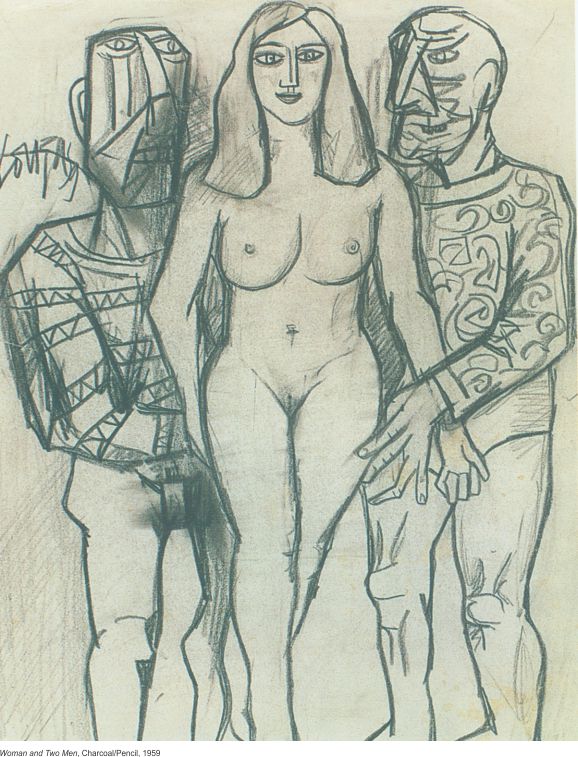
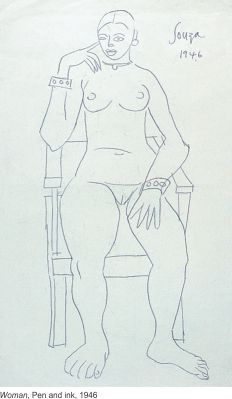
About ten years before the painter F.N. Souza’s death in 2002, I came across a pair of nudes by him in a gallery in Bombay. They were made in shaky lines with a black marker on what appeared to be the cover and inside pages of a British men’s magazine. The images, of blonde women in swimsuits, were still visible and I could even make out some of the headlines: ‘Melinda Returns’ and ‘(Something) Dogs the Cockney Mafia’ and ‘Giant Poster Inside.’ Souza’s figures were seated, fleshy, crudely drawn. They may have been two views of one woman, or similar views of two women. The art dealer offered both for the price of one. So I acquired two Souza nudes for a little less than a hundred dollars
A year or so later, the dealer who sold me the nudes was taken to court for selling fake Souzas. He denied the charge, but the case was not easy to call. Many in the art world said Souza orchestrated the affair himself so he would be asked to authenticate disputed paintings. He was said to always be in need of money. The affair was widely reported in the local newspapers. I began to wonder if my nudes were fakes. It was not unlikely. There was the shaky line, the strange choice of paper, and when I took them out of their frames, I saw that the backs of the pictures had been cleanly smudged. There were no scribbles or doodles, as there often were in paintings by Souza.
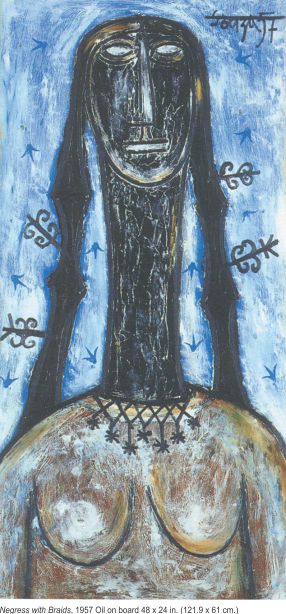
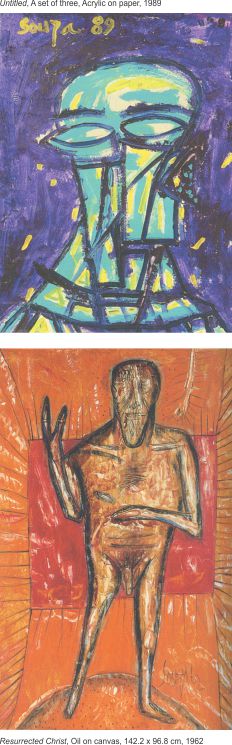
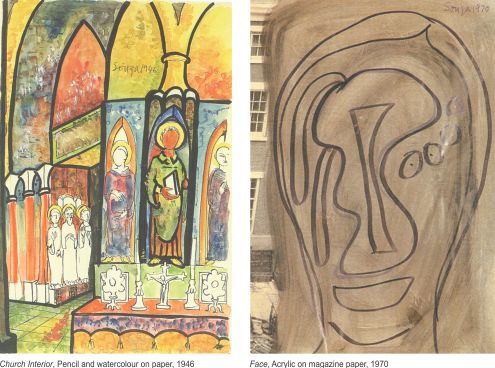
I named the pictures The Two Marys, because they were anything but virginal, or maternal. Souza—a Goan Catholic—had become famous in his thirties for a series of gruesome Crucifixion pictures which had horrified critics. Thanks to the notoriety his Crucifixions generated, he came to be called ‘the Indian Francis Bacon’ by the art press. The title annoyed him, as did the Roman Catholic church and most other institutions. His Catholic upbringing, or his reaction to it, gave him a constant source of material, and a way to profitably direct his rage into art and into publicity. He had been an altar boy; he claimed a special knowledge of the church; he described it as a place one should visit as one visited a theatre, for entertainment. He wrote: ‘I want to hang myself on the cross with my hands and feet nailed to it. I have no desire to redeem myself or anybody else because Man is by his very nature unredeemable’.
I placed the paintings together, on a wall in the living room of my Bombay apartment. There was nothing else on the walls of that room except a mirror, and The Two Marys came to imbue the space with something of their own ease and mystery. I looked at them for years, and wondered about their provenance, and of course I wondered about Souza. In the fall of 1998, I left Bombay to read for a master’s at a college in New York. I took the paintings with me. Perhaps I was hoping to meet Souza, who lived in Manhattan, and show him the nudes that he may or may not have painted.
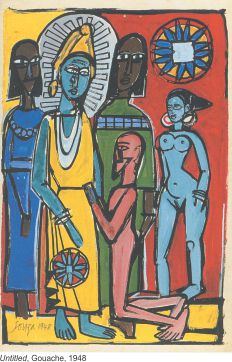
Francis Newton Souza was born in Saligao, a village in Goa, in 1924. He told me he was expelled from high school for improving ‘anatomically imprecise’ pornographic drawings that his schoolmates had made. He was expelled too from the J.J. School of Art for participating in the Indian Independence movement and he joined and quit the Communist Party of India. His pro-independence activism, driven, not by political commitment, but by restlessness and a lifelong taste for subversion, did not last very long. In 1947, the year India became independent, Souza was otherwise engaged. He and a group of Bombay painters, including M.F. Husain, S.H. Raza and K.H. Ara, founded the Progressive Artists Group, very possibly the most significant collective of 20th century Indian artists to date. Two years after Independence, at a time when patriotic Indians preferred to view the British as villainous empire-builders, Souza sailed for England.
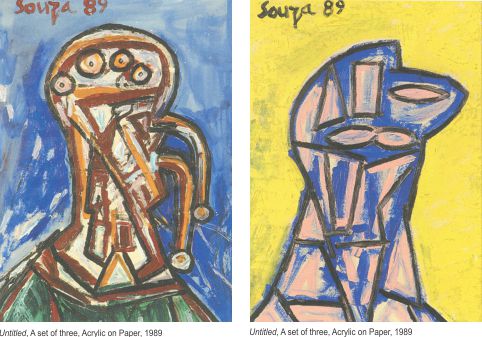
He painted a lot, expanding the range he had acquired in Bombay. He exhibited three paintings at the Institute of Contemporary Art, in a show that included Francis Bacon, and he published his first books. His autobiography Nirvana of a Maggot was noticed—Stephen Spender published excerpts in Encounter. Souza wrote the introductions to his own catalogues, as well as articles and essays. In the 1960s he began to experiment, loading his paintings with multiple planes and colour. His portraits consisted almost entirely of geometric shapes and cross-hatching. He became a celebrated figure who was reviewed in serious British art journals. As the decade progressed, he seemed to be settling down. But he found himself in the middle of two divorce actions. Neither marriage had lasted very long, one only for three months. The court liquidated his assets, including art, and he was left with very little money. In 1967, he left London for New York City.
He was rarely seen in India, and then only in print. One afternoon in 2000, in an Indian market in lower Manhattan where I was shopping for vegetables, I found an article by Souza in a Delhi newsmagazine. It was a two-page diatribe against India’s bureaucracy and her manners and customs. It raged against the country’s religions and holy men (‘Unholy Men, Says Souza!’), as well as politicians, goons, peons, artists, writers, ‘alleged’ intellectuals. It was incoherent but entertaining.
Towards the end of my course I went to a Souza retrospective at a midtown gallery. The curator and gallery owner said the retrospective, his first solo art show in the United States, had been very successful. ‘He’s one of the best-kept secrets of New York’s art world’, she told me. ‘And he’s a brilliant, difficult dirty old man’. She gave me his unlisted number.
I called Souza, introduced myself as a writer from Bombay, and told him the story of The Two Marys. I told him I had brought the paintings with me to New York. Would he take a look at them and tell me if they were real? To my surprise he agreed immediately. He said he lived on Fifth Avenue in the upper 60s and he asked me to drop in. On a day in late April, winter still in the air, I took a subway to 63rd street and walked the few blocks to his apartment. I carried the paintings in my arms. I had looked at them only once, soon after arriving in New York. The glass frame on one had cracked in transit, but I had done nothing to fix it. I was living in a basement, for heat I opened the door to the boiler room located a few feet from my bed. In my newly reduced circumstances, every time I looked at the Souzas I was reminded of the comfortable life I had left behind in Bombay. I repacked the paintings in the Indian newspapers in which I had transported them and put them away in a closet. Now I held them in my hands, my fingers raw with cold.
Souza opened the door himself. He seemed puzzled to see me, as if he did not know why I had come. But he let me in, and I followed him into gloomy, crowded interiors. He moved slowly, as if tired. His appearance gave him an air of disreputability, eccentricity, and neglect. Over pajama bottoms he wore a thin brown coat and a once-white shirt frayed at the collar and cuffs. His white beard needed trimming, as did his fingernails. On his feet were a pair of ancient rubber slippers which he dragged across the floor on his walk to his seat. The most striking thing about him were his eyes; they protruded at an impossible angle, as if they were following phantoms. It was the only part of him that exuded the energy I associated with his paintings.
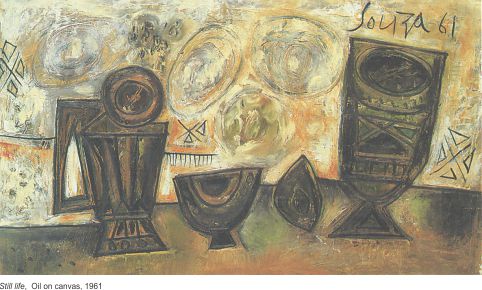
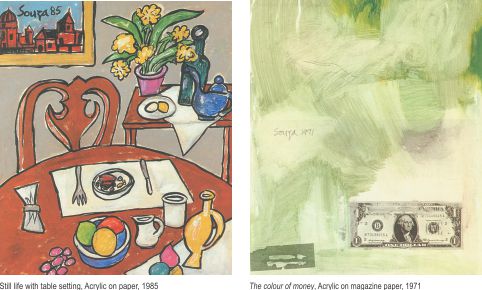
His third-floor walk-up was inconceivably cluttered. There were canvasses piled on the sofa and on the floor, stacked in two adjoining rooms, standing against the walls of the entrance hall, and in the bathroom and the kitchen. There were piles of books, newspapers, and magazines everywhere, their covers sketched on with markers. Some looked like preliminary sketches of pictures that would come to look like The Two Marys. I noticed oils on paper pasted onto the glass panels of two large windows, like a fractured stained glass in an artist’s church. Bathroom fixtures, windowsills, doorjambs, and bookshelves had been painted or written on. Most of the canvasses on the walls were dated, some as early as the early sixties. He used only two numerals when dating paintings, but he did not like the look of the numerals ’00’ and so paintings made in 2000 were undated. You could tell by the work on the walls alone that his subject was the female shape; it was everywhere. For me, looking at them was like meeting old friends. They were sisters of my Marys, from the same family of generous and unwise women he found wherever he went.
He liked my name for his paintings. ‘Good name, very good. I have many Marys’ he said, gesticulating from a paint-encrusted armchair. He frowned at me when he spoke, as if we were conducting a long-standing argument. And though I had not asked him a question– I had not yet taken a seat; it was difficult, there was little space in the apartment—he was off. ‘Women are unbelievably smart. Men are laggards. It’s hard for us to keep up with women. If you can’t match their wit they will flatten you like a pancake!’ He clapped his hands together when he said ‘flatten’.
I asked if he had been flattened in that manner and he replied without hesitation that it had happened ‘more times than I care to remembe’. He said he was single, ‘but I gallivant.’ Seven years ago he had come across such a woman, a Delhi-based art critic, who flattened him with a review, then moved in with him. ‘Srimati Lal was a writer when we met. But watching me work she took up painting. She’s just had her first exhibition, in London’.
They were not married. Souza’s family did not seem to approve of Srimati Lal (he always referred to her in this formal way, ‘Srimati’,— ‘Mrs’ in Hindi); they thought she was a gold-digger. He had ‘five kids from three wives’, he said, and Srimati Lal was younger than some of his children. He raised his shoulders in exasperation, opening his hands, palms upward, in a Christ-like pose. ‘My kids have a grudge against Srimati Lal. They say, ”You’ll give her what you should leave to us”. His voice was low and urgent; for a moment he looked piteous, as if was close to tears. ‘Human nature, what a vicious thing, even cats and dogs are nicer to each other’. I unwrapped The Two Marys and placed them on Souza’s bed. He got off the couch and stood over them, peering at them, worrying his beard. ‘I’ve been wondering if they are fake,’ I said, for something to say. Souza picked one up. He turned it over, examined it, then handed it back to me. ‘These cannot be fake,’ he said. ‘Only I know this technique. It is unique, a Souza technique. I call it an Alteration because I clear out the original image and alter it, make it something diametrically opposite.’
Now the talk began, gathering in volume and speed. ‘The thing about a fake is this. As it rolls down the art hill it gathers debris, it becomes a boulder. In London my dealer took me to a Piccadilly gallery with a lot of Souzas. All fake! A woman from Delhi bought six. She got them certified by forgers and experts who say fakes are real. I went to a party later that week. The host had my paintings all over his walls. I wrote him a letter. I said I was sorry but most of his paintings were fakes. He sued me! He said my saying they were fakes depleted the value of the collection. He said I was being malicious! I said, ‘What is malice? How can this word be used?’ In the end it cost me $20,000 to get a lawyer and get it all straightened out.’
He picked up a copy of a magazine with an article on his New York retrospective, and pointed out a paragraph about his alteration technique: ‘This creative destruction is particularly visible in Alterations—Souza’s experiments in which he reworks newspaper images, using chemical solvents to dissolve the existing form…’ He pointed out another passage which quoted a New York art dealer who said the alterations were ‘stunning’. He liked this passage better; he read it aloud. ‘Sometimes the ordinary turns into the majestic, sometimes the obscene changes into the poetic. When Warhol was employing photographic imagery to influence our way of seeing in the 1960s, Souza had already explored its possibilities.’
But very soon he was back to his subject. Listening to Souza it seemed as if every important event in his event-filled life had at its centre his preoccupation with women. He learnt about colour by looking at flowers and women. The predominant subject matter of all art, the only complete formal motif, was women. He said the problem with Cezanne was that there were too many apples in his work and not enough women.
Religion and women, these were his areas of obsession, and sometimes he examined his own mental processes. ‘My brain has developed into such an enlarged area of thought that it accommodates the universe,’ he told me seriously. ‘I speak a totally different language. It’s something new, not the usual hackneyed nonsense the newspapers churn out.’
His rants were so softly spoken that it took time for the listener to understand that Souza was indeed ranting, and that his rambling pronouncements were connected by a barely discernable thread. ‘Buddha had trichinosis, from worms in uncooked pork. I was amazed he ate pork! So do Brahmins of course, depending on their hierarchy. I’ve dropped the labels of ‘Christian’, ‘Goan’, and so on. Religion is prejudice, who wants to carry it around? People say, ‘God is one but my god is the one!’ For me, destiny signifies the laws of nature. You fall in love, marry; you have children. How does it happen? It’s been programmed’.
‘I see no difference between light and darkness. There is no confusion in my mind at this time, none at all. Not a single scientist has defined god, yet they make silly references to god. God is a creation of nature in man’s mind, the devil too. Comparative religion hypocrites say all religions lead to the same thing. Not at all, in fact they attack each other! ‘ I interrupted him since he was on, or around, the subject of Mary. I asked him again, was he sure my paintings, The Two Marys were not fakes? Souza smiled and became still. It was the first moment of silence in the apartment for some time. ‘Repair this one,’ he said, holding up the nude with the broken frame. That was all I was going to get. When I got up to leave he accompanied me to the door. We shook hands. He seemed already preoccupied. I stood on the corner of 67th street and Fifth Avenue, clutching The Two Marys. I still did not know if they were fakes and I did not really care.
Souza died in Bombay in 2002. He had made so many enemies by then that only one artist attended his funeral. A New York attorney was appointed by his family to oversee his estate, and to authenticate his paintings. Within a year of his death, his paintings were fetching record prices at auctions.
Jeet Thayil lives in New York City where he works as an editor and writer
About ten years before the painter F.N. Souza’s death in 2002, I came across a pair of nudes by him in a gallery in Bombay. They were made in shaky lines with a black marker on what appeared to be the cover and inside pages of a British men’s magazine. The images, of blonde women…