
validating the recycled image
For the image maker, challenged by both the retinal and the cerebral experience, it was the search for a visual language that led to new tools to draw, paint, sculpt and print. The invention of photography can be seen as a part of this quest
Photography with its faithful celluloid replication threatened the established position of art as ‘true’ documentation and marked the beginning of an ambivalent relationship between the two. As the camera and other scientific inventions in the field of optics altered the human perception of reality, by default, it began to spur the exploration of the conceptual and theoretical space by the artist and brought about successive modern art movements.
From a subaltern art form to its intervention in visual arts, the journey of photography in Pakistan is linked to the postmodern emphasis on hybridity. The mass media presence of photography and the moving image too has been influential in creating a parallel reality. The artist as the interpreter of this reality has begun to reference news, entertainment and advertising photography in print and on television, in highly individualistic ways.
This influence appears at many levels. In the 1970s photographs from the Vietnam War were quoted in the paintings of Ijazul Hasan. Readily available through the print media and newsreels, the artist, like the rest of the world, saw pictures of the wailing child victims of napalm bomb, which opened a window to the ugliness of the conflict and became instrumental in the global questioning of the legitimacy of the war.
These photographs are replicated on his canvas in stark black and white against a backdrop of coloured forms to create a chromatic tension that fore-grounded the urgency of his concerns.
With the same objective Salima Hashmi transferred newspaper images and photographs, sometimes even collaged them on her canvas to articulate gender issues through the stories of the victims.
The image of the Pakistani Kathak maestro Naheed Siddiqi in performance, which appeared in her work during the 1980s when she was banned from dancing in her country, became a ‘poster’ of resistance.

This engagement acknowledges the role of news photography as a part of the larger interface between public issues and art as an instrument of social awareness.
For artists with careers in commercial photography like Tapu Javeri, a reputed fashion photographer, the synthesis comes naturally. Often his art begins with a shoot of male models in togas fitted with wings. Once developed and enlarged the images of these protagonists inhabit painted dreamscapes. Tapu entire visual vocabulary is built around a symbiotic relationship between the images created behind the camera and on the canvas.
On her return from Turkey, where Summaya Durrani learnt printmaking, she could be seen detaching herself from the painted surface to work with purely mechanical techniques. Her work was largely based on staged photographs taken by her. These were juxtaposed with found images cut out from catalogues and magazines. These thoughtfully layered images were successful in stretching artistic possibilities within offset printing that were previously explored, purely as a commercial process in Pakistan.
From her personal album Summaya selected her wedding photograph in an elaborate traditional wedding costume. This was randomly cut into pieces and then assembled to resemble an incomplete jigsaw to articulate her concerns based on the politics of female sexuality within the institution of marriage.

For the majority who do not own a camera, their fascination for the medium takes them to the street photographer where the box camera records moments of celebration against a hand-painted backdrop of exotic locations.
Three artists have explored this relationship between the camera, subject, location and identity. In their installation ‘Sweet Sweet Medina’ dedicated to the aspirations of the man on the street, Durriya Kazi and David Alesworth invite visitors to lend their face to a cutout in a backdrop painted with figures in formal attire complete with a big car and house.
Recently Bani Abedi in her video art looks at the dressing up of children and young men in Arab costume for posed photographs. Her work acts as a critique of the simplistic viewing of an artificially constructed identity and its political subtext.
The photograph of a Persian rug enlarged to the size of the billboard with Urdu calligraphed text around it looks at an advertised message for its format but has a subversive edge as an anti-racist statement. Installed at various locations in the UK, the rug became a decorative device with its strong cultural resonance of South Asia but the calligraphic Urdu text which could only be accessed by an audience familiar with the language, was privy to another layer of the work. The text in Urdu read that ‘the British are a tolerant and fair minded people’. Dictated by their personal experience as immigrants, the billboard got different responses in different parts of UK. Here the artist Rashid Araeen art can be seen poised between meaning and accessibility.
In another installation by Rasheed Araeen on cultural specificity in art, snapshots of a family taking care of a goat and then sacrificing it on Eid ul Azha as a religious ritual are central to the idea. The graphic images of the whole process are open to multiple interpretations. One could be of violence on a pet, while in reality this ritual is an act of giving motivated by a deep faith.

New sources of photography like the Internet inspires Canada based Tazeen Qayum project on personal websites of young Pakistanis, particularly from small towns. Their information collected in an album reveals their static vision of the world through the narrow prism of popular films and soap opera. As the line blurs between reality and fantasy, they aspire to become willing recruits into the army of Bollywood clones.
Anwar Saeed, Iqbal Geoffery and Sheherebano Hussain follow a more conventional path of photographic collage.
Anwar Saeed strategic use of images cut out of magazines are meticulously integrated with his fine pen drawings to appear as an integral part of the work. Often they become acts of provocation within the narrative. ‘I take images of people, objects and architecture all the time with the objective to use them in the work. Sometimes I use images from the National Geographic’ shares Sheherebano Hussain. These images go through a xerox process that turns it into black and white. Specially done on butter-paper the xeroxed photograph is then fused to the canvas. These images that range from pylons to flocks of sheep, appear like ghosts in the surrealistic landscapes painted in vibrant colours.
Humour comes through the seemingly random assemblage of found images created by Eqbal Geoffery.
A master of wit, the photographs change their meaning with the new context that the artist creates with his hand- written comments and cartoons on the over-lapping papers which are often glued and stapled in clever compositions.
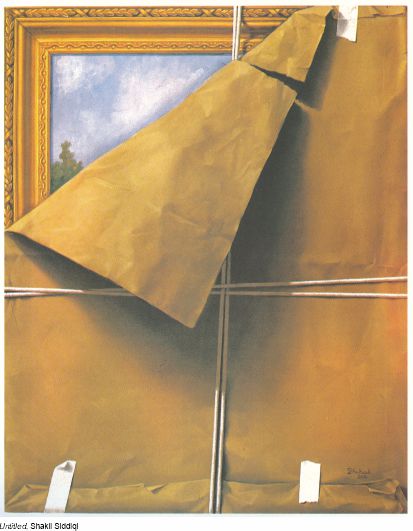
To term Shakil Siddique’s super-realism as an intelligent cousin of photography would not be totally inaccurate as the photographic realism in his art is enhanced by intellectual engagement. The subjects specially selected by the artist like a notice board with pinned notes, the back of a canvas with the stretcher visible and a half unwrapped painting, often succeed in convincing people that they are real instead of a super- real replica. Although Shakil paints from the original object photography remains a constant reminder in his art.
For Ayesha Khalid, the moving image becomes an extension of her art as images from her miniature painting becomes a part of an installation.
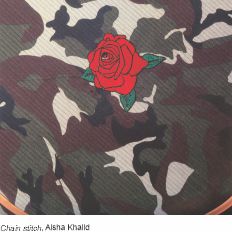
Ayesha whose work engages with the floral in decorative vocabulary, has appropriated the motif of the rose found in popular imagery. She has repeatedly painted it in her works as a symbolic motif and in a recent anti-war statement she has embroidered a dark red rose on a camouflage print of a combat uniform to draw attention to the forgotten women victims of war.
The installation that refers to the symbolic motif involves two screens that present a coordinated action. One screen with a brown hand is seen embroidering the rose and on the other one a white hand is undoing the embroidered rose.

Viewed in the context of her earlier work, the act of construction and destruction, constructs a new racial myth related to war violence, as apposed to stereotypes perpetuated by the Western media.
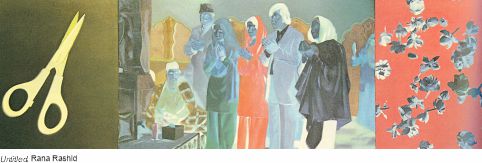
Digital photography has spawned visual expression in the new media. Using software to transform small images into pixels for a larger frame, Rashid Rana began his work by commissioning hundreds of pictures.
His art is often a harsh social comment as it peels the layers to reveal reality. One of his works is a replica of a gilt framed image of an idealized landscape of verdant harmony that on close scrutiny has tiny pixel of like images the abuse of rural land through neglect and urbanization.
The contemporary artist of Pakistan since the 1990s has being looking for a new visual vocabulary by exploring popular art and the conventions of miniature painting. The environment of an increasingly sophisticated digital technology has provided opportunities to interface with photography in more complex ways. From direct intervention as a technique to the appropriation of images from the media with their own political baggage can both be seen in the art of this period.
This sea change owes much to the postmodern paradigm of inclusivity that has dissolved traditional boundaries and material hierarchies. And this acceptability of photography as a medium rather than a technique has made them look not only at its celluloid and digital possibilities but an excavation of the historical space, as seen in the revival of camera obscura as a tool for artists and foresee futuristic inventions through the images created in biotechnological research.
The questions that increasingly confront artists, theorists and historians are- is art and technology interchangeable. Can digital software emulate creativity with scanned images as the reference in the same way images are saved via the retina in the brain? With art increasingly de-linked from its core human component, the intuitive mind, can art created by artificial intelligence with photography as the facilitator can become a possibility?
Just as the recycled celluliod and digital image has been validated by the contemporary artist, we must recognize constant change as the energy that evolves art; however while it may be possible to remove the human hand from art in the future it may not be
possible to do the same with the brain which is the inventor of the artificial intelligence.Niilofur Farrukh is the editor of Nukta Art Pakistan and President of Pakistan section of the International Art Critics Association.
For the image maker, challenged by both the retinal and the cerebral experience, it was the search for a visual language that led to new tools to draw, paint, sculpt and print. The invention of photography can be seen as a part of this quest Photography with its faithful celluloid replication threatened the established position…