
the digital window
‘What of the photograph made out of nothing? What about painting with light? Is it photography? Surely if we can paint with light we can paint with dreams, create the morning mist or the afternoon glow. Will it be a fake? Hardly. Whatever else may be false in this tenuous existence of ours, imagination is not. All that we value, that we strive to uphold, all that gives us strength, has been made of dreams, and we must dream on. If pixels be the vehicle that realizes our dreams, be it so.’
When the celebrated pioneer of digital photography, Pedro Meyer had written to me in the early ’90s, asking me to articulate my feelings about the new digital technology as an introduction for his new book Truths and Fiction, I had stumbled into this technology. Excited, mesmerised and a little bit scared though I was, little did I know that not so far away, another artist had taken this media by its horns, and undaunted by its hype or its exclusive domain, begun shaping it with his own clay; raw, direct, probing and exploratory. I still cling on to those words today, but Ismail Zain and others like him have made me realize that it is not the pixels that shape this new digital world, but artists like him, who have created the new spaces that visual artists can now enter.


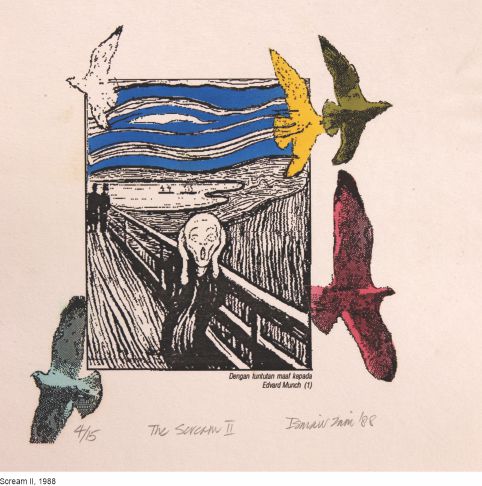
It is important while analysing the work to consider the physical limitations of this new palette and canvas. The Mac monitor was a tiny screen that prevented a wide panoramic view. The resolution available, necessarily created a staccato gradation, rather than the smooth vignettes available through the 16 million colours that we now take for granted. The dot matrix printer, punching pixels into perforated sheets, created both a granular structure and a tonality that gave rise to a texture more akin to a coarse brush on textured surface than the smooth gradation of delicate pigments on fine-coated paper.
Zain took on the characteristics of this new medium with typical gusto, probing this new medium, and stretching it to its limits. He refused to limit himself to the technical ability of the new art form, bringing wit, satire and his own sardonic perspective to create subversive statements that belied his position as a high ranking bureaucrat. The geometrical attributes of computer algorithms was transformed into art. Enriching his motifs with intricate angular patterns that were characteristic of traditional structures, he created depth within two-dimensional canvas, not only by exploring distance through form but also by playing with time and space. Deliberately tip-toeing on the incongruence of mechanical dimensions and cultural limitations, he toyed with our perceptions of norms, and constantly asked questions creating an unsettling, but vibrant platform that forced us to rethink our positions. Unhesitatingly, he challenged our zones of comfort.

Never having ever met the man, I can only imagine what he must have been like, or rather what one would have expected him to be like. I can imagine a high ranking government official who was a ‘once upon a time artist’ who wielding enormous clout. A giver of favours. A gatekeeper who determined what was art and what merited economic considerations. It must have been so easy to have fallen into that well of mediocrity that insulates the government official from the visionary who takes risks and encourages creative work. It would have been so convenient to tow the party line, favouring the faithful and avoiding controversy, or adapting safe option of going for the tried and tested, or not risking failure, or staying within chartered waters. Zain, however, had never been scared of losing, or of failure. The joy of experimentation had not been squashed to death by the weight of bureaucracy. The artistic spirit had not been cowed down by the weight of high office. This was a bureaucrat who took risks, who explored the possible, and sometimes the impossible, and was unabashed in his support for the creative soul.
Embracing this new technology had little to do with being seduced by gadgetry. Indeed, the work produced by Zain relied little on the filters and gimmicks that Photoshop was able to deliver even in those early years. It had more to do with reaching out for the horizons and exploring the edges of the medium. If involved testing, at conceptual, philosophical and political levels, how the medium could be shaped to accommodate the increasingly complex array of ideas that he wanted to propagate. At a mechanical level, the ‘manipulations’ that Zain incorporated were simple devices where the immediacy of the technique had a bigger role to play than the visual nuances. Indeed, Photoshop in those days was at best a clumsy tool. The darkroom wizardry of a Jerry Ullsman would have been difficult to emulate with such a blunt tool. Juxtapositions, the complexity of layers, simple blends, and the amalgamation of disparate images were the mechanical repertoire of this new set of tools. But that was fine with Zain. It allowed him to explore the medium at a conceptual level, and probe, at times tongue in cheek, into the social fabric that Malaysia had buried itself in. The granularity simulated by the enlarged dots gave a ruggedness to his edges. The posterisation enforced by the limited gamut gave rise to polarities that he loved to exploit. The lack of tones, which the modern air brushed smooth advertising imagery would have shuddered at, became his signature. There were bare patches, sections of solid black, and contours obliterating through a minimised gradation. He treated the virtual surface like a robust canvas where he could cut and tear and stitch and glue with abandon. He was happy for the jaggies to show. The seams became part of his repertoire. He borrowed from cartoons and screen prints and wood blocks, and used his new found virtual canvas to gel it all together. His was an attempt at synthesis and not percolation. And while the often disparate elements would sometimes reluctantly share a common space, Zain revelled in this uncomfortable feeling. It was discomfort that he was after, and he was not going to let the elite art body that surrounded him, relax in his presence.

An art world that is obsessed with ‘hand eye coordination’ as a test for artistic merit, will find a medium that is reproducible problematic as an art form. This is the same group that found photography difficult to accept, as it was not ‘made by hand’, and therefore reproducible. They reduced art to the level of motor functions, and confused the ability to control movement with the ability to open one’s mind. While masterful craftsmanship is a genuine attribute to be admired, it must not become our sole yardstick of creativity, and Zain was determined not to let the motor mechanics drape a shroud around the artistic arena. He was not always subtle in his statements. ‘The Magic Marker’ pointedly stuck its tongue out at the system that finds flesh in any form obscene, while the lewd suggestiveness of thinly veiled pornography, in advertising and popular cinema, merits official approval. He openly rebelled at the attempt to create hierarchies of artistic practice based on religious convenience. Rather than de-politicise art, he was prepared for political showdowns, for moments when art would have to be recognised for what it was, rather than pamper to current political norms.
Was he ahead of his time? Was society not ready for him? No. He was even the pragmatist, keenly aware of the flux of the medium. Ready to embrace the opportunities that technology opened up, he was an exponent of the present. A young mind in an ageing system, he refused to mellow with time. Confident enough to take risks, he trod unchartered waters, regardless of how unfashionable it was, or how ‘mechanical’ his elitist friends considered his art to be.
Sadly, there were few to follow in his footsteps. Rather than immerse themselves in the new visual domain, his contemporaries stuck to the tried and tested. Even the emerging artists chose to play safe, placing their feet on solid ground rather than sailing down the rapids on some rickety raft. As one might expect, they stayed safe, but never went anywhere. Their horizons circumscribed by self—imposed norms, they continued to produce predictable, popular, and safe images, that failed to question and offered little more than a constipated aesthetic.
It is difficult to know where Zain might have arrived had his life not been tragically cut short at the very moment when his creative spirit revived. Having chosen to create opportunities for artists at the cost of his own artistic fruition, he was finally beginning to live up to his own potential. Ironically, the doors he had opened for others was a door that he himself found no time to step through. A broken lifeline severed an artistic spirit that age, convention and the pressures of norms had failed to stem.


Technology is never neutral. I am not sure if Zain had foreseen the digital divide that separates the ‘knows’ from the ‘knows nots’ in our cyber culture, but by taking on the cobbled digital pathway, the steep learning curve, and the lonely path of a pioneer, he had opened the door to an artform that we have only now learned to embrace. Technology still suffers from being in the hands of nerds rather than artists. Computer programmers determine the limits of our art form. Engineers determine the event horizons of our visual palette. Ismail Zain, however, had opened a door to a space that few of us have dared to enter since his death but that really is the brave new world and the new function of photography.Shahidul Alam is Managing Director of Drik.
‘What of the photograph made out of nothing? What about painting with light? Is it photography? Surely if we can paint with light we can paint with dreams, create the morning mist or the afternoon glow. Will it be a fake? Hardly. Whatever else may be false in this tenuous existence of ours, imagination is…