

the future of photography
Cinema, TV, video, web cams, the Internet, have not been able to kill the need for still images as we tend to link memories to stills rather than to moving images. Part of that phenomenon is due to the naive, historically embedded belief that a still image is stable and a moving image is volatile
the future looks grim: ‘ça a été’
‘Ça a été’. It may well be the most frequently quoted phrase in photo related essays from the past twenty years. Editors on the board of Perspektief magazine (1980-1995), quoting Roland Barthes’ famous words were to bring a box of beer to the next meeting. As the magazine no longer exists, I go unpunished, using his words here again.

But photography no longer exists, either. At least not for what it used to stand for: evidence of a physical setting in front of the camera, recorded onto an analogue, physical carrier. The vast majority of images that reach us today are digital, some may still be digitized through scanning but most are ‘born digital’. In 2001, the turnover in digital camera sales was larger than of analogue models. In 2002, for the first time, in unit numbers, more digital than analogue cameras were sold, not even counting the numerous devices such as cell phones, PDAs or US smart bombs that sport a built-in digital camera. In May 2006, Canon announced they would not develop new film cameras anymore. ‘Ça a été’, the analogue image.
Does the credibility of the photographic image end with that as well? It really depends on how one is looking at this issue: the meaning of a photographic image has always been subject to the context it was presented in. To mention a few examples from the last decade. Benetton sold child fashion with the image of the bloodstained clothes of a fallen Bosnian soldier, Nobuyoshi Araki’s pictures for a beer campaign were pulled into the art market.
the future looks bright: no more photographic evidence!
Of course, a digital image can be manipulated a lot easier and a lot more perfectly than an analogue one and will not be so simply, if at all, discovered. A digital copy is, per definition, identical to its original. Protection in the form of a digital date stamp or electronic copyright watermark is unreliable. If well done, the components of a composite photograph are impossible to identify. Thus the trustworthiness of the image resides entirely with the context in which it is presented, such as the nature and the reputation of the medium it is published in. The status of the photograph as evidence should therefore be considered as equal to written content, to text based journalism. This has proven to be difficult to handle for well-trained judges; it may take a little longer for the average newspaper reader. Even the most conscientious picture editors have a hard time judging the trustworthiness of the digitally received material. With the economic and time pressure that is part of today’s commercial publishing, a mistake is easily made.

the future looks grim: how to take a picture of digital reality?
Yet, more fundamental changes are taking place. It is not just the medium that has become digital, it is reality itself. More and more time is spent behind screens connected to computers that relate people real-time with ever expanding and faster networks. A growing number of people are behind a computer or TV screen longer than they spend doing other things.
One sided? Again, it all depends on the perspective taken: the internet is an area for shopping, playing games with people, listening to music or radio stations from all over the world. Chatting, participating in on-line debates, newsgroups and having sex (safe!), it all belongs to everyday life on screen turning the Internet into a parallel digital society that both in a cultural, economic and social sense is competing and interacting with the physical society that we were confined too for so long!
One problem though: a camera, albeit digital or analogue, cannot be taken onto the Internet. So how do we keep informed about what is going on there? How do we form an opinion about the power processes in this society? As this space exists on the basis of interconnected computers, computers are also the most likely tools to take on the role that cameras have in the physical world. This implies that, on an abstract level, photography and photojournalism will, in computer jargon, have to be ‘ported’ to the computer to fulfil the essential role that classic photojournalism has played for democracy in the modern society. the future looks bright: cut and paste!
‘Red Alert – Hale-Bopp Brings Closure to Heaven’s Gate’ read the headline on the homepage of Higher Source, a California based new age sect in the late 1990s. The first time I saw this page, was when it was published on March 28, 1997 on the cover of NRC-Handelsblad, a leading Dutch newspaper. Soon after, the image was recognized by Internet journalist Francisco van Jole, as the first Internet photo ever. The 39 physical bodies of the sect members that had been the result from the group suicide, made the image leapfrog from the digital world into the physical one. All the NRC-editors did, was a matter of cut and paste. It is both extremely interesting as well as relevant to speculate about the ultimate camera-less image that reports about processes taking place in the digital society. No camera, no carrier, no (physical) reality: the ultimate ‘ça a été’. The homepage, embedded in a journalistic text, printed on the cover of a newspaper, relies in a wonderful, imperfect way past and present, the digital and the physical that no living human being can escape from. As long as we have bodies and need roofs over our heads, the hybrid character of the media will fit our cumbersome hybrid existence.
the future looks grim: youth and objects
Parents, educators and politicians are aware of the fact that recent generations hardly read books. They rather spend time behind a computer screen, playing games, chatting on-line, downloading music and films. TV, the book killer of the past generation, has lost it’s dominant position and is changing it’s strategies, integrating interactivity with the audience through the use of the computer via internet or of mobile telephony using SMS, trying to turn the tide. Reality TV and soaps alone, are not enough to keep viewers’ interest.
Museums collect objects or documents as objects, such as photographs, historical, technical, aesthetical. Why would future generations pay for these costly organisations that cherish these relics from the past? People are swamped in a media rich environment (poor in a different sense, some would argue….) where electronic images are omnipresent. Why bother about collecting images, so hopelessly connected to vulnerable objects, that are confined to specific places when one can download images that fulfil some specific need, anywhere and at any time of the day? What is so special about photo-objects, that one would spend large amounts of tax money collecting and keeping them?
the future looks bright: media democracy!
Luckily we have politicians that confront the professionals in museums with the man in the street. Museum professionals tend to be amateurs in their dealing with audience due to their often one-sided expert fascination with the objects of their study. Politicians tend to be professionals who do not only try to understand the man in the street but also try to influence public opinion in order to be able to control their own presence in the political arena. We used to call this propaganda, nowadays some are calling it media democracy.
In 1984, the American media sociologist Ben Bagdikian published his book The Media Monopoly describing the alarming political influence of media conglomerates. Bagdikian showed that at the beginning of the 80s half or more of the US media industry was controlled by only 50 corporations. For the revised second edition, appearing only two years later, that number was already down to 29. Bagdikian predicted between five and ten giant media combines for the mid-90s, a number that has proven to be quite accurate. To European observers it all sounded a bit eerie at the time: typically American, not our cup-a-tee. Because it was so American, anti-trust legislation was slow to be put in place.
So we caught up, even overtook them. Needless to remind you, that Italy is the current champion: the country was run for four years by a prime minister who owns some 50% of the commercial TV channels and a major part of the print media

the future looks grim: politics and art
Of course, there are politicians and politicians. Some are good, some are bad. The same goes for museum directors and curators. In Europe, most of the institutions depend on the government for their funding, private money is no more than a welcome extra. As a result, politicians have something to say about museums, we are talking about public money after all. Should a political majority ever wish to have a national referendum on state support for art museums, I fear most would have to close down. There is only limited popular support for these institutions, they rely heavily on the consensus of a sociopolitical elite.
Will this situation get any better with future generations of voters? I am afraid not: as we noticed earlier, young people grow up in a world dominated by electronic media and spend their time predominantly in cyberspace. If museums do not change their attitude, the gap between the virtual present and the physical past will only grow.
In many European countries politicians have started hammering on youth issues, pointing at an upcoming generation that is not only subject to the changes described above, but that also has a staggeringly different cultural background as a result of global migration and who do not feel addressed by the policy of most existing cultural institutions. On the whole, art organisations have been painfully reluctant to respond, defensive, hoping for this political storm to blow over, as so often in the past. What we have at hand, however, is not an act of political will, of opportunistic political thinking with the next elections at stake, but a matter of demographics and major cultural change that politicians are trying to address.
the future looks bright: photography finally part of the visual arts!
For decades, photographic activists in Europe have been fighting for the recognition of their medium, as a serious form of (applied) art. The lobby was a mixed bag of interests bringing together photographers whose work had more to do with an echo of the nineteenth century’s photo salon than with art (made with a camera), photojournalists, fashion photographers and an occasional art historian usually with a self-developed knowledge in photography.
In most European countries this has materialized into specialized photographic organisations of different sizes and statures, from museums to institutes, from magazines to programmes for commissioning work, festivals, etc. Some have consciously focused on specific areas of photographic production like photojournalism. Most try to cover photographic art, whatever they define this to be. Although individual cases may look problematic, the total of these initiatives covers quite nicely the variety and multitude of photographic production at large. Looked upon fromthis perspective, it has also brought a thorough understanding of the medium and a solid base of knowledge.
But for whom? At occasions, one gets the impression that the information remains confined to photographic circles. In the Netherlands for example reviews on photography in the leading newspapers are written by general art historians with a far too limited view on the scope of the medium, focusing almost exclusively on the relation with visual art, thus misinterpreting the majority of the work that is being discussed.
And how on earth was it possible that Okwui Enwezor’s courageous 2002 Documenta 11, dealing with the notion of the documentary and the archive, showed so many weak examples of photographic and video projects?
Is it a lack of ambition among photographers, photo historians and specialized curators that they cannot make the jump to the much vaster world of visual arts? Or are they unwilling to free themselves from the marginalized position that they have fought against for so long but which also gave them a lot of freedom thanks to the limited responsibility that makes an integral part of that position? Or do they sincerely mistrust the sudden, hyped and often cyclic interest of the market driven economy that the visual arts are part of?
Possibly it is just a matter of catching up for us Europeans. As we know, museums in the US have collected photography for much longer, so did private collectors, shaping a larger and more mature photography market that hardly discriminates between photography and other visual arts. In 2003, photo historian Adam Weinberg was appointed director of the Whitney Museum in New York. Would it be just a matter of time, then?
the future looks grim: close photographic institutions!
Anyone with more than an extremely shallow knowledge in photography can be stupified when confronted with the sudden, phenomenal interest in photographers such as Andreas Gursky, Thomas Ruf, Thomas Struth (all pupils of Bernd and Hilla Becher) or Rineke Dijkstra. The awareness of nineteenth century engineers photography or the work of August Sander for example turns these photographers into meaningful contemporary classics, if you will, but not into the revolutionary artists the art world is claiming them to be. Yet their presence in the market, the media and the arts has more than once been the reason for claims that specialized interest for photography, educational, institutional, in the media or otherwise is a thing of the past. That one could close down the institutions that have been established in recent years or that are, in some cases, still in the works. Nothing could be more dangerous for a thorough understanding of photography. A medium that is as much linked to the everyday as it is the world of visual arts, to science as much as journalism, to advertising as much as history, technology, entertainment, architecture, cinema, etc. Of course, this vast terrain cannot be covered by specialized institutions alone. It is, and always has been, the task of extremely different organisations and individuals, from art museums to newspapers, from historical societies to universities to research labs.
However, formulating the differences in use, linking the practices, analyzing the cultural, political, social and artistic role of the medium can only properly be done by specialized photo institutes. The successors of the Becher pupils and Rineke Dijkstra will benefit from the richness of the insights developed here. Even people in the art world, curators, critics, not to forget marginalized art photographers, may begin to understand the intertwinement of any kind of photography with the medium at large, not the visual arts alone! The recent, and possibly temporary, interest in photography shown by the art world should therefore be used politically to expand its independent base rather than to let it disappear in the limited notion of the visual arts alone.
the future is bright: the object as experience
What one should be aware of is that the existing interest in photography taken by the world of the visual arts cannot be seen independently of the interest in other more recent ‘new’ media such as video and computer related art. Playing the card of the visual arts will work as long as the visual arts remain interested in photography and will not turn to, let’s speculate, ‘new drawing’.
It is, therefore, necessary to broaden the public base for the medium by also developing another audience, an audience that is less prone to the hypes of the fine arts world and will see the relation with the visual arts as one of the possible relationships, rather than the prime measure for validation. Or, in less defensive terminology: an audience that is capable of judging the value, the basis of an overall experience with the medium.
Time to turn to the youth again. They may not read, they may be individualistic and spoilt. Yet, they are also non-dogmatic, media savvy and curious to have new experiences. So anyone who is capable of touching upon one or, preferably, more of these qualities is capable of making a start addressing his new audience. The target being not only to develop photography based support for a photography place, but ultimately also creating a genuine interest in the photographic object that still forms the core of most collections.
How can this be done? Some would say, it is thanks to the absence of a collection, a permanent space and an operational subsidy (all to be considered burdens?) that project-based production organisations such as Art Angel in the UK or the company I am directing, Paradox in the Netherlands have been more successful as innovators dealing with these issues than established institutions. Speaking for Paradox, I can only say that based upon an interest in the interaction of artistic, social and technological developments, we have created a number of events that tried to attract another audience (without necessarily scaring off another) by creating adventurous exhibitions that made use of multimedia, by commissioning works for public spaces (including the Internet), producing films, etc. In general, these projects can be characterized as ‘media rich’: most made use of a combination of old and new technology, combining film, print, projection, books and websites, enabling the audience to combine elements according to their own liking or interest and compare the nature of the content carrier. the future looks grim: the end of the individual
Among the best examples of multimedia installations from recent years are Stress by Bruce Mau Design and Solid Sea by Stefano Boeri / Multiplicity. Stress, a multi-screen projection dealing with the underlying ideology of (post)modern times, was part of EXPERIENCE, the main exhibition curated by Frits Gierstberg and myself in 2003 for the Foto Biennale Rotterdam.
Solid Sea was shown at Documenta 11 (2002) where the compelling installation confronted visitors with the tragic story of a ship full of migrants that sank in the Mediterranean in 1996, leading to the largest sea grave in the Mediterranean after World War II.
It is definitely not a coincidence that both pieces were the result of the professional, multi-disciplinary collaboration that both artists are used to in their practice but that has no real tradition in the world of art or photography where the romantic notion of the artist as a solo operating genius is still predominant.
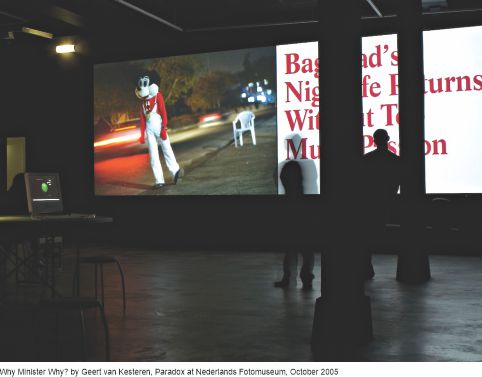
Yet, I have a strong belief that it is teamwork that is necessary to develop the projects that will make photography survive. It is my experience with Paradox projects such as Play (about youth culture), Go No Go (migration in Europe) or Why Mister Why? (on the war in Iraq), that incorporated graphic and web designers, audio artists, exhibition architects, social researchers, journalists and filmmakers. They all contributed to a project that was started by a photographer (Carel van Hees, Ad van Denderen, Geert van Kesteren, respectively). In terms of the multi-disciplinary teamwork, it has, I am sure, been no different for Stefano Boeri / Multiplicity (incorporating photographer Francesco Jodice) or Bruce Mau Design.
Remarkable in some of these cases is that the photography the production was based upon was not experimental at all: classic documentary black and white stuff in some cases. Thanks to the innovative character of the presentation however, it looked totally to the point, fresh and contemporary, building a bridge between a young and an older, sometimes expert audience.
People have argued that photographic exhibitions turning into multimedia experiences are leading away from the very interest of the work itself. If done in a careless way, this can be true. But it also goes for the umpteenth print exhibition with frames hanging on a white museum wall. Any presentation format is to be based on a carefully made, yet fundamental communication choice: who is it that I am trying to convey what message and under what circumstances…. This may lead to book-only projects, interactive on-line communities, installations featuring still and moving images and sound, and last but not least (but: well staged!) prints!
the future is bright: the next best thing
In a 2004 interview, the then 75 year old Dutch poet Remco Campert was questioned about the role of sexuality in his life and work. Part of his answer came down to the following: ‘if ever something that feels better than making love will be invented, I think I will still be practicing it alongside’.
Cinema, TV, video, web cams, the Internet, have not been able to kill the need for still images as we tend to link memories to stills rather moving images. Part of that phenomenon is due to the naive, historically embedded belief that a still image is stable and a moving image is volatile. Should evolution, training or education ever turn us into beings that no longer make the difference, we will probably act as Campert: practice [photography] alongside [another medium], because we love it too much.
This article is an updated version of one published earlier in: é contemporanea la fotografia?, ed. Roberta Valtorta, Museo di Fotografia Contemporanea/ Lupetti Editori, Milano, 2004.
Bas Vroege is director of Paradox (www.paradox.nl), adviser on Photographic Studies to the University of Leiden, and member of the supervisory board of World Press Photo.
Cinema, TV, video, web cams, the Internet, have not been able to kill the need for still images as we tend to link memories to stills rather than to moving images. Part of that phenomenon is due to the naive, historically embedded belief that a still image is stable and a moving image is volatile…