

truck art, the hit or a miss
The question and quest of identity are resolved in some unusual or unpredictable ways, often upsetting one’s notion about ethnicity and foreign influences. One example is the painted vehicle in Pakistan. Who could have thought that buses and trucks manufactured in UK and imported to Pakistan would one day be recognized as the sign/emblem of local culture? Or that the appreciation of the outside world would turn truck art into the most exciting, meaningful and exotic ‘art export’ from our land to international art arenas
The trucks, buses and rickshaws are painted by commercial artists mainly for decoration. Most truck art is executed in enamel paint, on tinted plastic sheets, and put up with the help of coloured adhesive tapes. The availability of a variety of new industrial material led to diverse techniques, yet the traditional ‘painterly’ aesthetics is observed in the use of all types of materials.
There has been a custom of employing arabesque-like designs, floral motifs, faces, flowers, animals and birds, along with imaginative landscapes on these vehicles.
The imaginative landscape is a common sight, painted over the years and seen in every part of Pakistan. Regardless of the fact that the painter is situated in the northern areas of the country, belongs to the plains of the Punjab, comes from the barren lands of Sind or lives in the port city of Karachi, the landscape they draw have some features in common, such as snowy hills, winding streams, trees in autumn, and a cottage in the style of English country houses. This fantasy landscape reveals the aspiration of a people/class for whom the ideal environment had to be a replica of an English (colonial) setting. The landscapes are not only painted on the bodies of trucks and buses, but are also sold as printed posters on the streets of different cities in Pakistan. Many people use them to decorate their houses. These pictures symbolize everything associated with western society (at least all the positive points). To an ordinary Pakistani, they evoke notions of security, beauty and prosperity.
Along with this dominant landscape, occasionally on view are some Muslim holy sites or animals painted in a symbolic manner, signifying love, beauty (such as the deer or pigeons, peacocks and sparrows) or power and might– for example, lions and the eagle. Usually these beasts have some human qualities. Sometimes one can see a mixture of the human and the animal worlds, such as a monkey in a well-tailored suit or a tiger smoking a cigar.
The most exciting aspect of this genre is the inclusion of mythological animals. For instance Buraq, the woman-mare, who bore the holy prophet on his ascent to heaven, is frequently painted on top of several landscapes (usually with the face of a young film actress).
In addition, a number of other images appear to be quite popular amongst the painters of this genre, such as knives, candles, geometric shapes of hearts (some pierced by an arrow), eyes shedding tears, and roses. These visuals substitute for verbal expression, and suggest a diction which can be described as figurative, but in actuality reflects a general fascination with words, seen as a potent means of defining reality, emotions and ideas. Hence painters of these vehicles approach these images as substitutions for words. English and Urdu letters and phrases are composed in elaborate scripts, as well as verses based upon folk wisdom and popular comedy. But, interestingly, in most cases, words are put up without any importance given to the pictorial space surrounding them.

For years these visuals have filled up the outer and empty surfaces of trucks, buses and rickshaws. Often the realistic mode of description is combined with stylised versions of objects. Along with the peculiar scheme of arranging various pictorial elements, the complexity of visuals and intricacy of forms are prominent aspects of vehicle art. All of them represent an aesthetics that was not recognized or appreciated by the art establishment which was trained according to Eurocentric notions of ‘fine art’. Hence the images on these vehicles were dismissed as the work of untrained individuals, meant for the taste and consumption of people of their class. The cultured elite dismissed these visuals for their gaudy colours, naïve imagery, industrial materials and commercial quality. However, with the passage of time this situation has changed. Fate seems to have finally smiled on transport art and it is now taken more seriously and viewed as an important expression of the period and place in which they are executed.
It all began with a group of young artists from Karachi who started to incorporate the images and techniques of painted vehicles in their art works. Not only were their visual vocabulary inspired by truck art but these examples of popular culture altered the structure of their art work too. They begun to produce art pieces which defied conventional ideas and formats of painting, sculpture or print. When the works of these artists (Durriya Kazi, David Alesworth, Iftikhar Dadi and Elizabeth Dadi) were shown overseas, truck painting was acknowledged as an interesting and meaningful exercise in indigenous image making—not only in those countries, but also in the country of its origin—Pakistan.

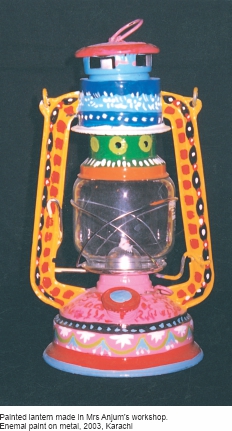
The consequence was an increasing fascination for truck art. This essentially popular art thus did not remain on roads alone, or stayed restricted to art exhibitions abroad; it was incorporated into local art as well (displayed and sold in local art galleries). Painters like Naheed Raza assimilatied images from truck art in their works. Each year, a few art students choose transport art as their research project, and investigate its history, style and contect. They present their theses both as written papers, or as art work. With all this hype, popular truck art—a genre initially created for a specific product, the vehicle—has impacted on the making of other domestic objects; at present, a designer from Karachi is marketing small utensils (teapots, cups, bowls, plates, lanterns and steel containers) painted in the fashion of transport art. However this act of borrowing the pictorial elements from one functional object to adorn another utilitarian item was possible only when popular art was sanctified by practitioners of ‘high art’.
While many people are still arguing about the artistic potential of truck painting, this art form is changing its appearance and aesthetics. Due to the interest of the global media and the introduction of new tools of image making (such as the computer and digital printing) the decoration on the buses and trucks are no longer the same as in ‘standard’ truck art. Most recently, these vehicles, instead of showing intermingling lines and multiple hues—are covered with bold, simplified and modernistic designs. The old lyricism persists, but not translated into thick waves of flat tones drawn next to circular areas of colour. Another significant change is in the preference for abstract imagery. On new buses there is hardly any recognizable substance, except the elementary shapes of flowers.

This shift in popular truck art, although not sufficiently noticed by many, is not happening in isolation. Other forms of popular visual culture in Pakistan, such as cinema hoardings, billboards and commercial signboards (which have been sources of inspiration for some of our artists) are also in the process of being transformed. Instead of painting by hand most of these surfaces are now prepared through machines. The manufacturing process has modified the aesthetic qualities of these items. Again, to be minimal and simple (and somewhat less imaginative) are the main features of cinema posters and commercial hoardings. In a way these are in harmony with the design sensibility favoured in other parts of the world.
Because of the changing concept of popular art, the gap between ‘low’ and ‘high’ art is more noticeable than before. While many artists are still romanticising about the naïve and primitive nature of popular art, popular art—oblivious to their aspirations—is moving in other directions and adopting hi-tech methods.
You can still call this art popular, urban or low—depending upon your position and temperament—but the art seen on public transports in Pakistan is certainly on the verge of a change, swerving very much like the sudden turns—without any indicators or signals—made by speedy trucks and buses on our roads.
Quddus Mirza is an artist and writes on art and society. He teaches at the National College of Art, Lahore
The question and quest of identity are resolved in some unusual or unpredictable ways, often upsetting one’s notion about ethnicity and foreign influences. One example is the painted vehicle in Pakistan. Who could have thought that buses and trucks manufactured in UK and imported to Pakistan would one day be recognized as the sign/emblem of…