

sheera betnag a portrait of the artist as a young apprentice
Is art for the masses or for those with more refined tastes? The question, so often asked and so often unanswerable, has probably been around as long as art itself, which is to say a long, long time. The romantic and socialist ideal of creating art that lies within the grasp of the majority is thought to conflict with the idea that metaphorically complex artwork can be understood best by a trained eye. In a country like India, which is struggling to catch up with the developed world but which also has a small group of artists who have achieved international fame on an unprecedented scale, this debate of class vs. mass assumes an intense, outsized focus. On the one hand, artists like Tyeb Mehta and Maqbool Fida Hussain fetch millions of dollars at auctions abroad, and on the other, there exist only a handful of schools that teach, professionally, the craft of painting and even fewer ones that engage in encouraging art education or art appreciation of the kind that is found in developed countries
In such a scenario, emerging artists often find themselves having to justify not only the fact that their art is inaccessible to the ‘common man’ but also their very choice of profession. Sheera Betnag, a young painter based in Bangalore, is not immune to these concerns. But she is hardly apologetic when she says she does not believe in painting for the ‘invisible, abstract entity called the common man.’
‘The common man may look at my painting and say, “Why did she paint these mountains blue?” she said. ‘My paintings reach for a higher, more intellectual plane, they hope to address people who are interested in art, have studied it, and want to arrive at some understanding as to what it is all about.’
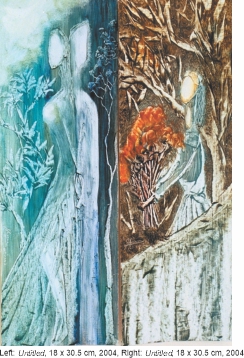
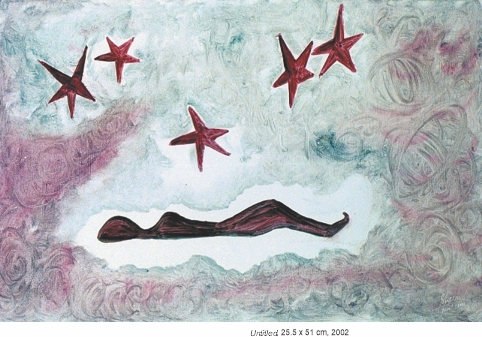
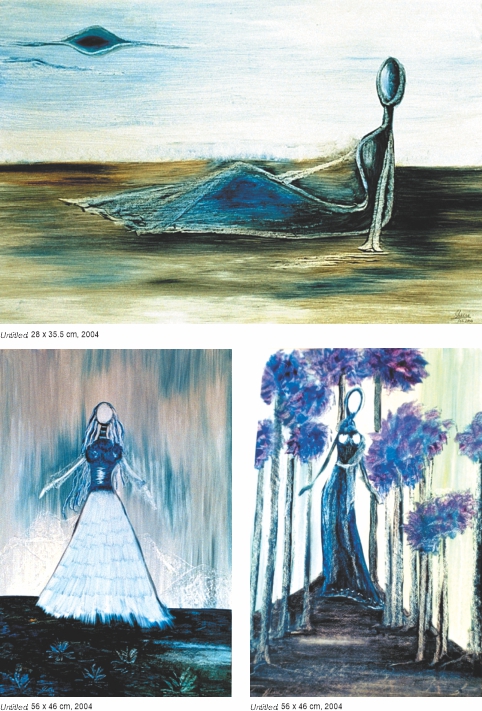
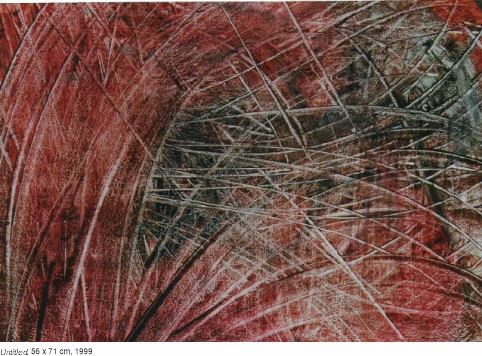
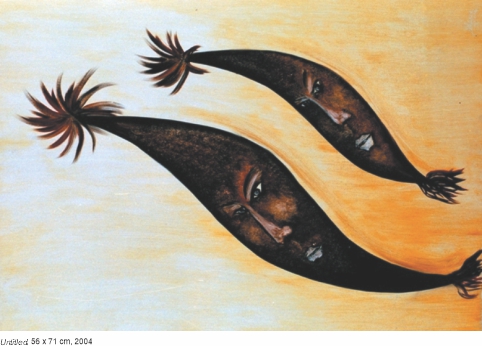
Betnag’s paintings offer a kind of gentle corollary to her ungentle ambition. Painted in vivid, mostly sombre colors, they range from distorted, Nubian faces against surreal backgrounds, and objects that resemble ancient earthen vases and pots, to landscapes that are more intimidating than appealing. These are, in fact, more star- or moonscape than landscape, and they bear a haunting – and haunted – quality in everyday images such as trees, water, even clouds. The viewer who gazes at them will find herself asking some fairly ominous questions: What terrible thing has happened, or is about to happen, here? Why is there such a sense of dread in the air? She may even find herself recalling lines from a Yeats poem:
Now and in time to be,
Wherever green is worn,
A terrible beauty is born.
Betnag has embarked on a patented, if difficult, path: her concerns are not merely figurative, in that she is not interested only in the mimetic representation of people and objects; she hopes to say something about her surroundings, about the time and place she finds herself in, and about her own consciousness when she makes a particular picture.
Trained as a software engineer, She worked for some years at an IT company, which, in a city that is now dubbed ‘India’s Silicon Valley,’ seemed to be the fastest way to a well-paid career. Yet for the artist she was yet to become, the nine to five routine was nothing short of oppressive. ‘I was forcing myself to do it,’ she said. ‘I found myself unable to work for someone and I was clearly a misfit. Besides, I don’t like to work in the morning.’ Betnag began a career as a painter somewhat late in life, several years after she earned her college degree. She had painted on occasion; but in a milieu where a secure job is considered a luxury, it was a hard choice to make between a guaranteed income and a life of financial struggle. After leaving her software job, Betnag took up fashion designing, which she saw as a balance between her creative talents and an economically viable profession.
As a fashion designer she learnt to frame her compositions, to make increasingly sophisticated figures; she learned proportion and measure in a way that would help to develop her painting skills. Indeed, many of the faces in her early paintings, including a sensuously beautiful Buddha, display stone-sharp features; the eyes are elongated, stretched as far as they can go; the lips almost always full; and the noses uncharacteristically long and distinct. These Buddhas—no less serene than those traditionally evoked in countless sculptures, paintings, and wall friezes—are startling departures. They belong to a new, bolder impulse, a tradition still only in its formation, as if a gesture had been made and not fully executed.
Yet for all the forceful expressiveness and sharp strokes in her work, Betnag is untrained; she is almost entirely self-taught save for a 3-month study of foliage technique, which involves detailed study of the natural elements. When asked about the lack of formal study, she likened her work to the solitary labour of a writer. ‘When you write a book, all you need are strong emotions and a vivid imagination,’ she said, as she ordered coffee and fruitcake at Koshy’s, a restaurant and coffee shop frequented by the city’s artists and writers, which has changed very little over the decades. The waiters, unfailingly courteous in an old-world way peculiar to the Indian south, still wear over-starched white turbans and uniforms. The clientele spends hours over a coffee as the afternoon subsides.
‘All my life, I used to say, ‘I can paint,’ but never really painted. I think I was just being lazy, because I was scared to go deep within myself. I knew that once I started [to paint] I wouldn’t be able to escape from it.’
Betnag’s early drawings were mostly sketches; she tried to make portraits but after an aunt told her they were not very good, she stopped. One day, about six years ago, a friend challenged her to come up with a solid body of work. Betnag retreated to her bedroom for a week of intense obsessive painting, and at the end came up with more than 30 pieces.
‘It was clear to me then that I should stop running away from the thing I do best,’ she said.
These paintings were imaginative visions of garden-variety seeds, an immersion into the minutiae of plant life; she eventually made 120 and distributed them as gifts, a generous act which she now looks back upon with mild regret. Once she had chosen to go fulltime into painting, her personality seemed to be drastically at odds with the demands of contemporary art world.
‘I wish I knew how to get along with people,’ she said. ‘There are times when a gallery is interested in exhibiting my work but after they meet me they are not so receptive. Maybe it’s my attitude, my arrogance. I am not soft-spoken. I also can’t relate to a lot of my contemporaries.’
Despite her aversion to self-promotion and acquiescence to commercial concerns—two arguably essential qualities for a contemporary artist to be successful—Betnag has had over a dozen exhibitions in the last five years. These exhibitions were partly self-sponsored and partly sponsored by galleries and hotels, which she admits were mostly a result of her friends’ efforts.
Over the years, she has cultivated a small but impassioned group of patrons in countries that include the Philippines, New Zealand, the United States, and Singapore. Though it has not made her rich, it is enough to pay for her expenses. That her art is appreciated and bought almost entirely by foreigners does not bother the painter. ‘I have never really felt like an Indian or thought like one,’ said Betnag, who declined to reveal her age. ‘Even though I haven’t travelled much, I have always considered myself a citizen of the universe, and not a citizen of India. I seriously think that all artists should be given a special passport that has the word ‘artist’ stamped on it, which will allow them to visit any country without visa problems.’
Moreover, according to her, Bangalore—where she was born and has lived ever since—’is not a very inspiring place.’
‘It is depressing and stifling,’ she added. ‘There is something very important lacking here. What that is, I don’t know.’
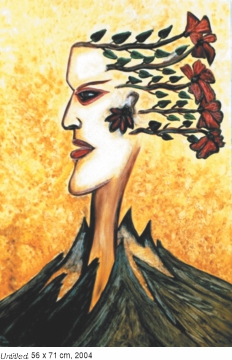
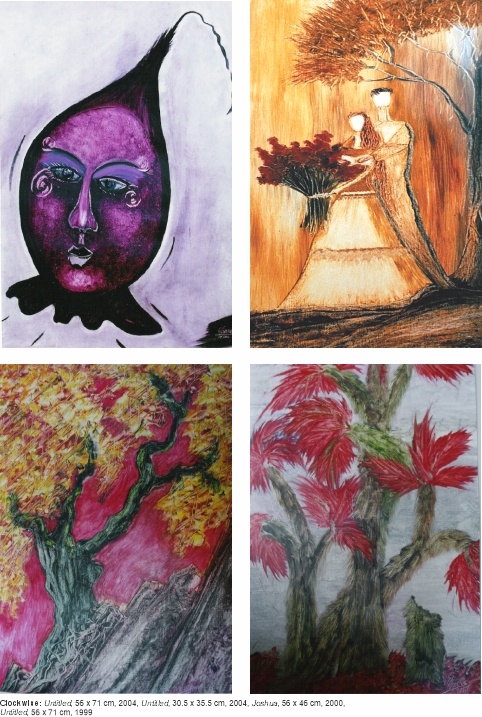
With little external stimulus, Betnag prefers to turn to her imagination. None of the hundreds of faces or landscapes she has painted are drawn from real people or places. Her memories combine with fantasy to create an unearthly yet oddly recognizable quality. Birds and fish appear frequently in her work; most often she gives them a threatening, sometimes sinister, character, as when a bird’s carcass is made to look perversely attractive or a fish seems to be about to devour the moon against a backdrop of tall buildings. These are vaguely unsettling works that hint at disturbances beyond the canvas. There seem to be untold narratives just beyond the frame, as if the objects in the picture were convulsed with an uncontrolled inner life.
‘There are two things that affect my process of composition,’ Betnag said that afternoon. ‘There are ideas that are always forming in my head. And then there are ideas that take hold of me when I have the brush in hand. I know that my paintings have no soft emotion; they are strong and they attack you. They express themselves too much. Sometimes I feel that that is my weak point.’
‘Once I am in front of my canvas, I become confident and commanding, though I know when to let the brush take control. If the brush wants the eyebrows to point upwards, then that’s the way it is. Perfection in that sense can be a dangerous thing for art.’
In post-independence India, it was mainly Bombay, and later Delhi, that served as dynamic hubs of contemporary Indian art. But now with increased urbanization of various parts of India, the artistic focal point is moving away from these cities. Among the country’s most noteworthy modern artists is Yusuf Arakkal, from India’s southernmost state of Kerala. He is primarily a figurative painter whose work is exhibited abroad and has won several awards. He is one of the few Indian artists whose work Betnag admires and it not hard to see why. The two painters have something in common a dismay at the depersonalization brought about by the rapid mechanization of their hometowns. They also share an implacable sense of alienation apparent in their choice of colors—murky and portentous—and the way with which they paint the disembodied faces and contorted bodies often found in their work.
Betnag’s medium is primarily oil on canvas though she recalls a time when she couldn’t afford to buy anything besides crayons. When a little more flush in funds, she likes to surround herself with a plethora of oils and a variety of brushes.
‘There is something to be said about having a surplus,’ she said. ‘Having all these colours around me makes me feel rich in a way that diamonds or cash cannot. Even when it comes to buying frames, I get the most expensive ones I can afford. I want my paintings to get the royal treatment.’ Away from her tools, Betnag becomes a different person altogether—’vulnerable, difficult, and belligerent,’—especially when she wants to paint and cannot. Where other artists wait for the day when their work can finally be seen in public, she dreads exhibitions because ‘they take so much away from you.’ She is uncompromising when it comes to creating custom-made paintings, a common practice in India where the majority buy art either as an investment—Citibank India recently opened a consultancy service, along with a magazine, Art Venture, to advise investors on art portfolios that will capitalize on the burgeoning appreciation of Indian art, especially by dead painters—or simply to match their furniture.
‘There are so many people who come to me saying they want this color, this pose, and this mood to be created,’ she said. ‘I tell them I’m not a carpenter or a tailor. A painting should stand out and not blend with the décor.’
Yet, working as a painter, and living as a single woman in a major city for six years, has made Betnag less intransigent than before. She recently made a trip to Hampi, a city about 200 miles from Bangalore, and returned with a large collection of drawings of the temples that the place has earned its fame for. It is the first time she has drawn from real landscapes, and it marks a substantive change.
‘Painting purely out of my inner life was getting more and more painful,’ she said. ‘It refreshed my pain in a way that I did not want or could not handle with restraint on the canvas. The more time I spend painting the more flaws I find in my work, and the more I read about the great artists of the past the more lazy I feel.’ Betnag’s self-flagellation is hardly deserved. As an emerging and acutely self-aware artist in the promising art scene of Bangalore, she may be poised to become a formidable presence, the amateurish rawness and unreserved emotions of her early paintings already giving way to a more distinct, controlled and forceful line.
But for now she is content with her uphill struggle, even enjoying it.
‘All artists should have to struggle,’ she said. ‘If they don’t struggle, they don’t bring their best to their work.’…
‘Getting there shouldn’t be easy.’
Shakti Bhatt is a writer and filmmaker. She divides her time between New York and Bangalore
Is art for the masses or for those with more refined tastes? The question, so often asked and so often unanswerable, has probably been around as long as art itself, which is to say a long, long time. The romantic and socialist ideal of creating art that lies within the grasp of the majority is…