

shahzia sikander’s art of destabalization
My first encounter with Shahzia Sikander’s work was in 1992. It was at a group show of recent graduates of National College of Arts that displayed selected parts of their thesis at Nairang Gallery in Lahore. The exhibition had been inaugurated by her mentor, Zahoorul Akhlaq, Pakistan’s eminent modernist. I remember Zahoor, usually a reticent man, being excited about the breakthrough in miniature by Shahzia Sikander
This was the only time the artist showed her work in Pakistan because shortly after the exhibition she left for Rhode Island School of Design to complete her Masters and since then has settled in New York. In the last decade not only has she been invited to exhibit at prestigious galleries but also received widespread acclaim in the art centres of the world.
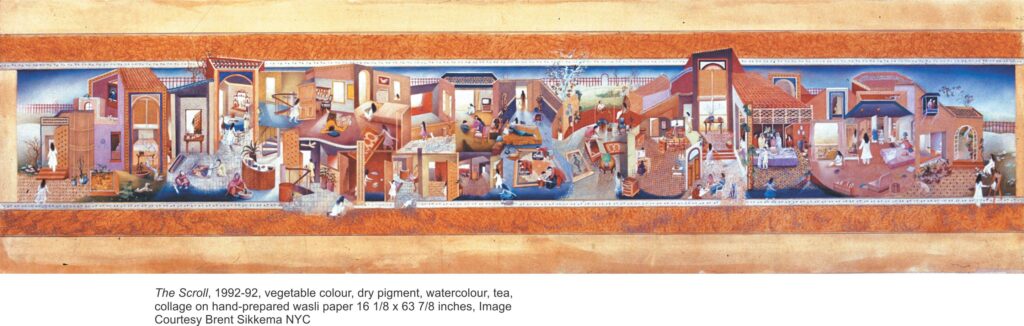
Her autobiographical scroll exhibited at the graduates show was executed in miniature technique. In retrospect, it can be seen as the genesis of her oeuvre both in terms of a personalized response to her environment and an exploration of a traditional art. This 5′ x 1′ scroll was impressive in the flow of its pictorial narrative in which the artist had skillfully encapsulated events and locations from her life into a cohesive visual.
Even at this point Shahzia was seen as an extraordinary talent. Reviewers responded with enthusiasm to her work. For instance, Munir Ahmed noted that ‘narrative style and spontaneity are the distinctive innovations of Shahzia Painting’. While in Friday Times, Rina Saeed Khan declared: ‘… Shahzia has demonstrated that miniature painting can be interpreted and revived in a modern context’. Salima Hashmi as a faculty of NCA, in one of her reviews of the thesis show, gives an insight into the debate of the relevance of miniature that had been in question for several years. She states ‘… Shahzia Sikander’s thesis exhibition has begun to settle arguments and has paved the way for future exploration and relevant expression’. Shahzia herself had confessed shortly after her graduation: ‘ People have this prejudice that miniature is a dead art and to learn it is to retard one’s creative abilities. I want to prove them wrong—it has to offer more than just pure craftsmanship’.


At this early stage of her career the artist was confident of the rich aesthetic possibilities offered by Miniature Painting and had begun to challenge herself to rediscover and re-energize the idiom despite societal indifference. In ‘The Scroll’—the title she gave to the personal narrative—Shahzia boldly mines the rich conventions. Meandering walls that diagonally cut across the horizontal composition to form intimate alcoves or open into outdoor vistas resonate with construction of architectural space within Mughal miniature to compartmentalize the stacked up perspective. Architectural details like archways, surface decoration like patterns and filigree carvings recreate the ambient motifs that appear so integral to the depiction of built space.

‘I had grown up thinking of it as kitsch. My limited exposure was primarily through work produced for tourist consumption,’ notes Shahzia about her early impressions of this art form. The legacy inherited by Shahzia in the late 20th Century may have become clichéd in the hands of master copiers but South Asian Miniature Painting at its glorious peak was neither ‘fixed’ nor moribund. It was dynamic and innovative like any art form that is fueled by political, cultural and social changes. When downward spiral of miniature painting was heralded by the loss of political power of its generous, influential and informed patrons it left many artists destitute. Some were forced to adapt their skills to the needs of ‘company drawing’, the state sponsored art of East India Company promoted to document the cultural diversity of India and its own successes for posterity. Those who remained true to their calling barely survived by selling their precious art for a pittance in the bazaars of India.
Shahzia Sikander’s had teachers like Ustad Bashir and his masters, leading Pakistani miniaturists Haji Sharif and Sheikh Shujaullah, come from this lineage of uncompromising court artists. It was almost as if they had preserved it for another generation to re-energize its creativity.

Zahoorul Akhlaq, the then head of the Fine Arts Department of NCA, became the catalyst that created the enabling environment for the revival of South Asian miniature painting. In his own work he had begun to explore the conceptual possibilities within this multi-dimensional art, and tried to foster the spirit of academic inquiry through the art curricula. Once a study of the conceptual content and technical skills of miniature was initiated, miniature painting was taught with a renewed intellectual vigour. It encouraged young artists to push its existing borders. These pioneering experiments gave the graduating class of 1992 and the graduates that followed, the confidence to subvert tradition. As dozens of artists became a part of this development, it led to a Neo-miniature Movement in Pakistan.
Shahzia, among the earliest exponents of this revival, explains that the movement started though her finding ‘ways of stepping outside the tradition in order to create a dialogue with it.’ From her creative position outside the tradition she could freely engage with the syncretic history of the South Asian miniature and investigate and peel back its layers of cultural sediments. In fact, Miniature painting in this region can trace its origin to Pothi that is illustrated manuscripts on palm leaves. Over centuries it assimilated the influence of other pictorial conventions to shape its distinct iconography used to express religious and secular themes. The Persian School Miniature was a major intervention in the visual arts of the region when Babar, the founder of the Mughal Empire, promoted it with great zeal as a part of his ancestral cultural identity. His son Humayun, an erudite and cultivated ruler, fulfilled his father’s dream by ‘importing’ two important miniaturists from the Safavid Court to initiate the royal Mughal ateliers. The energetic interface between the Persian Miniature and indigenous Indian art took place when local artists, many of whom were Hindus, brought their own sensibility and technique to the new artistic enterprise. Akbar’s ateliers at their peak employed 1000 artists to execute ambitious portfolios. Both in content and form we see the legacy of Persian miniature evolve its own characteristics, later referred to as the Mughal Miniature School. The synthesis of Persian elements like the portrayal of humans, architecture and landscape and the more local conventions, particularly the enlargement of details and broad panels of saturated colour mark this transition. Akbar, an enlightened ruler, was holistically inclined and gave a free hand to painters involved in the assimilation of non-Persian influences. When Akbar invited Jesuit priests to his court and the artists were exposed to European religious art it led to experiments in fixed perspectives and chiaroscuro.
Since the ruler was so personally involved with the art that came out of his studio it was not surprising that it often bore the stamp of his personality. Jehangir retained only the most outstanding talents and their oeuvre documents animals and flora with a zeal never seen before. Allegorical painting began to appear frequently and the halo around the head of emperors and holy men was a more concrete manifestation of the miniaturist’s study of European religious paintings. The elaborate borders in Shahzia’s work resonate with the memory of this era. Even though Shah Jehan’s passion lay in building, his ateliers were able to produce such a sumptuous manuscript as the PADSHAHNAMEH, the architectural grandeur of his Diwan-e-Aam, (the court of public audience) when evoked in images like ‘Gopi Crisis’ at one level point to the artistic excellence of the Mughal Court. On a feminist level, it is the absence of women at these courts, despite the contribution of Mughal women particularly Nur Jehan, that the playful presence of the Gopis address.
A critical study of what has been viewed as a decline in Mughal miniature painting reveals that the decentralization of patronage that began after Jehangir disbanded the large ateliers of Akbar and accelerated the production of sub-imperial painting in different parts of India. This also gave provincial miniature painting that pre-dates the Mughals a new lease of life under a renewed interest in miniature painting. Regional tastes, thematic preferences and cultural sensibilities dictated the content and style of the prominent provincial schools of Deccan, Rajasthan and Bihar.
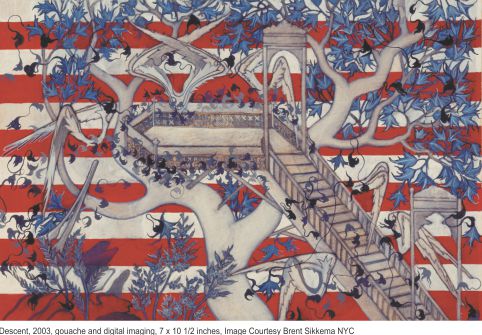
Against the backdrop of this rich and multi-layered legacy, Shazia did not let ‘the stylized genre…. that had more to do with craft and technique than genuine expression’ in any way limit her. She assimilated a diversity of stylistic influences and expanded the genre conceptually. The theme that runs through her oeuvre began with expressions of an experience of displacement and migration that compelled an engagement with and reading of the new culture. The lived experiences of her cultural encounters are interpreted through new symbols and established symbols are invested with new meaning. The CHALAVA, an Urdu term that describes an imaginary creature who is always on the move, emerged in her work. Shahzia defines it as ‘the signature figure evolving as an image of a self-nourishing, interconnected form, refusing to be grounded, to be stereotyped. It mirrored my own state of being’. The loaded symbol of the Chalava combined the amorphous shroud of the burqa with a closed hood fitted with a mesh that allows the wearer to see the outside world. The form is redolent of a similar garment worn all over South Asia that is referred to as the ‘shuttlecock burqa’ in local parlance. To indicate Chalava’s restless mobility, instead of feet, which are usually visible under the veil, Shahzia creates looped aerial roots. In an interview with me in the late 1990s Shahzia explained how the Chalava form had emerged from a heightened sensitivity as she wore a burqa at different locations in the US to get an insight into
how the veil can change the dynamics of visibility and interaction between people. By feminizing the Chalava, which in Urdu has no specific gender, Shahzia makes it an extension of her own identity that was shaped by her ‘diasporic’ experience, which she terms as ‘ a pleasing displacement’. After her short stint in Houston, cowboy boots began to appear in her work. This embroidered footwear particular to Texas brings into focus the issue of sub-identity within a larger national one. In South Asia, where after every few miles the dialect changes and tribes with distinct apparel markers are common sight, pluralism can be a way of life. The boots also highlight how hyper-masculine identities like that of the Texan male are embedded with an unexpected feminine sensibility that manifests itself in this kind of handcrafted intricacy usually associated with female apparel. The same is true of the patriarchs from Punjab who do not find donning their elaborately embroidered kurtas ( tunics) in any way in conflict with their ‘macho’ image. The other footwear that appears alongside the leather Texan boots in ‘Riding The Ridden’ and features prominently in ‘Uprooted Order 1’, is the minimal ‘karaon’ or wooden sandals with its elevated soles and knob like toe grip. This unisex footwear is particularly popular among orthodox Hindus of South Asia who find the use of cowhide objects sacrilegious. Taken out of their context, emblematic images can engage as an entry point into each other’s culture.
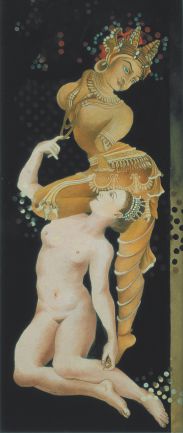
The layering of identity seems to be under investigation through binary opposites in Shahzia’s banner for MOMA, New York, ‘Maligned Monsters’. Two established female icons from history intertwine their nude bodies in an arabesque curve to create a visual synergy. The bejeweled absara and tiaraed Venus, both an epitome of classical beauty in their own culture, fit tightly into the vertical space of the banner. The title of the image with its reference to Partha Mitter’s corpus ‘MUCH MALIGNED MONSTERS’ further narrows the focus on the West’s traditional notions of the East that revolve around viewing their differences as exotic rather than entering into a dialogue. In this MOMMA banner Shahzia accepts the cultural polarity and expresses a desire to move beyond it.
Medium and stylistic representation is central to the language of miniature and Shahzia’s work feeds off this diversity. The unexpected is ever-present as randomly selected icons and images find themselves fused into a tightly knit transformation. They refer to their origin only in passing. The Duality that persists as a meticulously rendered cast of characters in one work can be replaced by spontaneous gestural washes with few recognizable forms in another.
Elements like tiny white dots that were used for pearl jewellery by the Provincial Miniaturists are playfully expanded to populate the painting like a translucent screen and is seen at its most versatile in ‘Pleasure Pillars’ (2001). It is the elastic expansion of pictorial devices that de-links contemporary miniature painting from exotification and keeps it dynamic. The ‘Chaman’ with its literal translation ‘garden’ (2002) is an installation constructed like an enclosed space with tissue scrolls bearing elusive images of flora and botanical specimens. These layered screens of paper evoke the spatial depth and colour of a garden. These vignettes of nature had a special place in the Mughal sensibility. Not only were they found on the miniature format, but they tantalized the senses in ‘pleasure gardens’ like Shalimar Gardens, located in Shahzia’s hometown Lahore. Shahzia’s Chaman is true to this promise and appeals to the sensory and the visual simultaneously. According to Shahzia, these installations are ephemeral and provide her with an opportunity to be free of the miniature’s spatial constraints.
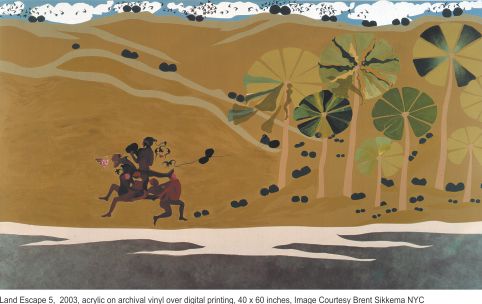
In recent years Shahzia has begun to work with digital animation. She says that ‘combining a non-traditional medium with a traditional genre allows her to build a relationship between present and past, space and dimension, narrative and time—all in the service of destabilization’. Her work centres around the way truth is hidden behind layers of information that alter perceptions. In ‘Intimacy’, the short animation alludes to the various stages in the process of building a miniature painting. According to Shahzia, ‘Introducing a non-painting process into the equation allows for the extension of a dialogue that pushes the experience of viewing into one of understanding, tracking, questing and, investigating it.’ Her most recent exhibition in New York, March 2005, is ’51 Ways of Looking’. According to the text of the press release, the imagery in her animation piece ‘Pursuit Curve’ ‘is inspired by landscape and its connection to human history’.
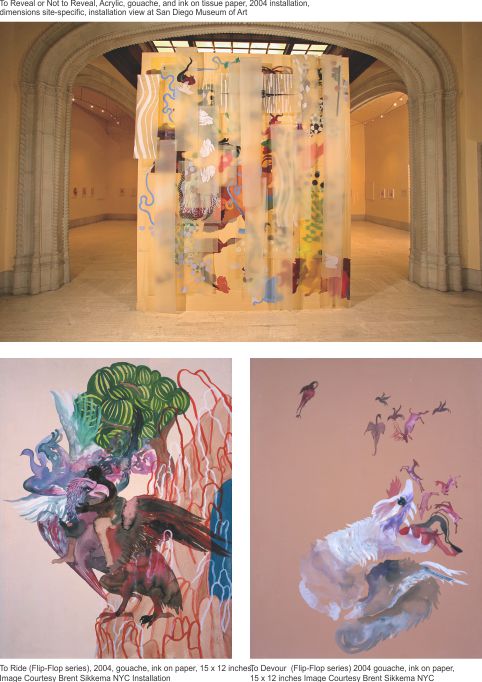
Shahzia thinks of herself as ‘a cultural anthropologist’ and her aim has been to collect and project the information of our time’. I find open-ended encounters and narratives compelling and perhaps seek to express that more than anything else’. To build a new discourse from the miniature aesthetics, Shahzia deconstructs the tradition by delinking symbolic forms and spatial interpretations from their original relationships with ever-changing configurations. Fully cognizant with the power of their cultural, and sometimes religious expression, she expands conceptual limits to encompass the contemporary. Shahzia’s emblematic imagery underpins an artistic and personal experience that is not without the tension of conflicting desires. The desire to be true to some aspects of the tradition is constantly challenged by her voracious appropriation of images from her immediate environment of popular icons. This process has allowed the morphing of the miniature into a genre that embodies all that is contemporary and yet has the resonance of the civilizational spirit of South Asia. This ability to weave two cultures—Pakistani and American–into a seamless creative matrix and address sensitive issues, has plotted the expansion of her identity and given strength to the duality within her expression. Her work is to be found in collections such as those of MOMA, Whitney Museum of American Art and the Guggenheim Museum. Her participation at prestigious shows like the Seville and Istanbul Biennials tells us that the paths of transformation taken by Shahzia have destabilized the conceptual balance between the periphery and the centre by finding a place for South Asian Miniature Painting in the global art discourse of the 21st century.
Niilofur Farrukh is an art critic, historian, curator and art activist and author of Pioneering Perspective. She is on the Advisory Council of the Pakistan National Council of the Arts. She is the President of AICA Pakistan, the national chapter of the Paris based International Art Critics Association
My first encounter with Shahzia Sikander’s work was in 1992. It was at a group show of recent graduates of National College of Arts that displayed selected parts of their thesis at Nairang Gallery in Lahore. The exhibition had been inaugurated by her mentor, Zahoorul Akhlaq, Pakistan’s eminent modernist. I remember Zahoor, usually a reticent…