
accidental artist tony twigg and the asian found object
Tony Twigg’s decade-long engagement with the Philippines has led him on a journey from figuration to abstraction. Turning to the found object and bamboo, Twigg has defined a personal style that sits beyond geographic borders. His timber constructions take us on a discovery of ‘art’ in the accidental and everyday
Tony Twigg (b.1953) first visited the Philippines in 1993 while returning to Australia from a screening of his film Parade at the Cork Film Festival. Since then, he has divided his time between Manila and Sydney, recently extending that engagement to Malaysia and Singapore. The cadence of moving between locations has become the latest buzz in visual art circles, where artists are described as ‘border jockeys’, as slipping under ‘ethnicity radars’ or ‘dallying in transitory migration’. Twigg sits outside this fashion. He falls within a long lineage of Filipino artists who have engaged with the found object, environmental installations and a modernist aesthetics, artists such as Junyee, Roberto Villanueva, Alfredo Aquilizan and Lao Lian-ben. But where does that tradition point today, and how do artists such as Tony Twigg sit within an Asian dialogue through the found object?
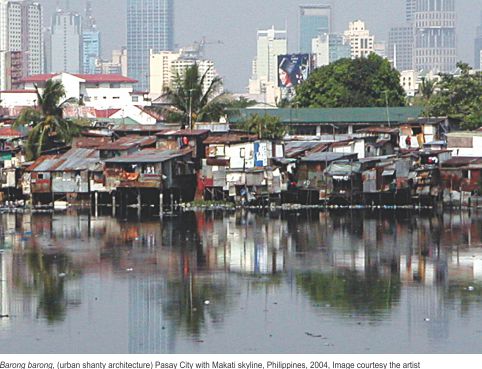
Twigg coined the phrase ‘accidental art’ to describe the intuitive construction of an urban infrastructure and discarded everyday objects that, when examined in spatial terms or as patterns of line and surface, are as true to the definitions of modern art as a Robert Rauchenberg assemblage or a construction by the celebrated Australian collage artist, Rosalie Gascoigne. It was the barong barong, spontaneous Filipino shanty architecture, which provided Twigg with the inspiration for his early drawings and constructions. Made from the seemingly random collections of found wood and metal sheeting, these anonymous shelters have an intuitive, raw aesthetic that appealed to Twigg. In his eyes, they had the spatial order of contemporary installation and evoked the cubist space of George Braque.

filipino installation
No one knows for sure when installation art in the Philippines began. The term itself gained currency in the West in the 1960s and ‘referred to temporary assemblages that physically dominated an entire interior space … a synthesis of sensory impressions that overwhelm[ed] the spectator’. Emerging through a kind of tug-of-war between the attraction of International Style and a search for cultural identity, the trend to use indigenous materials started modestly in the sixties when artists began incorporating found objects into two and three dimensional works, building to its pinnacle in the 1980s.
It is a history ushered by artists Junyee (Luis Yee Jr.) and the late Roberto Villanueva, renowned for their use of bamboo, seedpods, bark and vines — essentially found materials. It was a different way of approaching art making and was deeply charged with social and political connotations, asserting ideas of identity and celebrating traditional art forms to counter the incursion of global art activities. It is a familiar story across the developing world, and one that has contributed to the strength of regional diversities. But what has this to do with Tony Twigg?
Twigg once quoted Junyee saying to him that they were the same because they both wanted to make art out of their own backyards. ‘For Junyee this idea carries the strong nationalist overtones of a culture emerging from an era of colonisation. I share Junyee’s point of view, but in Australia the era of colonisation is being maintained, witnessed by its failure to become a Republic. …My engagement with Filipino Art is a step away from that position towards Junyee’s idea, and it is automatically reflected in my choice of materials.’
Junyee’s pivotal installation ‘Extinct Future’ 1983, followed a year later by ‘Unpath’, and Villanueva’s huge outdoor sitework at Cultural Centre of the Philippines, ‘Cordillera Labyrinth’ 1989, a concentric maze constructed from bamboo and runo grass that took its cue from Smithson’s ‘Spiral Jetty’ 1970, were pieces instrumental in shaping the acceptance of environmental siteworks and installation as a contemporary art form in the Philippines. Together with a push towards conceptual art during the 1970s and 1980s, led by artist-teacher Roberto Chabet, experimentation through installation was spurred on. At this time, Filipino artist Lani Maestro bagged the top prize at the 1986 Havana Biennial in Cuba for a politically-inclined installation using found objects and indigenous materials , bringing together these two strands of thought in contemporary Filipino art. Enter Baguio artist Santiago Bose, who during the 1980s combined indigenous materials with shamanistic talismans, an edgy ‘street’ rawness and the wit of popular culture, what results is a framework that shaped the generation of artists that followed. This combination of activities led to the establishment of the Baguio Arts Festival in 1989, a performance / installation based art event in North Luzon, steered by Villanueva, Bencab, Bose and other artists.

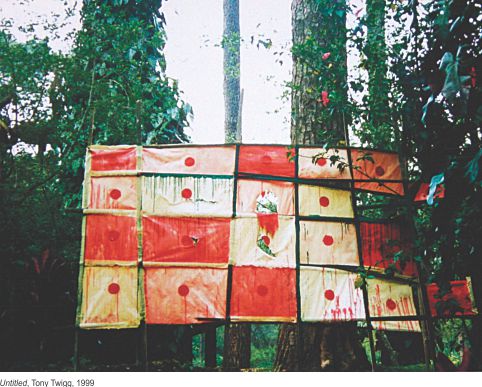
Tony Twigg participated in the 1999 Baguio Arts Festival with a work made from bamboo. A kind of environmental screen stretched with a skin of paper that would eventually return to pulp, its grid structure echoed that of urban scaffolding. It was a minor work for Twigg but one that would set him on a trajectory that responded to a Filipino landscape and placed him within this rich and layered history of Filipino found installation.
Today, Filipino installation artists have expanded this language of found materials beyond nature to encompass everyday objects that address contemporary ideas—artists such as Alfredo and Isabel Aquilizan and Alwin Reamillo. This intersection, or Filipino hybridity, is the place where Tony Twigg’s work sits today.
intersections
An installation that embodied this hybridity was a piece Twigg made for the Daet International Eco-Arts Festival (2003) in a regional Filipino fishing community. ‘We are reminded of ourselves by what we leave behind’ was the title of this ephemeral work composed of a single line of 64 bamboo poles that stood erect on the beach, parallel to the shoreline and soaring some 35 feet high. It is part of a tradition of Filipino bamboo installation easily traced through Villanueva’s bamboo masterpiece ‘Cordillera Labyrinth’, and carrying the same sensitivity to material and an engagement with space.
The interplay of the structure’s physical presence and its shadows cast long on the beach were integral to Twigg’s piece, moving it beyond a single dimensional plane. Sitting like a bamboo fence on steroids, its scale threw one off balance, forcing beach-goers to move through the work and experience it on different levels. Twigg individualized the bamboo with objects found around the coastal community – rusted metal, capiz shells, plastic bottles. The objects were transported beyond an ethnographic gesture to embody a community and question the fragility of its environment. Another work, some meters up the beach from Twigg’s installation, that also captured that ethos was that by Alfredo & Isabel Aquilizan, internationally renowned for their installations of found objects at biennales in Havana, Sydney, Venice, Fukuoka and Busan.
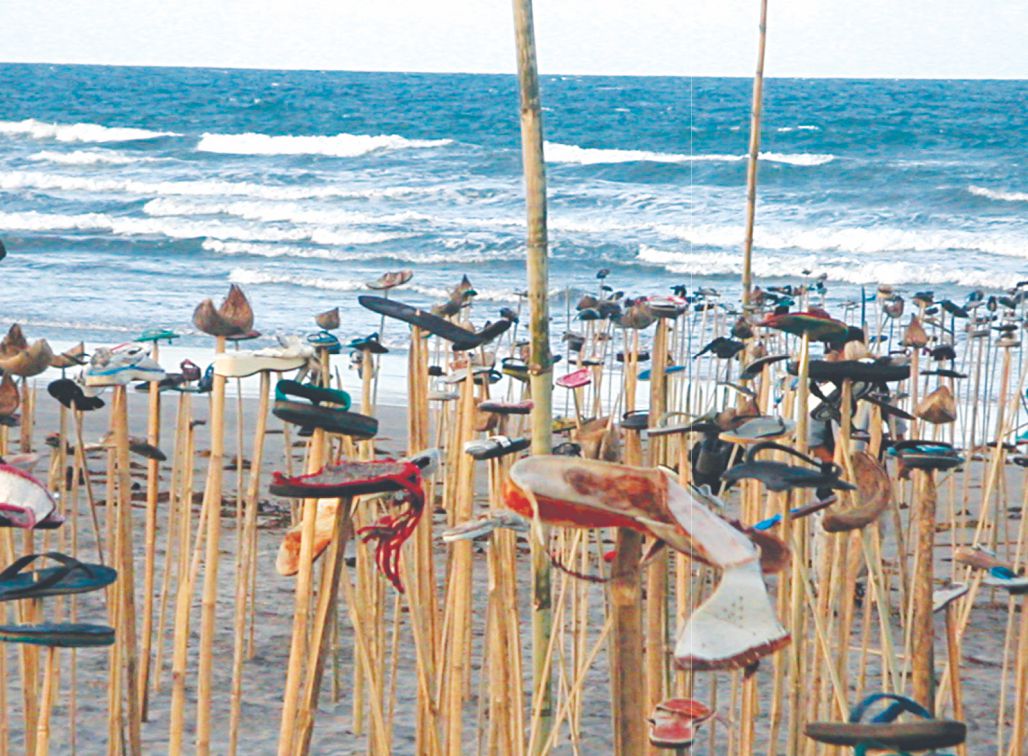
For their piece ‘Daing’, Aquilizan collected all the rubber slippers that washed ashore on the tide, installing them speared on bamboo shards in a kind of flotsam and jetsam hovering waist-high over the sand, returning to the sea metaphorically as a school of fish. The parallel between Aquilizan and Twigg, apart from their constant moving between locations, is that they both have an intuitive ability to capture and distil the essence of a place into a single object or material. We see these ideas re-emerge in a later work by Twigg, ‘Sugar Ballads in Bamboo Sticks’ (Pinto Gallery, Antipolo 2003). Just as Twigg used bamboo at Daet, here he sliced the bamboo in a manner that offered a curious intersection between his childhood in Queensland (Australia) and the sugar-fields of Negros (Philippines) where this piece was made. It is a simpatico that connects his work across borders.

drawings in space
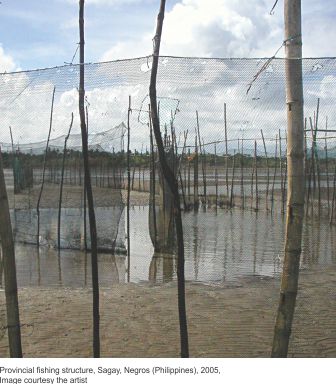
Twigg’s art could simply be described as ‘drawing in space’. His pencil is the ‘found lines’ of an Asian landscape: the lines of a fish trap, the rhythm of a provincial bamboo fence, the density of a field of sugar cane, the overlaid grid of bamboo scaffolding, or the verticality of a sapling forest. He seems to collect these ‘natural lines’ as a bank of memories, a kind of subconscious dictionary that he draws upon and which meld together with time. As he says, ‘Drawing for me is thinking. When they are completed all that separates my drawings from my installations is their size.’
‘Sugar Ballads in Bamboo Sticks’ illustrates this idea, essentially a line drawing in three-dimensions where the gallery space becomes the blank page. Twigg wedged 38 sticks standing ceiling to floor that, collectively, defined the parameters of the room. It was the scale of domestic architecture and challenged how we think about drawing. Twigg again forced visitors to weave through his installation, but this time in a kind of slow dance, as if passing through an enchanted forest. He had discovered the delightful push and pull of space; it was weightless, whimsical and layered and marked a new direction in the work.
What followed was his installations started to become more animated. The rigid line of the bamboo became totemic, taking on an anthropomorphic quality marching through the landscape. His two installations ‘Grove’, made for the ‘Domain’ sculpture festival (Woden, Australia 2004) and ‘Sculpture by the Sea’ (2004), a festival along Sydney’s famous Bondi Beach ocean walk, combined eucalyptus branches found in the Australian bush with milled woods, such as ply and plantation pine. It was strongly geometric. Some have even likened these new forms to Pukamani poles, the vertical grave posts of Aboriginal Australia, but such connections are subconscious and only point to the complexity of our visual heritage, regardless of place. For Twigg, working in Asia such politics of association start to fall away, as ‘visual connections’ become a shared abstraction, and if anything, take on an Asian sensibility. This is where Twigg’s work differs from his Filipino colleagues, such as Aquilizan and Reamillo, who use the visual connections to form a political statement.
objects as meaning
Twigg’s engagement with Malaysia echoed his earlier interest in Filipino barong barong, but was pushed to a new level of engagement—or dis-engagement—as he stepped away and allowed his constructions to be entirely directed by the found object. It reached a pinnacle with the work ‘MT Madras’ (2005), a discarded crate from Madras found in the backstreets of Kuala Lumpur. Playing only the role of conservator, Twigg arranged the elements of the crate and stablised his ‘found painting’. It presented an exciting and instructional lesson in how we look at the objects around us, and made us question how we define beauty.
Twigg explains, ‘Slowly, I’ve become aware of how subversively an object can be spirited. Accidental art has a great deal of beauty that I try to emulate by considering the making process rather than considering what beauty looks like. The result is a set of elementary forms that have a certain universal understanding common to places like the Vietnamese river village of Chau Doc, the border town of Pasir Mas in Malaysia or the spontaneity of Manila’s urban scape. Put these objects in cities like Sydney or Singapore and they instantly become exotic.’
This re-definition and integrity for the object is superbly illustrated in Twigg’s work ’24 Fish boxes'(2005). It is composed of eight units each made through the spontaneous joining of three found ‘fish boxes’, used in the wet markets of Malaysia. For Twigg, these crates presented an interesting proposition as they too were found made objects, constructed from the timber off-cuts of the saw milling process. It was the spirit of a conversation with another maker that excited Twigg, a practice he described as, ‘an anonymous jam-session’. What is curious in the context of Malaysia, where the hand-made object is all but non-existent, eroded through a complex social, economic and religious state, is that Twigg re-engages that intuitive process of ‘making’ that is so completely integral to the Philippines and ushers in an appreciation for the found object in Malaysia. This appreciation is not about ‘transposing’ cultures but an awareness of the visual intersections.

abstract space
Twigg’s constructions sit somewhere between paintings and wall sculptures. Visually abstract, they hang on the wall as a painting would, but like a 3-dimensional sculpture, they play with positive and negative space and the movement of light and dark across the surface. For him, ‘The space between the objects becomes a vital force, as dynamic as the objects themselves. Rhythm develops automatically in the placement of objects, like a heartbeat, as we move through spaces. We are reading between the lines, observing what is defined by objects, rather than what is stated by an object.
Twigg’s excitement and sensitivity for assembling space through the arrangement of found objects, is an abstract notion and one also celebrated by the great Russian-American sculptor Louise Nevelson and father of modern collage, German artist Kirk Schwitters. These artists embraced the expression of modern, particularly urban, life. Twigg’s engagement with the Asian found object is about that urban space and is not the space of an Australian landscape. As he explains, ‘You and I might see U-shaped canyons walking through the city, but a town planner or crane driver would probably see it differently. In that sense, the way we think about space becomes the system for our aesthetic. The idea of stacking space, and how that establishes illusionistic depth without referencing perspective, I think, is essentially ‘Asian’. This is what I am attracted to.’
Essentially, Twigg is talking about the space of an over-crowded city, abstracted and celebrated. Usually when we think of space we think in 3-dimensions, as sculpture. Twigg continues to challenge these ideas. Recently, he took one of his found object constructions made from a fruit crate and traced it onto canvas. The painted object became a negative of the real object. It was a different move for Twigg, but one that carried the same spirit of random placement found in his constructions. The new paintings look at the placement of objects: behind, in front, at the side. Distilled to lines along a horizon, there remains an echo of a bamboo forest or barong barong but viewed from a different angle. This is what sets Twigg’s work apart. It is a single coherent conversation over the past decade that transcends medium and location.
While considering Schwitters’ work, Klaus Rathert commented ‘Looking to the future does not prevent us also looking to the past. If anything, the two complement each other.’ Twigg’s work epitomises Rathert’s statement. As his work moves to a more reductive position – sometimes stepping away as ‘artist’ and allowing the object to speak, on other occasions meticulously working into the surface with thin veils of paint, or perhaps working with the spirit of the object in a painting—Twigg constantly moves between time and place, operating somewhere on the boundary between art and life.
‘By putting the object on the gallery wall—in whatever form—I am given the opportunity to examine it more closely. The end point is a more articulate awareness, and my engagement with the object challenges an examination of myself, and my aesthetic. It is a continuing journey, and that journey through the everyday is the interesting part.’
Tony Twigg is represented by Galleria Duemila, Manila and TAKSU Singapore. For more visit www.slot.net.au
Gina Fairley is a freelance writer moving between Manila, Singapore and Sydney
Tony Twigg’s decade-long engagement with the Philippines has led him on a journey from figuration to abstraction. Turning to the found object and bamboo, Twigg has defined a personal style that sits beyond geographic borders. His timber constructions take us on a discovery of ‘art’ in the accidental and everyday Tony Twigg (b.1953) first visited…