
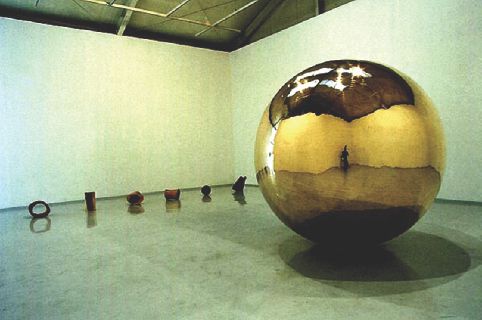
modern korean sculpture
Modern sculpture was introduced to Korea in 1923 by a young artist named Kim Pok Chin(1901-1940). He entered the Tokyo School of Fine Art in 1919, and won the entrance prize in a competition which was held by the Japanese government in 1923. He returned home to become the first Korean ever to be trained in the Western style of scupture. His wood carving ‘Baikwha’ (1938) and plaster modelling ‘Standing Boy’ (1940), produced just before his death in 1940, marked the climax of his career. Unfortunately, all of his work was destroyed by a fire when Chinese soldiers occupied his younger brother’s publishing company during the Korean War. Thus, we can only see reproductions of works published in catalogues.
A few other students then enrolled in the same Japanese institution in order to study modern sculpture. Those artists, including Kim Jong Young, Kim Kyong Sung, Yoon Hyo Joong, and Yoon Seung Wook, soon joined Kim Pok Chin in introducing sculpture influenced by European traditions to Korea. They were mostly absorbed with sculpting portions of the human body such as heads, torsos and costumes in a realistic manner, which they had learned in Tokyo, where academic realism prevailed. These sculptors were active in presenting works at national art exhibitions held annually under government sponsorship both in Seoul and in Tokyo.

One of Kim Pok Chin’s pupils, Yoon Hyo Joong presented the wooden sculpture ‘Shooting Arrow Woman’ at the official exhibition held by the colonial government in 1943. This work captures movement unlike any other work produced by the sculptors of the same generation. Stable proportion, contrapposto and skillful treatment of material are not only the evidence of good training from the Japanese academy but also demonstrate the artist’s talent. However, since early modern sculpture under colonialism was extremely weak, the first generation of sculptors had to suffer from a lack of information, new vision and creativity. In this aspect, the mainstream of modern Korean sculpture relied on a representational manner which was often an interpretation of Japanese models.
Since Korea’s colonization by Japan in 1910, Korea’s link to the outside world was largely coloured by Japanese goodwill. It is from this general perspective that the overall background and development of sculpture as a major aesthetic movement in modern Korean history should be viewed. By the 1930s, however, the national circumstances were far from conducive to lively activity among artists, as Japan was pulling its colonial reins ever more tightly in preparation for World War II. In 1945 Korea was liberated, but the overall situation did not improve and actually became even more hostile for aesthetic creation, as the southern half of the peninsula headed into ideological conflicts and military confrontation with the northern half.
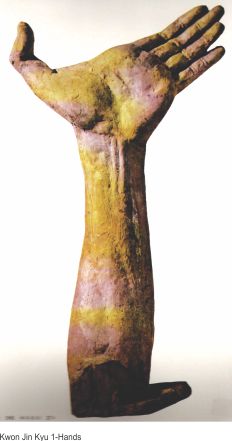
Admiration of Western sculpture breathed some life into the activities of Korean sculptors during this unstable period, however. Yoon Hyo Joong met Marino Marini in Venice in 1952, and was greatly influenced by the famous sculptor and his works. Kwon Jin Kyu, who studied in Japan during the colonial period and also lived in this unstable period, represented the existential agony of individuals. His small terra cotta figurative sculptures showed originality. In 1973, he killed himself in his studio out of despair at the failure of human relationships and paranoia. Although he failed in life, in his work the expressive qualities were maximized through a process of the simplification of mass, which embodied an idealism directed towards utopia. His self-portrait bust shows us that he eliminated details in order to present his own spirituality. With a shaved head and a red monk’s gown he also reduced the volume of the shoulders and elongated the neck, so the eye of the spectator concentrates on the head, which has a gloomy expression but seems immersed in profound meditation on eternity. His stoic efforts towards a search for the fundamental overcame the specificities of his representations.
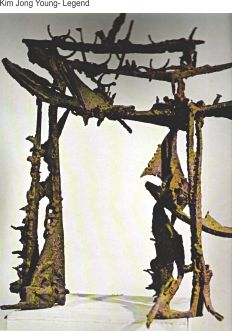
Futhermore, in 1954, the work of Kim Jong Young was selected by the international sculpture competition which was held in England. It was the first time in the 20th century that Korean sculpture was introduced to Europe. Kim Jong Young, although in many ways a traditional scholar-artist well-trained in the Confucian classics, also became the pioneer of Korean abstract sculpture. He studied modern sculpture at the Tokyo Fine Art Academy in the 1930s, hence he never participated at any of the artistic events held by the colonial state. Following liberation, he was appointed professor at Seoul National University, and he finished his career in seclusion at his hometown. He began abstraction in 1954 with plaster and iron welding after his work was selected at an international competition for the unknown political prisoners held in London in 1953.

His works resemble Arp and Brancusi with the pursuit of purity through the constant reduction of details. However, as his works emphasized asymmetrical structure and respect to the working process rather than results, he did not want to sacrifice the aesthetic for an accomplished finish. He was a man well versed in modernism and the depths of tradition. He worked as if drawing the Four Gracious Plants or performing calligraphy through the moderation of expression, reduction of shape, mass and technique and stoicism with materials. It is for this reason that he is comparable to a classical scholar.
After the Armistice which brought the three-year Korean War to a cease-fire in 1953, art circles began to regain some vitality. A few large-scale exhibitions were organized by private organizations, and these helped encourage a remarkable diversity in style and technique most visible in the fields of painting and sculpture. Among the exhibitions of notable significance were the annual membership show sponsored by the Korean Fine Art Association, and the Contemporary Korean Art Exhibition for Invited Artists sponsored by the leading daily newspaper Chosun Ilbo. The latter deserves special note for providing emerging artists of Avant-Garde tendencies the chance to display their works.
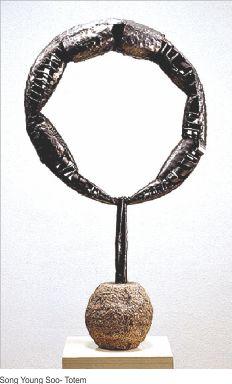
Modern Korean sculpture became firmly established by the end of the 1950s. As the conflict between the opposing schools of realism and abstractionism was increasing, sculptors began to employ a greater diversity of materials, including assorted metals and stone, thus breaking with their traditional reliance on plaster and wood. Song Young Soo had worked with junk objects from the war such as steel drums, wheels, and wasted iron plates from 1957.

Metaphorically speaking, the seed of experimental art was cultivated at the end of the 1950s, and the seed grew without an incubator; that is without an institutional basis for self-examination and the cultural resource of self-confidence. The unstable situation between the 1950s and the 1960s did not provide a chance for artists to deliberate on the identity of Korean art. The limitations of abstract expressionism were the thoughtless adoption of the belief that this trend might be suitable to express the artists’ passion, and the continuing acceptance of this style without enough examination of the identity of Korean art. In fact, contemporary Korean art in the 1970s showed an extraordinary maturity while focusing on one aspect of art.
From the end of the 1960s, the Korean art world has accelerated towards modernization to construct an ivory tower of art. Various experimental trends such as object art, happening, event, performance, process art, land art, installation, minimalism, and conceptualism were introduced under the name of the avant-garde. These trends have emerged out of an opposition to a conservative hierarchy and the previous l’art informel. The artistic movement group for the avant-garde, so called ‘Korean Avant-Garde Association’was’ founded in 1969 with the theoretical support of three art critics. This circumstance seems to show the diversity of Korean art, but it is merely of the external perception.
In sculpture, there was a transformation from previous traditional figurative sculpture and abstract expressionism to non-figurative, and geometric forms concerned with not just constructivism but materialism as well as formalism. In defining the arts of the 1970s, among diverse flows two tendencies emerged as the mainstream; reinterpreted minimalism and conceptualism. Korean minimal art was somewhat different from the Western example, despite similar features. For instance, Korean minimal art was more intuitive as well as contemplative, while Western minimalism was analytic, rational, cool and dry.
Lee U Fan, the most remarkable minimalist who studied philosophy in Japan and wrote numerous significant articles in Japan as an art critic, was both a minimalist and conceptualist. He was a member of ‘Monoha,’ the experimental trend in the 1960s in Japan, which had similar characteristics with Arte Povera in Italy. His early work, ‘Relatum’ which consists of iron and stone, is situated between conceptual art and minimalism, if we accept his concept that; ‘. . . at any rate, a work of art is neither reality itself nor is it purely an idea. It exists between reality and idea, as an intermediary that is penetrated by both, influencing both reality and idea.’ He adopted the policy of confronting reality as a tabula rasa. He pursued the fundamentals of the material itself through contemplation. His work cannot be reduced to fetishism, as his work was determined by a subtle interrelationship between the purity of perception and the essence of thingness.
Korean minimal art adopted ‘theatricality’ as defined by Michael Fried. Theatricality, not as a literary but as a philosophical term, was based on a metaphysics borrowed from Lao-tzu and Chuang-tzu’s ideas. Lee actually wrote an article synthesizing Eastern philosophy and phenomenology in the 1960s in Japan. We can see the intermediate relationship between stones found in nature and the iron plate from his recent work, in which the stone symbolizes nature and the iron plate is a metaphor of civilization. However, it is obvious that his conceptual and minimal viewpoint pursued pure abstraction, free from all emotional binds and connotation.
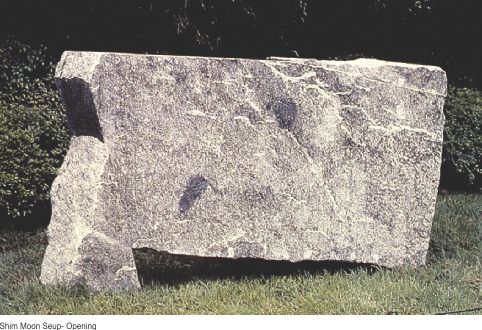
Shim Moon Seup can also be classified as a minimalist; his works were more emotional than Lee U Fan’s. His shapes originated from Korean folk tools planes, boats and so on. There were, of course, more frequent presentations by other minimalists such as Cho Sung Mook, Kim In Kyum, Choi In Soo and Kum Nuri. Later, geometric and reductive abstraction came to simultaneously increase the art scene at the end of the 1970s.
Another neo-minimalist, Lee Hyoung Woo who was born in 1954, installed many cubes made of wood, stone and clay at the Korean Pavilion of the Venice Biennale in 1997. Within a Korean minimal context, his simple and daring forms were different to those of the previous artists’.
Although both minimalism and materialism which relied on metaphysical ideas and fetishism, as well as formalism, were the major features in the art in the 1970s, these trends generated a consciousness of originality and discernment of what was truly Korean art in the next decade. There were extensive experimental attempts in the field of Avant-Garde schools in 1970s including minimal and conceptual art, but they did not get rid of the hierarchic dilemma just yet. Formalism was a remarkable limitation of experimental tendencies, because almost all experimental artists only pursued the purity of idea and pure abstraction in accordance with a limited view. Sculptors of this vein repudiated all natural forms respected by the traditional school of academic realism. They sought to give spontaneous expression to their emotions through nonrepresentational shapes. In the following decade of the 1970s, this emotional abstractionism faced a strong challenge from another new art movement that opposed its conception and style, called ‘sculptural conceptualism.’
Sculptural conceptualism pursued ‘pure’ abstraction, free from all emotional binds and connotations. In terms of style, artists of this movement favoured simple and daring forms in contrast to those of the previous generation of anti-formal vanguardism which tended to be complex and intricate. The 1980s experienced an unprecedented burgeoning of sculptors and sculptural activity. A number of young artists became nostalgic about past trends of a more humane nature, in reaction to the cold intellectualism of the previous decade.

Since the 1980s, Korean sculpture has embarked upon new and culturally diverse trends. Foremost among them is the establishment of a new realistic tendency by artists primarily concerned with restoring the communication between artists and the public. Genre boundaries between sculptures and other forms of arts were also being broken down. In addition, technology became a very important element in the sculptural art of this period. The video sculpture of Paik Nam June was a starting point for these artistic movements. These trends all reveal the extent to which the traditional concept of sculpture in Korea has been recast by the introduction of new media, which in turn has brought about a newer and more socially diverse relationship between the artist and the public.
Modern sculpture was introduced to Korea in 1923 by a young artist named Kim Pok Chin(1901-1940). He entered the Tokyo School of Fine Art in 1919, and won the entrance prize in a competition which was held by the Japanese government in 1923. He returned home to become the first Korean ever to be trained…