
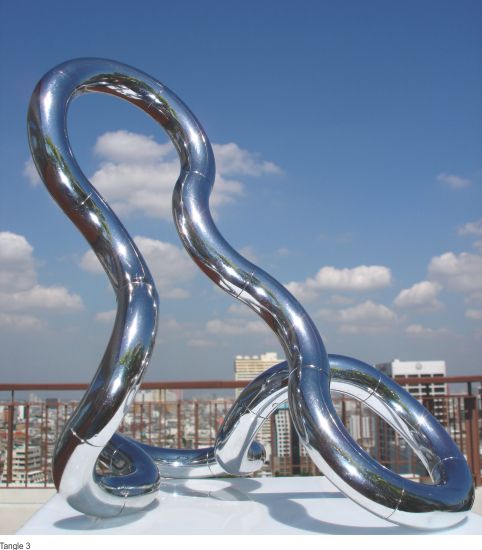
the sculpture of richard x. zawitz a twist in time anda line in space
The American sculptor Richard Zawitz seeks, and finds, in his work the serenity and spiritual tranquility of Shanta rasa
In his essay ‘The Theory of Art in Asia’, Ananda Coomaraswamy confirmed his reputation as one of the twentieth century’s most erudite scholars of the sacred arts of both East and West. He expounded on many different issues from the nature and meaning of representation in Asia, to symbolism and convention, originality and novelty, intensity and energy and the nature of art itself. He concluded his essay with an examination of rasa as a central part of the formal theory of art in India. In Sanskit, the term rasa means the sap or juice of plants. In this physical sense, we can readily grasp what this essence may imply, be it orange or lemon or any other flavour. But when the word is applied to Indian art and aesthetic experience, it also refers to the state of heightened delight produced in the viewer’s mind by the emotion and experience of a work of art. The term was originally applied to the performing arts of dance, drama and music, but, as pointed out by Coomaraswamy, it is immediately applicable to all the arts. The principle of rasa can be subdivided into nine distinct sentiments, each arising from or embodying particular subjects and situations. These comprise the erotic, comic, pathetic, furious, heroic, terrible, odius, marveleous and the quiescent or tranquil sentiment. This last sentiment, known as Shanta, comes from knowing, or at least approaching, the utter serenity of spiritual tranquility.
It is this same quality that American sculptor Richard Zawitz seeks, and finds, in his work. Zawitz began his studies in Asian philosophy and art in Pittsburgh, Pennsylvania with Chan Wing Tsit. Chan was a consummate scholar, teacher and mentor, and a living exemplar of the Chinese philosophical tradition. Of all the leading figures in twentieth century Chinese philosophy, he was among the first to make his home in the West, teaching and publishing in English and Chinese, but always in touch with Asia. During the years of the Cultural Revolution that was launched by Mao Zedong in 1966 and which sought to overthrow ‘the old ideas, culture, customs, and habits of the exploiting classes’ and declared that ‘Mao Zedong’s Thought is the Guide to Action in the Great Proletarian Cultural Revolution’, Chan played an important role in helping to maintain and foster traditional Chinese values in the West.
In practice, the philosophy elucidated by Mao set the stage for the imposition of an aesthetic and ideological hegemony that stifled tradition in order to deliver a style of art that met the ideological demands of the times. But what China lost, or perhaps more accurately misplaced, Zawitz gained. From Chan he learned about Chinese philosophy, and most importantly, the Tao Te Ching. He was also convinced by Chan to further his studies at the University of Hawaii, where Chan himself had started his teaching career in the United States and where he began, in 1939, a series of conferences on Asian and comparative philosophy which later gave rise to the journal Philosophy East and West.
The literal meaning of the word Tao is path, or way. The term is generally used in three ways: giving a name to the ultimate reality that surpasses human experience; describing the observable rhythms and patterns of the universe; and describing the way of human life when it is in harmony with the Tao of the universe. An important aspect of the Tao is its state of perpetual motion. ‘All things, as they come into being and develop, progress through a series of changes moving persistently to a return to the state of non-being, the primal unity and source of all things.’ The basically circular movement of Tao confirms the idea of heaven as round, symbolized by the circle. The pictographs and ideograms of Chinese writing may often themselves encapsulate their meaning. Thus the character tao combines the character ch’o representing a foot taking a step or moving step by step, and the character shou, or head. The combination of head and foot symbolizes Tao as an inner way; it also illustrates the circular, complete and perpetual course of Tao for a circle’s beginning and end are the same and the movement around its periphery is unceasing.
These two pictographs also illustrate the Taoist idea of Tao as both unmoving and continually moving, as the path lies motionless on the ground yet goes somewhere and so has movement. This aspect of Tao is the basis of the concept wu wei, a phrase which translates literally as inaction but in Taoism means actionless activity or pure effectiveness. Another interpretation is that the concept describes creative quietude, being that state when a certain dislocation of the conscious self takes place, and which frees the resources of the subconscious mind to engage in pure creativity.
In Hawaii, Zawitz began a two-year period of independent study with Prithwish Neogy, who was a student of Coomaraswamy and a renowned scholar of Asian art and aesthetics in his own right. In Hawaii, Zawitz encountered the writings of Jacques Maritain and Sigfried Giedion and began to develop his own philosophical pluralism, drawing on primitive art, Taoism, Zen Buddhism, tantric art, Indian aesthetics and comparative philosophy to help articulate his understanding of the fundamental underlying principles of art and creativity.
Maritain was a French Catholic philosopher who advocated what he called ‘True Humanism’, saying that the human person is both material and spiritual, and can become more than a merely self—interested individual by acquiring and practicing the habits necessary to actualize his humanity. In his Creative Intuition in Art and Poetry Marutain describes creativity as naturalistic in the sense that it does not rely on any extenal source or Platonic muse. He distinguishes two stages in the creative process, the first of which occurs below the level of consciousness in the ‘preconscious intellect’ in which are found ‘sources of knowledge and creativity, of love and supra-sensuous desire hidden in the primordial translucid night of the intimate vitality of the soul.’ It is in the preconscious intellect that the artist’s soul ceases to be controlled by the external world and his creative intuition begins to germinate. In the second stage the creative idea is clarified for consciousness and is expressed. In an age that is essentially practical, and which posits praxis as the ultimate truth, he advocated the primacy of the spiritual.
Maritain’s revelations about the importance of intuition are reiterated by Sigfried Giedion. Giedion is perhaps best known as an architectural historian and author of Space Time and Architecture. However, in his book The Eternal Present: The Beginnings of Art, originally presented at the National Gallery of Art in Washington DC in 1957 as the AW Mellon Lectures in Fine Arts, he examines theories regarding the origins of art. Giedion notes that art is a fundamental experience, born out of the urge for elemental expression. ‘It grows out of man’s innate passion to develop a means of expression for his inner life. There is no difference whether the basic impulse for these feelings rises from a cosmic anguish, the urge to play, art for art’s sake, or—as today—the desire to express in signs and symbols the realm of the unconscious.’
The key to Zawitz’s philosophy is pluralism, a subtle melding of Eastern and Western thought. This is not as straightforward as it might seem. In his book Mysticism and Morality: Oriental Thought and Moral Philosophy, the philosopher Arthur Danto notes that while ‘the East has always held the promise of a deeply alternative existence, satisfying and pacific and exalting… It is nevertheless an aim of this book to discourage the hope that a way through our moral perplexities may be found in the Orient.’ For Danto, the problem lies with the inability or unwillingness to put one’s own cultural assumptions at risk. But Zawitz was able to take risks and to ‘unlearn’ his western aesthetic bias. For him, the key that opens the doors to perception is the nondualist interrelatedness of all things. It is this that for him links the art of Asia with that of the West—from the humanism of Michelangelo to the inventive genius of Da Vinci and the pure form of Constantin Brancusi.
Zawitz’s graduation work was a stone carving called First Twist. In this work a cylinder of white marble rises from a trapezoid wooden base. At about half its height, the cylinder bends sideways and turns up over itself completing one full turn. At its apex, the cylinder tapers and ends in a roughly spherical shape. It is a remarkably allusive work, suggesting at times either an Indian figure in a pronounced tribhanga pose (where the figure is oppositely bent at waist and neck to form an ‘S’ shape), or a Tang dynasty figurine of a woman with her hair piled characteristically high. As an abstract image, the essential elements of the sculpture have been distilled in order the simultaneously simplify and concentrate the composition. Abstraction in the Greek sense of aphaeresis refers to ‘the process as well as the result of the withdrawal from the particular, accidental, inessential in order to obtain the general, inevitable, essential. By bringing together essential characteristics in one artistic concept, abstraction offers us our most important means of systematically arranging the boundless multiplicity of objects which approach us in our perception, our imagination, and even in our thoughts.’ This work presages the artist’s mature work but further development was required.
On his graduation from the University of Hawaii, Zawitz went to live and work as a sculptor in Kyoto, Japan. He became interested in the story of Enku, an itinerant Buddhist monk who lived in Japan in the 17th century in the early Edo period. Enku is known as a shugendo, a devotee of a form of religion that is a conglomerate of Taoism, Shinto and Buddhism. Shugendo means the path of training and testing and it centres on an ascetic and nomadic life. Enku travelled all over Japan and everywhere he went, he would carve an image of the Buddha. During his lifetime he was extremely prolific and is reputed to have carved some 120,000 images of Buddha. No two were alike and most were crudely fashioned from found timbers with just a few stokes of an axe. These images were not made as monuments or for self-aggrandizement but for their spiritualism. Enku left these simple expressions of prayer and devotion as a reminder of enlightenment in hamlets and villages all over Japan.
The notion of a cheap, simple and widely available evocation of enlightened creativity was to have an enduring impact on Zawitz. However, it was not yet evident in the work that he produced at this time. A work of Zawitz from this period is a rather bland wood carving representing Bodhidharma, the Buddhist monk traditionally credited with having introduced the Taoist influenced Ch’an (Zen in Japanese) Buddhism to China. Traditional representations of Bodhidharma depict him as an ill-tempered, bearded and wild-eyed ruffian.
In Japan Zawitz worked with the calligrapher Morita Shiryû who had played an important role in developing a hybrid art that fused Japanese calligraphy with aspects of Western expressionism. Morita theorized calligraphy as having three properties: time (the duration of reading and of creating a work with the brush), space (including the formal qualities of composition and line quality), and literary value (the moji). The moji is the character or other component of the written word that was regarded as the irreducible unit of calligraphy. In the 1940s and 1950s Morita advocated focus on the formal qualities of calligraphy. In an essay about Matisse he enthuses about Matisse’s extreme reduction of all form to pure and simplified line and, as calligraphy is also an art of line, imagined these two art forms coming together like a rainbow with one end in the East and one in the West.
Morita’s own calligraphy is avowedly illegible. In a theory of expression influenced by the Zen Buddhist principles taught by the Kyoto School of philosophy which argued that while the West was tied to dualistic thinking and approaches to art, the East pursued a path of nondualism, Morita understood the given conventional forms (the moji) as attaining utter sameness with something profoundly internal to the calligrapher. ‘The character is revered as the timeless product of centuries of language use, but at the same time it is intuited at a level so deeply interior to the calligrapher as to undergo a massive upheaval when brought forth as an expression in brush, ink and paper.’
Zawitz also travelled to India, Nepal and Tibet. In Tibet he encountered the Tibetan infinite knot, the pattern of interwoven lines without ending or beginning that is a symbol of infinite life and creation. Zawitz returned to America in 1975 and built a studio in Waltham, Massachusetts, in Boston’s western suburbs. Here he began the process of unifying and reconciling his myriad influences and experiences into the creation of a four dimensional universal energy form.
The result was a line in space, a wave, a curve, a circle. A line without beginning or end, solid yet supple, immutable yet capable of constant change, a delight to both hand and eye. Zawitz called this sculpture Statue of Infinity. It is comprised of a series of linked quarter-round curves that can each be twisted around its central axis into an infinite variety of new and different shapes where every new shape is as smooth and graceful and as aesthetically pleasing as the last.
Visual reality is transitory at the best of times as objects seen under natural conditions change in appearance from moment to moment owing to changes in light, atmosphere and the relative positions of object and viewer. Zawitz’s line in space gives physical form to things seen only in the mind’s eye. Together the interlinked curves allude to many things. They may be a waterfall or the movement of water through a series of shallow rapids, rushing around and tumbling over rocks. They may be clouds, tendrils of vapour blown by the wind. These are powerful images that have important associations in Taoism. Water is an important Taoist symbol, always taking the path of least resistance, finding rest at the lowest point, making a level surface over irregular depths, infinitely supple yet incomparably strong and having no shape of its own but capable of being infinitely accommodating. Water also attains clarity through calmness—’muddy water let stand will clear’. These are the virtues of wu wei.
The linked curves also make an outline enclosing nothing. Emptiness is a key Taoist concept as emptiness is Tao. Space is filled with meaning as it is filled with Tao. Tao cannot be defined but it can be alluded to. Thus the Tao Te Ching notes that the inner space of a jug is its essential part, not the pottery, and that it is the space within four walls that comprises the usefulness of a room. The purpose of Taoist meditation is to empty the mind of all distracting thought and emotion so that it is more conducive to quiescence and receptivity and better able to reflect on the Tao. In Indian art, this is also the Shanta rasa.
The twists and turns of the sculpture have an organic quality, and seem to reflect the moment where coherent patterns of flow emerge from the discordance of turbidity, the point where vortices, eddies and ripples emerge out of chaos. In this work we can see not just the interconnectedness of all things but also the double helix as the building block of life or the cosmic spiral form of the galaxy.
Most often when we appreciate a successful work of art we share its rasa – the state of heightened sensation produced in the viewer’s mind by the emotion and experience of the work itself. But with Zawitz’s work we can go even further because we are the artist. We are responsible for the kinesthetic action of creation and can take pleasure in both the instinctive, subliminal act of creation itself and in the form that we create. It was while watching visitors to his exhibition manipulate this art work and take great pleasure in it that Zawitz had an epiphany. He realized that this object could be accessible to millions of people—like Enku and his thousands of wooden Buddha, but it could do more. It could allow all of them to clear their minds, to find clarity and serenity and to participate and interact with both the process and the product of sculpture. The work itself seems to foster multiple intelligences. People with strong left-brain traits are drawn to the logical linearity of the sculpture. People with right brain dominance appreciate its allusive qualities and its ability to spark visualization, imagination and intuition. Manipulation of the work seems to allow us to link the powers of both hemispheres.
By some measures this may be the most successful work of art ever made. Zawitz patented his work in 1982 and began manufacturing and distributing it commercially. Known and sold as a Tangle, there are today over 90 million editions of this work in homes, offices, institutions and playgrounds all over the world.
In his later works Zawitz continues to explore the nexus between being and nothingness. In works such as Flying Stone, Mind Over Matter and Cosmic Stone he uses stone to capture the fizz and spark of effervescence—the moment of transition when gas is freed from an aqueous solution. These works appear like rafts of bubbles, held together by surface tension. In fact they have been laboriously carved out of alabaster. Their combination of spherical forms allude to problems of space – just as bubbles have the smallest possible surface area for any given volume and will always find the smallest surface area between points or edges. And they capture temporary, transitional, ephemeral moments—the instant of time between one state of being and another—which is after all a metaphor for life.
Jonathan Thomson is an art historian, curator, critic and consultant. He lives and works in Bangkok and Hong Kong. Website www.thomsonfineart.com
The American sculptor Richard Zawitz seeks, and finds, in his work the serenity and spiritual tranquility of Shanta rasa In his essay ‘The Theory of Art in Asia’, Ananda Coomaraswamy confirmed his reputation as one of the twentieth century’s most erudite scholars of the sacred arts of both East and West. He expounded on many…