
Three artists from bahrain
In ancient times, before Christ was born, the people of the civilizations of Iraq thought Bahrain was Paradise. It had endless fields of palm and fruit trees thriving on rich natural springs and wells. The sea was calm and abundant and teemed with all kinds of fish and large pearls. The climate was temperate; man and nature were in perfect harmony. People honoured their dead with ceremonial burials. Temples were built amidst the fields and expansive burial mounds in the dry half of the land contained their dead.
Today the Kingdom of Bahrain is a cosmopolitan Arab country that lies on the shores of the Arab Persian Gulf. It’s a financial and commercial hub, and also an active participant in the contemporary cultural happenings of the Gulf. Three Bahraini artists in particular have been actively seeking to affirm a contemporary identity and to open up as many pathways to a future dialogue as possible. Each one of the three in her/his own way is attempting to conquer our senses and our minds. They ignite questions that make us think about the tools, content, and issues of art today.
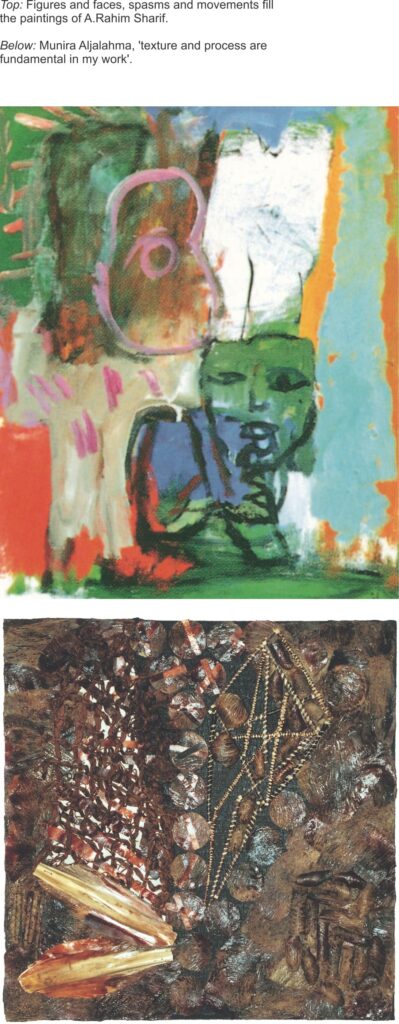
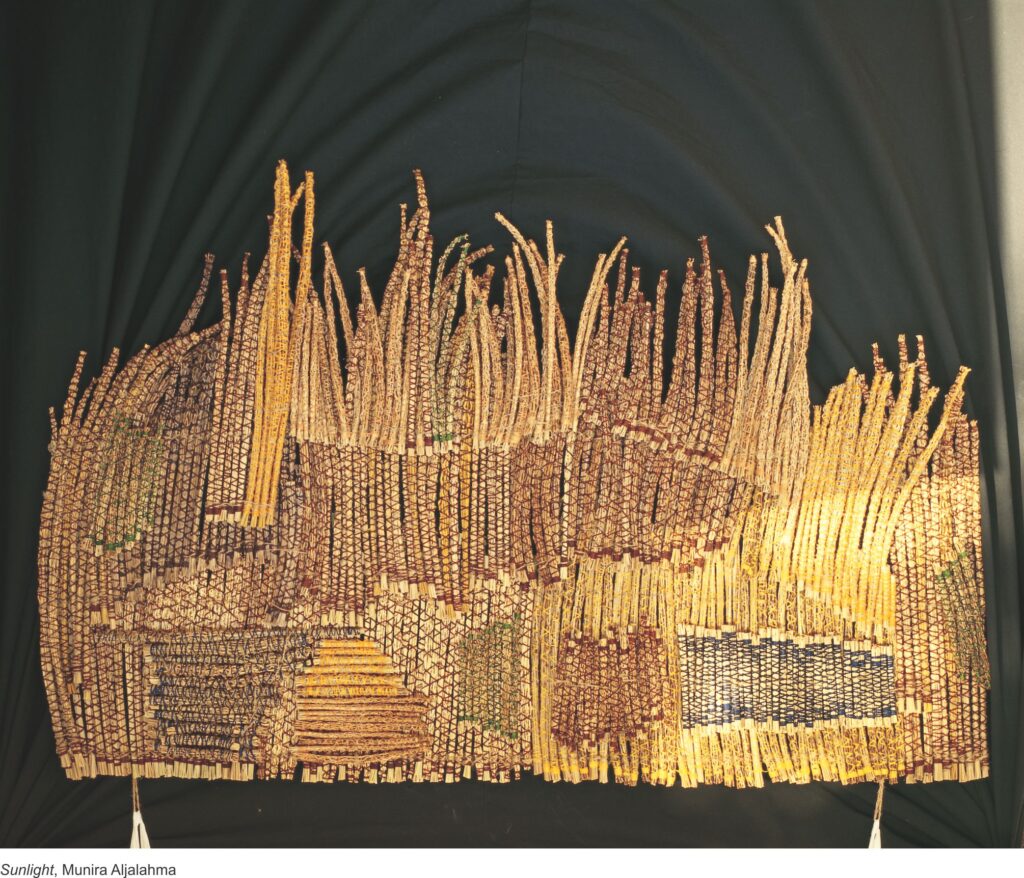
Not long ago, I was invited to visit artist Munira Aljalahma’s workshop and studio in Manama. The ambience there reminded me of the interior of a natural museum; all kinds of shells, stones, fossils, dried stems, flowers, and sprigs could be seen as well as pictures of birds, and natural objects of the region. One picture depicted the artist after she had taken a generous dip in the sea and shows her happily holding a sackful of stones and shells. ‘I love snorkeling in the summer,’ she comments. There’s another picture of her collecting herbs: ‘That was after the rain we had last year. The desert was lush afterwards with all sorts of plants. I dried some herbs, and grew some in the sand.’ Aljalahma’s been an artist since the age of 20; she’s in her late 40’s now, but has only started showing her work to the public in the last ten years. In the early 70’s she worked as a full-time art teacher at what used to be Bahrain’s Institute of Teachers. Aljalahma is kind and affable, and is generous with her time in exhibiting her work to anyone interested in it and explaining how she ‘does’ things, and what they mean to her. ‘ Especially over the last four years, in most of my work I’ve been using the ‘regenerative’ parts of the palm tree, and I use all the parts,’ she insists. ‘I’m very knowledgeable about palm trees, I learned a lot from my father, who was an expert in dates and their trees. I have mature palm trees of my own, and every year in the trimming season, I take the trimmings, plus what I can get from some farmers, and then start preparing them.’ Aljalahma explains to me how ‘process’ is all important in her work. ‘Often artworks are about a finished object; you don’t see the skeleton, or the foundation of the work in them, and it’s all about the end result. I don’t mind the end result at all, but I also find it fascinating to show the ‘steps’ that took me there. When you see a work of mine, and after you take it all in, you can view the textures, the colours, the overall shape, and the shapes within, and also come to see ‘how’ I did it. I think texture and process are fundamental to my work.’ One large corner of the artist’s studio is devoted to heaps of washed and dried palm fibre, cleaned palm stems, shaved and cut fallen bark. The smell alone is wonderful. ‘It’s so fresh!’ I exclaim to her. Then, I look at the different textures, the grading of colours, hues of brown and even black. I never thought palms had black in them. ‘The shapes—they are so rich,’ I tell her. She shows me a large wall piece of finished work, ‘Sunlight,’ where she’s made row upon row of neatly tied bundles of one sort of stem only. The singular texture is fascinating to look at. One can almost ‘feel’ Aljalahma’s work. Unlike paint or colour in the strict sense, where more than anything else ‘mood’ is generated, in her work, it’s the visual experience of texture at its best that one encounters; one is also acutely aware of one’s ‘sense of touch’.
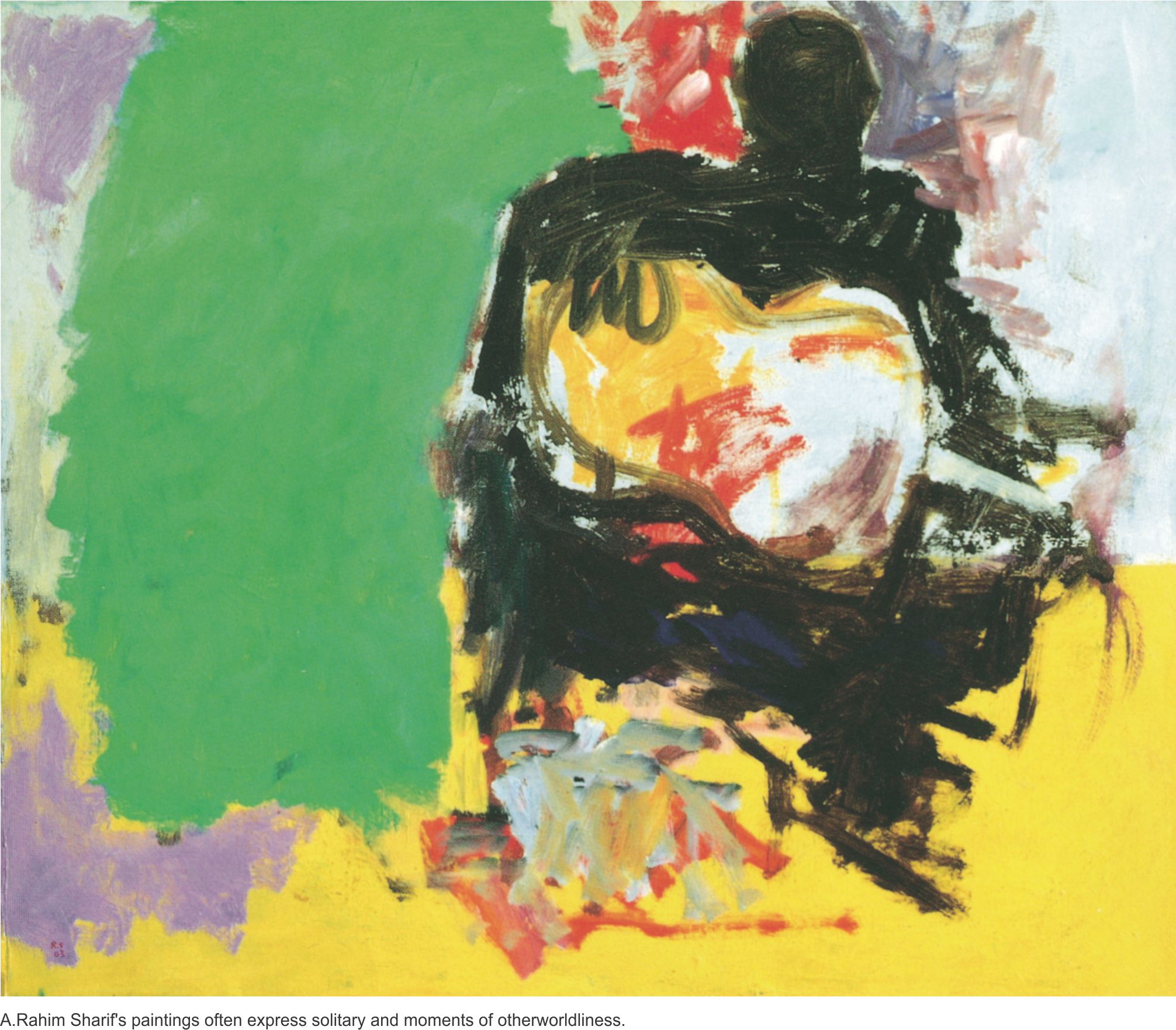
Unexpectedly, the ‘look of touch’ more than the sense of touch, is abundant in the latest one man exhibition of one of Bahrain’s leading painters, A. Rahim Sharif. He’s been a full-time artist since the 70’s. ‘More than anything, in this show I wanted to show that painting as a genre still has a lot to give and say.’ He’s referring to the contemporary preoccupation with installation art. And Sharif sufficiently proves his point with his highly invigorating and challenging paintings, 32 in all, shown at the premises of The Bahrain Arts Society. ‘Painting is alive, and will always be alive,’ he insists.
Sharif says it struck him some time ago that ‘unfinished works are far more interesting.’ In other words, this gives us, his viewers, more leeway to breathe and to bring in fresh interpretations. All Sharif’s surfaces carry the physical evidence of his brushes. Every single one of his paintings carries his distinctive mark; a brushstroke that is often aggressive, spontaneous, fast, but also gentle and precise in some parts if one slows down to follow the lines. Figures and faces, of women and men, of shapes that uncannily look like the artist, of dancing girls, of war, and of men in torment, of private moments of joy, and even heady romance and love fill Sharif’s surfaces.
The colours are vibrant in the extreme, they attack one’s senses with their freshness, spasms, movements, and even violence. Large parts of some paintings have been blotted out after strenuous re-workings—the surface says as much. In some parts, colours have been applied again and again, and then painted all around with a single colour leaving the figure with the original surface. That figure becomes a concentration of effort and has a halo-like quality because of the layers of paint tracing its body. In other paintings the blotted out areas look like countries in a map; geographical boundaries that allude to our times—troubled over borders and countries, both psychological and physical. One viewer who had seen the show later told me, ‘Each painting tells a story, but not in the traditional sense; you don’t know all the threads, you have one main moment with all its associative moods captured in that instant through Sharif’s eyes and feelings, and you have to guess the rest.’ The comment is apt. But often that moment is so charged, so transporting that it’s enough; to just dwell on that moment of being is invigorating.
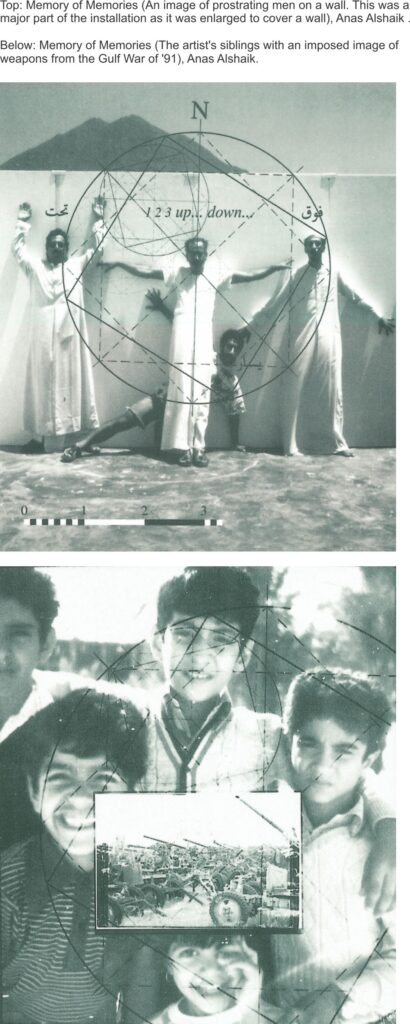
In Memory of Memories, Anas Al-Shaikh’s installation at an ordinary man’s house in the central streets of Manama, dwells on what it means for the artist to be an Arab in today’s simmering political climate, what with all the wars, and the constant upheavals. The work is about identity and soul-searching and conveys a subtle but clear warning. It seems to say, ‘We can’t stay like this for long. When is our suffering to end?’ For starters when one approaches the garage where the installation was set up, three medium-sized black and white photographs on the wall above, of different images, frame small bags of blue cloth, stuffed with what seems like sand, and seemingly tied from the noose with a rope that leaves them dangling in a line. They seem to refer directly to bodies and executions. Once inside the small one-car garage, Al-Shaikh has arranged many artifacts, some of them very personal, some ready-made, and some arranged by him. In the centre is a large metal fish trap, famous, and in fact, synonymous with the pre-oil heritage of Bahrain, the kind often seen on postcards, in heritage festivals, in paintings and drawings of the good old times. Within the fish trap, there are two levels of sub-traps. In the bottom the artist has put a cockerel which roams happily along with food and water. In the level above, he has put a chicken, also with food and water, but far less space, as is the way with these fish traps, and therefore more constrained in her roaming—or at least that is what seems to be the case to viewers. One likely interpretation is that female-male relations in a highly patriarchal society are symbolised; possibly the resulting injustices in it too? The social divisions that continuously segregate the sexes? That the world is a man’s world where the cockerel roams happily and freely and at large, and his space is all there is? Or possibly, ignoring the chicken for a while, that cockerels (in Arabic culture) signify new beginnings: the promise of a new day for Arabs? Right at the back of the garage covering the entire wall, Al-Shaikh has installed a large black and white photograph he’s taken of four middle-aged men prostrating themselves like clowns on a white plain wall, with a circle and fine lines graphically imposed on top, that allude to target lines, and even have instructions written in Arabic of ‘Up’, ‘Down’, ‘Left’, and in English, ‘1 2 3 up…down…’. Who are these men? We don’t know, but each one’s position, considering their age, is surely one of a victim’s. All four men seem to be standing on a wall ready to be executed, but instead of blood and shots, they are obeying orders, listening to someone in a position of power standing in the place of the cameraman; why else these target lines, why these instructions? They are men who have lost their dignity, who do not own their bodies, and who are being victimized willingly. They seem to have lost any sense of self or direction; they have only a semblance of the self.
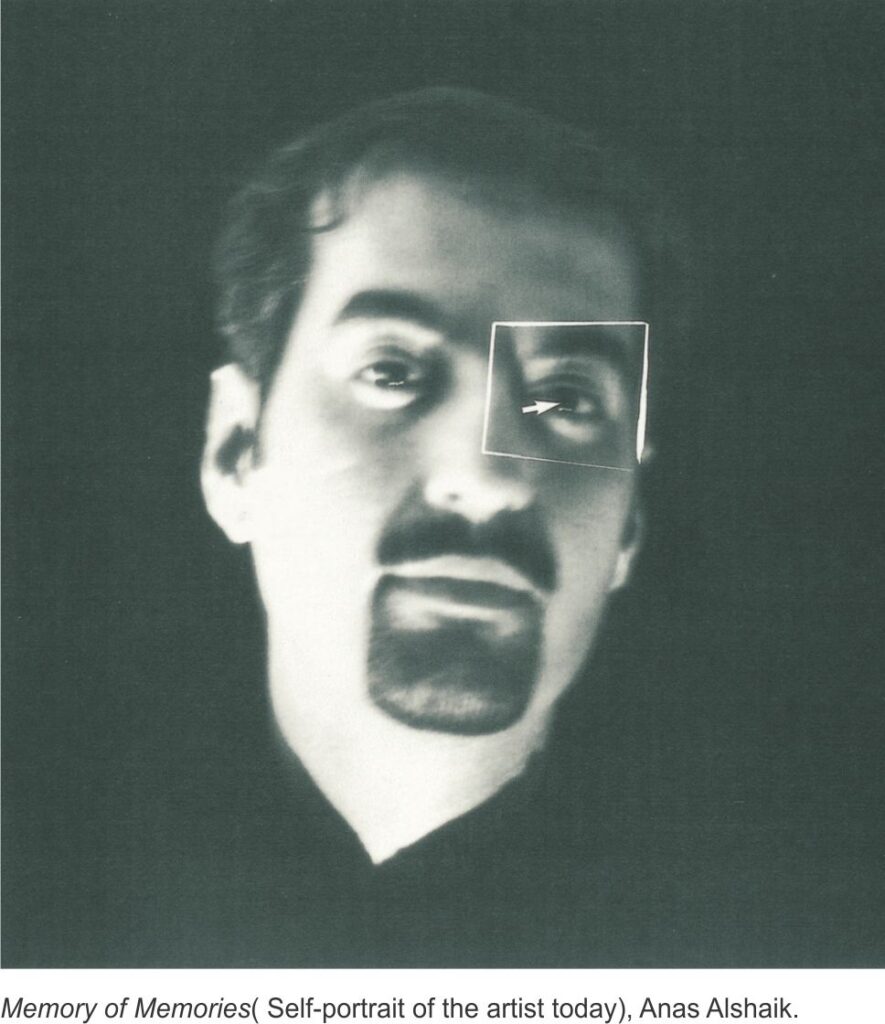
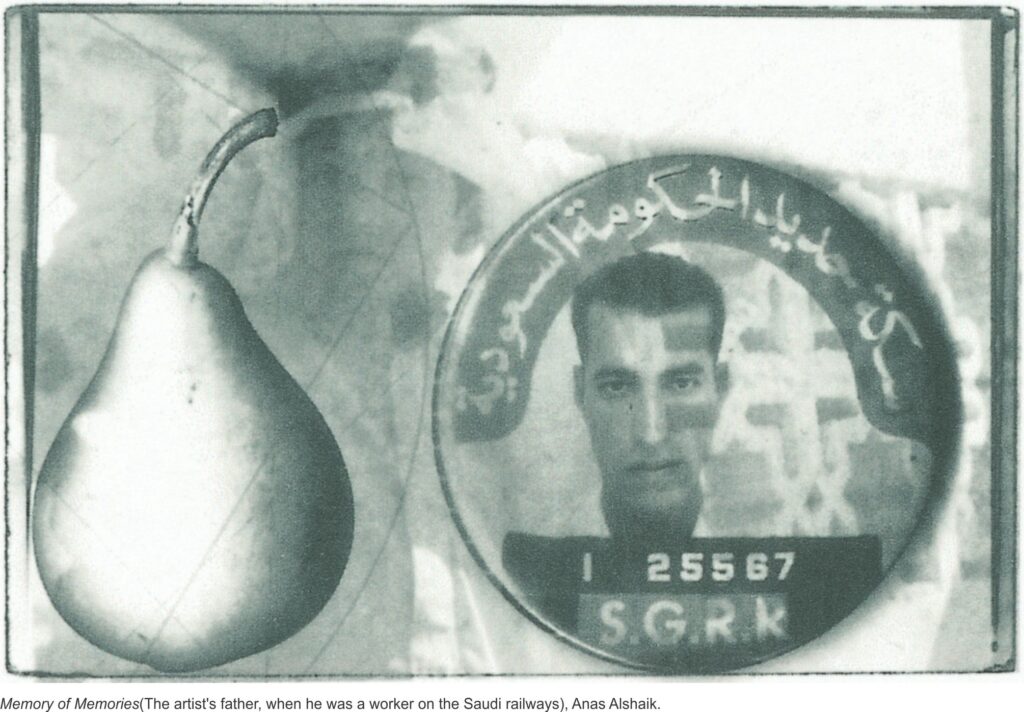
On either side of the wall inside the garage are more things to look at and think of. On one side is more personal imagery: a moving original photograph, possibly from the late 1960’s or early 1970’s, of four children in daylight, innocent and playful. It’s highly likely they are the artist’s siblings—the catalogue dedication suggests as much. Imposed is a harsh contemporary picture of weaponry, possibly from the Iraq-Kuwait War of ’91, and faint target lines in black. Lost innocence? Lost dreams? Lost hopes? On the side is a self-portrait of the artist as a child in a black and white photograph, again with impositions, though this time rather sweet ones: three kinds of sweet fruit; a pear, a banana, and a cluster of grapes, and what seems to be an old illustration of Mecca. The child looks upwards, dreamy in his innocence. Then there’s the image of an intense middle-aged man. We can guess it’s the artist’s father. It’s an enlarged original stamped picture, of the kind found in official papers and passports, designating the man with a number, and on top it says in Arabic, ‘The Saudi Government’s Railway.’ On the side, in a size just as large as the stamp with the man’s picture, is a pear, beautiful in its roundness and fullness. Both are imposed on a very faint but beautiful dream-like image of the artist as a child, dressed in traditional Arab Gulf garb and staring sadly at us. Is he missing his father? Was his father far away, toiling in the Saudi desert? And what does the sweet pear mean? On the other side of the wall are three small wooden frames without a back, each containing a fruit suspended from the centre with a thread, it’s left dangling in the middle. On the lower side of the frame small heavy red sacks are tied from the noose, similar to the ones on the entrance of the garage. Fruit again. What could they possibly mean? Anas Al-Shaikh’s use of a muted but very expressive melancholic colour—black and white—and his re-use of old and very personal imagery laden with feelings, memories, and dreams transform the small intimate space of the garage from a place of utility to a place of signification. Though a neglected part of memory, nonetheless it’s there, and it’s important, and it’s painful, the juxtaposition of weaponry in times of war, of a mark that looks uncannily like a prison stamp, of selfless men, of sweet fruits that will invariably decay like unquenched dreams, of dashed hopes; the child yearning for his sweet father’s love, for a bright future; Mecca possibly; a united Arab nation? One thing is sure though: Memory of Memories is a very poignant work.
But there is hope still; the cockerel is always there to announce a new day; there is sunlight, and there is the possibility of heady romance and love. Three artists, three invigorating visions of life!
Wejdan Almannai is a visual artist and tutor at the University of Bahrain
In ancient times, before Christ was born, the people of the civilizations of Iraq thought Bahrain was Paradise. It had endless fields of palm and fruit trees thriving on rich natural springs and wells. The sea was calm and abundant and teemed with all kinds of fish and large pearls. The climate was temperate; man…