
Acts of representation: The Production of art in singapore
The state of the visual arts is often symptomatic of their socio-political environment. In Singapore, the production and management of the visual arts is primarily negotiated through an economic ideology which transposes subject matter through the three-fold distinction of West, East and intra-SEAsia. The development of a Singaporean identity is going on through the process of creating what I would term acts of representation of self within a socio-political context.
Visual art in Singapore can be said to emerge out of a collective consciousness. While this may reflect a certain degree of trust, intellectual or social like-mindedness through solidarity in numbers, it can also result in a lack of confidence or a fear of differing from the rest. In fact, art practice in Singapore reflects neocolonial hegemonic unity, not counter-hegemonic principles. Colonial utterances and visual grammar continue to be privileged over what often seem to be indigenous in nature.
Nanyang Style
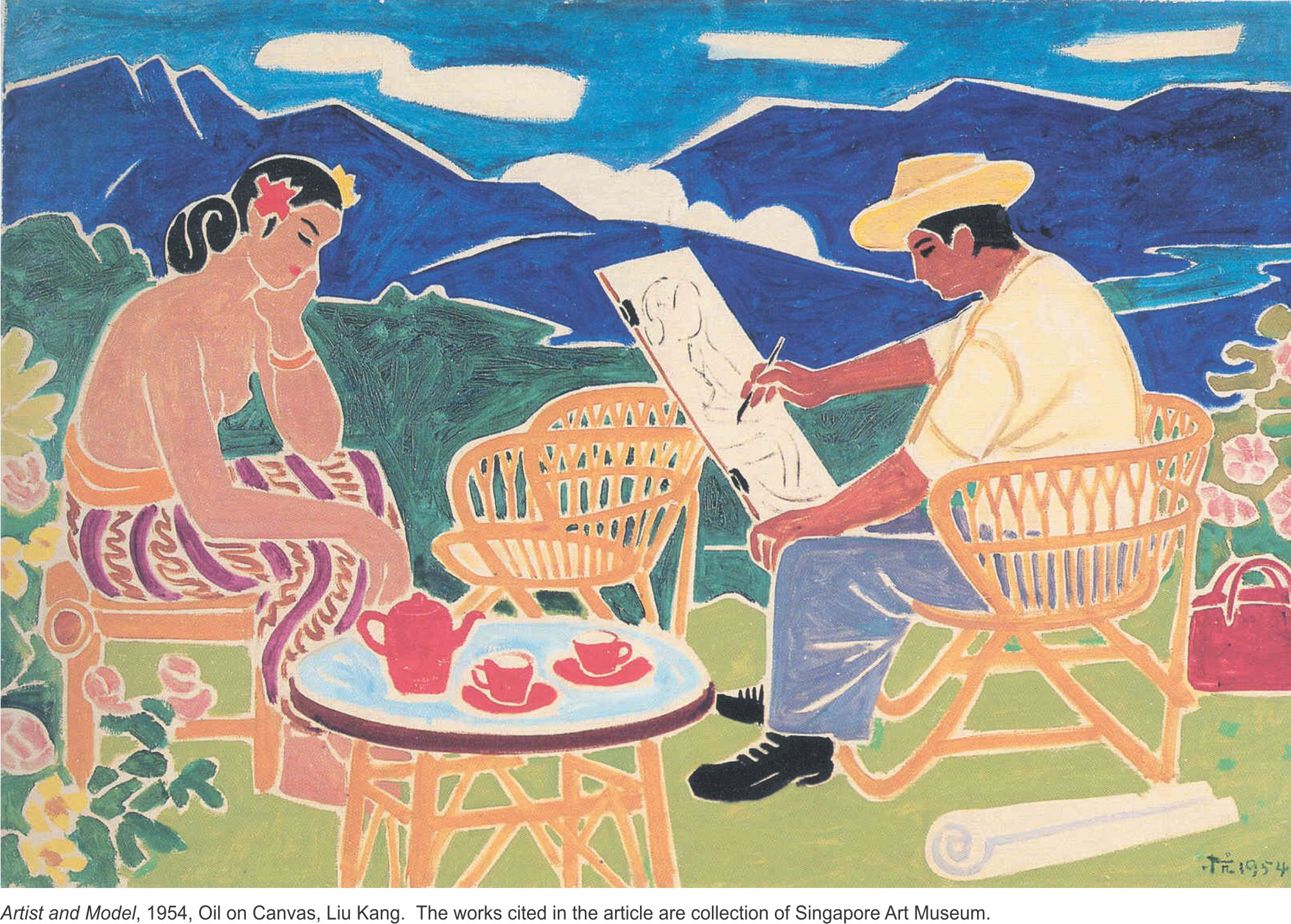
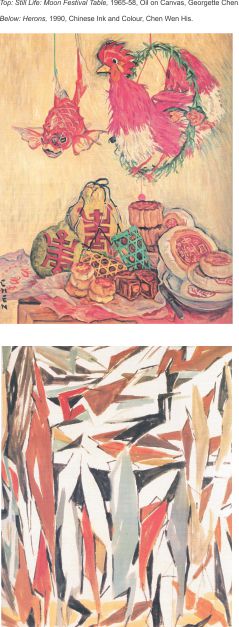
Art historian T.K Sabapathy locates the beginning of modern Singapore art history in 1937 when a few China-born artists and enthusiasts considered the setting up of an art institution in Singapore. It materialized under the stewardship of artist, educator and administrator Lim Hak Tai.1 The Nanyang Academy of Fine Arts became the first art institution to be set up in Singapore/Malaya during British colonial rule. Before the Second World War, the institution was a hothouse for artists: particularly, ‘Nanyang’ artists – Cheong Soo Pieng, Chen Chong Swee, Chen Wen Hsi, Liu Kang and Georgette Chen. Drawing their inspiration from Chinese painting as well as Parisian traditions, these artists were comfortable in both traditions. They were, in fact, part of the art movement of the 1920s and 1930s in China, particularly the ones in major cities like Shanghai and Guangdong where artists engaged aggressively in ‘reinvesting Chinese art with fresh scope and new dimension.’2 According to Michael Sullivan, Chinese artists were more at home with Western art than their predecessors; they had greater skill at using it, and were able to adapt more freely to their own expressive needs…it seemed that a new Chinese painting, native in spirit, contemporary in theme, borrowing techniques freely from East and West, was about to take root…”3
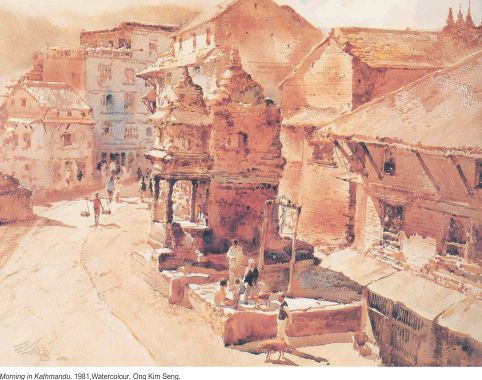
Tradition, nativity and modernity framed the works of the Nanyang artists who were preoccupied with a newfound land-its determinants lodged in Nature and the economics of the new place. A particular trip to Bali in 1952 was a turning point for the artists and for Singapore art history. Inspired by the seamless integration of life, ritual and art—Bali became the ideal for art making. Importantly, the trip framed the notion of modern SEAsian art. As Sabapathy notes, ‘the development of modern art in this region is rooted in conceptions and options framed by com peting artistic traditions’ namely, the West, the East (China), and intra-Southeast Asia. While this may be so, I would argue that the latter two traditions are inimitably negotiated through the lens of the West, which imagined a Singapore that embraced the philosophy of cosmopolitanism, which was springing up throughout the colonies. Despite the heterogeneity in styles, themes and experiences, the Bali Trip encapsulates an Orientalist ritual of encountering ‘the journey, the history, the fable, the stereotype, the polemical confrontation. These are the lens through which the Orient is experienced and they shape the language, perception, and form of the encounter between East and West.’4
The Nanyang Style5 foregrounded a hermeneutic cultural inscription of Singapore which cannot be ignored. There is a great degree of desire to capture essential physical moment as opposed to the study of subjectivity. But all art is inextricably linked to power and the works of the times reflect the discursive weaves of colonial masters. The verve of the representational qualities of the early art of Nanyang artists poses the postmodern problematic that what it reveals, contextualises and historicises is privileged over what it conceals, decontextualises and erases, especially in its hermeneutical approach. The works reveal a lack of critical distance from the ideologies they seem to be producing and reinforcing.
Self and Identity through Nationhood: The Second Generation Artists
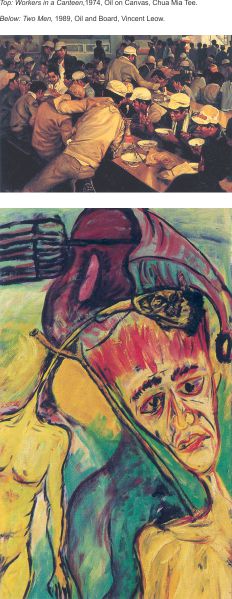
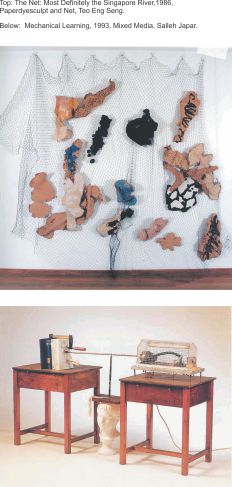
The 1950s and 1960s represented ‘Messianic times’ where seeds of the nation-state were sowed. In the 1970s a group of artists trained in the West began to define an aesthetic that imprinted itself well within the social development of Singapore. Known as ‘Second Generation’ artists,6 these artists were preoccupied with notions of self, identity and place, notions particularly significant at a time of nation-building. The formal breakdown between two-dimensional and three- dimensional works coupled with a greater degree of conceptual abstraction—congruous with the ‘internationalist’ movements in the west-marked the works of these artists in the 1970s. The socio-psychological dimensions, as seen in the works of Thomas Yeo, began to reveal themselves just as artists tried to come to grips in an overtly pragmatic island state which pushed forth a very rigorous economic programme as the sole option of survival for the islanders. Internationalism itself, in this instance, provided a quiet egress out of the overtly sensitive political-ideological climate of Singapore.
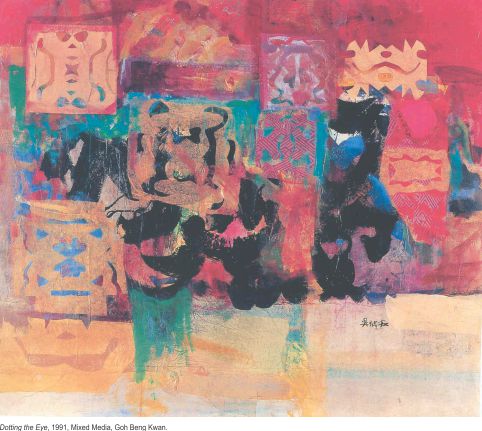
Equally important were developments in the Chinese ink tradition by artists such as Tan Swie Hian, Tan Oe Pang and Henri Chen. Goh Beng Kwan, in particular, attempted to marry traditional practices to western abstract expression. Invoking Chinese traditions through such subject matters as landscape, animate beings in nature eg. birds and flowers, and using such materials as rice paper, scrolls and techniques of design, these artists, as art historian Constance Sheares remarks, ‘are original artists creating a new art for Singapore, not a particular style but a new aesthetic attitude and new way of perceiving their world…deliberately or unconsciously, they continue to draw inspiration from centuries of cultural tradition.’7
Performance/Ritual
The cultural representation of Singapore remains multicultural and the production and management of culture remains within this ambit. The multicultural discourse has been mutated and reduced to a constitutive imagining of Chinese, Malay, Indian and Others8 (CMIO) who are geographically specific. Multiculturalism remains a key politico-performative principle that affects everyday life in Singapore. Against this backdrop three significant events registered themselves in the cultural consciousness of visual arts that could be seen as an enigmatic, yet primarily metaphorical, clash of the Singapore conundrum: the formation of The Artist Village in 1987, the Trimurti Exhibition of 1988 and the setting up of the 5th Passage in 1992. All three saw the entrenchment of performance art as a mode of art production and a signature feature of contemporary art in Singapore.
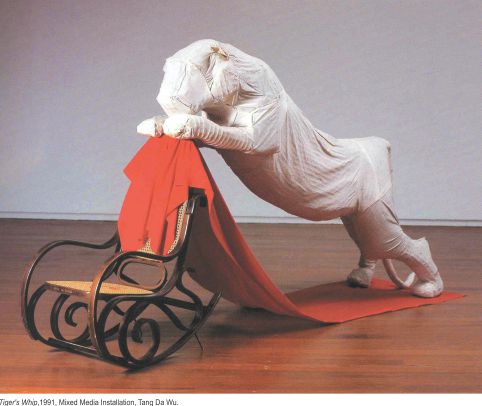
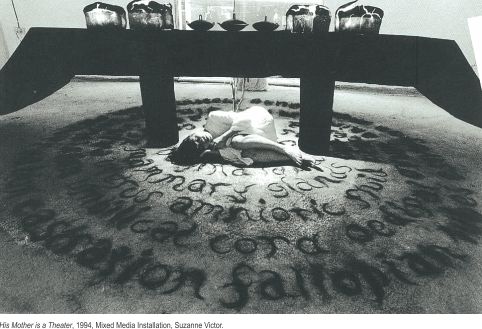
Tang Da Wu returned to Singapore in 1979 after a 10-year stay in Britain. Equipped with technical and conceptual strategies far beyond the expectation of the exhibition-going public in Singapore, Tang’s drawings, installations and performance art generated a critical debate: ‘his name [ignited] different responses in the local art community. Some good, some bad, never indifferent. The more traditional masters didn’t know how to respond to Tang Da Wu…At best, old style followers raised an eyebrow and felt uncomfortable with his flamboyance.’9 In 1987, Tang led a group of young artists to establish The Artist Village in rural Singapore. Unlike the Nanyang artists who were fond of rural Bali, these artists were found ‘in a cluster of zinc-roofed huts, with real farmers and chicken and pigs.’10 The Artist Village programme exposed younger artists such as Vincent Leow, Amanda Heng, Suzanne Victor, Zai Kuning, to principles of nativity negotiated through the eyes of western-trained Tang. As Sabapathy notes, ‘they seek to use the artistic medium boldly and directly without artifice or ornamentation. They are concerned with figuration, whereby the worlds of man and nature are transformed into images which express highly-charged emotional and psychic states.’11 In a time when state policy was shifting towards the Asianising of Singapore within Asian-flavoured capitalist traditions and notions of Asian Values, Tang sought to engage the land, space and people at a more fundamental and emotional level even though he could be criticized for being coloured by his training within the scope of an Orientalist trajectory. Nevertheless, Tang’s training did play a vital role in shaping the language, perception, and form of the encounter between artists and the state.
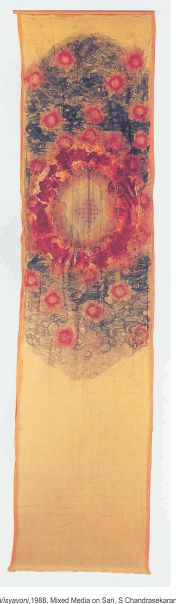
1988 saw three graduates of the Nanyang Academy of Fine Arts—S Chandrasekaran, Goh Ee Choo and Salleh Japar—present an exhibition titled Trimurti 12 that took the art world in Singapore by storm. Trimurti, a display of pictures, sculptures, installations and performance in the codified format of Chinese, Malay and Indian philosophical idioms grew out of their dissatisfaction with art education at the Academy and a need to explore the vicissitudes of their own cultural make-up. While the three artists may be viewed as products of a multi-racial national discourse, their works crossed boundaries, drawing on similarities, differences and contentions between canons. ‘Trimurti can be interpreted, at one level, as challenging the streams structure and as forging rapprochement between streams. Delving into their respective heritage resources Chandra, Ee Choo and Salleh also agree to secure common or shared grounds enabling them to infuse their project with a semblance of integration while maintaining distinctiveness in particulars…the three of them transformed themselves into shamans, and in doing so corralled the function of artists and art into overtly ritualistic, communitarian contexts.’13 But does Trimurti risk introducing an art practice that has a limited audience?
Trimurti indeed was a celebrated event for the visual arts community, which, in an unwarranted fashion, reveled in the artists’ return to roots-assiduously splashed with a malleable theory that balanced the official and colonial discourse. The artists did not intend a multicultural mix. They happened to be good friends, troubled by dogmatic art practices, inspired by their religions and cultural roots, and excited about new avenues of art in the west, especially performance art. Ahmad Mashadi, in an essay on Trimurti, stated that the exhibition was an act of representation ‘at a point of Singaporean history when discussion on race, religion and language was encouraged by the state.’ Mashadi’s criticism that the artists were agents of official discourse, presenting non-contentious ‘cultural shows’, is cynical. However, it highlights the problem that any form of collective consciousness, during a time of nation building, must be held suspect. It also pre-empts a certain bias towards a position that may end up supporting the official discourse of the time. Where Trimurti was concerned, the collective consciousness of being different was in opposition to art practice and not necessarily the official discourse. Secondly, comprehensive state programmes, at that time, covered all aspects of life that any other genuine attempt is seen to be complicit with. I would assert that the visual arts community and the state were far less familiar with new practices of contemporary art-installation and performance art, in particular: its potency would not be realized until much later in the early 1990s. In an instance where there is an international art practice and the viewing community is ill equipped to engage with it, the art becomes a novelty and is agreeable to the state since any form of discussion would be cursory and academic. This I believe leads to a complicitous rapprochement from the other end.
In the 1990s Singapore not only saw a change in Prime Ministers but a flurry of artwork incorporating social and political issues. The aim was to have more real-world referentiality and a re-ignite public sensibility about the value of art, which had been stunted by modernist beliefs in internal reflexivity as a hallmark of art. Art began to enquire into the legitimacy of the social order and to remark on the control by the state of the private lives of people. This worked in two ways: firstly, there were commercial art fairs such as Tresors. Money legitimized art practices where the citizen expressed the right to citizenry through the dollar. Secondly, the development of performance art allowed artists to make direct contact with social issues.
1994 saw the clash between the state and contemporary art practices. Artist Village and Fifth Passage Artists Ltd organized a weeklong series of performance art shows, poetry readings, music events, videos, and forums. The Board of Film Censors censored several videos; furthermore, newspapers presented sensationalized reports on the event. Annoyed by inaccurate reports, Shannon Tham incinerated a local tabloid, The New Paper, swallowed the ashes and vomited. Josef Ng in his performance Brother Cane commented on the arrest and public exposure of gay men for alleged gay activities. In his performance Josef Ng stripped to his briefs and snipped his pubic hair. Wide media coverage led to the National Arts Council condemning the act as ‘vulgar and completely distasteful.’14 The state reacted, noting the potential dangers of performance art and forum theatre, which relied on devised scripts and spontaneous audience participation, to public order, security and morality; the fear that it contained the potential to propagate deviant messages and be a means to political and social subversion led to the arrest of the artists and circumscription of performance art.15
As an act representative of the social discourse of the time, the 1994 event was deemed irrelevant by the state: a fundamental ontological opposition between self (as defined by the state) and the other. As an act representative of the international art discourse in the West, this event positioned itself well—pending a critical appraisal of the works themselves. But the clash between the acts of representation can be deemed ahead of its time, when social and political commentary was opened up within Singapore. This event and others played a role in the state defining its Out-of-Bound markers (OB) for civil society. Any form of liberalization is manufactured within this cultural framework. On the other hand, the event can be seen as a ‘political’ act that lives the ideology of that time and also as a necessary tool for enforcing the status quo.
Globalisation and the New Asian Art Market
In a forum organized at the international Asian Art Fair held in Singapore in April 2004, sociologist and cultural critic Professor Chua Beng Huat was asked how he would define Singapore art. He retorted that there was no such thing.
With an abundance of international art practices proliferating in Singapore through art institutions, museums, participation in international biennales, and the strong presence of the international art market, visual art in Singapore has to be engaged as an activity within cultural practices that constantly create and circulate meanings, which are entwined in the recent past. Is there a cultural impasse? In the ‘events’ I have discussed above I have not focused on the production of meaning by the various art works, rather I have treated the ‘events’ as being symptomatic of the nexus of economic, political and social factors that define their context of production which is heavily weighted by the national discourse of the time.
This brings us back to the retort by Professor Chua. Singapore Art, being in its historical infancy, is defined by movements, practices and events within the structures of history. Caught between the discourses of officialdom, internationalism and localism, the contemporary Singapore artists seek solace in the blurring lines of abstraction, which circumvents social and current issues through a process of allusion that is atemporal and ahistorical. This is a double-edged sword. Unfortunately, it self-censors by virtue of this circumvention and by leaning towards internationalism — is neutral and sterile of social criticism, which plays to the tune of globalisation and the global art business. Can there be any form of social criticism if there is no fundamental philosophy of engagement? It is a growing process and contemporary artists are looking at establishing self-identity through a visual language that is international in nature. This will give them the self-confidence to engage with the cultural capital not only of Singapore but of the world.
1. T.K Sabapathy. “Forty Years and After: The Nanyang Artists. Remarks On Art and History” in New Direction: Modern Paintings in Singapore 1980-1987. Ed. Thang Kiang How. et.al. Singapore: Horizon Publishing, 1987. unpaginated. Art Historian Chia Wai Hon locates the formative year to 1935 when the Society of Chinese Artists was founded and inaugurated. Sabapathy has noted this point in his essay but its discussion pending. See also Chia Wai Hon, “Whither the Fine Arts?” in Singapore Towards the Year 2000. Ed. Saw Swee Hock and R. S. Bhathal. Singapore: Singapore University Press, 1981. p. 132.
2. T.K Sabapathy. Ibid. unpaginated.
3. Michael Sullivan quoted in T.K Sabapathy.
4. Edward Said. Orientalism. New York:Vintage Books, 1979. p. 58.
5. Kwok Kian Chow. Channels and Confluences: A History of Singapore Art. Singapore: Singapore Art Museum, 1996. p. 24. According Kwok, the Nanyang Style did not denote specifically a particular aesthetic trend or tendency rather it referred to the subject matter articulated by the diasporic experience of the Chinese artists.
6. The “Second Generation artists” here refers to Teo Eng Seng, Ng Eng Teng, Thomas Yeo, Goh Beng Kwan and Anthony Poon.
7. Constance Sheares. Contemporary Art in Singapore: Where East Meets West. Exhibition Catalogue. Singapore: National Museum, 1989. unpaginated.
8. The fourth category is a sum accumulation of all those who do not fall within the ambit of the first three constitutive imagining.
9. Pauline Loh. “Kampong Refuge for Artists” in The New Paper, February 7, 1989.
10. TK Sabapathy quoted in Kwok Kian Chow’s Channels and Confluence. p. 144.
11. Ibid. p. 144.
12. Trimurti refers to the Hindu trinity of Brahma, Vishnu and Shiva who represent the forces of creation, preservation and destruction, respectively.
13. T.K Sabapathy. “Trimurti: Thoughts on Context” in Trimurti and Ten Years After. Singapore: Singapore Art Museum, 1998. p. 25.
14. New Paper, 5 January 1994.
15. For an in-depth reading of the events, See Looking at Culture. Ed. Sanjay Krishnan, Lee Weng Choy. Et. al. Singapore. Limited Edition. 1996. The 1990s also saw artists in other fields such as literature and theatre making similar stabs at social and political issues.
Venka Purushothaman is currently Programme Leader and Senior Lecturer of Arts Management at LaSalle-SIA College of the Arts, Singapore.
The state of the visual arts is often symptomatic of their socio-political environment. In Singapore, the production and management of the visual arts is primarily negotiated through an economic ideology which transposes subject matter through the three-fold distinction of West, East and intra-SEAsia. The development of a Singaporean identity is going on through the process…