
Contemporary art in pakistan
The art of Pakistani is multifaceted and varied. The diversity is so great that it becomes impossible to stick one single label to the activity which has grown manifold in the last fifty years.
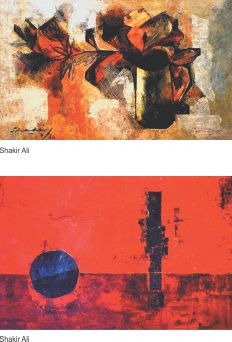
Three of the most famous elder artists of Pakistan, Abdur Rehman Chugtai, Shakir Ali and Allah Buksh passed away in 1975 within months of each other but by then the foundations of art had been solidly laid for the succeeding generation of artists to build upon. The younger artists have found it comparatively easy to do their work because their predecessors had already created a market. While Shakir Ali and Abdur Rehman Chugtai had to look for buyers and sold their work for a few hundred or a few thousand rupees, the later artists have had the advantage of ready buyers.
In the last few years painters have made creative use of tradition. Compared to the time after partition when a sharp division existed between painters given to realism and those enamoured of abstraction, the lines are drawn now between those who rely on tradition for the basic vocabulary of their work and those who prefer mixed media. In the debate that raged in the fifties and the sixties it was generally said that the gulf between the realists and modernists was too wide to be bridged. There was no meeting point between the two for there was no local reference.
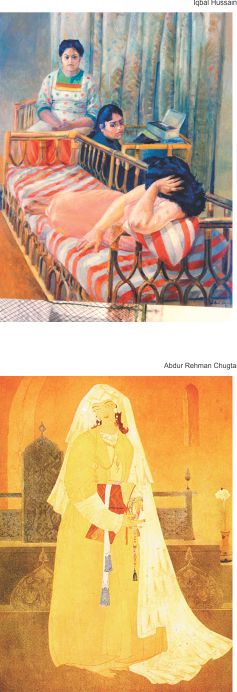
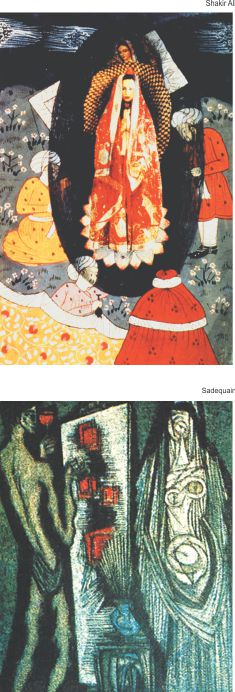
Painters in Pakistan have always sought inspiration from poetry. The art of the book was greatly influenced by poetic images. Abdur Rehman Chugtai produced pictorial accompaniments to both Ghalib and Iqbal, not in the manner of illustrations but reaching out to seek a common imagery between the two genres of expression. Sadequain too in the 1950s and 60s painted the hero from ghazals as anguished, unrequited and weary, a wanderer in quest of fulfillment. Sadequain was one painter who had the appeal of a star. His being a cultural icon helped in the popularization of painting. To most people art was an esoteric activity that appealed only to a limited number or to those who could afford to buy it. His star value helped the average middle class person to relate to art. The market became bigger and even if it did not increase the number of buyers, it added more viewers from different backgrounds to encourage a more varied response.
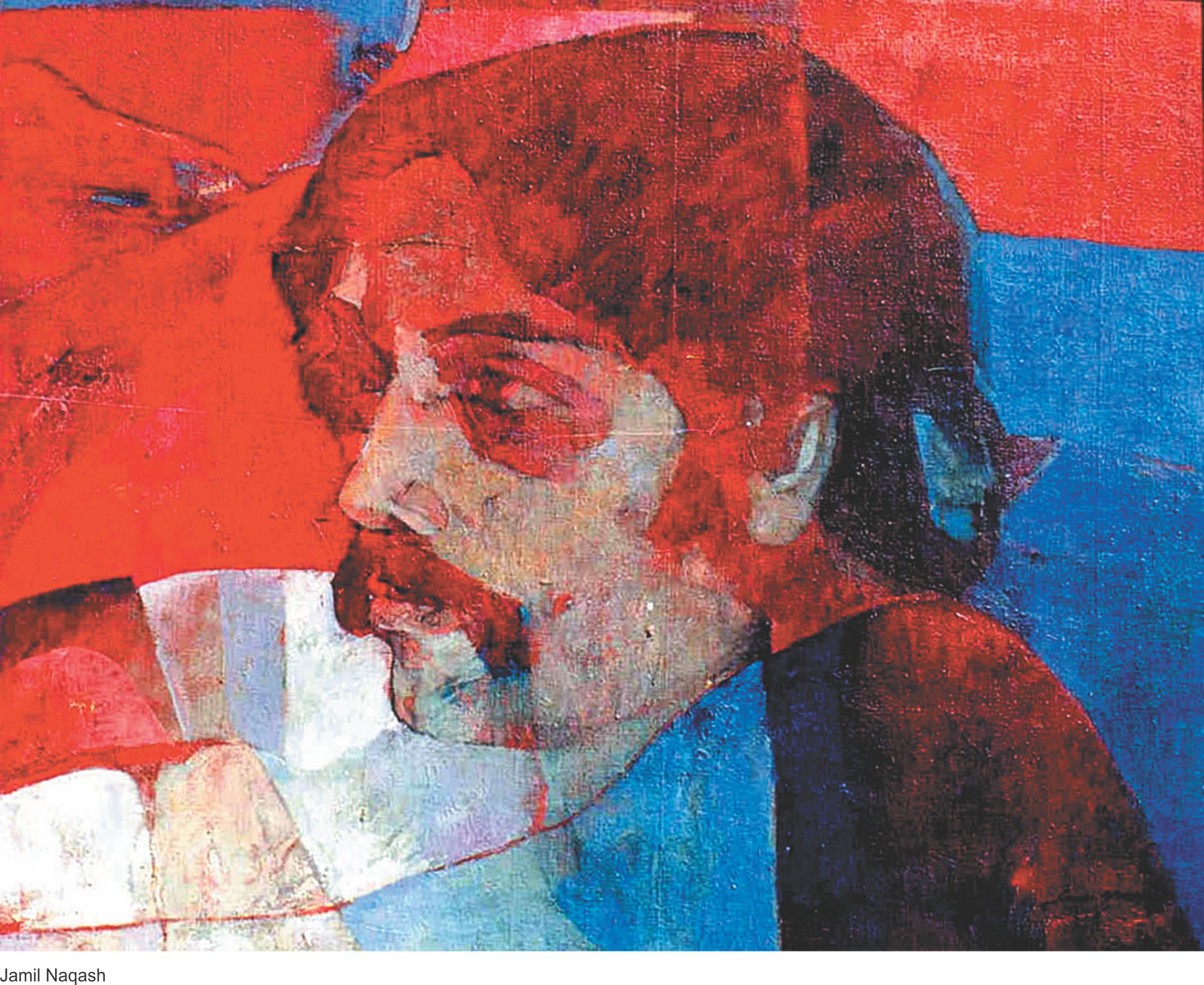
Abdur Rehman Chugtai represented traditionalists while Shakir Ali was more influenced by the cubists. The images of Shakir Ali’s paintings such as Leda and the Swan or Pieta also came from outside sources. Jamil Naqash, greatly influenced by Shakir Ali, has been painting for the last forty years outside the accepted painterly conventions. He is inspired by stock images and symbols like the dove and the female nude. The human form, especially that of the female, is a permanent feature in his work. Love and peace border on the erotic. The sensual apprehension of reality in his painting is pitted against ideas of power, acquisition and conquest.
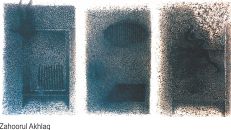
Zahoorul Akhlaq too was inspired by his artistic heritage—not so much by the images from miniatures or the stylized manner of applying paint and brush but by the possibilities inherent in the two dimensional surface of our traditional art. For a viewer conditioned by the closed nature of three dimensional objects, the two dimensional surface offers a more open-ended approach and shifts the onus of interpretation on to him. The themes that Akhlaq selected for his paintings were all very contemporary. He used the background of the grid and against it placed the human form. The human form appeared pinned down as if waiting for a nuclear holocaust or some other catastrophe.
The various experiments that have taken place in Pakistani art have their origins in the tradition of miniature painting. Shazia Sikander, for instance, like many traditionalists, derives the references of her work from miniatures while she attempts to relate the genre to contemporary reality. Like most artists she is a graduate of the National College of Arts in Lahore where a very vibrant Miniature Department under Bashir Ahmed has been working successfully for a number of years. The department’s reputation was ensured by traditional masters who passed on their incomparable skills of miniature painting to the students so that they could incorporate the issues that characterize the current age. A whole new expression then developed and evolved into a significant movement from the department. Many artists are comfortable with the miniature mode, as the form expresses their modern sensibility.
In addition to Shazia Sikander, two other younger artists who have shown unquestionable promise are Imran Qureshi and Usman Saeed. With Imran Qureshi the figures are usually in the traditional mould but the activity which they are engaged in is quite contemporary. The scenes are not the stock idyllic landscape where the beloved pines for the lover while a couple of animals symbolizing eroticism linger in the background or the heroic figure of the king, either leading his army into battle or going out for a royal hunt. Instead it is a woman getting ready in the toilette to face the challenges of the day. She is not a figure from the aristocracy who indulges in the cultivation of taste to endear herself to her lover but a working woman inhabiting a different environment for a different end; yet the demands of her sexuality struggle to find a new meaning in these very different circumstances.
There are a whole lot of women painters who make women the subject of their painting. Obviously they tend to move away from depicting the traditional image of woman. They see women being denied their rights, exploited and treated as second class citizens. The paintings are about their unhappy state while some go on to suggest that something ought to be done about it. The element of protest is very much there and so is plenty of anger. At times it appears that this art stands very close to being a statement. The women painters gravitating towards this form of protest are Salima Hashmi, Nazish Ataullah and Lala Rukh. Usman Saeed has experimented with mixed media based on miniatures. He works on the wasli and the strength of his line is totally in accordance with the toiled delicacy of a miniaturist although other mediums are mixed to create an image very different from what one finds in traditional miniatures. It is not so much in figure, posture and the movement that he experiments as in the mixing of the various mediums.
The other major sources of inspiration for Pakistani art are calligraphy and the art of the book. In the absence of figurative drawings abstract geometric patterns have been the main source of inspiration and the motifs are generally drawn from nature as in floral and vegetal patterns. These decorative motifs on the margins of the books, whether divine or secular, are in some ways related to the calligraphic patterns of the main text.
Mehr Afroze from Karachi has a very exquisite sense of design. Figures on her canvas dimly recede in the background while the rest of the space is filled up with abstract geometric patterns that flow from the rich repository of tradition. The colours that she uses are also dark and she applies extremely bold strokes. The patterns are close to those of calligraphy but then these are dealt with in abstraction without too pointedly being calligraphic. Her paintings have no specific theme, as has become the wont with women painters. Gender related issues like the question of veil, chaddar, and the general discrimination that is meted out to women often find expression in the work of women artists. Some go further and narrow their focus even further and deal with specific issues like discrimination and harassment at the workplace. Mehr Afroze does not go into the specifics of women’s issues—she must be aware of them but prefers not to be overemphatic. Her appeal is not limited to a certain section of society, but cuts across gender lines.
One patent way of capturing the reality of the new country in the early years was landscape. Khalid Iqbal has been the foremost landscape painter in Pakistan. He depicts in a realistic mould the landscape of the Punjab. This benign way of looking at reality was given a new twist during the Zia ul Haq era when all paintings except landscape and calligraphy were considered suspect. Painting the landscape was kosher while miniatures and abstractions were not encouraged and the human figure was disapproved of completely. Painting the landscape was loaded with political implications and its photographic qualities were both understood and appreciated. A whole body of work produced during that period and later under the lure of official patronage could not, however, stand the test of time. Khalid Iqbal started to paint landscapes a lot and helped to make landscape an accepted form of art, and has continued with the genre. The colours on his palette are all in close approximation to the colours that are found in nature, especially in the Punjab.
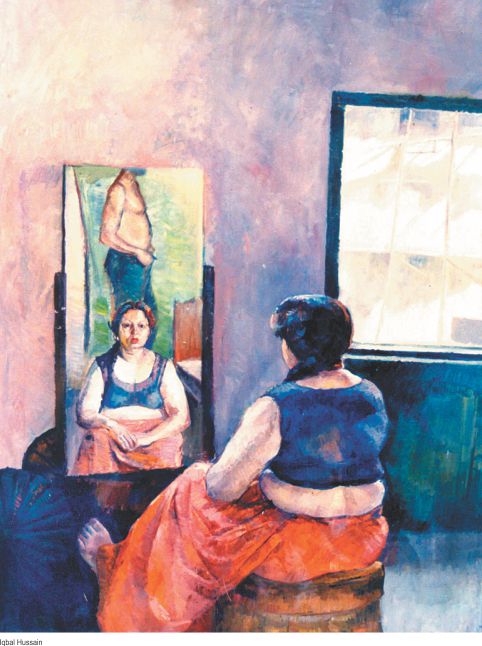
The work of Iqbal Hussain has an expressionistic touch. His subjects are also unusual. Prostitutes or dancing women figure prominently in his work but it is not the glamour or the beauty traditionally associated with their profession but the human tragedy that he reflects. His women are not beautiful objects of lust but dull, unglamorous and mechanical in their approach towards their work. They are seen with their peers, children, and the kids that they have to look after while going through the chores of earning a living without pleasure and involvement. These women wait for their clients with bored expressions. The entire thrust of Iqbal Hussain is to go against traditional images of beauty and glamour associated with courtesans. There is no music, no dance, no longing—only an expression that says the sooner they get it over with the better. The colours that he uses are garish and the application of paint is thick to highlight the grossness of the situation.
Quddus Mirza is fascinated by the child in us. The child is innocent and not corrupted by the ways of the world and he sees reality through the child’s eyes. The images are more like impressions and not the end result of a process that has been conceptualized. With Anwar Saeed, on the other hand, the child is seen indulging in a fantasy world. The figures are not in the realistic mould but are more like caricature; the movement of the line is dictated by the impulse of fantasy rather than premeditated drawing.
Another trend in Pakistani painting is minimalism. A large number of painters follow the minimalist tradition and get down to the bare essentials after stripping off the layers both in terms of the colours and the geometric patterns. The experience as it appears is very podgy and it needs to be torn skeleton-thin for reality to appear from below. This accretion is really the fat that needs to be carved away leaving the bare bones. Enver Shafi experiments only with colours—his colours are bright and attractive. The colours of the other minimalists are all dull and with a brownish hue. Enver is full of life as if wanting to fall into a pattern and yet failing to do so. The primal strength is there all the same, unfazed and undeterred by the lack of his ability to give it a form.
One indication of the good health of art in Pakistan has been the opening of galleries in the private sector. Nearly all galleries a couple of decades ago were in the public sector and were owned and supported by the government but Karachi took the initiative as private galleries started to make an impact with their more aggressive salesmanship and smaller overheads. In tiny spaces these galleries—led by Ali Imam’s Indus Gallery—guaranteed a good sale and a handsome return for the artists. The middle classes too became aware of the need to buy art and that increased market volume considerably.
In Islamabad, due to the presence of the diplomatic corps, the display and sale of paintings was a more acceptable social activity and despite a few public galleries many in the private sector have a good turnover rate. The last to respond to this change was Lahore, ironically, because being the capital of art in the country for about fifty years it housed the only arts college and the largest museum of the country. The city is quite vibrant in terms of literary and musical output. It is also the home of the film industry and has a flourishing theatre where five to six performances are held every evening. It also had the biggest art centre in the country in the public sector—the Alhamra—and hence the biggest gallery. Gradually galleries were commissioned in the private sector and after an indifferent start have established themselves by ensuring reasonable sales.
Sarwat Ali is Professor at the National College of Arts, Lahore
The art of Pakistani is multifaceted and varied. The diversity is so great that it becomes impossible to stick one single label to the activity which has grown manifold in the last fifty years. Three of the most famous elder artists of Pakistan, Abdur Rehman Chugtai, Shakir Ali and Allah Buksh passed away in 1975…