
face value
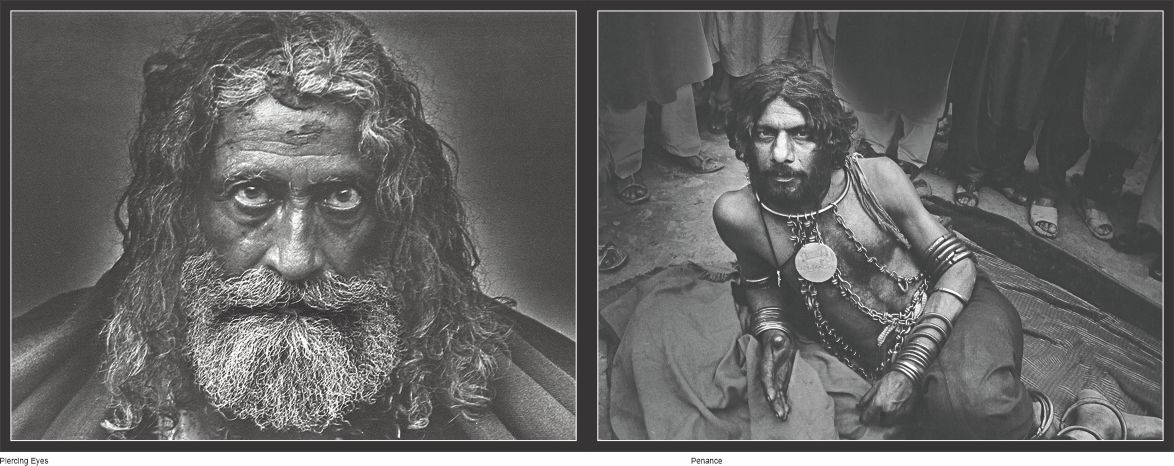
Throughout the history of portraiture, objectivity and documentation see-saw with subjectivity and symbolism. The finite, singular subject leads to our understanding of universal themes, while our individuating tendencies link generalities back to our own experience. Javaid A.Kazi (MFIAP, ESFIAP, FRPS, FPSA) creates a pictorial environment in which these dualisms dilate and declare their inversely proportional relationship
The tension between formal composition and implied content is wire-tight. He describes this tension as the vital, humanist essence of his portraiture. As he sees it, human existence is situated between freedom and determination. By analogy, and as far as the pictorial plane is concerned, he is interested in the similarly dynamic relationships between freedom and form, between freedom and the obligations entailed by our integration within a larger whole. In my view, these relationships are not dualistic; they are in dialogue. Consequently, the notion of transparency, the various ways these two principles fit within one another, is very decisive for him. After all, we are not entirely matter, nor are we entirely idea.
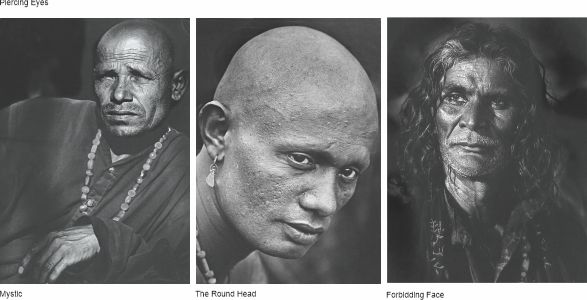
In Kazi’s portraits of the faqirs and malangs who swarm the dargah, the initial impression of visual clamour soon gives way to a coherent series of singular head shots. The eye can either work at random, attracted by idiosyncrasies, or methodically. Either way, the process of looking never quite tires—eyes out, ears in, chin lengthened, hair shortened—we might be tempted to apply the dark science of eugenics to such a close-knit social group.
There is an apothegm of Diane Arbus’s, from 1959, that goes, ‘What’s left after one isn’t is taken away is what one is.’ Put into rhyme, it would fit into many of the rueful, hortatory songs of the ’60s, when truth telling was praised both as a moral medicine and for its beauty. Before all else Kazi’s photographs plead for honesty. Those who are golden and exemplary are not the ones you must see, they say; you must see those who are specific and peculiar, like the majzoob and mendicants at the Sufi shrines, whom fever for devotion has brought close to imbecility. Where any of his pictures equalizes you with someone repugnant, or dream-sotted, or ashamed, it tells you that you must descend to the bottom, abandon all the sunny fictions that make you feel safe. In the years of his greatest work, faqirs called themselves freaks with pride, not just irony, and the grotesque came to stand for the truthful. The unmasking of fraud was central to the better impulses in politics and the arts, was equated with the saving of the self.
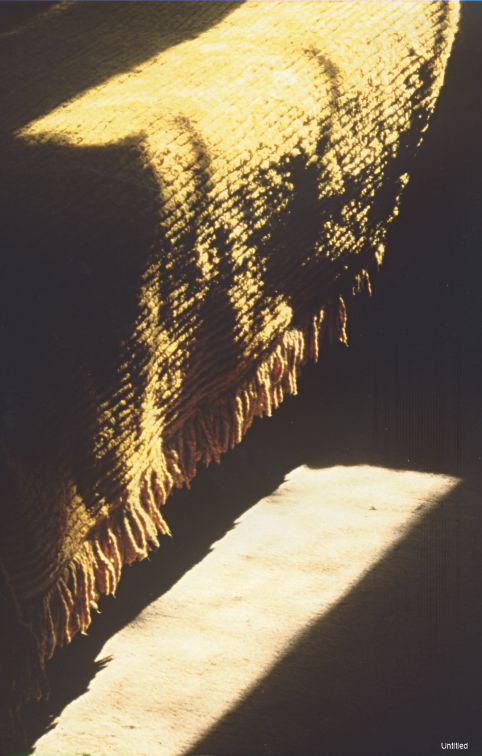
Kazi’s large-format photographs speak the language of the ’60s in many ways—through their raw intensity and love of the strange, in asserting that the present moment is crucial, in denying one a mere observer’s safe distance—but these are all aspects of their fundamental concern with whether the subject and the viewer admit the truth. In this preoccupation, his pictures belong to the decade’s overarching search for authenticity. They retain within their blackness, even now, the exhilaration of a departure upon a ship from which certainty has been flung over the side, and they also touch the decade’s torment profoundly. Being empty of action, it is hard to call them parables, but Kazi’s finest work frequently has the same impervious logic a parable does, pointing like a giant arrow beyond the facts that it relates.

If we can say that their bead necklaces, rings, dreadlocks and cloaks give Kazi’s subjects screens behind which to hide, almost all the principles in Kazi’s finest portraits are also masked. It is equally true of his posturing malangs, and his gracefully made-up young women who fled behind the austerity of their own faces. Sometimes the mask is appalling; occasionally it is exquisite. Sometimes the mask slips ominously; sometimes, as with his commanding, inquisitorial…, its hold is tight. What impressed Kazi most powerfully, though, was less the mask per se than the discrepancy between mask and face. The gap between intention and effect offers not just a guide to the route Kazi’s intuition took; it is also a principle that sets his world apart from the ordinary one. Kazi’s best work supports the Chekhovian idea that even an awful character must display some genuine virtue, and the subject of any strong Kazi picture is never merely ridiculous. The sour, porcine idealist of ‘Mystic’ has failed spectacularly to win the lost grace and innocence. But one must see how the atoms of the dreadful fuse in him, and will sense, astonished, a little love rising into one’s revulsion. When his work is at its most august, Kazi sees through his subject’s pretensions, his subjects know that he does, and an intricate parley occurs around what the subject wants to show and wants to conceal.
It is often countered that Kazi’s photographs express a warm compassion for the outcast, yet this is no less simplistic. The distress that his work provokes is real. Its ability to awaken fear, for example, is one of its great strengths. What is essential to understand is that it interests him not as a blunt, obscene fact, but for how it shapes the psyche of the person who endures it. If to get to the ultimate beauty and tenderness in Kazi’s photographs one must abandon the idea that he is an artist of the ‘strange’, one cannot do so completely because it is partly true. It does no good to sanitise Kazi’s work, but then, one must never fail, either, to see how it shines with wonder. There are loves more complex than that for handsome faces and figures!
As contrasted with Javaid A. Kazi’s work, over the past few years, Azmat Kamal has produced a body of work that has gone through a number of formal permutations, though it has always reflected an interest in the mind’s capacity to envision the physical negotiation of space. His variable photographs have consistently focused on the sensation of ‘entering space visually’, as he puts it. This is not to suggest that one has to enter into a meditative state in order to appreciate Kamal’s aesthetic. On the contrary, experiencing his work involves propelling the body into motion.
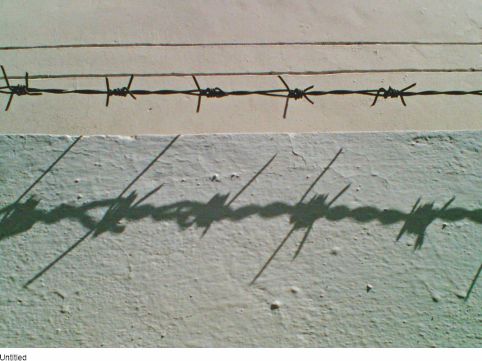

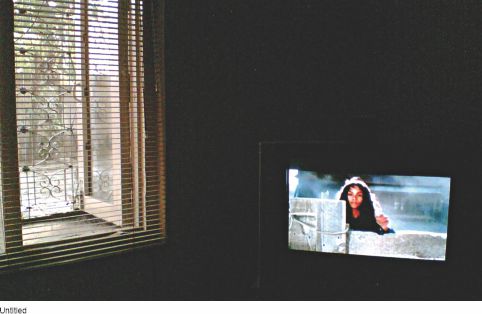
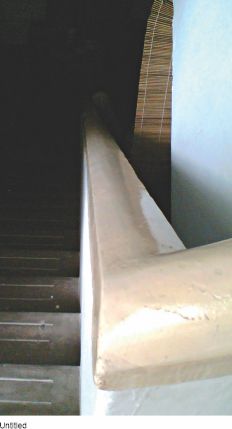
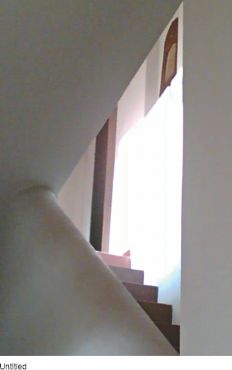
Kamal’s studies of space do not resemble particular sites. A generalised, pseudo-sublimity resists the effort to see them as pictures of his native land, or records of his travels overseas. At times, his photographs seem to be born of those accidents that guided Ralph Gibson. As a product of imagination and not just empirical observation, such work surely evinces suspicion over the ideological construct of land that tries to compensate for the loss of human ties with nature. In an untitled photograph of the multitude created, more recently, with the help of cell-phone camera, the landscape vanishes altogether, and all that is left is the trace of a sort of scar on the sky, left by the cables used to power electric poles and streetcars. Speckled, glittering, or spangled surfaces draw us forward only to frustrate the wonder for which we are nostalgic. The closer we get to them, the more disfigured the representations appear, and the more the photographs look like objects. This is noticeable in a suite of four miniatures—where the image wraps around the walls, underscoring its artifice. No frame hides the materiality of the plaster here; the window necessary to realist illusion does not form. What these observations suggest is that Kamal is not only cognizant of the historical and cultural difficulties involved in figuring a landscape-abstract, but that he is willing to take the risk of working through these circumstances in order to discover a critical aesthetic appropriate to the subject. He depicts an alienated reality in which the compelling recession of light portrays a quintessential essence of celestial luminosity.
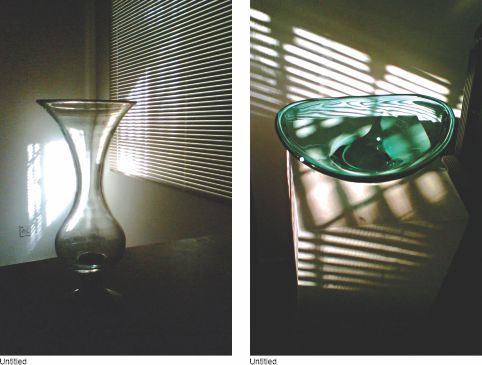
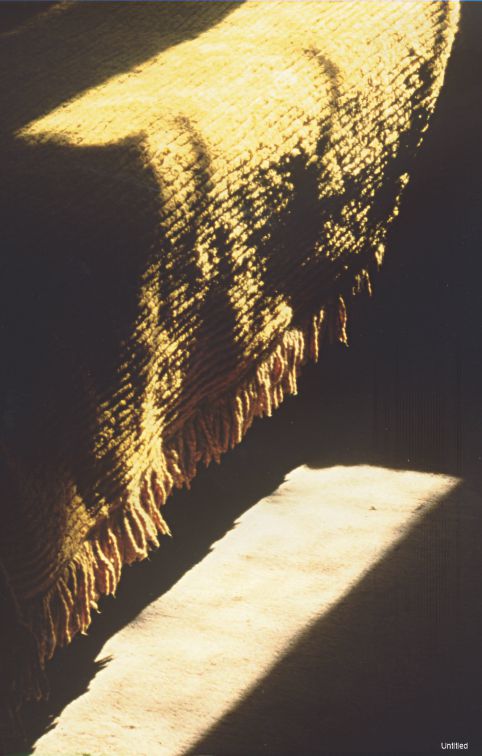
The fusion and clarity of colours in Kamal’s photo-oeuvre offer a dynamic rhythm, engendering a visual journey of advancement and retrieval. It offers space for indulgence and contemplation. The lines are subtly changing shapes from thick to thin, criss-crossing and intersecting to give a sense of encounter and discovery. Discovery is the essential element of the work. It presupposes an alleviation of the burden of knowing, so as to engage the unknown. The gentleness of encountering evokes the pleasure of seeking. This essence comes through vividly in the lyrical photo surfaces. Most of the photographs are made with unassuming spontaneity. Sometimes, when Kamal’s subject is solely the landscape—the swatch of green grass overspread with a net of stone walls, stretching away to a low horizon, or the late-afternoon shadow of a leaf on wall, the image can seem a bit non-committal, as if the photographer felt uneasy about merely describing. But if he places a roofscape in the foreground or a telegraph pole so that its wires swerve across the print—if he focuses on the knot in a wooden door resembling the belly-button, cunningly tilted—the photograph is suddenly transformed: the lines tauten and seem to quiver with energy. Because a tension is set up between geometrical, man-made forms and the organic forms of nature, the design takes a life of its own, still anchored in a particular place, but also obeying an internal logic.
Kamal, however, in his desire to stress the non-metaphysical origin and intuitive process of his work, could at times misleadingly oversimplify. In truth the question of whether or not the moon originated in the sky is academic, since the power of the images comes not from a reductive simplification but from an intensification which has burnt out all accidents of the phenomenal world so as to allow our awareness to expand to the universal. The stone-like surface or patinated effect that we have noted is now used to a more or less greater effect. Neither is intended simply as an ingenious, but pointless, simulation of stone or some time-battered, antique object. The back of a metal garden chair, for example, is a self-existent object whose colour, form and texture are to be appreciated as one, indivisible whole—a concrete reality in its own right. Equally, it is a means of conveying his experience of living: not a representation of something seen but a recreation of the experience of seeing it tinged with other emotions and memories.
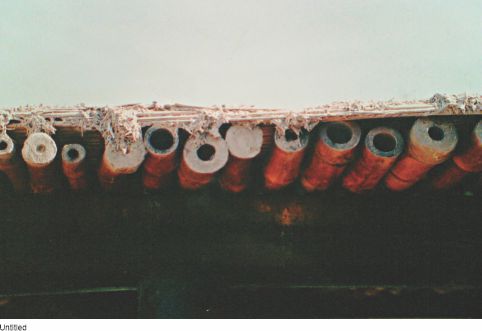
Kamal’s ongoing projects are, if not boundless, then potentially vast. By using a systematic approach and reductivist aesthetic, and working in series, he refers to Modernist practice. His subject matter, however, is classical. The cleanliness of photography can accommodate this convergence of Modernism and Classicism, which painting would perhaps over-articulate through the artist’s painterly mannerisms. Here the artist’s hand is not directly evident—like Conceptualism or roasting meat, the essence is embedded in choice and staging rather than expressive execution. Although Kamal’s images are constructed, they have a sense of inevitability, an archetypal presence which comes from a Classicism that is adroitly served up with technological precision.
Aasim Akhtar is a photographer and art critic from Pakistan. He is the author of Regards Croises: Peshawar (in collaboration with Lin Delpierre) and The Distant Steppe.
Throughout the history of portraiture, objectivity and documentation see-saw with subjectivity and symbolism. The finite, singular subject leads to our understanding of universal themes, while our individuating tendencies link generalities back to our own experience. Javaid A.Kazi (MFIAP, ESFIAP, FRPS, FPSA) creates a pictorial environment in which these dualisms dilate and declare their inversely proportional…