

tale of an artistic city
Berlin has certainly become one of Europe’s foremost artistic centres now. On any given evening, the curious visitor can plunge himself into anything from the world of experimental dance, 12th century German paintings, or home-grown jazz. The arts and culture section of Berlin’s leading listings magazine Zitty is filled with pages of dense, small-font recommendations about how best to ‘plug in’ to the city’s cultural life – a challenge far more diverse than anyone could imagine.
Anyone with a knowledge of German history might not find the explosion of art and culture in Berlin surprising. In the nineteenth century, Berlin was the home of such forward-looking artistic movements as the ‘Berliner Secession’ groups of August Strindberg and Edvard Munch. The presence of other modernists like Vassily Kandinsky and Emil Nolde at the turn of the century kept Berlin in the artistic vanguard.

This position was cemented by the still legendary ‘golden 1920s’, when Berlin was the industrial capital of Europe. Buoyed by its economic prosperity, it was the home of diverse artistic, literary and journalistic worlds. Its residents included Walter Gropius – one of the founders of the Bauhaus architectural movement; Bertolt Brecht – the leading author and playwright of the ‘absurd’ – and great painters like Max Liebermann, George Grosz, Max Beckmann and Lovis Corinth.
With the rise of Hitler, the ideals of progressive Berlin were dealt a severe blow. The post-war partitioning of Germany in 1953 and the building of the Berlin Wall built in 1961 to separate the Allied and Soviet sectors of the city heralded the beginning of an uncomfortable political and cultural era punctuated by the student revolt of the 1960s and the ‘alternative’ punk revolution of the 1980s. Consistent Soviet repression meant stagnation in the arts scene and the beginning of ‘socialist realism’ the results of which can still be seen today in the colossal, bland buildings along Karl-Marx Allee.
On October 3, 1989, the Berlin Wall was literally pulled down, marking the end of ‘East’ and ‘West’ Berlin, and the beginning of German re-unification. Yet it is only now that Berlin is beginning to regain its former position as the leader of the German arts scene.
The two major state art collections have recently been given new homes; public transport links between the two sides of the city are almost all completed; and the pre-World War 2 central area ‘Mitte’, which was allocated to East Berlin after the war is only now being rebuilt as the heart of the city.
On the one hand, the old no-man’s land at Potsdamer Platz has been reshaped into a glistening business district now housing the shiny new Sony building and, on the other, former depressed and ‘alternative’ East Berlin districts like Prenzlauer Berg are slowly being gentrified. Nevertheless, the old East German neighbourhoods closest to the old line of the Berlin Wall are still the homes of experimental and radical new art forms and have retained the young population that always gave impetus to artistic development, even during the Communist era.
Perhaps the best indicator of the ‘new’ Berlin has been the overhaul of its two biggest symbols: the federal parliament (the Reichstag) and the Brandenburg Gate, the only official passage between the east and west sides of the city for 40 years. In 1999, the former was given a new glass ‘dome’ designed by British architect Norman Foster and the latter was treated to 22 months of renovation at an estimated cost of 3.9 million Euros (approximately US$4 million). As if to cement its historical importance, the mythical Gate was unveiled to the public on October 3, 2002, 12 years since the wall came down around it.
The official art scene has undergone a similar revitalisation in recent years. Galleries and museums have been brought under the administration of one body – Staatliche Museen zu Berlin (SMB) – which looks after a mind-boggling array of cultural sites: almost 200 in the Berlin-Brandenburg area. It is quite possible to indulge your railway fantasies, visit the Berlin arboretum, and enjoy Egyptian artwork on the combined daily or three-day ticket available at every SMB museum. Their two flagship sites are the Kulturforum (Culture Forum) and the Museumsinsel (Museum Island).
Of particular interest in the Kulturforum are the Neue Nationalgalerie (New National Gallery) and the Gemäldegalerie (Picture Gallery). The first museum to be opened on the Kulturforum site, the Neue Nationalgalerie, was designed by Mies van de Rohe in the mid-1960s, and now contains a large number of 20th century painting and sculptures arranged in a series of rooms.
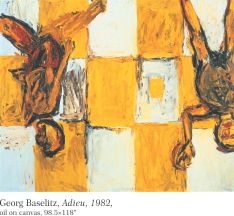
Even more impressive is the magnificent collection of 13th – 18th century European art in the Gemäldegalerie. The deep Christian symbolism of Botticelli rubs shoulders with the intensity of Rembrandt, all housed in will-lit and airy surroundings. The permanent collection of early German painters is also a revelation, since their works often exhibit a calmer and less dramatic interpretation of Biblical scenes than do the later Italian painters.
The Museumsinsel includes, among other things, the newly-restored Alte Nationalgalerie (Old National Gallery). Proudly proclaiming ‘Der Deutschen Kunst’ (The German Art) from the top of its classical pillars, it concentrates on 19th and early 20th century European painting. Tourists and locals flock to see highlights such as Arnold Böcklin’s haunting ‘Toteninsel’ or enjoy the soft colours of Edouard Manet and Paul Cézanne. The building’s grand, sweeping staircase seems entirely appropriate for the numerous depictions of German 19th century court life displayed on the walls.
Two other SMB museums are worthy of note – the Sammlung Berggruen and the excellent Ägyptisches Museum (Egyptian Museum). The collections of Berggruen form the backbone of the displays in the museum named after him and focus heavily on the early 20th century Modernist period. One of the five floors is devoted to Paul Klee’s enigmatic and playful creations, while another is dedicated to a notable display of works by Picasso.
At the other end of the historical spectrum, the Ägyptisches Museum exhibits a remarkable number of Egyptian sculptures and what has been called the ‘most beautiful depiction of a woman’: Cleopatra’s bust. The whole is cleverly housed in a black interior under minimalist and atmospheric lighting.
Art is thriving outside the SMB too. Independent and unofficial art contribute hugely to Berlin’s cultural scene. From world-wide independent art collections like the Guggenheim to small – scale exclusive galleries that fill the area around the Hackescher Markt district Berlin has it all!
Where the Guggenheim recently displayed provocative sculptures from the world famous and recently deceased Basque sculptor Eduardo Chillada and the new Daniel Libeskind-designed Jewish Museum outlines the multiple facets of Jewish-German history, the one hundred or so listed galleries run by private collectors show off the work of Berlin’s rising stars. Experimental exhibitions with names like ‘Telepathic Agriculture’ and ‘Pixelpictures’ is ensuring that Berlin retains its position at the forefront of the artistic world.
This is further reinforced by the many artistic gatherings that take place either at the Akademie der Künste (Art Academy) or the Berlin Messegelände (conference centre). Lectures, films, special exhibitions and the 2002 International Fair for Contemporary Art were all scheduled for the ‘kunstherbst 2002’ autumn season, this last being a gathering of collectors from all over Europe and the USA.
But it is not only the organisations within the art world that make Berlin a great cultural capital, it is also the interest Berliners show in the arts that makes the city’s culture so vibrant. Events are organised throughout the year and these draw huge crowds and receive extensive coverage in the local and national press.

Perhaps the best example of Berlin’s thriving culture world is a twice-yearly event held during my stay in the German capital in September: the twelfth ‘Lange Nacht der Museen’ (Long Night of the Museums). The original aim was to keep most of the museums under the control of the SMB open until 12 or 1 am, but it now includes concerts, talks, readings and special presentations. One ticket gives access to an unlimited number of museums and allows unrestricted use of the public transport network for the one evening. Not surprisingly, both the underground and regional railway were throbbing with people well into the night and the event was a huge popular success.
The ‘Long Night’ is the biggest of a regular series of festivals held throughout the year that bring the arts to the residents of Berlin. Others include the ‘Museum Island Festival’ which integrates art and music through a series of concerts by leading lights such as Ravi Shankar and Nigel Kennedy.
The visual arts have even found their way into two of Berlin’s most significant spaces. In September of this year, there was an outdoor display of landscape photography on the Potsdamer Platz. The fabulously evocative photos were taken by the French photographer Yann-Arthus Bertrand whose book ‘The Earth From the Air’ has been a European bestseller.
Finally, there is the East Side Gallery representing spontaneous artwork on the last remaining one kilometre section of the Berlin Wall. Although the paintings done in 1990 and re-painted in 1999 have been sadly marred by the graffiti of tourists, they make clear the collision between Berlin’s history and its culture.
Certainly, what is gratifying about the German capital is that its cultural scene is anything but history. It is surely as eclectic and provocative now as it was in the 1920s. Pick any field from fringe theatre to Renaissance art and Berlin looks vibrant. Vigorously supported by the state and its residents, the city seems to thrive on a continuous impetus for further developments. Surely then, Berlin is a model of how to create an artistic city.
Emile Chabal is studying history at Trinity, Cambridge
Berlin has certainly become one of Europe’s foremost artistic centres now. On any given evening, the curious visitor can plunge himself into anything from the world of experimental dance, 12th century German paintings, or home-grown jazz. The arts and culture section of Berlin’s leading listings magazine Zitty is filled with pages of dense, small-font recommendations…