
Editorial
The enthusiastic response given to the debut issue of Jamini, both at home and abroad, has confirmed us in our belief that Bangladesh can sustain a quality art journal. We have been able to muster capable and willing contributors at home and writers of note from abroad; potential advertisers have evinced keen interest; our technical staff and printers have proved their competence; and readers and reviewers have been appreciative.
There is no room for smugness, though. Keeping a quality journal going requires a steady flow of innovative ideas. While the task of coming up with such ideas lies ultimately with the editorial team, much of the inspiration has to come from readers and critics. At a more mundane and somewhat materialistic level, it is undeniable that subscribers and advertisers are the lifeblood of a periodical; and we could do with more of both. But judging from the response so far, the prospect looks bright.
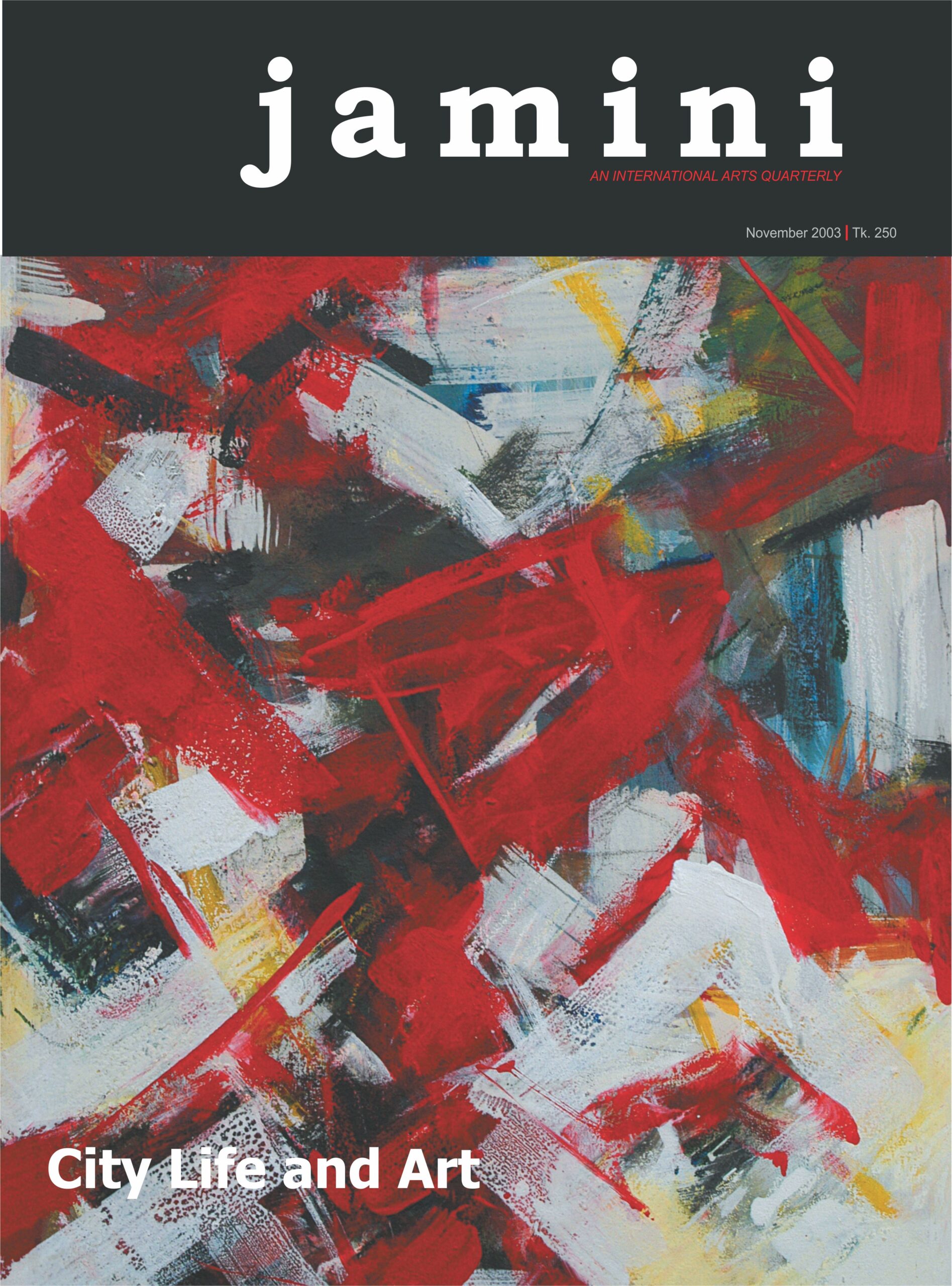
This issue of Jamini is devoted to ‘City Life and Art,’ a theme that lends itself to variegated treatment. Perveen Ahmad meticulously garners information on Mirpur’s Banarasi sari-weavers. Monica Ali’s lively recollections of her forays into Brick Lane, the eponymous street of her celebrated novel, accompany Nasir Ali Mamun’s evocative photographs. Amiri Baraka writes with characteristic verve to give us a critique of the New York theatre scene. The up-and-coming classical singer and author Amit Chaudhuri evokes the lost grandeur of Babu Kolkata. Coral Hull strikes an adversarial pose vis-a-vis the hedonistic modern city to make a convincing case for minimalism. Tabish Khair takes the reader on a pleasant walkabout through Copenhagen, where the remnants of the Hippie movement coexist with a very bourgeois society. Waqar Khan presents rare watercolours of Dhaka’s waterfront dating from before 1840. Muntasir Mamun (translated by Fakrul Alam) showcases Sir Charles D’Oyly’s classic drawings of Dhaka’s Mughal ruins. Accompanying photographs by Mamun, Catherine Masud’s article captures Dhaka’s restless and somewhat neurotic energy. David Perry highlights the role of New Orleans, Chicago and New York in the development of the liveliest of modern musical modes Jazz. Abhi Subedi reports on artistic activity in the fascinating Shangri-la that is Kathmandu. Our cover comes from the easel of Abdur Razzaque, one of our most respected senior artists. He talks to Ziaul Karim about his work and offers us a glimpse of his paintings of Dhaka scenes. We hope every discerning reader and lover of art and city life will find something of interest in this issue. Our next issue will centre on festivals those in the broad cultural or religious sense, as well as the more specialized ones celebrating the arts, like the Edinburgh festival or the Biennale organized by the Bangladesh Shilpakala Academy. From our second year of publication, that is, from the fifth issue onwards, three issues in a year will cover a variety of topics, while the fourth will focus on a single theme. We also plan to cover exhibitions in Bangladesh from the next issue onwards. We welcome comments, criticisms and suggestions from readers; we have no doubt they will help us make each issue distinctive.
The enthusiastic response given to the debut issue of Jamini, both at home and abroad, has confirmed us in our belief that Bangladesh can sustain a quality art journal. We have been able to muster capable and willing contributors at home and writers of note from abroad; potential advertisers have evinced keen interest; our technical…