

show time
Not all that long ago art exhibitions were seasonal affairs, adding colour to the cool, dry months. Not any more. It may be blistering summer or the wet and musty monsoon or muggy post-monsoon season, but Dhaka’s art galleries, despite their steadily increasing number, are never short on bookings. This means, of course, that artists are not only producing and showing their works but also manage to find buyers. In the cultural as in the economic fields, the circulation of money is a sign of vitality; it also means more work for the critic.
The Bengal Gallery of Fine Arts may well be the busiest exhibition venue in town. It hosted four of the shows covered here, all over three months or so. In July Ferdousy Priyabhashini showed her varied new work there, in August Babu Ahmed exhibited his photographs of ‘One Hundred Temples’ and in the first half of September Nasreen Begum displayed her new paintings.
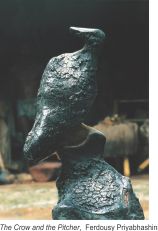
Priyabhashini is a good example of a late starter who announces her presence with work of conspicuous maturity. She was in her forties when she had her first solo in 1991 in Jessore. In the dozen or so years since, she has consolidated her reputation as a sensitive shaper of driftwood into exquisite sculptures. Though lacking in formal art school training, she picked up the essence of an aesthetic education through a leisure activity—woodwork. Before long a mature sculptress emerged and began steadily producing engaging expressionistic pieces.

Priyabhashini’s art depends first of all on the ability to detect the aesthetic potential sleeping in useless pieces of wood; and secondly on the delicate skill to awake that potential with the minimum of intervention. The finished work then gives an immediate impression of serendipity, such as one would expect in a happy example of found sculpture.
The seminal influence behind Priyabhashini’s work, however, is not a sculptor but a poet-painter, Rabindranath Tagore. Indeed, it wouldn’t be too fanciful to describe her sculpture as the translation of Tagore’s art into three dimensions. Fittingly, the show was titled after one of Rabindranath’s songs—an apt tribute to the seminal spirit in modern Bengali culture. But the translation of ‘Emon ghanoghoro borishay’ in the catalogue is infelicitous: ‘In the Deep Days of Monsoon’ is sheer gobbledygook.
One of the pieces is also titled ‘Rabindranath,’ while a number of titles refer to the independence war of 1971, a theme poignantly evoked by Priyabhashini’s expressionist art. A number of pieces carved in relief are framed to be hung and to me were the least successful component of the show. A few of the freestanding sculptures are meant to be seen from one side alone; it is a trifle disappointing to walk round and discover that the other side hasn’t been worked upon.
An unusual aspect of the show was the inclusion of a large number of items that cannot be classified as sculpture. Most of these are hybrid plants, but there were also a few pieces of furniture attractively fashioned out of tree stumps. I see these as a manifestation of the tradition, going back to the pre-Raphaelites, of artists infusing aesthetic value into utilitarian objects.
The opening of Jamal’s Gallery is an event that deserves mention in any history of art in Bangladesh. In the piquant idiom of the gallery’s flyer, it ‘is being incubated by RIZBIZ (i.e., the company that owns it) to promote Jamal Ahmed both at home and abroad by organizing exhibitions and managing commercial aspects.’ I do not know if there is another gallery anywhere in the world devoted exclusively to the promotion of one artist. One thing proved by this is that Jamal is commercially the most successful artist of his generation, perhaps of all living artists of the country. He produces copiously and sells well, and his work bears a clearly recognizable stamp.


The most conspicuous aspect of Jamal’s work is his commitment to realism. True to the tradition of classic realism, he concentrates on the human figure, on typical characters (e.g., the Baul), on landscapes and on views of city life or the waterfront. Commendably, he has produced a number of female nudes, a genre frowned upon (to put it mildly) by our puritan culture. Realism of course depends on the delineation of types, but it can degenerate into the production of stereotypes. This is a danger to which Jamal is not immune, perhaps because of a preoccupation with the volume of output rather than intense artistic exploration. At his best he is a highly competent draughtsman and painter, but the small show with which Jamal’s Gallery launched itself did not include his best.
The flyer mentioned above singles out a recent painting, ‘Buriganga,’ touting it as ‘The Masterpiece by Jamal.’ Done in acrylic and measuring 28 feet by 5 feet it testifies to a predilection for gigantism. It gives a romanticized view of the Sadarghat waterfront, eliding the sordid aspects that disturb the ecologically conscious. Appropriately enough, it hangs in Heritage, the restaurant recently started by the most celebrated Bangladeshi chef in Britain. The particular branch of realism to which one could relate Jamal is that of Company Art, which also was preoccupied with picturesque views and typical personalities.

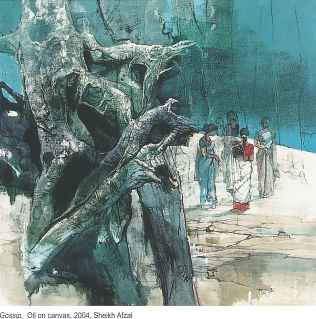
Another form of popular realism is evident in the work of Sheikh Afzal, who specializes in sentimentalized tableaus of poor children depicted against semi-abstract urban backgrounds. His recent show at Saju’s, his 22nd solo, included a few paintings of women in stereotypical situations—’The Lonely Maiden,’ ‘Intimacy’ (a Tableau of three women friends at a bathing ghat), ‘The Lady in Love.’ More interestingly, there was a large number of landscapes depicting the country’s deltaic region, including the Sunderbans, as well as the Hill Tracts, in watercolour, sometimes in conjunction with sumi-e, the Japanese technique of painting with solid sticks of black ink. They are quite remarkable in their fluent articulation of detail and lyrical use of line and colour. Quite incongruously, though, they incorporate a few lines of text in Bangla written in the Sino-Japanese style from top to bottom. Why, one wonders. A Japanese landscape may include a poetic line or two in ideograms written vertically—because that is how it is supposed to be written. But it is unnatural in Bangla: the reader’s eye has to strain to take in the message, surely a minus point for the paintings.
Another popular painter to show recently (‘The Path Within,’ at the Bengal Gallery) is Nasreen Begum, our most successful exponent of Oriental art. Her adaptation of Oriental stylization to the situation in contemporary Bangladesh goes down well with the buying public, for the good reason that it looks good on living room walls. It will be unfair, though, to suppose that her works make a homogeneous whole. Take the varied fare of this show for example. The portraits, the ‘Model’ or ‘Love’ series are posterish kitsch; the series on ‘Flood’ prettifies something quite horrendous; and a number of works are simply decorative. Nasreen’s best works are the ones where she taps the collective unconscious and uses fragmented perspective with a mix of earth tones and flaming hues. The incorporation, unconscious perhaps, of Tantric motifs in the ‘Creation’ series or in the many paintings featuring doors or similar elongated forms is quite fascinating. The doors beguilingly combine both key Tantric motifs—the lingam and the yoni—in a single image; so do a number of other ambiguous forms.
The Bengal Gallery has distinguished itself by occasionally hosting shows by foreign artists and by organizing workshops. It has done both by exhibiting the charming ebru watercolours of the Turkish artist Hikmet Burutengil and simultaneously getting the artist to teach the ebru technique to a group of Bangladeshi artists. Hitherto little known in this country, ebru (literally ‘water surface painting’) creates a marble-like effect by transferring the patterns formed by dripping paint on water onto paper.
Ebru originated in 15th Century Central Asia and travelled via Iran to Turkey where it became a major art form. Some Mughal miniatures too evince a limited use of ebru technique. At once traditional and popular ebru can significantly enrich the technical repertoire of our ‘Oriental’ artists. One couldn’t find a better master than Barutcegil to introduce ebru to this country, for he has made an original contribution to the development of the ebru tradition; his individual style has been named after him ‘Barut Ebru’.
The Shilpakala Academy deserves to be congratulated for putting on a solo show of works by the late lamented Rashid Choudhury (1932-86), though the selection is not really comprehensive enough to merit being called a retrospective. Still, it does give us a convincing impression of Choudhury’s talent. Choudhury took his first degree from the Dhaka Art College before pursuing post-graduate studies in Spain and France. He taught at the Dhaka Art College before moving to Chittagong University, where he set up the Department of Fine Arts. It was in Paris that Choudhury developed a passion for tapestry, the art form with which his name has become synonymous in this country. The vibrant colours and semi-abstract. Cubism-inspired forms of the tapestries make a feast for the eyes. One wishes, however, that there were more works in other modes. Choudhury was a fine draughtsman, as a few drawings (especially a small self-portrait inscribed to a friend) show. There is also evidence in the show that he was an excellent portrait painter. The early works on display bear witness to a rigorous apprenticeship in post-impressionist styles.
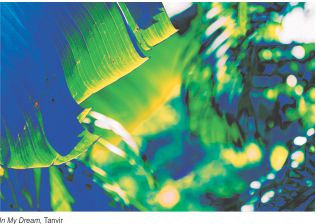
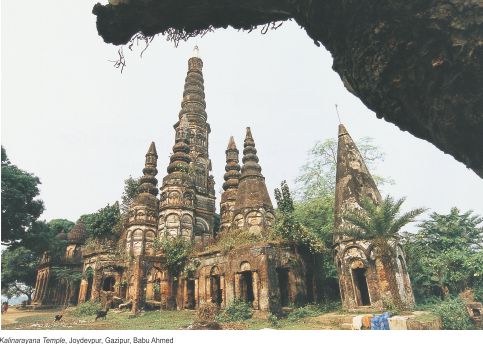
I will round off with a brief mention of two photography shows. Babu Ahmed’s ‘One Hundred Temples’ at Bengal Gallery was of great sociological interest. The lovingly captured images of a hundred temples in Bangladesh bear witness to centuries of communal harmony. I was particularly struck by the photographs of the 16th century Mathurapur Deul in Madhukhali, Faridpur and the 17th century Jagannath Temple in Comilla; beside their venerable age these structures are striking for aesthetic reasons. Very different kinds of photographs were on display at Tanvir’s show titled ‘In My Dreams’ at DRIK Gallery. By computer-doctoring digitally photographed images Tanvir has achieved vivid, colourful, sometimes surreal effects. Is it photography or photo-graphics (if one may coin a term)? Call it what you will, it has greatly enlarged the scope of camera-produced art.
Not all that long ago art exhibitions were seasonal affairs, adding colour to the cool, dry months. Not any more. It may be blistering summer or the wet and musty monsoon or muggy post-monsoon season, but Dhaka’s art galleries, despite their steadily increasing number, are never short on bookings. This means, of course, that artists…