

pinaree sanpitak’s ‘temporary insanity’
Pinaree Sanpitak’s works do not amount to a grand gesture or an epic of feminist statement in the 21st century. They constitute the statement of a woman who speaks about her own time and space and expresses herself freely about her situation, sensibility and sensuality through her works of art. Pinaree is an example of a new generation of women in Thailand who break the old stereotype about the role of woman as ‘the hide feet of elephants’. Her works are semi – autobiographical in that she records and re-examines her own physical and emotional conditions.
Pinaree, a Bangkok-based artist, started to expand her artistic expression, moving from art composed from a woman’s point of view to cross-gender issues in her latest show, ‘Temporary Insanity’ at the Art Centre at the Jim Thompson House Museum in the heart of Bangkok. Pinaree Sanpitak is, of course, not an unfamiliar name on the Southeast Asian art scene. She became an integral part of the art community in the late 1980s with her brilliant photo- collages of fruits and animals symbolizing a woman’s body. She has this to say about her work, ‘My earlier works were collages and mixed media works of photographs, dyed handmade paper and other materials that I had then painted and drawn over. The photographs were mainly of fruits, vegetables, burnt tree barks, things very organic. There were a lot of focal points in each piece. They were semi-representational and semi-abstract. I was interested in the idea of subliminal usage; the concealed and the confessed; and of the hidden and the revealed. In short, of a play of the senses.’
Working with various mediums–drawings, ceramics, sculptures, paintings and textiles–Pinaree creates abstract shapes and forms of the female body that confidently reflect her feminine sensibility. When she launched her career in the late 1980s with a beautiful photography and mixed media exhibition upon returning from her studies in Japan, there were few practicing women artists in Thailand and Southeast Asia and even fewer who insisted upon taking the demanding role of wife and mother alongside that of a professional artist. Pinaree has balanced the two roles since then.
Her candid and direct approach to the female state of mind, nature, desire, sensation and sensibility developed strongly during her Mother and Child: a Dialogue series in 1993, when she was pregnant. Later in 1994, she started a new series focused on breast works consisting of upright breasts that suggested the fertility of motherhood as a source of nutrition for her child. She said in her statement in the exhibition brochure
‘Breast Works
Breasts … I feel their presence.
I admire their potential.
Breasts are delicate, sensitive and unique. They are the symbols of beauty. They are the baby’s most important source of nutrition. They symbolize women as sex objects. They are soft and warm. They have strength. They are victims. They have become taboo in some cultures….
Breasts … Might these works give you pleasure? convey a thought ? provoke a change in attitude ?’
Dr. Apinan Phoshyananda, a renowned Bangkok based international curator, dubbed Pinaree Sanpitak as FBI (Female Body Inspector), in the ‘Temporary Insanity’ Catalogue (2004). He investigated her works, which had evolved from ‘Breast Works/Untitled’ (1997), ‘Breast Stupas’ (2000-01), ‘Breast Leaves’ (2000), ‘Candle Works’ (2000) and ‘Noon-Nom’ (2001-02). He said, ‘Like excavating the “archaeologies” of the female body the anatomical parts, skin and flesh transform into multiple shapes and materials. A morbid relationship with the beautiful as breast shapes without torso insinuate the removed tissues and glands after cancer surgery. Confrontation with pain and death is linked with the psychosexual relation of penis/breast envy. By investigating the libido’s flexibility Pinaree’s installations become anti-Oedipus preferring the schizophrenic as a model for resistance to male authority.’ He further stated that ‘In “Temporary Insanity” (2004), soft and sound sculptures reveal transformation of breasts to balls and vice versa. Desire for breasts/balls refers to asexuality and androgynous gender. Without rationality the viewers are trapped in Pinaree’s invented space of harmony and hysteria, beauty and morbidity, ecstasy and insanity. Out of control, out of context, the role of the subordinate takes centre stage. Pinaree Sanpitak’s obsession and passion of female body parts over the years make her a truly remarkable FBI.’

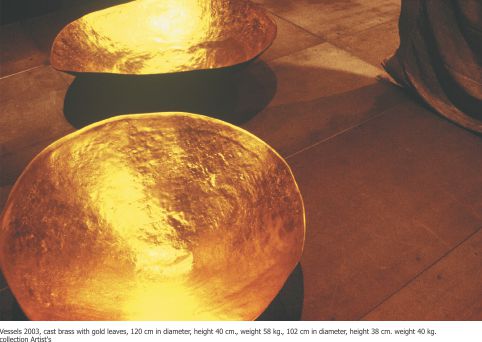
‘Temporary Insanity’ is inspired by natural forms, the female body and textile. It bridges the gap between the traditional and the contemporary. Pinaree’s works explore the thin line between art and craft. They redefine the potential of textile to be more abstract and challenging, thus expanding its boundaries into contemporary art forms. The title of the show evidently implies the artist’s state of mind, and reveals how she views the world. It is unusual for one to admit that he or she is ‘temporarily insane’. For Pinaree, this show occupies the important space of a confessional experience: something that she would like to share with all of us. This exhibition features three major works, ‘Breast Stupas’ (2000-2001), unthreaded silk, ‘Vessels’, (2003), cast brass with gold leaves inlay, and a new interactive soft sculpture piece, ‘Temporarily Insane’, (2003-2004), soft sculptures with motors, timers and sound detected devices. Pinaree’s recent works have added more flavours. They are not merely an object (of desire and with desire), but are imbued with their own emotions. ‘Temporary Insanity’ defines a shift from more formal sculpture to interactive soft sculptural work. Using silk to create a blurred form somewhere between breasts and balls, she covers sound detection devices hidden inside her sculpture, and allows the audience’s voice to activate them. Gradually, they move and wiggle and become active: no longer passive objects but something with lives of their own.
Pinaree has been interested in working with fibre since 1994 and textiles since 1998. In ‘Breast Works/ Untitled’ (1994), she uses saa (paper mulberry) fibre to create soft sculptures based on breast forms. Later, in the ‘Womanly Abstract’ series (1998), Pinaree incorporates her grandfather’s textile collection in her painting ‘Womanly Temper’, (1998). Audience interaction has become an important element in her works. The installation ‘Womanly Bodies’ (1998), first exhibited at About Studio/About Café in 1999, positioned itself amidst eclectic tables and chairs of a café. Saa fibre portrayed female shapes and bodies of different forms, creating a physical feminine landscape in the process. Taking over both the walls and the floor, it invited people in and allowed them to ‘be’ with her work. Pinaree has explored and extended boundaries of art by her use of diverse materials. Choosing to work with silk in ‘Breast Stupas’, Pinaree deals with the idea of the sacred and the profane. Her iconic presentation of breast as a Stupa has been a major challenge to the male-dominant Buddhist regulations. Pinaree dares to compare female body parts to a stupa confronting the taboo subject of the traditional position of women in religion. The banners of silk in breast stupas reflect a mood of celebration but also create a meditative ambience for the audience. The compositions welcome the audience, enticing them to walk through and explore them. It is an important gesture for the artist to allow people to come inside her own body/ space and investigate them generously.
In ‘Vessels’, Pinaree creates brass sculptures lined with gold leaves that originally were to be installed on the deck of ARTSHIP (a passenger/ cargo ship turned into an art centre) in the port of Oakland, California, but unfortunately the centre closed down. Pinaree played with ideas of site and space; however, things didn’t go according to plan and the vessels were exhibited with other works in a restored Victorian house-art gallery in Berkeley. The pieces inspired a group of San Francisco/Oakland based performance artists who in turn created a performance in the Bay using these vessels and passively opened an interest in physical interaction. The artist first intentionally courted direct physical contact with the audience in her piece ‘Noon-Nom’ (2001-2002). Hundreds of alluring soft breast-shaped sculptures offered the audience the opportunity to touch, interact and linger amongst them in the space.
Obsession and repetition play major roles in her works. An Australian art critic and curator, Rhana Devenport, has compared Pinaree with Yayoi Kusama, a Japanese woman artist, and Eva Hesse, a German artist, in terms of her obsession for repetition of breast and body forms. Rhana said, ‘The act of repetition is acquiesced to and contested within the practices of all three artists; it has been chosen as a conscious way of working. The dynamic space occupied by the compulsive push-pull of the repetitive act in art is worth exploring further. A response to the absurdity and irrationality of life was a continuous filament that drove Hesse in her work. Kusama has spoken about a similar momentum within her own practice, as has Sanpitak.’ However, there is a slight difference between her works and those of the two senior artists: as Pinaree puts it, ‘The repetition in the work for me is a form of meditation, a way of looking into my body and mind. And by using different materials, the works can offer subtle changes in definition with each substance.’
Her recent installation, ‘Temporary Insanity’, creates bodily space for people to enter. Interaction has been extended, not only by allowing people to enter into the space of the work but also by the use of sound. Audience interaction through laughter, voices, shouting or simply talking to each other creates a curious effect. In Thai such a condition is referred to with the saying ‘og san kwang kwaen’ or ‘shaky heart and soul’. Its meaning is something like shock and being out of control. Pinaree herself gives an air of certain human states of temporality, especially that of a woman in midlife crisis: A woman who enters a new half of her life and encounters physical changes and emotional turbulence. If this is the case, this piece successfully reveals her true self with frank, self-critical honesty.
In medical terms this approaches psychosis. As Dr. Aroon Shaowanasai, a leading Bangkok based psychiatrist, explains, there are briefly six categories of psychosis: peer pressure or group psychology, acute stress disorder, brief reactive psychosis, shared psychotic disorder, hysterical reaction and substance abuse. According to that classification, the state of ‘Temporary Insanity’ might fit into a case of psychosis, that is, brief reactive psychosis, or a hysterical reaction. It suggests a notion of an unbearable condition, an inability to deal with an unexpected situation or transition. It can refer to someone who has begun middle life, or is in the middle of a situation, and is waiting for a major change. One has to be strong to encounter such a condition, or prepare to become one of the ‘temporary insane’ And in this case, Pinnaree stressed such a human condition, where she intends to include images of some balls spread among groups of sculptures of soft breasts. Pinaree addresses cross- gendered issues by attempting to speak for women’s and men’s mentality.
Psychological approaches have been practiced by other artists of Thailand since the late 1990s. Kamol Phaosavasdi’s ‘Dilemma’ (2001) is an installation work that collaborates with fortunetellers sitting in the gallery space to work with audiences. The sense of desperation of people in a city like Bangkok needs to be spiritually and superstitiously healed as in the Asian way. Currently Pinaree’s contemporary, Araya Rasdjarmrearnsook, a Chiangmai based woman artist, is working on her new project with psychotic patients in an asylum. In order to explore the line between normal people and the mentally ill, a new possibility will appear which will set them free to express themselves within this kind of society. Both Kamol and Araya have been working extrovertly by connecting with the outside world, and working with other people (fortunetellers and viewers for Kamol and psychotic patients for Araya). In contrast, Pinaree constructs her works introvertly by finding her own resources, experience and sensuality. Compared to such approaches, Pinaree translates them into her ‘subliminal usage’. A sum of her thoughts can be found in a recent talk where she says, ‘Although my works have changed over the decade, I still believe they stem from the same thoughts and concept about perception. I wanted to be able to open up with all my senses, to open up to potential possibilities and consequently to be able to learn more about oneself.
It is just that because I happen to be born a woman, I try to achieve this by examining and underlining the essence of the female being through the Self. The most important goal is to challenge the conscious and sub-conscious of not only the viewer but also my own.’
Gridthiya Gaweewong is an independent curator based in Chiangmai and Bangkok.
Pinaree Sanpitak’s works do not amount to a grand gesture or an epic of feminist statement in the 21st century. They constitute the statement of a woman who speaks about her own time and space and expresses herself freely about her situation, sensibility and sensuality through her works of art. Pinaree is an example of…