

showcasing fifty years of bangladeshi painting
Bangladesh Art: A Collection of Contemporary Paintings. Published by the by the Society for the Promotion of Bangladeshi Art, Dhaka, 2003.
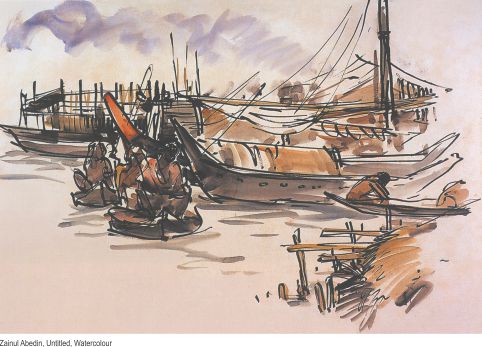
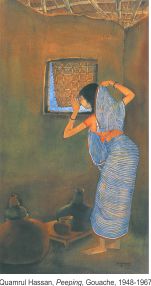
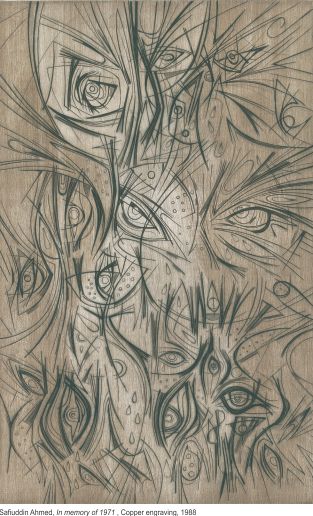
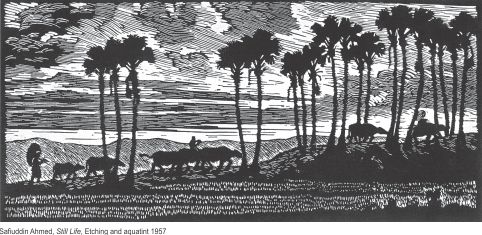
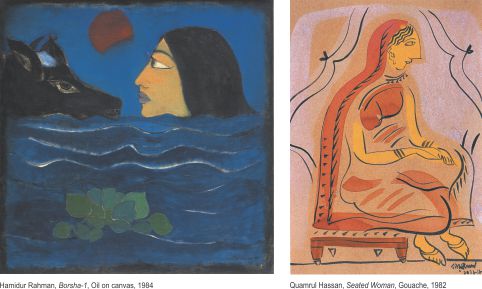
At 327 thick, around- folio size pages, Bangladesh Art: A Collection of Contemporary Paintings is a big book. But the dimensions of the book are fully functional: this is an ambitious work and its magnitude has allowed its publisher, The Society for the Promotion of Bangladesh Art, to be generous in covering its large pages with mostly impressive reproductions of the work of leading painters of the country. The scope of the book is, indeed, vast: within its covers we have a gallery of paintings that range from the modern masterpieces of Zainul Abedin (1914-1976) to the neo-expressionist works of Mohammad Iqbal (1967-). Of our modern and contemporary masters Zainul Abedin, Quamrul Hassan, and Mohammad Kibria get 11 paintings, Safiuddin Ahmed and S. M. Sultan 10; Qayyum Chowdhury gets to showcase 8 of his works, as does Monirul Islam. Artists who are now consolidating their reputation such as G. S. Kabir, Dhali Al Mamun, Nilofar Chaman, and Atia Islam Anne are able to exhibit at least three of their creations. In all, more than 300 works of 68 painters have been reproduced in a volume spanning over 50 years of Bangladeshi art. This is a wide sampling of the best in Bangladeshi paining, of artworks that are representative of the immense creativity of our artists.
The Society for the Promotion of Bangladesh Art must, therefore, be congratulated for the effort they put in, the funds they raised, the research they commissioned, and the search they undertook in order to produce this substantial book.
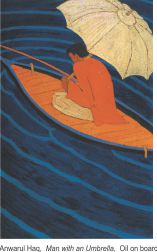
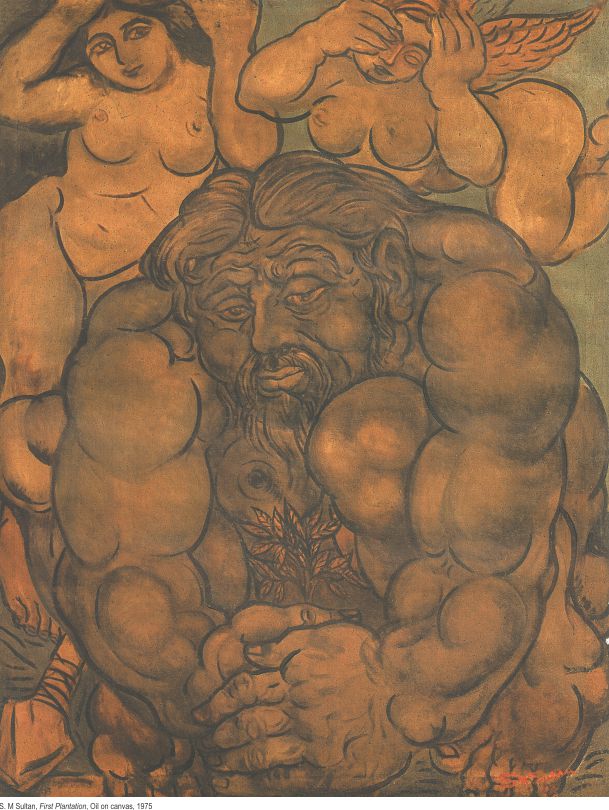
The work is nothing less than an aesthetic treat: from its cover, designed by the doyen of cover designers in Bangladesh, Qayyum Chowhury, and the expressive and muscular lines of the 1966 masterpiece by Zainul Abedin, The Rebel Cow, to the blue-tinged solemnity of Mohammad Iqbal’s painting that rounds off the book, one views almost all the impressive phases of the evolution of Bangladeshi art. As if in an overture, Syed Manzoorul Islam deftly sketches the history of Bangladeshi painting in a succinct 4-page introduction, and offers concise and incisive comments on the individual painters and their achievements.
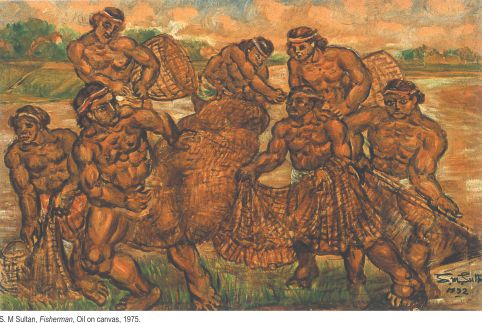
Looking at the 300 plus works on display, and reading through Islam’s clear and helpful introduction to Bangladeshi painting in general and the achievements of the painters included in particular, one is struck by the diversity of Bangladeshi painting in its fifty-five year history, which began with the establishment of the Art Institute in Dhaka in 1948 by Zainul Abedin and some of his friends. His works, and those of Quamrul Hassan and Safiuddin Ahmed, though recognizably modern, incorporated folk elements and were essentially realistic in intention. In the next phase, painters like Mohammad Kibria and Aminul Islam swerved towards abstraction and opted for non-figurative ways of expression, affiliating themselves with internationalization even when deriving inspiration from the colours of our world and the contours of our land. With liberation a new generation of painters engaged once again with the local and the topical, but dug deeper into the past in Bangla myths or the history of the land (Abdus Shakoor is an example) or visualized mindscapes and feelings (Monirul Islam is exemplary in this regard) or engaged with contemporary history, especially the liberation war (Sahabuddin comes to mind immediately), although international influences seeped into their palettes and made for a distinctive and contemporary style. But in its latest phase, Bangladeshi painting has been influenced by the ironic, self-conscious gestures of postmodernism. It is at present striking out in several directions, as is evident in the versatility and vitality of the works of painters who started to display their works in the eighties and nineties– artists like Mohammed Eunus, Tarun Ghosh, Dhali Al Mamoon, Khalid Mahmud Mithu, Shishir Bhattacharjee, G, S. Kabir and Wakilur Rahman. And if in the beginning there were no women painters of note, the works of painters such as Nasreen Begum, Rokeya Sultana, Dilara Begum Jolly, and Niloofar Chaman have brought a whole new dimension to Bangladeshi painting.
As Elthem Kabir, the Chairman of the Society for Promotion of Bangladesh Art has noted in his introductory words, artist Rafi Haq, the project coordinator, has done ‘outstanding work in simply putting everything together for something conceived on so grand a scale.’ Without a doubt, Mr. Kabir, and the General Secretary of the Society, Intekhab Mahmood, must also be praised for their commitment to the project. The comprehensiveness of their plan to represent Bangladesh painting, and the time and thought, not to mention the funds they have spent in bringing out the book augur well for the future of Bangladeshi art; after all, if such sponsors can be found for so costly a project, how can Bangladeshi painters not go from strength to strength? Similarly, the Royal Norwegian Embassy, Grameen Phone, and the Khairul Kabir Foundation deserve the gratitude of lovers of Bangladeshi art for financing such a lavishly conceived project.
It must be said, too, that despite the size of the book, it has left out at least a few of the leading painters of our time. Where, for instance, is Murtaza Baseer in this massive collection? And what about Mahbubur Rahman, Tayeba Begum Lipi, and Ronni Ahmed, emerging talents who have already left their mark on our art world? It must be said too that the text occasionally mentions paintings by name and identifies them as of importance in an artist’s development but does not reproduce them within its pages. The index is very inadequate and the work is the poorer for not having a page of contents and a bibliography. To put it somewhat differently, the very size of Bangladesh Art: Collection of Contemporary Paintings and the large scale on which it was conceived have led to expectations that aren’t all fulfilled.
Also, precisely because of the high standards that the publisher of Bangladesh Art: Collection of Contemporary Paintings had so obviously set themselves, the book at times disappoints because of a few egregious errors. For example, Mr. Kabir, we note, has offered a ‘Foreward’ to the book; prithee, what is that? He mentions that the Society has set out to produce an ‘international standard book’, but will phrasing the ambition thus achieve the end? I would certainly have liked to see some of the paintings in colours that were truer to the originals since printing technology has advanced to a point that allows publishers of art books to come quite close to what painters execute on their canvases, but perhaps the paper chosen has dulled the reproductions a bit.
A final point that too must be associated with the size of the book: although my reviewer’s copy does not have a price sticker, I have seen it priced at bookstores at Tk. 5, 000. How many people in Bangladesh will be able to buy this book and at this price? It seems to me that the Society took a conscious decision to price the book out of the reach of Bangladeshis and aim it for expatriate Bangladeshis visiting Bangladesh and foreigners sojourning in our country, but is that sensible policy for a society dedicated to the promotion of Bangladesh art? If the book does not circulate well in our country, what good will its international existence do to our art world? I conclude, then, that the Society is only interested in promoting the book overseas, but if I am correct, I can only conclude that that is a sorry ambition.
One more criticism: in a book that shows so many signs of the generous intentions of its producers, why is Syed Manzoorul Islam’s name acknowledged only in the ‘Credits’ page, although the over fifty pages of the text that he wrote for Bangladesh Art: Collection of Contemporary Paintings is the ballast without which the paintings displayed in it would have drifted in textual space?
However, I would like to end positively: Bangladesh Art: Collection of Contemporary Paintings is a fitting tribute to an art world that has come of age. One can only hope that the The Society for the Promotion of Bangladesh Art will be encouraged by the response that this book receives to bring out more works that will document the flowering of Bangladeshi art.
Fakrul Alam is a member of Jamini editorial board
Bangladesh Art: A Collection of Contemporary Paintings. Published by the by the Society for the Promotion of Bangladeshi Art, Dhaka, 2003. At 327 thick, around- folio size pages, Bangladesh Art: A Collection of Contemporary Paintings is a big book. But the dimensions of the book are fully functional: this is an ambitious work and its…