

shattered heads and tribal totems
The great Scottish-Italian sculptor and graphic artist Eduardo Paolozzi offers an uncompromising vision of the contemporary West and its violent and superficial culture
Now that the Irishman Francis Bacon is dead, the Scottish-Italian Eduardo Paolozzi, his friend and (in part) disciple, must, in his eighties, be the most imposing living artist from the British Isles. One possible rival is the Englishman Lucien Freud. As with Paolozzi, Freud’s starting point was in the rather undistinguished milieu of British Surrealism in the 1940s. Their paths diverged swiftly to the point where nothing could contrast more starkly with Freud’s calmly obsessive exploration of the pathos of nude pinko-grey flesh than Paolozzi’s always-edgy transformations of the human face into mask and body into robot. What both men have in common with Bacon, however, is the most important property of all. They do not underestimate the immanence, and imminence, of death in life.
In 1995, Paolozzi emptied his studios to make a presentation to the city of Edinburgh, where he was born—3000 sculptures ( mostly plaster casts) and moulds, 2000 prints and etchings, 3000 books and a large collection of tools and materials. The latter, in Paolozzi’s very special case, included, as well as photos and slides, boxes of toys, piles of periodicals, and scrapbooks. Here was an artist operating simultaneously in the traditions of (let us say) Rodin and the Dadaist father of Merz art, Kurt Schwitters.
Clearly, housing all this was problematic for the donatees, the National Galleries of Scotland. Luckily, Lothian Region had an education centre surplus to requirements, conveniently adjacent to the Gallery of Modern Art. So the Dean Gallery was born, opened after interior redesign by the notable architect Terry Farrell. It is always exhilarating to go there.
Here, on a cold but bright March afternoon, questing for Paolozzi, I return with pleasure. The building, dated 1883, was designed by Thomas Hamilton, one of the master architects of late Edinburgh Neo-classicism, as Dean Orphan Hospital. It is a fine austere thing. From the steps in front of the entrance, with trees leafless, one looks across a large down-sloping lawn, ideal for the display of sculpture, to a clear view across the top of the Dean Village to the skyline of Edinburgh’s West End. The village was always ‘industrial’—from ancient times the site of mills beside the Water of Leith, developed from the nineteenth century around a big tannery which closed as recently as 1970. The skyline is dominated by the neo-Gothic spires of three Victorian churches. Though his arrival in just this spot is fortuitous, it is hard to think of a more appropriate prospect for Paolozzi. His work encompasses intrinsic classicism, a severely objective aesthetic, an urgently ambivalent response to the forces unleashed by the Industrial Revolution, and, in many works, fervent elaboration akin to much church architecture. One fancies that his gifts might have made him an ideal collaborator in the erection of one of the great Victorian railway stations.
I will come back to the gallery’s entrance later. Meanwhile, it should be noted that the building memorializes Gabrielle Keillor. For a decade and a half she was the chief patron of Paolozzi, then in mid career. Her outstanding collection of Surrealist works, and Paolozzis, also came by gift and bequest to the National Galleries. And today I can reverence another remarkable collector. Margaret Gardiner has just died, aged 100. Decades back, she founded the Pier Art Gallery in Stromness, Orkney, with gifts from her personal collection, built through patronage and friendship, of artists associated with the village of St Ives, in Cornwall, at the other end of the Northwest European Archipelago. So famous for art was St Ives that the London National Gallery now has an annexe there. Now the Pier Arts Centre is being refurbished, and a selection of its holdings is on tour. So I start today with works I last saw in Orkney four years ago.
Fine stuff, but with Paolozzi in mind, how tame they seem. The minimalist abstracts of Ben Nicholson, still regarded as way-out fifty years ago, now seem positively pretty. Roger Hilton and Terry Frost, considerable painters, evoke English Pastoral. The one artist here who weighs in with Paolozzi is the very wonderful Barbara Hepworth, his extreme opposite. Her characteristic forms, womb morphing into lyre, impose harmony, speak of fertility.
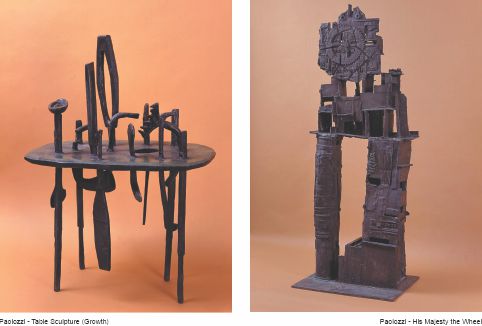
Next, the Dada and Surrealism Gallery, where the spirit of Gabrielle Keillor presides. Surprisingly, here, too, select masterpieces of mid-twentieth century European art—even Picasso, for instance—seem timid compared to Paolozzi. The biggest canvas, ‘Max Ernst Showing a Young Girl the Head of His Father’, with nightmare forest depicted by grottage, suggests a Hollywood parody of a Hollywood horror movie. However, the famous metal sculpture, ‘Woman with Her Throat Cut’, by Albert Giacometti, whom Paolozzi met in Paris in the 1940s, stylised corpse morphing into spider or scorpion, does intersect at an angle with EP. Intriguingly, Francis Picabia’s pre-Dada ‘Child Born Without Mother’ (1916-1917) is adapted from a large printed foldout of a two cylinder stationary steam engine. The note on the wall points out that it anticipated the appropriation of printed and photographic material by the German Dadaists. It also anticipated by some four decades Paolozzi’s assimilation, as in ‘His Majesty the Wheel’ (1958-1959), of the human and the mechanical.
But the most Paolozzian items in the room are anonymous and quasi-timeless—a monumental Polynesian ‘sculpture’ and a Melanesian memorial carving. The latter is an intricate metamorphic pillar, man and beasts melded together. Picasso before the Great War, Surrealists after it, had their own takes on the ‘primitive’. Paolozzi slips past them direct to source. With unusual imagination, in 1985 the British Museum invited Paolozzi to co-curate an exhibition, ‘Lost Magic Kingdoms’, at the Museum of Mankind, which houses hundreds of thousands of items from the BM’s ethnographical collections. In the book of the exhibition, Paolozzi set up his aesthetic stall, denouncing the ‘neglect of the primitive’ in British art school education. ‘There was, and is, a dislike for both the primitive and the modern.
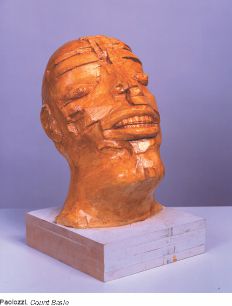
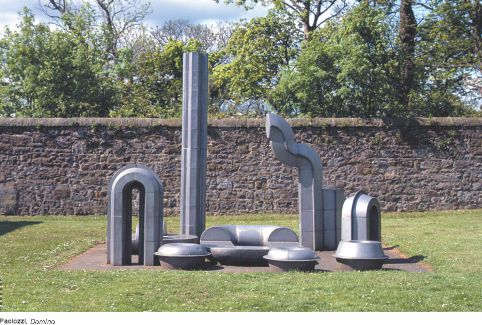
Paolozzi’s independent interest in the primitive, picked up in England, was satisfied later in Paris, where the erstwhile Dadaist Tristan Tzara gave him lunch in an elegant room where a Picasso was flanked with carefully chosen African artefacts, and books on primitive art were easy to come by. The book of ‘Lost Magic Kingdoms’ demonstrates in the most startling fashion the depth and power of that influence on EP. Amongst illustrations of art from several continents are interspersed photos of Paolozzis. So his segmented bust of Count Basie (1994) echoes the papier mache mask from the Mexican ‘Day of the Dead’, 1978. A mask from the northwest coast of North America, a wooden Maori figurine, would seem entirely in place in any exhibition of Paolozzi sculpture. In a photograph, a mummified body from ancient Peru bears a distinct facial resemblance to Paolozzi himself. Still more horrifically, an Aztec skull inlaid with turquoise and lignite mosaic anticipates Paolozzi’s ‘shattered’ heads. His relatively calm and classical ‘Crash Head’ (1970) is juxtaposed, enigmatically, with a photograph from Tibet c.1920 of a veiled Muslim woman and one from the same period of a Bhutanese masked dancer. More easily grasped is the flanking of a Central African female figurine and a Nigerian ‘cast brass voice disguiser’ in the form of a stylized human male, with two Paolozzi sculptures in which humans are machines. The African works represent an influence, but also imply an alliance with Paolozzi in their critique of contemporary Western civilisation. Now, at last, to Paolozzi’s Great Hall, which confronts one on entering the Gallery. Up to the roof of the building—two floors’ height—towers an immense statue in stainless steel, ‘Vulcan’, especially created for this space. The colossal head evokes a man in armour—or a wounded fighter whose ‘shattered head’ is swathed in bandages. The segmented body recalls both armour and the industrial clothing of, say, a welder. It lunges forward on huge feet. Seen from the rear from one of the first floor galleries, the thought of a pitiless armed man dominates. But from the front, looking up, suffering is mingled with the menace, and it is clear that what Vulcan, a creative Roman god of the forge, brandishes, is not sword but hammer. Under his Greek name, this is the god held in effigy by Paolozzi himself in ‘The Artist as Hephaestus’. Brilliantly, the only picture hung in this room is a big canvas ‘Troubled City’ (1991) by Ken Currie, perhaps the sole current Scottish artist who can punch at Paolozzi’s weight—an urban nightscape, or nightmarescape, featuring arson, gunfire, scourges, a butchered animal carcass and the megaphone of mob oratory in a vision of the crowd as Hell.
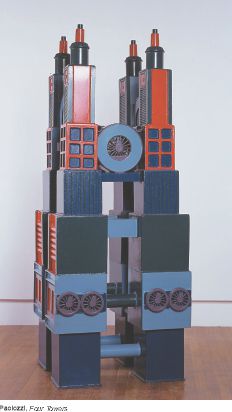
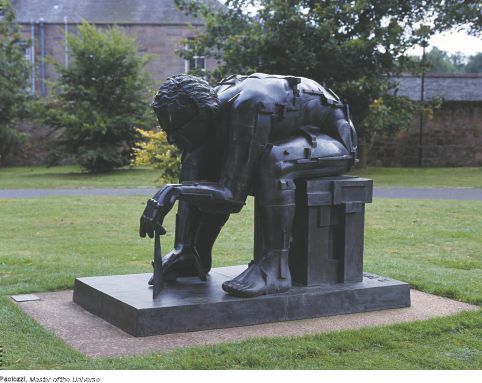
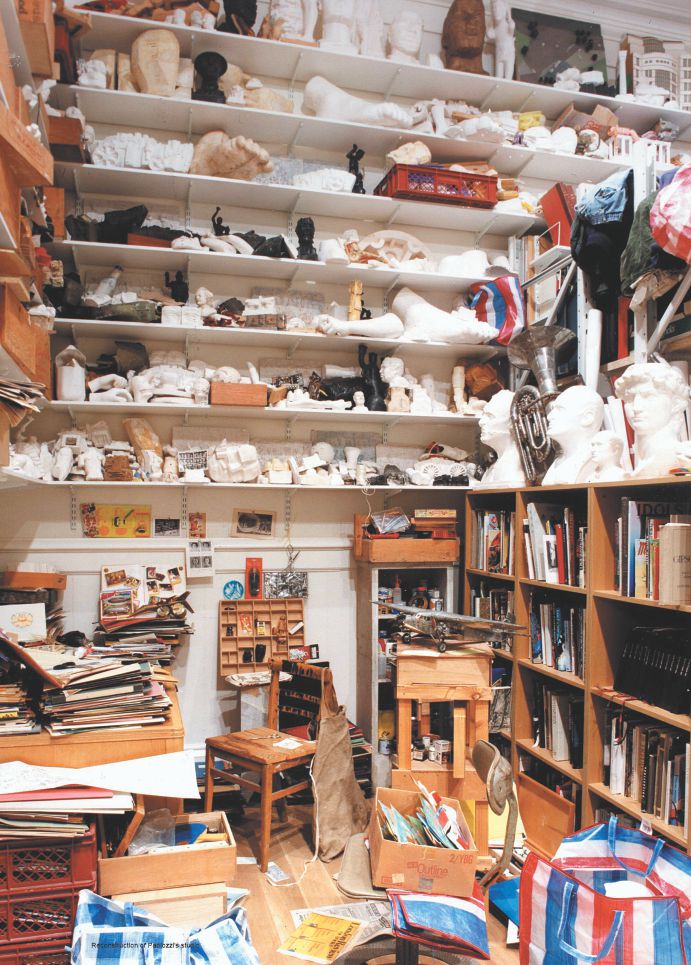
‘Pessimism’ is too weak a word to apply to either artist. ‘Objectivity’ comes closer. Life is not what we would wish it to be, but we can maintain dignity while inspecting its horrors. Currie presents by figurative methods drawing deeply on post-Renaissance European tradition what shallower artists might strive to render through screaming Expressionism. Likewise, there is an almost scary classical poise (stoicism?) at the centre of Paolozzi’s amazingly fecund and diverse oeuvre. This is most easily apprehended through his busts of the famous architect Richard Rogers. Paolozzi is an immensely accomplished draughtsman and can be as ‘realistic’ as any sculptor if he chooses. Hence two extremely lifelike plaster busts, evoking ancient Rome, one of Rogers grim, one of him smiling. Then Paolozzi bisects each bust and puts left of one against the other’s right, creating one of the simplest of his shattered heads. Another straightforward case of ironic classicism is his open air statue of seated, stooping Isaac Newton as ‘Master of the Universe’ which confronts the visitor entering the Gallery’s gates. This is a straight copy of a famous design by the Romantic, William Blake, who detested Newton’s imposition of order on nature. Paolozzi’s Classical reworking expresses his ambivalence: he reveres Newton while mistrusting what post-Newtonian technology has done to the world. Opposite Vulcan, through glass, one may see a recreation of Paolozzi’s studio, in which innumerable plaster busts ( including a realistic one of EP himself, in the fireplace) jostle with boxes of tacky toys, old magazines to hand for collages. A bust of Einstein abords the head of Michelangelo’s David. So Sir Eduardo Paolozzi, Knight Commander of the British Empire since 1989, has created a kind of shrine for his art in Edinburgh.
But at the top of Leith Walk, which led from the old city down to its long-separate port town, is sculpture by Paolozzi of which the humility probably explains a mysterious immunity to vandalism. On a small parade in front of a shopping centre and Roman Catholic church, an enormous foot, ankle and open hand are bordered with an inscribed text from the archives of the Abbey of Monte Cassino. It is addressed to the Deacon Paul and recalls the hospitality and peace that a weary traveller can find among the brothers. Inevitably, it will allude for many to the terrible battle of World War II which destroyed the Abbey.
Paolozzi was in fact born in Leith—to this day zealously ‘separatist’ despite having been long ingested for administrative purposes into Edinburgh.This compounds an enigma—why should Paolozzi, who has lived all his working life in London, with spells in Germany, choose to gift his work in abundance to Edinburgh? Why does he continue to identify himself with Scotland, let alone Edinburgh? He might have particular cause, in unhappy memory, to shun his place of birth.
Soon after Eduardo’s birth in 1924, his Italian immigrant parents acquired a confectionery. While he shared his schooling in the obvious local schools with neighbours, and spoke Scots in the playground, at home the language was Italian, and every summer during the thirties Eduardo went off to Italy to youth camps run by the Fascist Party. When Italy declared war on Britain in June 1940, his parents’ shop was sacked by a mob, and soon after his father, his mother’s father and an uncle were arrested as ‘enemy aliens’. As such, they went down with the Arandora Star, a ship carrying over a thousand ‘aliens’ to detention in Canada, struck by a U Boat. All three died. Eduardo himself had been briefly detained, but emerged to help his mother with the shop. He soon started evening classes at Edinburgh College of Art, and was fulltime there in 1943 when he was called up for the Army Pioneer Corps (a lowly formation deemed suitable for dodgy foreigners). After little more than a year he was found psychologically unsuitable for the Army and decanted in England, where he resumed the study of art in Oxford. In 1945 he was enrolled in London’s famous Slade School, and thereafter his triumphs were continuous. On the proceeds of his first London exhibition in 1947, he was able to go to Paris, where he was readily accepted by the great artists of the day—by Giacometti, by Braque who had pioneered collage which would be one of Paolozzi’s favourite forms, by Leger, who had celebrated the machine in his paintings. On return visits to London, who did he stay with but Margaret Gardiner? From 1949 (remember, he was still only 25) he held successive appointments teaching at celebrated London art schools, while his international reputation extended rapidly through Europe and North America. From the Independent Group of artists which met at the Institute of Contemporary Arts in London, he became, along with the Englishman Richard Hamilton, the pioneer of Pop Art. A stint as Professor in Hamburg in 1960-1962 introduced him to shipbreakers’ yards and an aluminium foundry, confirming his long obsession, following Leger, with industrialism and its materials. One might have expected that his near-native Italy would have made a lot of him, granted certain affinities with Futurism in his work, but in fact it was Germany which over three decades appreciated and fostered his art—at one stage he was given an entire factory floor to use as a studio in Berlin. He also taught in America, and nothing is more remarkable in his life than the fact that he was at Berkeley in 1968, the great year of student revolt, and that his work provides no echoes whatever of Woodstock and all that (or, for that matter , of the Paris May and the Prague Spring)—he went on his own way. Or ways. Brilliant collage from the forties onwards. Sculptures mimicking the forms of industrialism. Tributes to major figures in Western culture—the philosopher Wittgenstein, the composers Bruckner, Charles Ives and Britten, his Scottish compatriot the architect Mackintosh—bespeaking his very wide self-taught erudition. Throughout an interest in the ‘metamorphosis of rubbish.’ At one stage in the fifties he was collecting ‘found objects’, the meanest plastic detritus, pressing them into clay beds, then casting them in bronze. And a brooding over science and technology. Now that the characteristic technology of our twenty-first century is no longer ‘heavy’ but ultra-‘lite’, his designs using electrical circuits perhaps have a contemporaneous frisson which his massive machine works no longer possess. But no artist has steered closer to the material bases of our life, while keeping our most archaic impulses in mind.
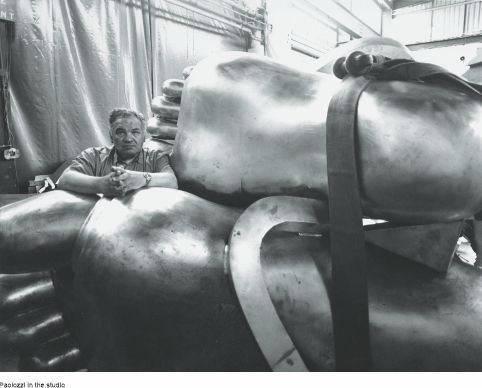
Accepting his identification with Pop Art, Paolozzi once made the significant discrimination that, whereas Lichtenstein and Warhol accepted the artifacts which they imitated—their validity—his own view of popular iconography was critical. On the face of it, this triumphantly successful artist, with widespread and sometimes pompous public commissions, and a knighthood following lifelong recognition of his exceptional talents, would seem to be an ‘Establishment’ figure. Yet his art has always been radical, question-posing. What he is up to seems to me to go beyond Thomas Hardy’s famous defence of ‘realism’—’If a way to the better there be, it exacts a full look at the worst’, implying as that does that ‘better’ may well be possible. Paolozzi’s vision does not include a ‘better’. He merely requires that we stare calmly at the worst as Vulcan, creator and destroyer, blunders, with and without purpose, side by side with his Yoruba counterpart, the artificer-god, also god of war, Ogun.
Angus Calder is a poet and historian who lives in Edinburgh. He was formerly on the board of the Fruitmarket Gallery. His latest titles are Gods , Mongrels and Demons: 101 Brief But Essential Lives and Sun Behind the Castle: Edinburgh Poems
The great Scottish-Italian sculptor and graphic artist Eduardo Paolozzi offers an uncompromising vision of the contemporary West and its violent and superficial culture Now that the Irishman Francis Bacon is dead, the Scottish-Italian Eduardo Paolozzi, his friend and (in part) disciple, must, in his eighties, be the most imposing living artist from the British Isles.…