

european artists in bengal (1760-1824)
Following the East India Company’s rise to political power, an array of European painters, portraitists, miniaturists, engravers and lithographers came out to India. Like the British and European Merchants they sought fortune, fame and adventure. They were not disappointed in their pursuits as they made good money by painting portraits, both in oil and water, of the affluent and influential English and native rulers. They also drew historical scenes, landscapes along with massive ruins and palaces, as well as public buildings symbolizing the expanding might and power of the ‘Honorable John Company’. Subsequently, these were engraved or lithograph ed and published in expensive folios for sale in Europe. As photographic devices and cameras were things of the future, these lithographs were the only visual medium available to the people of Britain and Europe to quench their thirst for exotic India
The first painter adventurer to set foot in India was the British artist Tilly Kettle. Kettle, who came to India in 1769, drew portraits of influential people and some historical scenes disregarding the charms of European Calcutta. Common people understandably remained outside the purview of his artistic work. He is still remembered for his historical piece called ‘The Mogul of Hindustan reviewing the East India Company’s Troops'(The ‘Mogul’ Emperor was Shah Alam, and he had reviewed the English troops at Allahabad in September 1767). Tilly Kettle’s financial success can be estimated from the fact that on his return to England he bought a house in the aristocratic area of Bond Street in London. Kettle was followed by William Hodges, the uncle and nephew team of Thomas and William Daniell, and Johannes Zoffany 1783, the best known European artist to have come to India. Thomas Daniell (1749-1840), and his nephew William Daniell (1770-1837), inseparable from each other in their work, also highlighted Calcutta. Immediately on their arrival in 1786, they started work on their Twelve Views of Calcutta, employing the newly-invented process of aquatint. They remain memorable for their mighty opus, a six-part double elephant folio containing 144 plates that included 12 celebrated views of European Calcutta. The next painter to come was Captain William Baillie Fraser who too, like his predecessors, concentrated on ‘white Calcutta’ and ignored the lives and manners of local Indians of the ‘Black Town’. Zoffany meanwhile devoted his talents in painting portraits of the Governor General Warren Hastings, his wife, and the Last Supper, a mural for the newly constructed St. Johns Church in Calcutta which can still be seen there. It is said that the head of each apostle in the mural was the portrait of someone living at the time in Calcutta (The good old days of honorable company by W. H. Carey). As portraitists, all of these visiting artists were financially successful, as can be ascer
tained from advertisements published in Calcutta newspapers where the exorbitant rates charged by these painters were displayed.
While the attention of most of these artists was directed at ‘White Calcutta’ and the European way of living, the local way of life remained outside their purview. This gap was somewhat bridged by the intrepid Madame Belnos, a French artist, and Sir Charles D’Oyly. Madame Belnos drew the day to day lives of common Indians–men and women, their dress, manners and lifestyles, their exotic social and religious festivalsin her celebrated lithographic album entitled Twenty-four Plates Illustrative of Hindu and European Manners in Bengal (1832).In passing, we may mention that Raja Ram Mohan Ray commended Madame Belnos for faithfully depicting Bengali life and environs. Another artist with a similar contribution is Miss Emily Eden, sister of the Governor General Lord Auckland. She was an amateur artist who left behind many interesting works and curious anecdotes on Bengal and other provinces. Emily Eden’s paintings show Bengali students of Hindu College (now Presidency College) coming to class wearing achkan, pagri (headdress), earrings and necklaces.
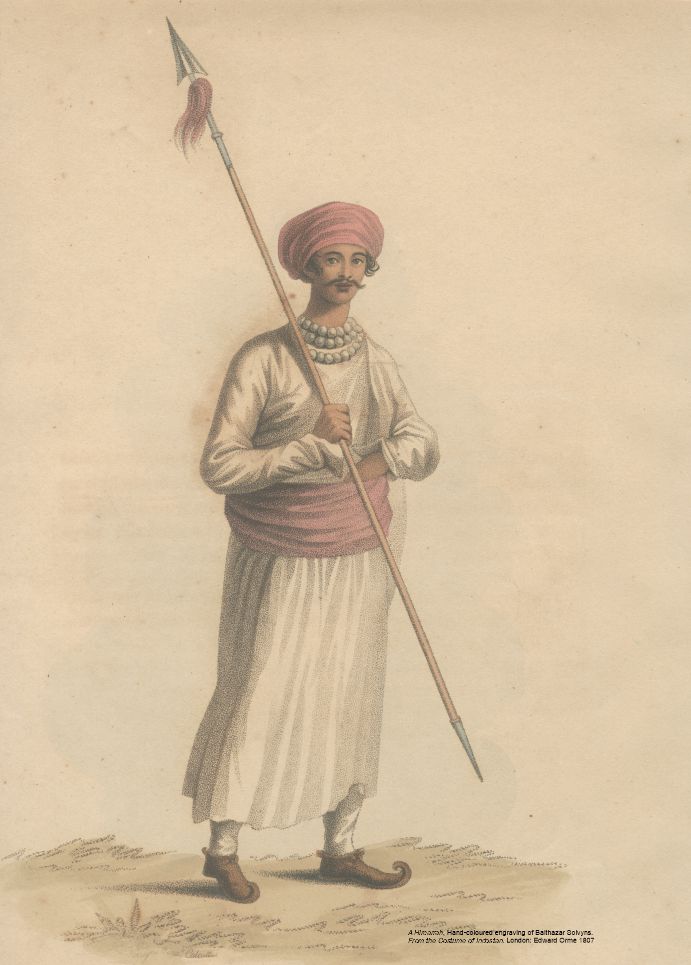
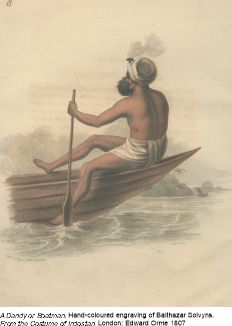
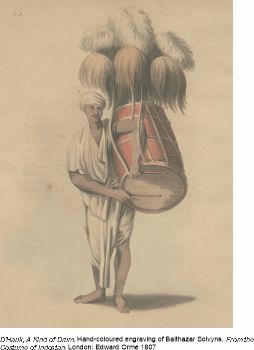
It was, however, Balthazar Solvyns, a Franco-Belgian (1760-1824) who landed in Calcutta in 1791, that lavished all his attention to the depiction of the local scene, braving dust, squalor and garbage. From the very beginning, Solvyns was fascinated by the colours, smells, sounds, sights and the vitality and resilience of local life. He was overwhelmed by the endless religious and social festivals of Bengal. In The Calcutta Gazette of 6 February 1794, he advertised his proposed set of hand-coloured engravings, illustrating the customs, manners and dresses of the Bengal natives, at a cost of one sicca rupee per plate for subscribers. He completed and published the plates–all of 250– in Calcutta in 1799. These pictures, along with 38 others, were finally published in Paris between 1808 and 1812 in four massive volumes with texts in English and French, entitled Les Hindus. Both versions were internationally acclaimed. Solvyns’ work captured many facets of Indian life in the 1790s ‘the humble buildings , the soaring temples and mosques, the teeming streets and bazaars, the gharries, rickshaws and palanquins, the bullock carts and the entire gamut of country craft dotting the river.’ (R.P Gupta, The Artistic Legacy from the Taj Magazine: Calcutta 300 Years 1690-1990,1989) But the most fascinating aspect of his work was his human gallery that took in men and women, both rich and poor, of every profession. The three hand-painted aquatints from the Solvyns’ album accompanying this article bear testimony to his penetrating eyes, powerful observation and varied skill.
The write-up will be incomplete without the mention of Sir Charles D’Oyly, not a visiting artist but a Bengal civilian (1781-1845), who is certainly remembered more for the paintings he did as his hobby rather than his official career. His engravings on the monuments and buildings of Mogul Dhaka still remain one of the best visual record of nineteenth century Dhaka. He published these engravings as a folio titled Antiquities of Dacca. ‘These drawings are the witness to the politico-socio-economic adversity of Dhaka during a particular period of time'(Muntassir Mamoon, Charles D’Oyly, BANGLAPEDIA 2004). During his long professional career in India, from 1797-1838, D’Oyly, a gifted amateur artist, served in Dhaka (1808-1817), Patna and finally in Calcutta. He established a lithographic factory in Patna, known as Bihar Lithography. The two hand-painted aquatints, accompanying the article, by Sir Charles D’Oyly circa 1813, (a) A Gentleman with his hookah-burdar and (b) An elephant fight are examples of his remarkable skill and poise.
Arthur William Davis arrived in Calcutta circa 1791. He published in 1794 a proposal for a print from his painting of ‘The Reception of the Hostage Princess’, depicting the reception by Lord Cornwallis of Tipu Sultan’s two sons as hostages for the due performance of the treaty on 26th February 1792. Davis also painted about thirty pictures, all of Indian subjects, which included Indian traders, manufacturers, fakirs, Indian women and agricultural scenes.
Along with riches, India offered to these visiting artists a vast array of fascinating and varied subjects including majestic mountains, mighty rivers, sprawling ruins, sunburnt deserts, magnificent mosques, temples and colourful religious festivals. The foreign painters (most of them were residents of Calcutta) had to endure a great deal of physical discomfort while journeying throughout India in search of scenic locations, historical places, and powerful and wealthy patrons. The ubiquitous dust of North India, the heat of summer, inaccessible roads and the language problem could not deter them from travelling throughout the subcontinent. The majority of these painters arrived in India from 1770’s to 1845’s. During this period as many as 37 amateur painters alone came from England.
The last great British artist who visited India was George Chinnary who is said to have remained in Bengal for about twenty-three years( 1802-1825). He was a favorite portrait painter amongst all classes. ‘His style has a singular charm and his colour is most pleasing’ said Sir Charles D’Oyly considered him to be the topmost painter who ever worked in India.
A few common characteristics seem to be discernible in the works of all these European artists whoose stay in Bengal coincided with the rise of the English Company in India. Historical scenes painted by them glorified the success of the Company’s military campaigns. The depiction of public buildings testifies to the consolidation of the English Company’s power and administrative prowess. The artistic works related to social aspects of the local people responded to the needs of the foreign rulers in their efforts to understand their subjects better.
As fascination for ‘exotic’ India continued to grow, artists responding with new mediums opened up more exotic facets of India. The change in outlook created a demand for paintings/lithographs on local subjects. The Europeans started employing local artists, preferably from Patna, for commissioning works of arts on typical Indian themes. These were known in common parlance as ‘farka’, which means ‘pictures to be viewed in one flash’, its nearest English equivalent being ‘snapshot’. Those people who acted as the main workforce of the European household figured prominently in these works i.e. washermen, cooks, tailors, gardeners, khansamas, maidservants, dog keepers, vistis etc. The Indian market with its exotic and colorful ambience never ceased to be a source of amusement and fascination to the Sahibs and Memsahibs. Consequently, these bazaar paintings (as they came to be known) started appearing; they displayed butchers, fisherwomen, carpenters, goldsmiths, ironsmiths, basket makers, bangle sellers, hawkers, and water hewers. Of course, the picture of a bazaar cannot be authentic and truly artistic without an the impressive elephants, palanquins, bullock carts and women clad in colorful dresses frequenting the various shops. Lithographs became very popular, and most of them were jointly produced by English and Indian artists. For instance, Sir Charles D’Oyly employed an artist of Patna named Joy Ram Das at his lithograph factory.
Although India provided a fascinating subject for painting, Indian techniques or for that matter Indian artists, never received any critical acclaim from Europeans. In spite of the close contact between European and Indian painters through commissions and in making lithographs, there was no fusion between the techniques of the two worlds. No new trend or school emerged from the interaction between local and visiting artists. Ashok Mitra in his book Bharater Chitrakala (Bengal Publishers, Calcutta 1956) cites European prejudice as a reason for this unhappy development. He regretted that visiting European artists, firmly committed to the concept of the superiority of their own technique, had an indifferent attitude towards Indian techniques and Indian artists and never seemed to have appreciated them.

It is perhaps this bias or refusal to absorb Indian techniques that resulted in the inability of European painters’ to exploit the bright sunlight of India. The visiting painters were conditioned to the mellow daylight of their own European climate, and in India they treated the local landscape through their familiar way of looking at objects or nature through subdued sunlight. Consequently, their landscapes though beautiful and romantic, were painted in an opaque and hazy shade that scanted the bright sunshine that is available almost throughout the year in India. A touch of melancholy and sadness hangs over almost all the landscapes drawn by these artists. The majestic banyan and peepal trees, the golden grain fields, the massive historical ruins all appear to be pale and moldy looking. The sunburnt Indian villages, the shrubs, waterways and the dark green vitality of the banyan leaves look bereft of brightness and exuberance. In contrast, their depiction of the local people turned out to be artistically superior in terms of vividness of colour and strong details.
The painters of the Company era have left behind a legacy that is remarkable and important. Most of the visiting European artists were not top rate. But they were definitely amongst the best in the second category of artists during their time. They left behind invaluable historical documents for reconstructing life, manners, customs, religious festivals, costumes, and the ecological history of Bengal and the rest of the colonial subcontinent. In the absence of photographic and other visual media, these lithograph engravings are the only genuine and contemporary documents available to us for reconstructing the social system, public life and topography of 18th and 19th century colonial India. Read together with the memoirs and diaries of those times, these documents help us to better understand the internal dynamics of British rule and the social and religious life of the subcontinent during the eighteenth and the first half of the nineteenth century.
Mahboob Alam is a former Ambassador and Secretary to the government of Bangladesh. The engravings and aquatints by Solvyns and Sir Charles D’Oyly are from his personal collection
Following the East India Company’s rise to political power, an array of European painters, portraitists, miniaturists, engravers and lithographers came out to India. Like the British and European Merchants they sought fortune, fame and adventure. They were not disappointed in their pursuits as they made good money by painting portraits, both in oil and water,…