

contemporary masters of korea
The 1970s was a critical period in modern Korean history, marked by economic advancement and political repression, and a protective attitude towards cultural legitimacy. The situation influenced the art forms of the time. Thus monochrome painting came to be practised and was considered an aesthetic product in Korean formalistic modernism

The central topic in any discussion of Korean monochrome painting during the time was the process in which it was generated and the way it assumed an identity of its own. The influence of minimalism, Japanese Mono-school and Korean conceptual art have remained a major point of discussion up to now.
Specifically, in the late 1960s, the modernity critique differed from the wartime discourse on ‘overcoming the modern’ in that the latter implicitly equated ‘Western’ and ‘Modern’ within the nationalist effort to posit Japan in resistance to the West, whereas the former, infused with the sense of international contemporaneity, saw Japan as part of the world that resided in the dusk of ‘contemporary’ times. Influential Japanese art critic, Miyakawa Atsushi’s (1933-77) would comfortably enumerate the international signs of ‘contemporary’—Yves Bonnefois’s poetry, Gaston Bachelard’s theory, musique concrète, Jean Dubuffet’s painting, and contemporary physics ; the proponents of the modernity critique, in contrast, would point to the negative consequences of postwar modernization and the resulting prosperity in industrialized countries: increasingly rampant consumerism, environmental destruction, and moral crises ubiquitously manifested by students marching for anti-establishment and anti-war causes.
Lee Ufan (b. 1936) was one of the most important energetic figures of the period in Korea both because of his works and with his theory and aesthetics. As is well known, he was the leader of the Monoha and was the figure who most influenced Korean Dansaek [monochrome] painters. He was also the bridge between Korean and Japanese modern art, and his Monoha theory was extremely popular amongst young Korean artists. It is precisely in this context that Lee Ufan’s theory of Mono-ha (literally ‘Things School’) should be understood, despite his advocacy of East Asian aesthetics. Having studied philosophy at Nippon University in Tokyo, the Korean-born artist Lee began his discursive practice in 1969. His seminal text World and Structure: Collapse of the Object/Gegenstand [Theory of Contemporary Art] begins with a rhetorical question concerning the shift from modern to contemporary, asked in a unique tone: ‘What are the true and false images of the so-called GENDAI BIJUTSU [‘contemporary art’]? Since it is gendai bijutsu, it must be something that goes beyond KINDAI [another adjectival noun, meaning ‘modern’ and ‘modernity’]. And it must be something that has acquired the essence of gendai [gendai-sei], in presenting a new world. To ‘go beyond a period’. Shouldn’t the historical periodization be defined not so much by the change in lifestyle as by the change in the structure of thought which informs the lifestyle?

Though not anthologized in Lee’s 1971 book In Search of Encounter: At the Dawn of New Art (Tokyo: Tabata Shoten), which as a whole can be read as his Mono-ha manifesto, ‘World and Structure’ is the key text through which one is to understand Lee’s theory, since it outlines the philosophical foundation of his thinking. He began by calling into question ‘consciousness’s agency of representation’ in the structure of modern thought, which separates humans who objectify the world—that is, the ‘subject’—from things that are objectified by human consciousness—the ‘object’. Defining technology as the apparatus for things to make things and equating the agency of objectification with that of making things, he pointed out that ‘humans never brandished the word of creation more in any other period than KINDAI. Humans secure their superiority in the world through their ability to make things. When things are making things, the human superiority cannot but collapse’. In other words, the birth of technology deprived humans of the right to objectify the world. What, then, should humans do to overcome this wretched state? Lee’s answer: ‘Man will have to learn to see everything as it is, the world as it is, without objectifying the world through human-imposed representation’. The underpinning of his proposition was an alternative mode of metaphysics with a hint of Eastern thought ‘because, since time immemorial, everything is realized and the world is revealed as it is, what world can we newly make, and where?’
The problem of contemporary art, in Lee’s view, was that there were too few artists working to ‘show this fundamental state of the world more vividly’. He condemned a long list of what he considered to be misguided artists, both Japanese and Euro-American, and in the pop, minimal, land, and conceptual camps, for their ‘conceptualismth’. Or more precisely, their ‘attempts to give autonomy to the idea or otherwise rehabilitate it,’ as he states: ‘[Their] works speak of nothing but the ideas they intended—nothing more, nothing about the world other than themselves’. The sole exception was Sekine Nobuo (b. 1942), who in the previous year caused a sensation by producing Phase: Mother Earth at an outdoor sculpture competition near Kôbe, which was later credited as the ‘big bang’ of Mono-ha. The symbiotic relationship of Lee, as theorist, and Sekine, as practitioner, that ensued after the two met for the first time in 1968 vigorously propelled the new Mono-ha movement. It should be noted that unlike Gutai Bijutsu Kyôkai[Gutai Art Association], modeled after Japan’s dantai [art association] system, and Hi Red Center, a loose collective whose membership was fluid, Mono-ha never formed a group as such and its name did not come into existence until around 1973. Sekine, for his part, had good reason to ally himself with Lee. Keenly aware that he stood at the end of kindai, he also knew, from his study of the postwar avant-garde, that a new art like his one needed an equally new language in order for him to make a lasting mark in history. Thus, to Sekine, Lee was an answer to his search. The fact that they had a similar worldview helped (as Lee observed in ‘World and Structure’, Sekine inscribed in his notebook, ‘When the world exists as it is, what on earth can I create? All I can do is to be as I am in the world as it is—and to show it vividly’). More than this, however, Lee’s philosophical exegesis of kindai’s predicament fascinated Sekine at a time when the critics failed to see anything more than visual play in his Phase: Mother Earth.
It is significant that, with Lee, the sense—and, in fact, reality, as demonstrated by the Tokyo Biennale in the following year—of international contemporaneity finally brought about a discourse that specifically supported a local practice vis-à-vis the international. This is in marked contrast to Miyakawa’s universalism of a few years prior, in which the Japanese examples were more or less a supplementary, though not neglected, feature. Certainly Lee’s Korean origins must have played a significant part by affording him a detachment, or a distance from which to see both the international and a locale that is Japan. But although his theories and Mono-ha exerted great influence on what was to come in Japan, by 1973 he saw Sekine and the initial core members of Mono-ha (Koshimizu Susumu [b. 1944] and Yoshida Katsurô [1943-99]) abandon their Mono-ha practices as they came to feel constricted by his command to ‘reveal the world as it is’. Moreover, in a sound development of the local discourse, a counterdiscourse emerged from the younger generation. The most notable example of this was from Hikosaka Naoyoshi (b. 1946), who argued that Lee’s negation of consciousness’s agency of representation led to his absorption in modern irrationalism and mystic naturalism, as well as a disregard of artists’ social and historical contexts. Lee Ufan still lives and works in Japan, Korea and France and is represented in major museum collections including: the Museum of Modern Art, New York; Centre Georges Pompidou, Paris; Kroller-Muller Museum, Otterlo Holland; and the National Museums of Modern Art in Tokyo, Kyoto and Osaka. In 1997 he had a solo exhibition at the Jeu de Paume, Paris and in 2001 the Kunstmuseum, Bonn held a major retrospective of his work.The Japan Art Association awarded him the Ho-Am Prize in the Arts and the Praemium Imperiale in Painting.

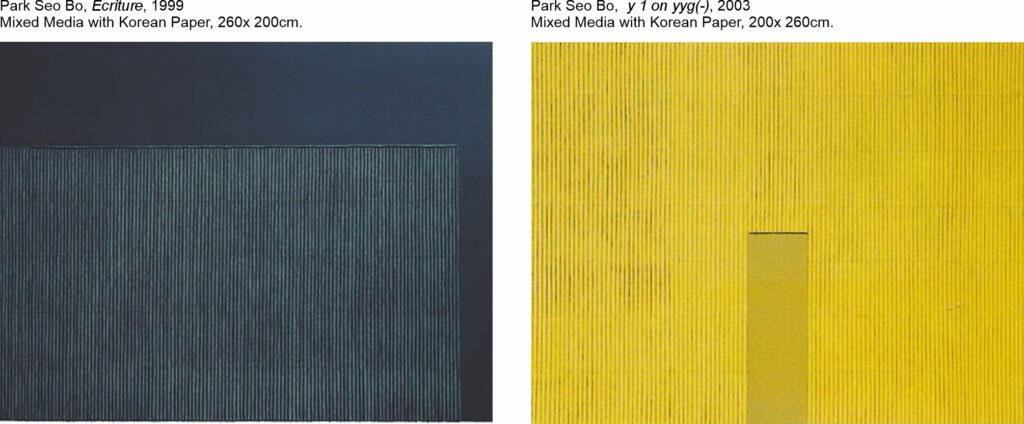
Park Seo Bo (b.1931) has established himself as an important contributor in developing contemporary art which serves as a bridge between the East and the West. Park is an important artist in Korean contemporary art, his works having a hybrid nature employing gestural ideas and based on Buddhist Philosophy. His paintings express the relationship between the artist and the exterior world; to be specific, they act as a visual signifier representing the unification of the artist’s interior and exterior worlds. His pictures of ‘allover composition’ are different from Action Painting in America, in that they are not the product of free and autonomous action. Jackson Pollock’s drip painting is connected to gestures emanating from Automatism. Park Seo Bo’s paintings from the late 1960s to the mid 1980s are quite distinct from Pollock’s painting as they result from accumulations of pencil and brush strokes, resulting in monochrome surfaces that give a continuance of vitality. In the late 1980s, his work revealed through gestures the continual flow of time in pictorial space. His monochrome paintings define the integration of space, and the concept of time. Park Seo Bo commenced his painting series titled Ecriture in the 1970s, thereby legitimizing monochromatic painting and establishing its foundation in Korea. The Ecriture series includes canvases of white with changes of colour tone created by linear rhythms of persuasive power. These works divide the perfunctory problem of the obvious two dimensionality of the pictures, while establishing the basic attitude of drawing in artmaking. Park made use of strategies like anti-figuration, anti-logic, anti-subjectivity and anti-expression and considered the nature of work which reflected the idea of ‘painting nothing’ all of which parallel certain strategies for stilling the conscious mind in Buddhism. Park has said of his Ecriture series that ‘through the reiteration of motion one empties oneself, experiencing progress sometimes like the ascetic movement of a Buddhist priest in reaching the state of nirvana’. The specific symbolic and metaphysical interest in these works are clearly influenced by Buddhist philosophy in direct contrast to the white paintings of the Western Minimalist painter Robert Ryman, which emphasize the actual, material nature of painting.
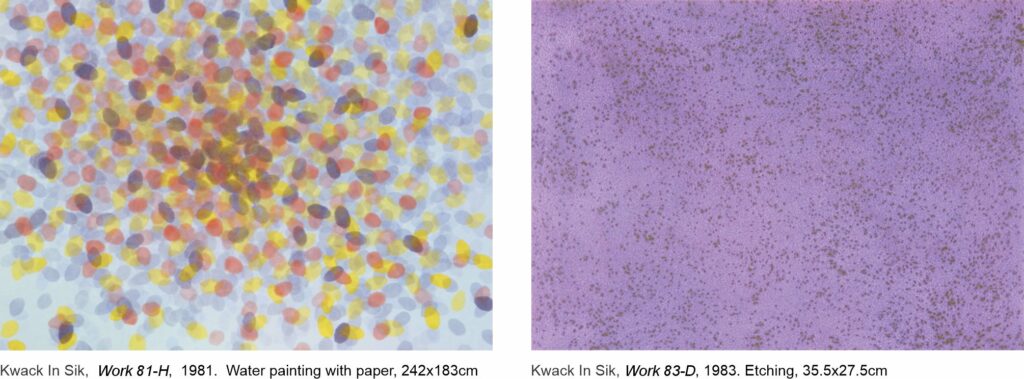
A third contemporary Korean master Kwack Insik(1919-1988) also settled in Japan since 1950. He graduated from Japan Art School, Tokyo in 1941. Kwack helped and led Lee to modern art and was claimed as a forerunner of the Monoha by a few critics such as Minemura Toshiaki. Lee denied his role in Monoha and his influence, but certain works and his early interest in the matter suggest that that was not the case. Regretfully though, he died of lung cancer in Tokyo, Japan at the age of 69. Many retrospective exhibitions have been held in Korea and Japan in his illustrious memory.
In sum, Monoha was a matter-oriented movement but matter itself was not the point for its members. It was rather the relationship between matter and man, and the consequent relationship between world and man. The above three pioneers made it clear that Monoha was not about matter, and their paintings had nothing to do with the material side of the medium. Moreover, they rejected Western notions of representation, focusing instead on the relationship of materials and perceptions rather than on expression or intervention. Its definitive goal was to embrace the world at large and encourage the fluid coexistence of numerous beings, concepts and experiences. In so doing, the Korean monochrome was not aiming at the restoration of pure property of matter but at the evaporation of subjectivity and at returning to nature through it. In this sense, the Korean monochrome was an original art form and differed from Japan’s mono school.
MeeAe Lee is an art critic and curator
The 1970s was a critical period in modern Korean history, marked by economic advancement and political repression, and a protective attitude towards cultural legitimacy. The situation influenced the art forms of the time. Thus monochrome painting came to be practised and was considered an aesthetic product in Korean formalistic modernism The central topic in any…