
landscape as a living system shanghai 2010 expo houtan park
shanghai, 2010 shanghai expo park, china, 2007-10
Built on a brownfield of a former industrial site, Houtan Park is a regenerative living landscape on Shanghai’s Huangpu riverfront. The park’s constructed wetland, ecological flood control, reclaimed industrial structures and materials, and urban agriculture are integral components of an overall restorative design strategy conceived to treat polluted river water and recover the degraded waterfront in an aesthetically pleasing way.
The site is a narrow linear 14-hectare (34.6 acre) band located along the Huangpu River waterfront in Shanghai, China. This brownfield, previously owned by a steel factory and a shipyard, had few industrial structures remaining and the site was largely used as a landfill and lay-down yard for industrial materials.
The objective of the park design was to: create a green Expo park; cope with the large influx of visitors during the event that takes place from May to October; demonstrate green technologies; transform a unique space to make the Expo an unforgettable event, and transition into a permanent public waterfront park after the Expo.
The first challenge was restoring the degraded environment. The site was a brownfield littered with industrial and construction debris both on the surface and buried throughout the site. The water of Huangpu River is highly polluted with a national water quality ranking of Lower Grade V, the lowest grade on a scale of I-V, and one that is considered unsafe for swimming and recreation and is devoid of aquatic life. The eminent site design challenge was to transform this degraded landscape into a safe and pleasant public space. The second challenge was to improve flood control. The existing concrete floodwall was designed to protect against a 1,000-year flood event with a top elevation of 6.7 meters (22 feet), but it is rigid and lifeless. The 2.1 meter (6-foot) daily tidal fluctuation creates a muddy and littered shoreline and is currently inaccessible to the public. A conventional retaining wall would continue to limit accessibility and preclude habitat creation along the water’s edge, so an alternative flood control design proposal was necessary. The third challenge was the site itself. The area is long and narrow and locked between the Huangpu River and an urban expressway with water frontage that is over 1.7 kilometers (one mile) in length but averages only 30-80 meters (100-265 feet) in width.
Regenerative design strategies were used to transform the site into a living system that offers comprehensive ecological services which include: food production, flood, water treatment, and habitat creation combined in an educational and aesthetic form. The site was meant to be an innovative demonstration of ecological culture for 2010 Expo.
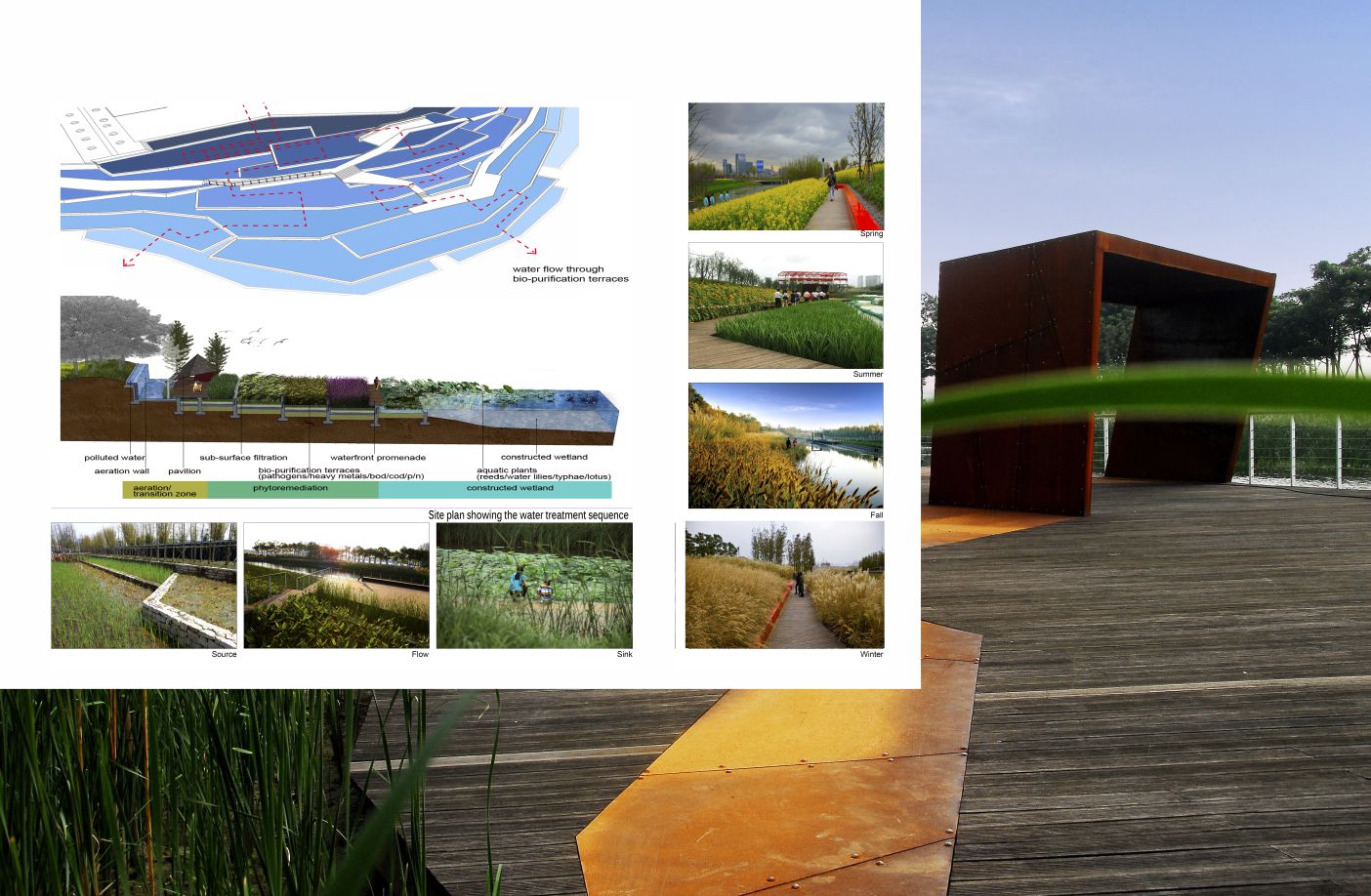
Through the center of the park, a linear constructed wetland, 1.7 kilometers (one mile) long and 5- 30 meters (16.5 – 100 feet) wide was designed to create a reinvigorated waterfront as a living machine to treat contaminated water from the Huangpu river. Cascades and terraces were used to oxygenate the nutrient rich water, remove and retain nutrients and reduce suspended sediments while creating pleasant water features. Different species of wetland plants were selected and designed to absorb different pollutants from the water.
The wetland also acts as a flood protection buffer between the 20- and 1000-year flood control levees. The meandering valley along the wetland creates a series of thresholds contributing to visual interest and refuge within the bustling world exposition and providing opportunities for recreation, education, and research. The terrace design of the wetland alleviates the elevation difference between the city and the river, safely reconnecting people to the water’s edge. Additionally, the existing concrete floodwall was then replaced by a more habitat friendly riprap that allows native species to grow along the riverbank while protecting the shoreline from erosion.
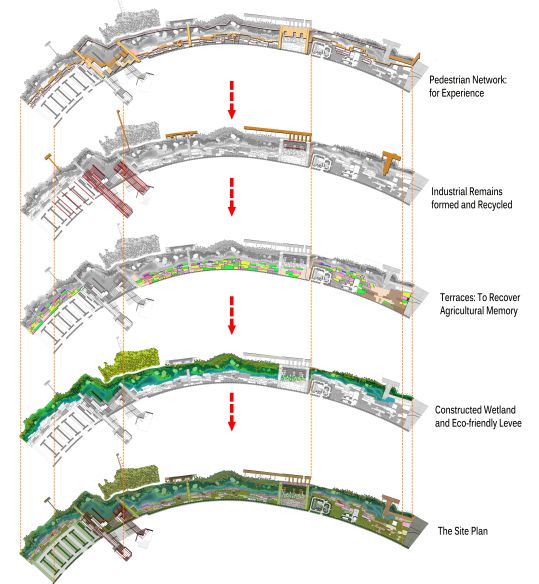
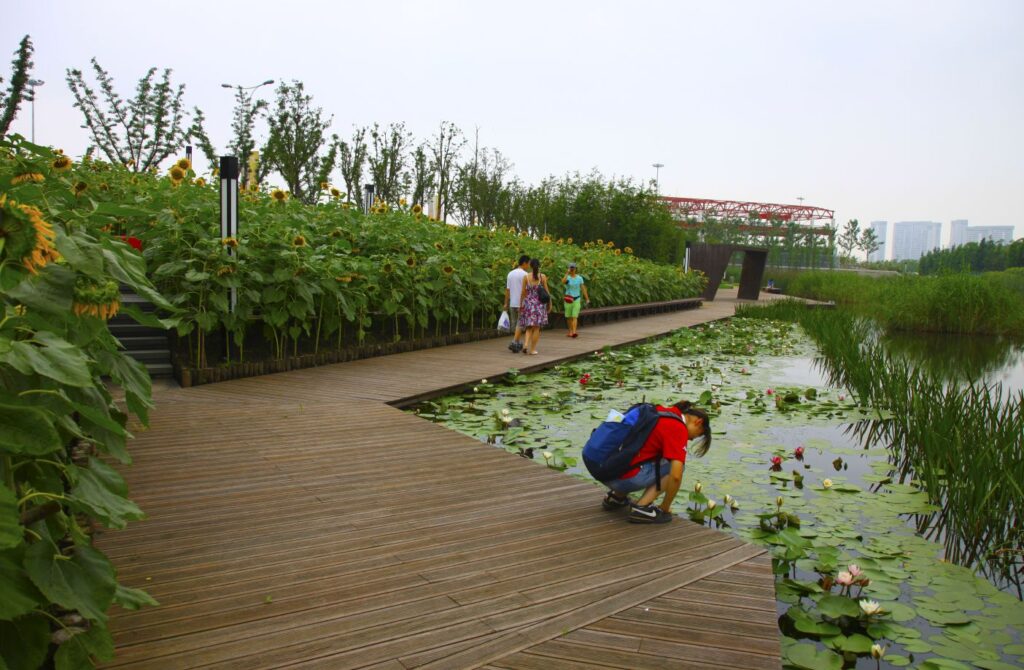
Inspired by the fields of Chinese agricultural landscape, terraces were created to break down the 3-5 meter (15-18 foot) elevation change from the water’s edge to the road, and to slow the runoff directed to the stream in the constructed wetland. These terraces are reminiscent of Shanghai’s agricultural heritage prior to the industrial development of the neighborhood in the mid-20th century. Crops and wetland plants were selected to create an urban farm that would allow people to witness seasonal changes: the golden blossoms in the spring, splendid sunflowers in the summer, fragrance of the ripened rice in the fall, and green clover in the winter. It provides a premier educational opportunity for people to learn about agriculture and farming within the city.
The terraces enrich the landscape along the wetland by creating spaces that encourage visitors to enter the living system through the field’s corridors and experience firsthand the agricultural landscape and wetland. The paths, like capillaries of a sponge, absorb and pull people to circulate through the park.
The industrial spirit of the site has been celebrated through the reclamation of industrial structures and materials. Shanghai is the birthplace of China’s modern industry and the iconic structures that remained onsite have been transformed into hanging gardens and overlook platforms.
An ecologically recovered landscape, urban agriculture and industrial spirit are the three major layers of the park, woven together through a network of paths where visitors are educated about green infrastructure within a lushly restored recreational area. The pedestrian network is composed of a main loop, a series of perpendicular roads bisecting the wetland and a multitude of footpaths leading through the terraces. This network ensures seamless connections between the park and its surroundings, encourages access within the site that not only effectively accommodates the massive pedestrian flows during the Expo, but also ensures a pleasant and accessible public park at the human scale afterwards.
shanghai, 2010 shanghai expo park, china, 2007-10 Built on a brownfield of a former industrial site, Houtan Park is a regenerative living landscape on Shanghai’s Huangpu riverfront. The park’s constructed wetland, ecological flood control, reclaimed industrial structures and materials, and urban agriculture are integral components of an overall restorative design strategy conceived to treat polluted…