
Regenerative Design Tianjin Qiaoyuan Wetland Park
Tianjin City, China, 2005-08
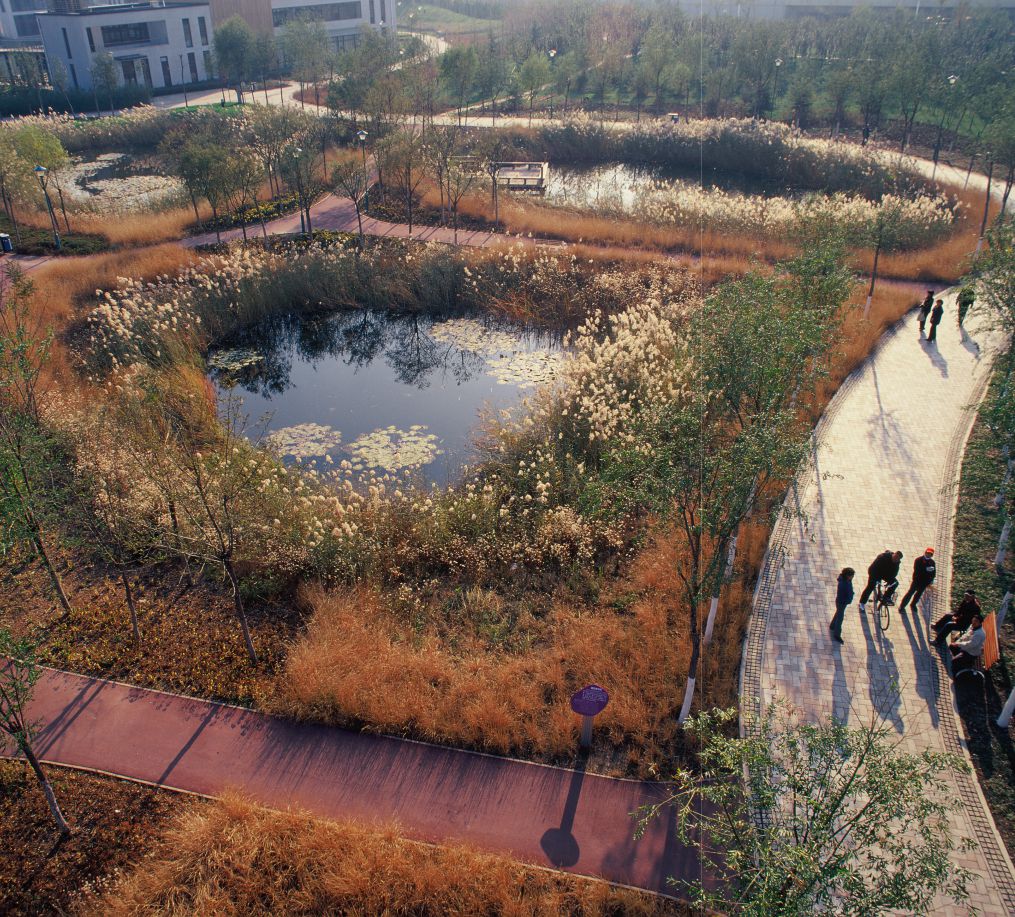
Through regenerative design and by changing landforms, the natural process of plant adaptation and community evolution is being introduced to transform a former deserted shooting range used as a garbage dump, into a low maintenance urban park; providing diverse thereby services for the city including containing and purifying storm water; improving the saline-alkali soil, providing opportunities for environmental education and creating a cherished aesthetic experience.
This is a park of twenty-two hectares (fifty-four acres) in the northern coastal city of Tianjin, China. Rapid urbanization had changed a peripheral shooting range into a garbage dump and drainage sink for urban storm water; the site was heavy polluted, littered, deserted, and surrounded with slums and temporary rickety structures, which had been torn down before the design was commissioned. The soil is quite saline and alkaline. Densely populated at the south and east boundaries, the site is bounded on the west and north sides by a highway and an overpass.
In early 2006, in response to residents’ call for environmental improvement of the site, the municipal government of Tianjin contracted Turenscape with the difficult task of an immediate transformation of this degraded site.
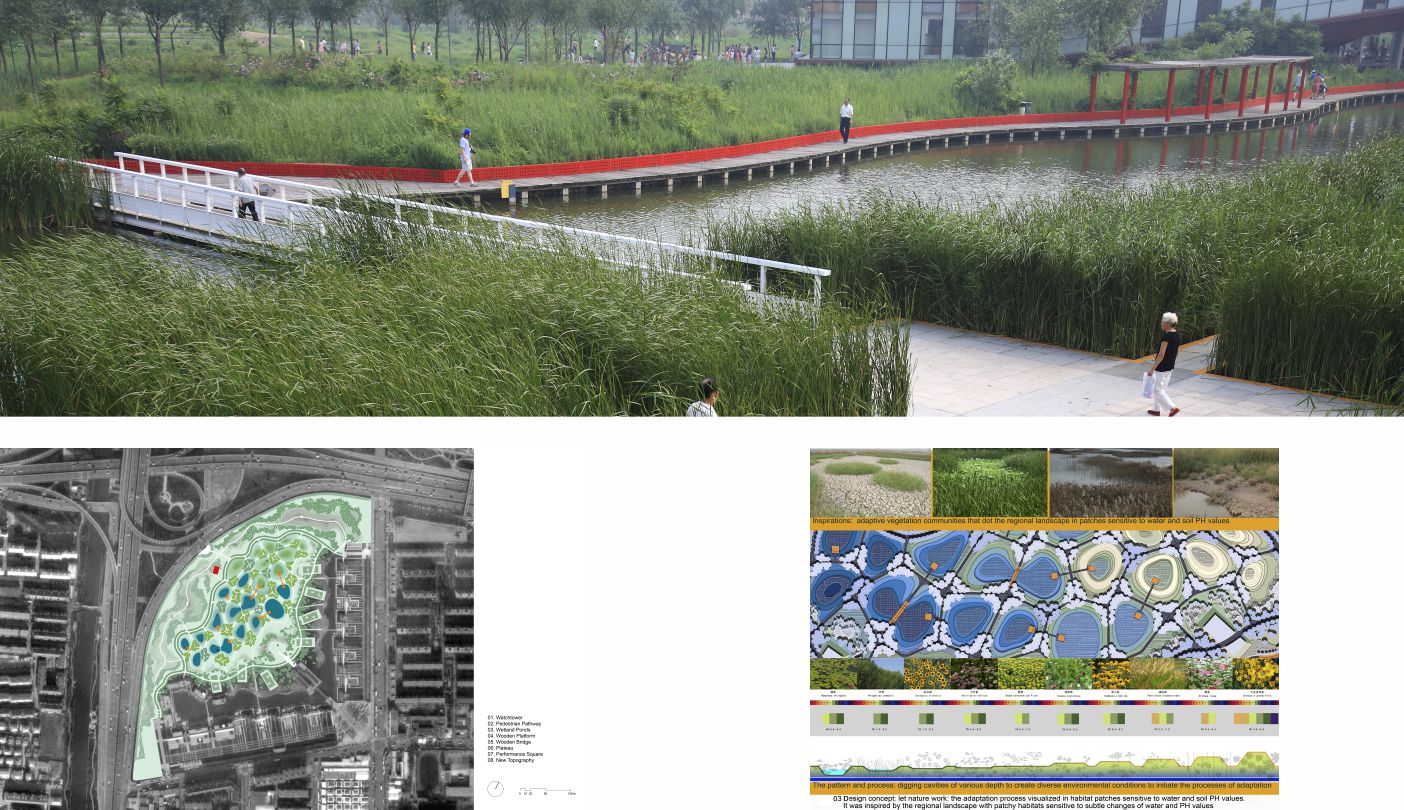
The overall design goal for this project was to create a park that could provide a diversity of nature’s services for the city and the surrounding urban residents, including: containing and purifying urban storm water; improving the saline-alkali soil through natural processes; recovering the regional landscape with low maintenance native vegetation; providing opportunities for environmental education about native landscapes and natural systems, storm water management, soil improvement, and landscape sustainability; and creating a cherished aesthetic experience.
Inspired by the adaptive vegetation communities that dotted the landscape in this region, a solution for this park was developed called “The Adaptation Palettes,” designed to let nature work. A simple landscape Regenerative Design strategy was devised. It included digging twenty-one pond cavities varying from ten to forty meters in diameter, and from one to five meters in depth. The garbage was handled in the earth work. Some cavities were constructed below ground level and some above on mounds.
Through the raining season and due to the shallow underground water, some cavities can turn into water ponds, some into wetlands, some into seasonal pool, but some stay as dry cavities. Through seasons’ rain wash and filtration, the saline-alkali soil of the dry cavities keep improving, while nutrients deposit in the deeper ponds can catch storm water runoff.
Diverse habitats were created and the natural process of plant adaptation and community evolution were initiated. Seeds of mixed plant species were sowed initially to start the vegetation, and other native species were allowed to grow wherever suitable. Through the seasons’ evolution, patches of unique vegetation are being established in correspondence to the individual wet or dry cavities, and various PH values.
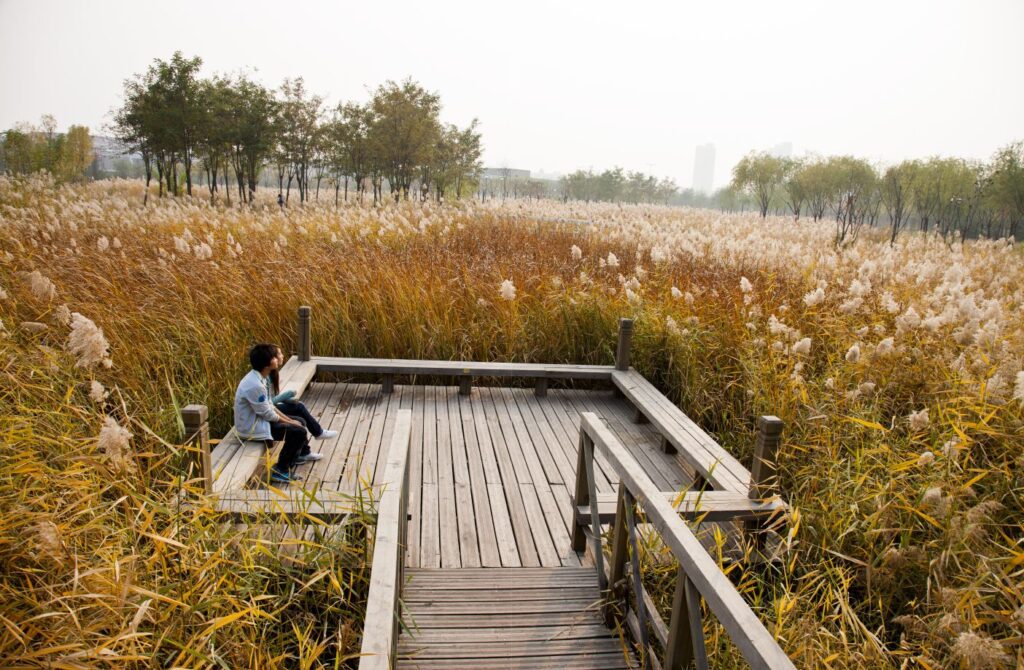
This project helps to define the new aesthetics of landscape today, defined by a continuous evolving process. Untidy forms, unplanned biodiversity and nature’s “messiness” keep ongoing, letting plants live and expose their genuine beauty to enrich the landscape. The ecology-driven Adaptation Palettes has in the process become a valuable and remarkable site fun the community of Tianjin.
Tianjin City, China, 2005-08 Through regenerative design and by changing landforms, the natural process of plant adaptation and community evolution is being introduced to transform a former deserted shooting range used as a garbage dump, into a low maintenance urban park; providing diverse thereby services for the city including containing and purifying storm water; improving…