

Australian Women Artists Sailing To Tahiti
The following is an account—inevitably one of many possible—of women artists in Australia over recent years. In fact it is an account of the last 25 years but from a perspective and memory mostly informed by the last decade. Most of the artists I will treat are well-known now. A few are recent reputations. One or two are in abeyance, though probably temporarily. Some have careers and oeuvres that have changed considerably and brought a number of peaks in their relative visibility. Almost none were big names twenty-five years ago
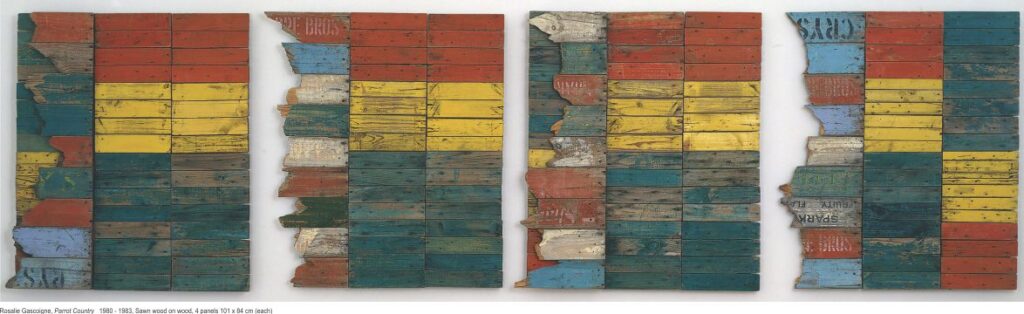
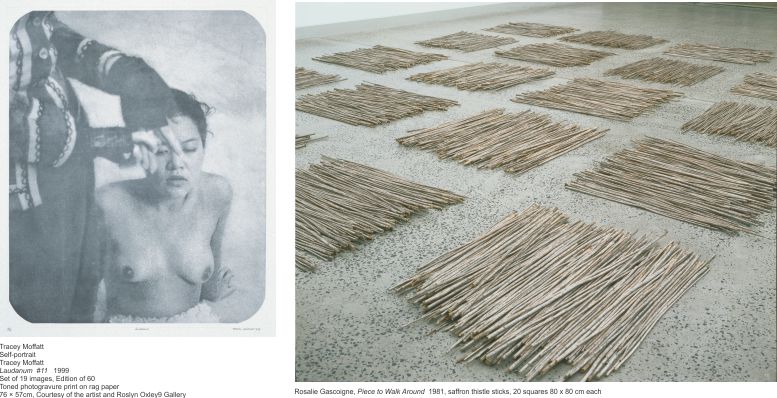
An exception to the last generality might be Rosalie Gascoigne (1917—99). She and Aboriginal artist Emily Kngwarre died recently at the height of massive recognition and acclaim. Gascoigne was causing quite a stir by the early 1980s. Born a New Zealander, she married an Australian and settled near Canberra in the 1940s. She had been trained in New Zealand but had given up art in marrying and mothering her children. Gascoigne began again seriously—no longer as a New Zealand painter—in the 1970s, making assemblage sculpture that read pictorially, a kind of Dada-lite. This work resembles the Giacometti of The Palace at 4 a.m., Murdered Woman and others—mixed with Calder and a post-Pop sensibility. The work quickly became interesting as it took in and blended the influence of Rauschenberg and the Minimalists (like Judd, Morris, Andre), and probably Colour Field painters—along with, importantly, training in and suggestions from Sofu Teshigahara, a Japanese Sogetsu School Ikebana artist. Gascoigne had been interested in this through the 1960s and by the 1980s it would seem to have gelled with the other western influences: her work became more abstract, more procedurally ordered: laid, or arranged, serially, and focused on the properties of the found materials the work collected. The results were works both lyrical yet seemingly matter-of-factly literalist: textures, colour, all made wittily from the actual—interestingly worn and weathered and faded drink crates, or corrugated tin, arrangements of sticks or twigs. White Garden, 1995, or, from 1982, Scrub Country, or 1980’s Parrot Country are examples. Her work was well collected in Australia and by the 1990s was well received in New Zealand too—witness, among others, the large retrospective at Wellington’s City Gallery in May of this year, Rosalie Gascoigne—Plain Air.
Emily Kngwarre died in 1998, an elderly Aboriginal woman from north-east of Alice Springs, Central Australia, after a brief painting career of about ten years. She is one of a large number of Aboriginal women painting in traditional or traditionally-derived modes. Much of her work will have content unavailable to Western analysis. It is splendidly ravishing. Its scale and decisiveness, its daring in seeming to follow its perceptions, its sensuousness, and ability to entertain singular effects, enable it to triumph over much of the abstract western painting that has prepared ordinary Australian eyes for work such as hers. It is both gestural and alert to colour and surface. If Gascoigne sometimes suggests the minimalist cool of Judd and Ryman, Kngwarre’s work can suggest Morris Louis’ moody veils of colour, late Colour Field painting’s grasp at pleasure—or it suggests, at any rate, the vocabulary of its most rapt admirers and the ambitions, if not the achievement, of artists like Barnett Newman and Clifford Still. But her work, produced in poverty and under pressure (from dealers, from an impoverished tribe), is intense and careless of cautious aesthetic discriminations, is somehow fabulously ‘actual’, too big for the museums it is housed in. At the turn of this century Kngwarre’s work, in astonishing variety, must have been the most reproduced of any contemporary Australian artist’s.
Emily Kngwarre was one of many Aboriginal artists, though pre-eminent amongst them. Non-aboriginal artists painting in analogous Western idioms, a painter, for example, like Angela Brennan, produce work that is, and perhaps necessarily, ringed about with ironies and circumspection. It is often very good—Brennan’s certainly is—but is not a great focus of critical attention anymore.
Mikala Dwyer might be regarded as carrying on in a mode that relates to Gascoigne’s. Gascoigne made installation pieces—mostly akin to her other sculptures (that is, two-dimensional typically and covering wall or floor) and made installations that, by virtue of scale, could occasionally occupy whole rooms. Dwyer’s work is in the hybrid manner of the late 1980s and 1990s—fully three-dimensional, and kookier, less ‘pure’ in mode than Gascoigne’s—joyous, inventive, manically playful. I remember cool late-sixties formalist objections to Anthony Caro as ‘picturesque’. Relative to strict Minimalism it was. Mikala Dwyer is much more exhilaratingly so—comparable to Jessica Stockholder, but less a translation of space to two-dimensional, pictorial, de stijl push-and-pull. Dwyer is much less ‘optical’ than Stockholder.
Micky Allan’s career covers all of the period I am discussing. Japanese born and living mostly in Melbourne, her career’s first peak came at the end of the 1970s with much-acclaimed exhibitions of hand-coloured photography in combination with a diary-like insistence on the everyday. Allan sometimes ‘lived’ in the gallery during exhibitions and also showed photo-and-text accounts of trips and journeys, picnics, etcetera. By the early 1980s her hand-coloured techniques broadened into a much more expressive style, greatly modifying and effacing much of the photographic image beneath. The techniques—and various whole manners of Allan’s—were borrowed by others beginning their careers.
By the mid 1980s’ Allan had returned via vigorous drawing—in chalk pastels and charcoal—to painting. The works were figurative but highly fanciful. A series from the early 1980s were charcoals, each featuring intensely—sometimes inanely, sometimes spritually-benign–aliens, space monsters who obviously ‘came in peace’: friendly, goofy, innocent, odd. Klee-meets-Dubuffet-meets-Children’s Art. The paintings that followed evolved rapidly through postmodern narrative scenes—of travel in a medieval Europe of castles, winding roads and of vistas that promised picaresque adventure—into large works, more spatially ambiguous, and which might feature all of whales, molecular or abstract diagrams, a vignette of a suburban bicyclist and vignettes of the Melbourne sky-line—all in disparate scale.
With these paintings Allan found herself once more on the crest of critical approval. The work seemed visionary in not too utopian, trippy or stentorian a manner‚ like epiphanies. Recent work has been more highly toned coloristically and more sparse: imagery that might suggest Eastern religions and mythological tales (Indian, Japanese Zen) floats, or goes adventuring, alone on large expanses of colour.
A number of women rode to prominence with the acceptance of photography within the art world here by the 1980s. Painting might still have been regarded as the province of the (masculine) Romantic Genius artist. Carol Jerrems produced some of the iconic photographs of the late 1970s. She died young, her fame mostly posthumous and tied to wonderful pictures of easy-living youth in the Australia of that time, particularly inventive compositionally and, as Helen Ennis notes, unusually successful at photographing young men as relaxed, vulnerable, gentle. Fiona Hall’s reputation was at first tied to closely observed and cannily composed photos of absence—of empty driveways, details of domestic architecture, that hinted at failure as well as aspirations to respectability, style, and ideals of ‘home’: lonely, dry, telling. But these works are in a now distant past. By the late 1980s Hall was photographing tiny mise-en-scenes carefully constructed in the manner of window-dressing: shallow spaces framed with small sculptural details and central images that were a mixture of 3-D, 2-D and trompe l’oeuil and produced as large photographs. One memorable series dealt with Dante’s Divine Comedy, another with the seven deadly sins.
Though acclaimed for these works, Hall had already abandoned them and moved to exhibiting the sculptural objects she had begun making, originally to photograph. Best known are the often reproduced series of exquisite, fantastical botanical works cut from her cat’s sardine tins, Paradisus Terrestris. They look like ornamental silverware of a previous century and combine the genital and reproductive organs of various hybrid plant and human forms. Hall has also worked to produce large public art pieces, often centred on natural history. Hall’s work reflects many of the concerns of the last decades: the suburban and the non-event(ful), systems of classification and conceptualization (the taxonomies of Dante, of 19th Century botanists, as they relate to or exemplify the colonial, the postcolonial and the global).
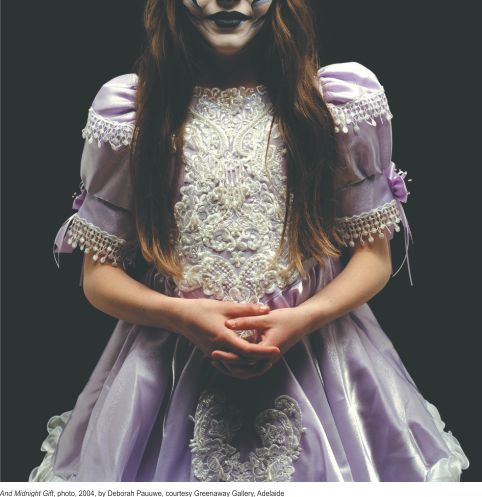
A number of women photographers have been interested in quite deliberately staged photography. Anne Zahalka has re-staged well known iconic images from Australian art—famous photographs of the supposed Australian character from the 1950s, nationalistic paintings of still earlier times. Deborah Pauuwe has gained a good deal of attention for pastel-coloured depictions of eroticized adolescent girlhood: fetishized details—shots of dress and legs or of torso—a combination of Guy Bourdin’s Cries and Whispers ad campaign and girlish checks, stripes and spots, but muted, vanilla-ized, sensuously soporific. The pictures have shallow depth with all elements on planes parallel to the picture’s, so that the images read easily as flat and abstract. They deliver a sensuous dream or idyll—of flesh and pattern—and a ‘knowingness’ that is ours but is projected onto the subjects. It is work that, it seems to me, comes deliberately close to bad faith. Is this exploratory? Doesn’t it love the issue it skewers so accurately? (I am reminded of Lord Leighton and Alma-Tadema.) But ambivalences and ambiguities around sexuality and gender have generated much women’s artwork in this period.
Sam Small’s best known work (2003) consists of photographs of poetically empty, romantic, forlorn domestic interiors. Empty room, lounge chair, long curtain billowing inwards, eerily still. On inspection the rooms are seen to be hand-made scale models, made from carpet, cardboard, millinery material. They are too sober to recall doll’s houses, especially as the viewer has already found him/herself identifying them with scenes from, say, languorous Marguerite Duras movies.
Polixeni Papapetrou currently makes still more frankly fanciful stage-set images. These delight in delivering what we would not accept from painting—though arguably they reprise the illustrative art of the distant past.
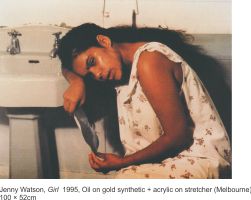
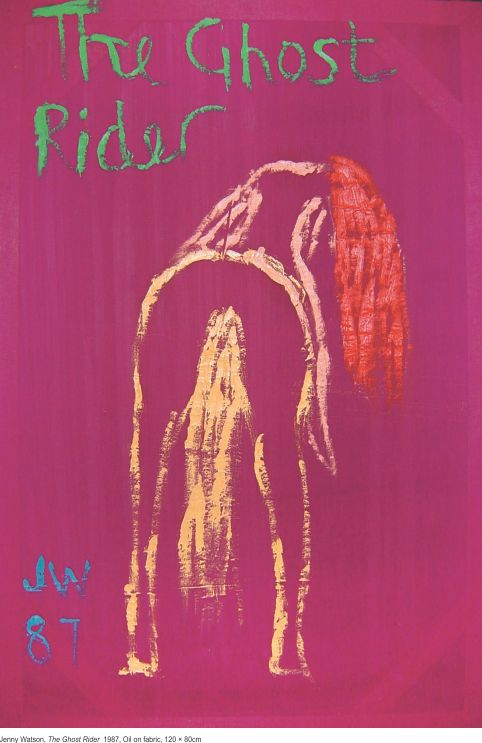
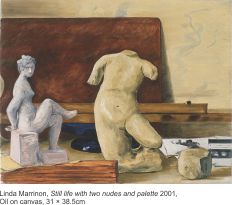
The eighties was a big decade for painting in Australia and the new work was very much associated with Melbourne’s Art and Text magazine under the founding editorship of Paul Taylor. Two favourite painters whose beginning I associate with that period are Jenny Watson and Linda Marrinon. Marrinon’s reputation is a little eclipsed at present but could be re-ignited any moment. (Her well-known productions are not confined to the 1980s.) Both artists are quasi-expressionist and figurative: Watson’s is a staged, histrionic acting-out of themes of feminine power, helplessness, self-destruction, idealism, and more. Marrinon’s expressionism could be said to have undergone Jameson’s ‘linguistic turn’—ironies and ventriloquism abound. Marrinon’s deliberately badly and baldly drawn graphic paintings enacted, for our delectation and hers, a kind of abjection—before I, at any rate, had noticed the term gaining currency in contemporary art. Typical were stick figure cartoons with captions: ‘What I Must Bear’ (girl on all fours bearing a crucifix on which are the words ‘prejudice’ and ‘misunderstanding’, face frowning sadly), ‘I Sailed to Tahiti with an All Girl Crew’ (tiny figures on a schematically drawn yacht, girls topless, lone male at the wheel). Marrinon has gone on to make many other amusing paintings and sculptures whose deliberate ineptitude smiles affectionately at the subject lampooned.
Jenny Watson has produced numerous series of works in a style identifiable as faux girlish. They are intelligent and stylish, a meta-style marshalling the inept. The best known deal with feminine aspiration and disappointment, frustrations and victories—many of them via a surrogate subject figure, a kind of late 20th century Alive-in-Wonderland. This figure will be in love with horses, with problem males, given to alcohol binges, and will typically swing between self-abnegation and a rallying confidence, and is always mercilessly realistic in her appraisal of the politics of situations. (A painting of hers I saw in the Museum of Modern Art showed the artist figure snuggled asleep in an iron four-poster bed somehow situated amongst the trees, ducks, and ponds and walkways of New York’s Central Park. This is Watson’s joke about Australian artists’ aspirations, her own included.) These paintings caused considerable shock and resistance in the late 80s and 1990s. Recent works have a more expansively decorative feel, painted on patterned materials and composed like collage.
Deej Fabyc, Simryn Gill and Bronwyn Platten must here suffice to represent the more conceptually based installation work that has filled many galleries in Australia through the 1980s and 1990s and continues to do so.
Simryn Gill has produced a number of discrete bodies of work that have examined empire, globalisation and the colonial/postcolonial dynamic. The first of her works I saw was a wire cube, a grid in which were affixed tiny products—ephemera like commercial brands, breakfast cereal, toys of the past, things of that nature—all emblematic. Deep Thoughts (1992) was made up of small, chicken-wire cubes, in each of which was suspended a tiny piece of culture-bearing flotsam or jetsam. The whole was airy and light, a kind of spectral cloud of wire in which were fixed the tiny exhibits, strangers in a strange land. The items were mostly aged and unselfconscious bric-a-brac–a plastic mermaid, a 1920s Gordon’s Gin re-sealable lid, a bamboo sampan inexplicably bearing the legend ‘Greetings from Port Lincoln’, and others—tiny knick-knacks, mementos, novelty toys, bits of ephemeral decoration and ephemeral usefulness, tokens—a cigarette lighter, a plastic orange, a barometer American Indian (‘Apron blue—weather is too / Apron pink – weather stink’)—and more, all interesting in their own right.
The whole piece spoke of the relativity of cultures and the tides and fluctuations of migration, trade and empire. Particular phases of cultural fortune—of Britain in India, of the Marshal Plan and the Great Society—could be discerned. All the pieces seemed totemic, tiny genii which evoked eras through their confident belief and participation in the ways-of-their-world. Their gross assumptions were rendered almost brave and quaint, guiltless and sentimental—rueful and mordant. The work considered a passing colonialism, the relativity of values, and their material and political forms and costs.
Larger floorpiece installations by Gill have featured in Biennales in Australia and in exhibitions overseas. Gill has also worked with the display formats of ethnographic or other kinds of museum display. Typically, her work deals with the connections and divides between cultures via mnemonic objects and items of language—one work, I think, made playful reference to Hobson Jobson, among other sources. More recent work (2002) has looked at representations of her home, Singapore, and the susceptibility of the photographic to exoticising or orientalist readings.
Bronwyn Platten’s Love Maps and Shadow Play (2003) was the second in an ongoing series of exhibitions by the artist treating and researching conceptions of love, erotica, the erotic and desire. Where a previous Platten exhibition (The Museum of Love and Romance) had looked at Asian, European and American sex-museums’ conceptions of the erotic and sexual, this exhibition dealt with some conceptions of romantic love—and the metaphorical modes by which love and romance are imagined. Where the previous exhibition had dealt with ‘limit-case’ instances, Love Maps dealt in the serviceably normative. Love Maps consisted of a number of filmed works, projected to wall-size—and objects in the other half of the gallery. The films were meditative and suggested dreamy, subjective contemplation—or even fretting—and practical, perfunctory, dealing with the business of sex and love—and with journeyings, ideas of life and love as search, yearning, destiny.
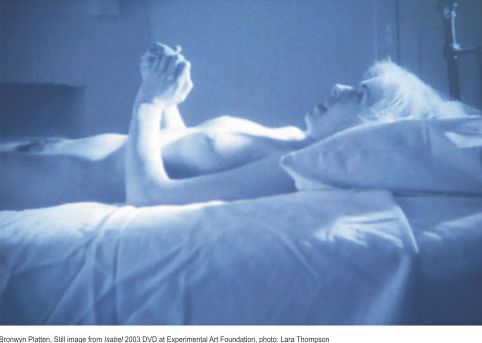
The films functioned in the exhibition as a source of emotion and gravitas that the other half of the show depended upon and refracted more abstractly. The films were called ‘Isabel’, after the artist’s great grandmother who lived in the Orkneys. Some sequences traced a slow path through a seaside village to a door (of the artist’s grandmother in the Orkneys), focusing on the cobblestones—retracing actual footsteps. Others showed the wake of the ferry from island to mainland. Another showed the island headland shrouded in mist. These last were very beautiful and suggested inchoate longing, reflection, sadness or serenity. Other sequences showed a young woman naked on a narrow bed thinking, daydreaming, wondering, and examining her body (moles, folds of skin). Yet another showed the scaling and gutting of a fish. The slit made in the fish seemed sexual—a cliché, but this was also the practical preparation of food, the no-nonsense ‘work’ of being a woman and suggesting there was something of this about the ‘work’ of sex, too.
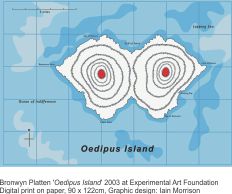
Balanced against the films were concrete objects: a girl’s notepad (scaled-up to four or five feet in height), with its implied secrets and imaginings. A goofy ‘map’ of the ‘Oedipus Island’ (looking much like a bra, with maddened ‘eye’ nipples), rather than suggesting sentimentalized ideas of love, shifted to the register of ribald, Mel Brooks-style humour: the looming, mesmerizing mammaries, the ludicrously portentous Cape of Love, Bay of Destinies, Cape of Shame, etcetera, all indicated on the map. The bra or breasts, as a shape, also suggested a rorsach ink-blot—all cornball popular indicators of ‘the Freudian’, the ‘psychological’. Perhaps these are the tools with which we do consider love and the psychic life.
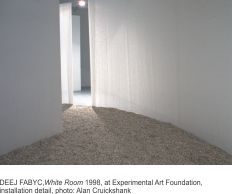
Deej Fabyc is best known for the installation White Room. It showed originally, in 1998, as a two-piece, White Room/Strawberry Girl. The viewer entered a kind of antechamber (the Strawberry Girl room) filled with arrangements—vanity-mirror-style—of cutely girlish objects surrounded by pink and white illustrative images of a ‘type’ of sexuality that seemed to morph from David Bailley sentimentalized soft-porn to a more aggressive, punkish and androgynous perversity and provocation: decor turning scornful.
White Room was a room within a large, circular walled enclosure. A secluded, private room within a protective walled moat of white gravel (three tons of marble chip) and of stretched gauze curtain. The viewer penetrated the outer wall and crunched around the all-white, circular maze–white walls, white mesh, white gravel: a very artificial, insulated purity, slightly sci-fi. Given the themes that seemed latent: the ‘enclosed garden’ metaphor for female sexuality, the satin, Elvis-in-Las Vegas feel and one’s self-consciousness as encroaching voyeur or participant in a police search—this was a site of surprise. Would you find a murdered body, a sexual act? The padded walls suggested kinky boudoir as much as private cell, some private, ritualized confrontation: power and pleasure, the illicit or shameful. A third element, a video, played in the gallery’s toilets showing a young woman in the same padded room, hand held camera focusing on empty corners and lines of the room and accidentally, on parts of the woman—an unwilling and uncooperative complicity on her part. The show projected feelings—of ambivalent recklessness/worthlessness/victimhood/assertive autonomy etc—back onto the viewer.
Tracey Moffatt was early (1989) associated with a series of mise en scene pictures famously showing black and white Australia’s relationships in a cruelly and theatrically oppressive light—a policeman’s gleaming knee-high boots and leather gun holster, jodhpurs evoking standard master and slave hierarchies—vis-a-vis the thin, despondent female Aboriginal figure sharing the scene. These were exciting and seductive for their high, American movie- trailer colours and gloss and succinct advertorial composition, cannily counterbalancing the bitter pill of the message.
Moffatt is enormously successful—showing all over Australia, in the MoMA in New York, at the Tate in London and all over Europe, the USA and Japan. The work has dealt with issues of race and gender—but not didactically since those early works: the artist seems curious and responsive and much more concerned with pathos and emotion. Of course race and identity in Australia will generate plenty of both. Recent works include studies of faces of losing Olympic athletes (Fourth), a film made up of scenes from old movies all involving men slapping women and, in the second half, women slapping or shooting men (sometimes exhilarating, sometimes amusing, maybe depressingly realistic), and a film about voyeurism. Her work often deploys a mastery of melodrama, of the operatic: stories of a small-town country girl come to the big city shown in a series of quasi film-stills, a mysterious lesbian colonial nightmare in which the rich mistress administers laudanum to her Asian servant and abuses her.
Patricia Piccinini is another extraordinarily successful artist. She represented Australia at the 2003 Venice Biennale. Her more conventional work—contemporary urban/suburban culture as high art or through the rhetoric of cinematographic convention—is terrific. It has more or less been forgotten over the last five or so years and her name now conjures her better known imagery: visions and anticipations of genetic engineering—cloned teenagers that look aged already, wrinkled but ‘youthful’ in their youth-culture sportswear; cute/ugly hybrid animals at the same time cuddly but repulsive, asking to be loved; an airbrushed supermodel with a mouse on her shoulder, a living ear attached to the host mouse; combinations of the organic and the mechanical. These works exist as photos, videos, sculptures. Their sensibility connects them to her other work: they employ the rhetorics of sci-fi drama, of documentary, and normalise their subject matter via the mediation of youth fashions and preoccupations.
There are a number of artists working in Australia in the relatively new field of Bio-art. This places them a little closer to science (or to the science) than the fictions or science-fictions of Piccinini approach. Which will prove more true, more valuable? In any case Bio-artists do work closely with the technologies of science and bio-science. One such is Ionat Zurr. Working in collaboration with Oron Catts, at the recent (2004) Art of The BioTech Era exhibition in Adelaide she presented The Tissue Culture & Art Project. This was a quarter-scale ear grown from human cells, cultured in a rotating, micro-gravity bioreactor which allows the cells to grow in three dimensions. It was a ‘semi-living’ entity—sustained alive, growing outside the human body and coerced to grow in this predetermined shape, a new kind of object-being. Zurr and Catts are interested in the new ethical and cultural discourses these things generate.
I haven’t spoken of the situation of Australian women artists today. Patriarchy is entrenched here. Women are doing much better in the arts than they once were: Tracey Moffatt and Patricia Piccinini, for example, are possibly the best known contemporary artists in the country—and female students are the majority at art schools, as they have long been, but of late many more are going on to make careers in art. Of course artists generally are way down the economic scale—and the official, Public Imaginary, as determined by mass media, and despite the population’s real interest in art, is resolutely fixated on party politics, money, power, sport and entertainment. The patriarchy is perhaps ceding high culture to women? Our Prime Minister, in signing away any protection policy for local cultural production (TV, film, publication) as part of a free-trade agreement with America, said, Well, you can’t have everything!
Ken Bolton is a poet and art critic. He works at the Experimental Art Foundation in Adelaide, Australia
The following is an account—inevitably one of many possible—of women artists in Australia over recent years. In fact it is an account of the last 25 years but from a perspective and memory mostly informed by the last decade. Most of the artists I will treat are well-known now. A few are recent reputations. One…