

korean women artists
Korean women artists now invite viewers to share their experiences through explorations of the consequences of having to conform to Confucian norms. This effort reflects a tension within them and a space where conflicting ideologies have to be reconciled in order to function in a society that is intolerant of differences
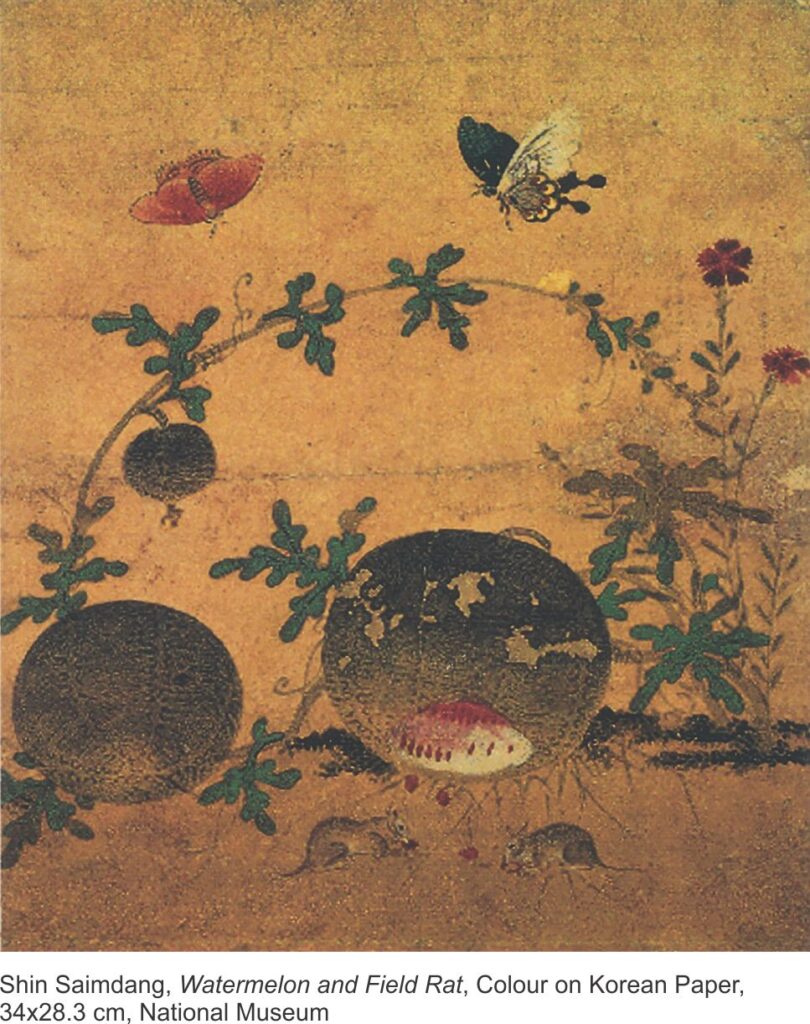
Looking at today’s women who are active in the various walks of life, it will be difficult to imagine what it was like to be a woman in pre-modern Korea. In terms of legal rights and social status, their lot was not much different than that of women in pre-modern Western countries. However, when it comes to the question of freedom in daily life, women of the Chosun dynasty (1392-1910), Korea, had few parallels in the world. They were required to lead a life severely restricted by Neo-Confucian moral standards.
Nevertheless and despite the restrictions imposed on them, some women were able to express their remarkable talents and intellect through literature, painting, calligraphy, and scholarly writings. Take, for instance, Sinsaimdang(1504~1551) and Heo Cho-hui (pen name Nanseolheon, 1563~1589). Heo’s poems are sensitively and delicately worded, and reveal a woman’s unique sentiments and lamentations. She expressed her sufferings in marital life as well as a maiden in poems to console herself. Her poetry book, titled Nanseolheonjib, was published and highly praised in China. Sinsaimdang was a literary woman active in the middle of the Chosun dynasty; she hailed from Gangneung, and mothered and brought up Lee I (pen name Yulgok) to be a calligrapher and great scholar. She is thus praised as a model of a good daughter, and a wise mother in Korea. Sinsaimdang was good-natured, high-principled, and filially pious to her parents. Furthermore, she excelled in poetry and prose. She was also dexterous in needlework and embroidery. She inherited Angyeon’s painting style, and is seen as the best female painter in Korea. After she died, the government posthumously granted her a position. One hundred pieces of her mementoes, including Dangseo folding screens, as well as paintings such as Sansudo (landscape), Noando (wild goose), Yeonrodo (lotus), Maehwado (Japanese apricot flower), Pododo (grape), Chochungdo (insects on flowers), and embroidered folding screens are kept in Ojukheon. (her house) in Gangneung.
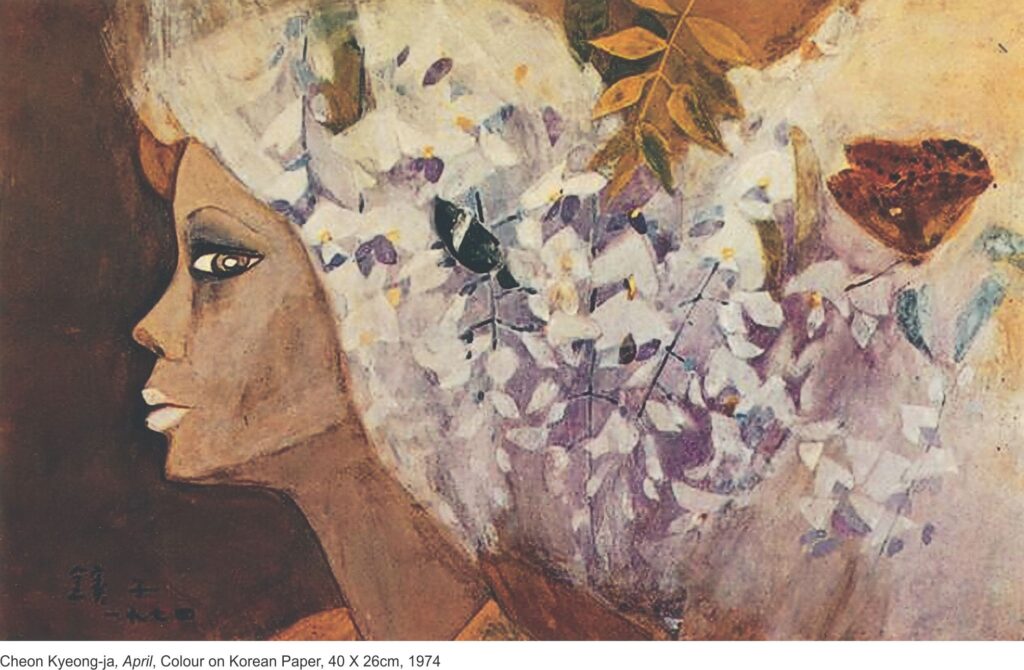
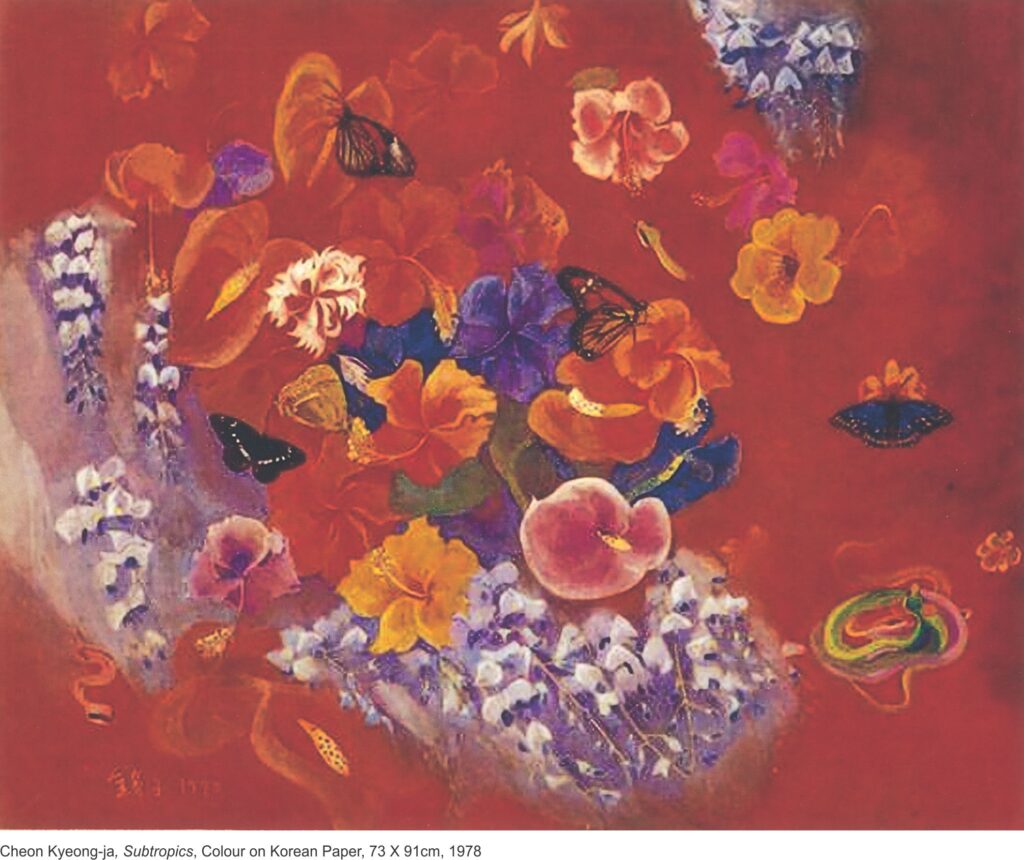
Although these women represent but a tiny fraction of all the women of their time, the concrete evidence of their creative endeavors has left a lasting imprint on Korean history. Korean women artists now invite the viewer to share their experiences through explorations of the consequences of having to conform to the Confucian norms. This effort reflects a tension within them and a space where conflicting ideologies have to be reconciled in order to function in a society that is intolerant of differences. Despite their desire to find a place of equilibrium, it was difficult for them to find an environment that offers intellectual or creative freedom for Korean women artists. The narrow Confucian society of Korea leaves women with no choice but to adopt multiple identities, and each of them have to perform different roles such as daughters, wives, mothers, and as career women. In each role, the Korean woman feels a sense of disingenuousness.
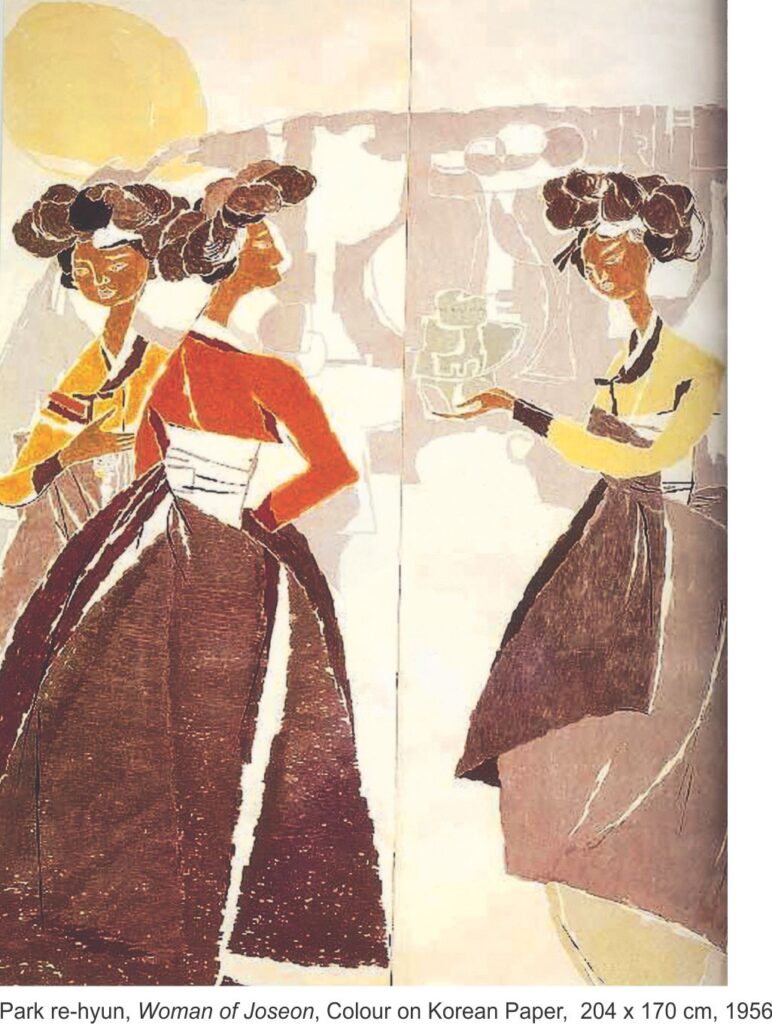
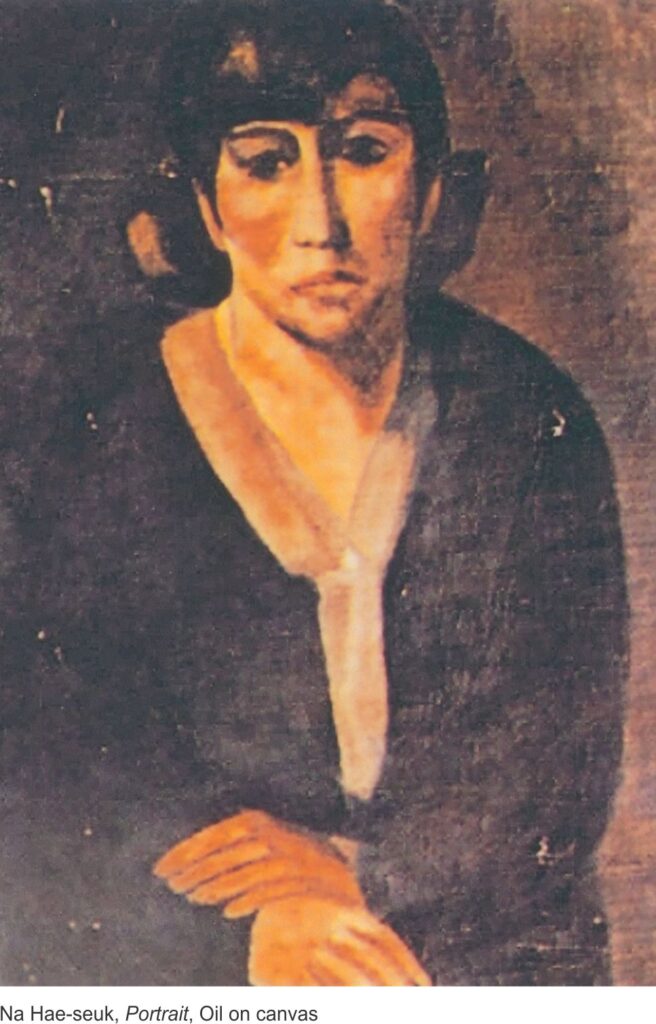
Na Hae-Seok is currently the center of attention in feminist artistic and scholarly symposiums. This, however, is a drastic turnaround. Until recently, Na was dismissed as an anti-heroine because of her “fall” later in life, which crushed her reputation. She was the first Korean woman to study abroad (1913), first to hold a solo art exhibition (1921), to launch a feminist movement (1919), to publish a feminist novel ‘Kyong-hee’ and the first to publicly demand equal rights for women. In short, she was the first woman artist and feminist of Korea. Her ‘fall’ began on a trip to Europe and America with her husband Kim Woo-young, then a lawyer and later a diplomat. She had a love affair with Choi Lin. The act led to divorce, a very shameful episode at a period that lasted from the end of the 19th century to the beginning of the 20th century, a period when the patriarchal system placed women at the lowest rung of the social strata. This would have been unforgivable for any woman, especially for Na, who was a public figure. The upper class scorned her, and her writings defending her behavior were denounced as scandalous, while her paintings weren’t welcomed in shows. She soon suffered from mental and physical illness, and at the age of 52, died alone in a dingy hospital. No one claimed her body and her burial site is still unknown. But the recent rise of feminism in Korea is forcing people to revalue Na and her significance in Korean history. People are wondering if the real tragedy wasn’t Na’s wrong choices but society’s unwillingness to accept them. But whatever the current status, the focus on Na as a key historical figure is likely to grow stronger in upcoming years, since all agree that she is the starting point for the link between modern art and the women’s movement.
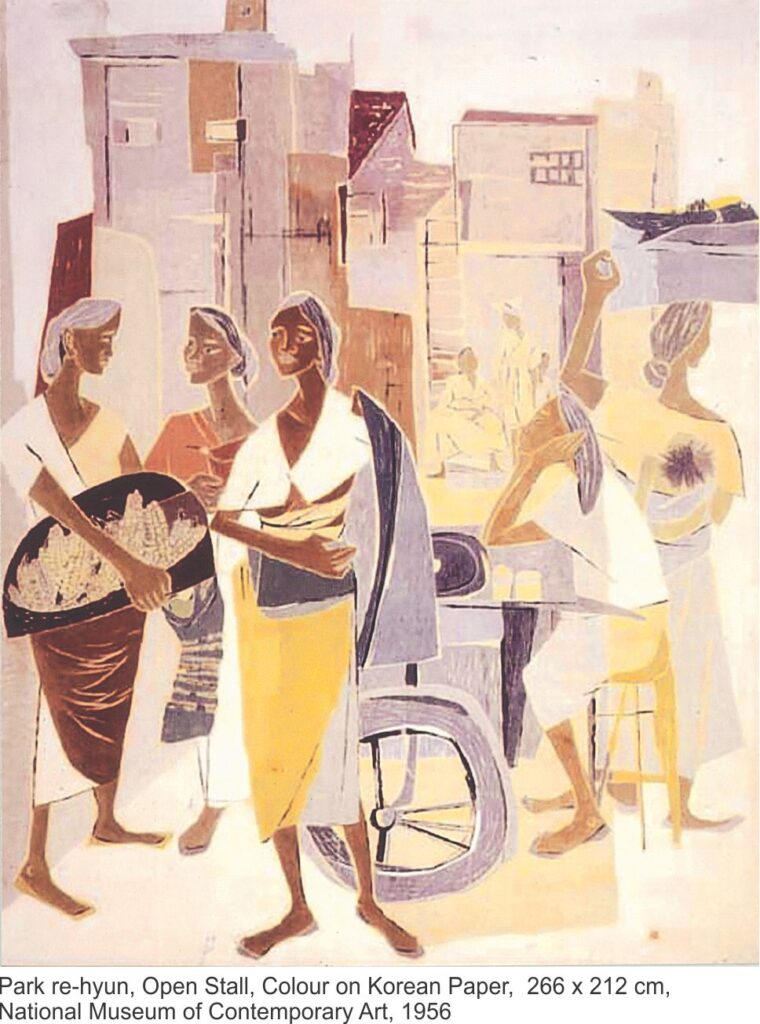
Park Rae-hyon (19211976) is regarded as one of the leading artists of the modern school of Korean painting. She did not confine herself to the conventions of traditional painting in subject matter nor in painting technique but was steadily searching for a distinctive style of expression and painting method. The rediscovery and recognition of Korean native traditional cultural forms continued to act upon her stylistic transitions towards abstraction and functioned as the aesthetic determinant in her adoption of such new genres as printmaking and tapestry. Her interests ranged from not only the paintings of the Koryo and Chosun Dynasties, but also included Chosun ceramics, Koryo celadon, earthen-ware from the Shilla Dynasty and woodwork and also folk crafts, which acted upon her work as compositional devices, or appeared in her paintings as motifs, and served to function as resources that infused a native sensibility in her painting. Park Rae-hyun exhibited paintings with old coins as motif, reviving this dying technique, and produced abstract paintings that brought out the beauty of negative spaces. She also exhibited tapestry work using rag pieces, strings, pieces from dusters and rope. In so doing, she left her mark as an important woman artist in the predominantly male Korean art world, and has proved to be a role model for younger women artists.
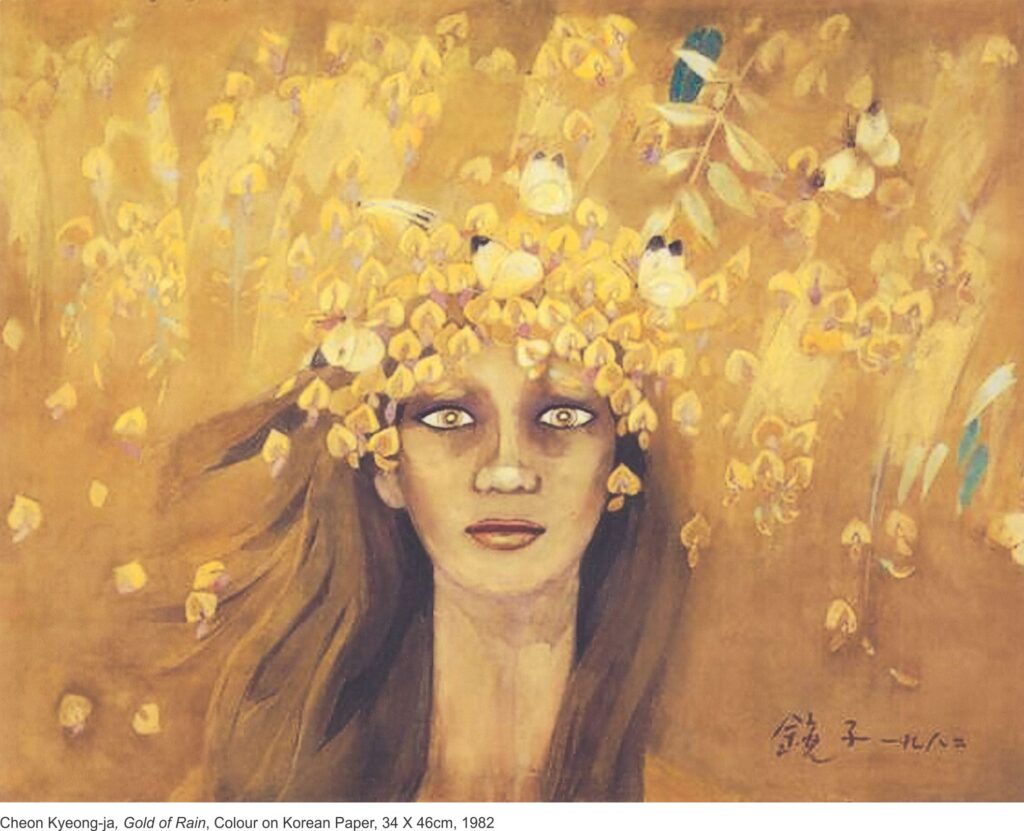
Cheon Kyeong-ja was born in 1924 and graduated from Tokyo Women’s Arts College. She also studied in Paris Academy Goez. In 1955, she won the Presidents Award in the Korea Arts Exhibition and the Golden Crown Culture award in 1983. She includes many subjects in her works such as her own perspective of life, the beauty of nature, the wonder of life, a human being’s internal life, and meditation. She is one of the great artists in Korea. In particular, she is unrivalled in producing colorful pictures. She deserves praise because she has successfully gone through difficult times from the Japanese colonial period to the sixties when people downplayed colorful pictures as Japanese-style ones. She predicted that those pictures would later be popular in Korea. Her main images are flowers and women that represent beauty in general. Since she can infuse everyday life into her paintings, it can be said that her works are products of experience. In short, they describe everyday life and express the thoughts that go on in people’s mind.
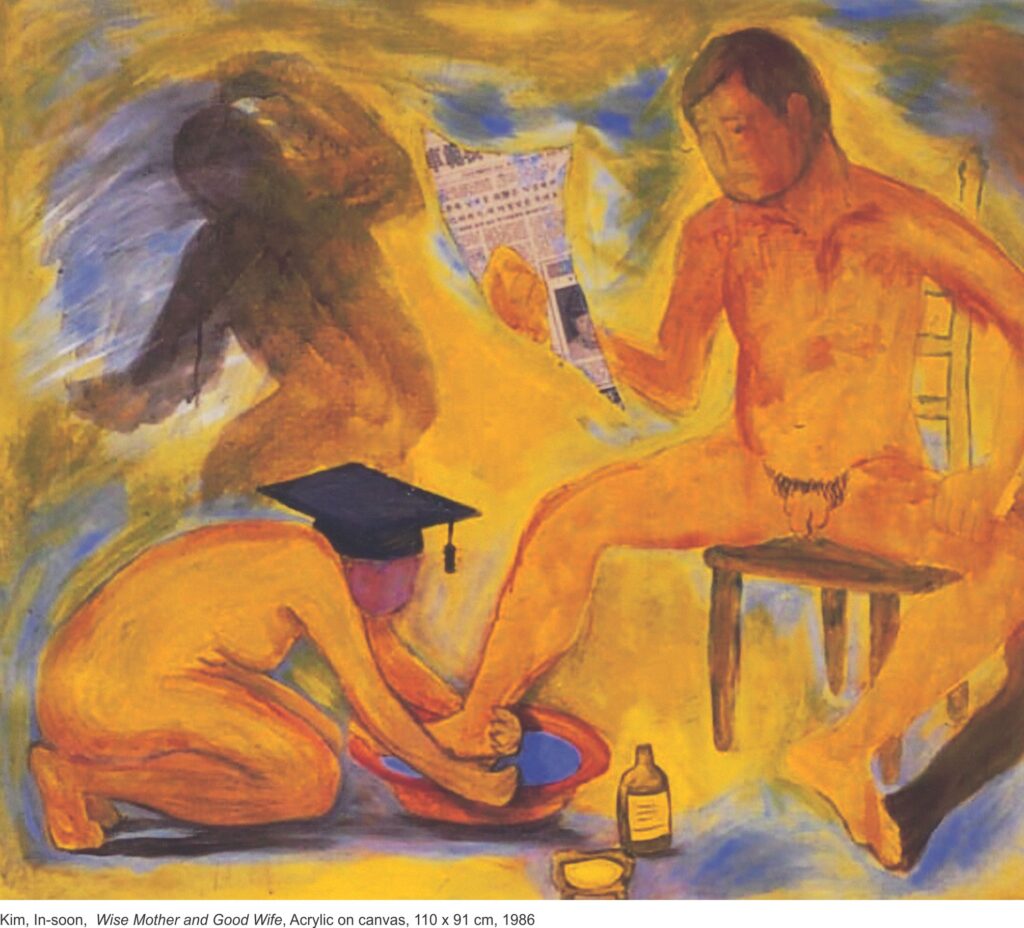
However, it was not until the mid-1980s that Korean women artists began to gain recognition. Although women artists had contributed to Korean culture throughout history, their contribution had hardly been credited. The change in their status was brought about by the Minjoong Art (People’s Art) movement, which was pivotal to the formation of the first phase of women’s art movement in Korea. It emerged as a critique of modernist and internationalist art in Korea in the early 1980s, showing left and nationalist tendencies. As a result of the women’s movement, many artists became newly aware of what it meant to be female: the consciousness of sex discrimination, of the tendency to trivialize women’s work, and of being perceived as a sex object animated their work.
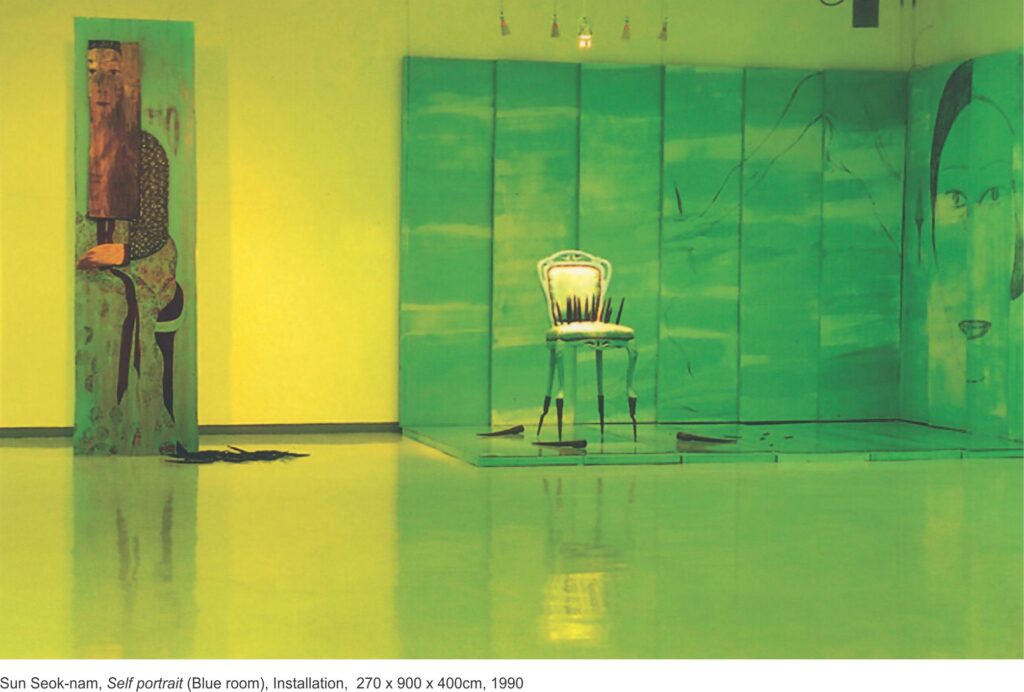
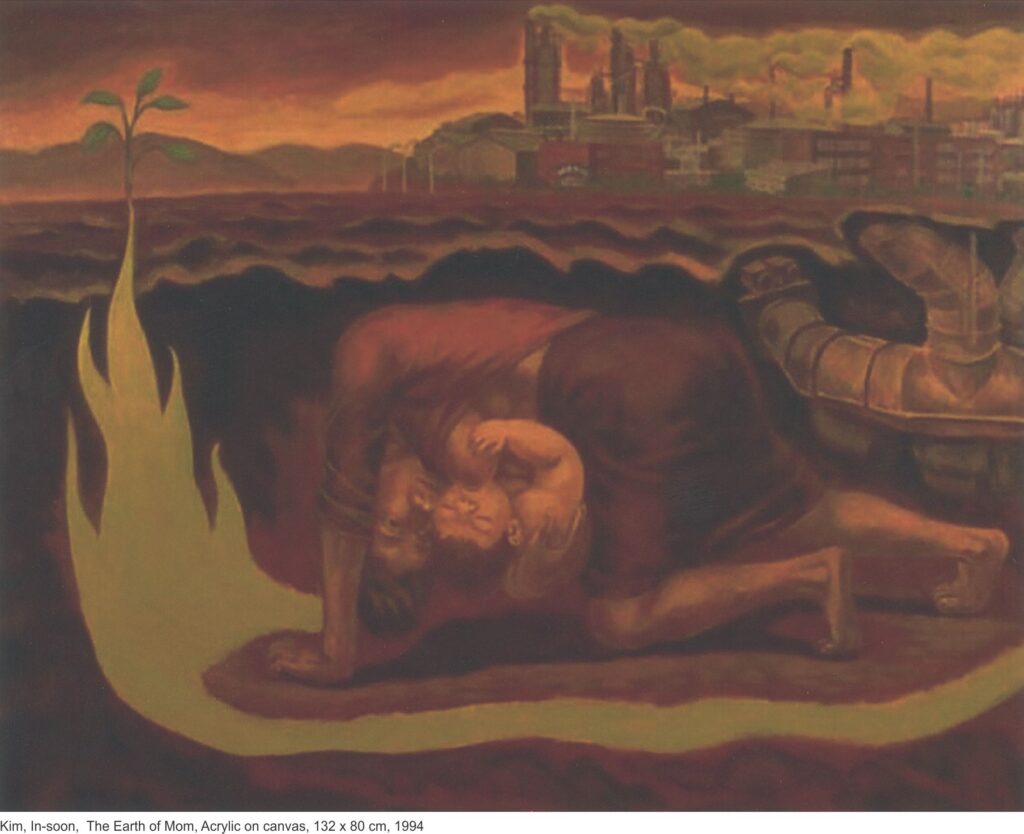
The principal artists of ‘feminist art’ were Yun Suknam, and Kim Insoon who cofounded the feminist art group in 1985 in Korea. Implementing the movement’s slogan that ‘the personal is the political.’ they participated in group consciousness-raising with other women artists, working together and making art out of their experience as women in general and Korean women in particular Kim, In-soon(1941~), is for example, an exceptional artist who started her career as an artist rather late in life. She had been an amateur till the 1970s painting still life or nudes, but in 1984, her first solo exhibition led her to become an artist whose works were based on critical social consciousness, and on feminists’ ideas. This change, however was not a sudden one, for she had already been interested in realistic literature early in the 1970s. In 1985, she participated in the establishment of the National Art Association. Calling herself a ‘painting laborer’, she describes the negative side of society extremely straightforwardly from the point of view of a participant. She meets reality at first hand and collects materials from life. The theme is the lot of woman. Since her paintings describe social reality through very simple brushwork, they are often criticized for lacking artistry or for merely being agitative posters. Nevertheless, she’s a faithful successor to the realists who believed that true beauty lay in the reality of life.
Yun Suknam (1937~), transmitted feminist content via centralized imagery, the incorporation of explicit images, and her choice of such gender-identified subjects as ‘motherhood’ and ‘sisterhood.’ Yun Suknam, was in her late forties when she consciously began to mine her female experience for her art. Yun Suknam’s art refuses easy classification. Simultaneously sensual and conceptual, Suknam’s feminist art resides somewhere between confrontational sexuality and the cool, media-wise work of the latest western feminist vanguard. Her work demands yet another redefinition of the elusive term ‘feminist art.’ Yun Suknam’s works since 1970 reveal an oeuvre that, in its successes and its failures, makes plain the fact that feminism is not a single, one-dimensional philosophy or ideology, but, rather, an evolutionary—and revolutionary—organism in its germinal stage. When it succeeds, Suknam’s work is remarkably free of didacticism as it inhabits a vast middle ground linking the strategic positions of essentialism and deconstructionism, thereby deflating any semblance of a polarity distancing the two points of view—the first positing the existence of an ‘essential,’ timeless female essence; the other stressing the language and social roots of gender identify. Even when her work fails, it remains a fascinating diary of Suknam’s direct confrontation with the practical dilemmas of engaging feminism in art, and succeds in demonstrating that feminism is more a process than a program.
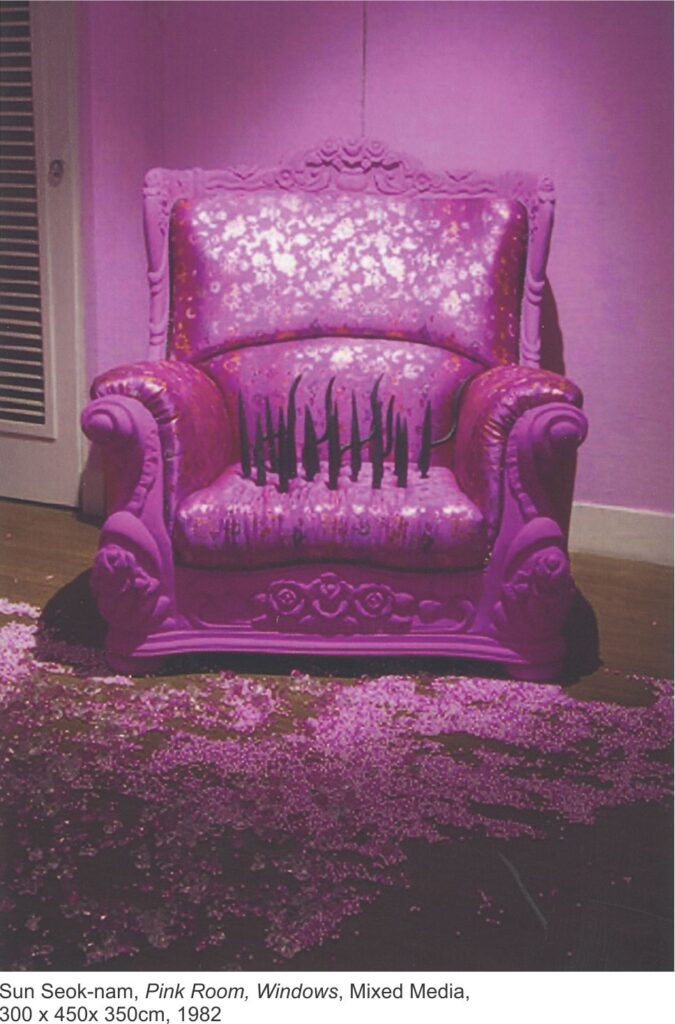
Her accumulation of images and object are convincing in their original context, but viewed next to one another, seem to be dramatically different. The implication of her work is that objects and people are made what they are—or made what they seem to us to be—by the representational style in which we are accustomed to experiencing images of them. Freed from the constraints of the male presence or voice, her women are also seen as free to construct their lives anew. That the images themselves originate from male-controlled cultures is no more paradoxical than western deconstructionists’ application of the male voice in order to deconstruct it. Suknam thus seeks solutions to women’s situation both without—in critiquing representation used to enforce women’s limited options—and from within—via women’s collective assertion of full personhood. Shunning the distanced, theoretical feel of deconstructionist work while drawing on its ideas, Suknam’s most recent works constitute an exuberant documentation of women’s transcendence, throughout her/history, of patriarchal structures and expectations. What she presents are optimistic, energizing images of women through the ages ‘living beyond their means.’
Finally, Lee Bul (1964~) is an artist known for her high-tech feminism and ‘global’ fusions of culture. Through her interventionist performances, her cyborg and monster sculptures, and now her karaoke installations, Lee Bul has lately made a name for herself. But Lee’s reputation is not uncontested internationally. In Korea, critics have occasionally charged her with commercial sensationalism or with presenting herself as a ‘Korean feminist’ overseas while neglecting Korea’s own art scene—a criticism she has tried to defuse through several recent shows in her country. The daughter of a left-wing political dissident, Lee began her artistic career in the late 1980s, when the country was finally on the road to democratization and the vibrant period of political Minjung art was coming to an end. Feminism and the queer movement were latecomers to South Korea, starting to emerge only at the end of the `80s. Lee at first shocked her audiences with soft sculptures resembling limbs and viscera–some of them, in wearable form, donned by the artist in places like Seoul’s Kimpo Airport or the Meiji Shrine in Tokyo. Later, working in various mediums, she produced giant sculptures of buttocks, breasts and vaginas. Her provocative, interactive ‘Hydra’ installation series of the late `90s—involving inflatable vinyl forms printed with the photo-transfer images of Lee herself decked out in a traditional robe, strap-on baby dolls and sexy space-hooker garb (black knee-high boots and fishnet stockings on legs splayed toward the viewer)—skillfully manipulated cultural cliche, simultaneously spoofing Western images of the exotic Asian woman and expectations of how Eastern feminist art should look. Throughout the late `90s, Lee’s principal theme remained the human body and technology—or, more specifically, women and high tech. Her various series of monsters and cyborgs (cyber organisms)—weird but elegant sculptures made of silicone and white porcelain that feature fragmented, often headless, one-legged and one-armed bodies with the voluptuous proportions typical of Western women as depicted in sexually loaded Japanese comics and animation have-been successfully exhibited around the world.
Though many Korean women agree that the social and political feminist movement in Korea has inspired Korean women to combat patriarchal practices and systems, they are less satisfied with the Western feminist political viewpoint flattening out the complicity of the culture they wished to repudiate. Many Korean women believe that it has been possible for Korean women to meld their voices with the mainstream culture, literature, and visual arts, which was almost exclusively a male realm. A recent study suggests that an archetypal heroine in literature written not only by Korean men, but by Korean women is often the filial daughter or chaste wife who is employed to embody the Confucian virtues of the official ideology and exemplify society’s values and beliefs in a subtle way. Despite the Western feminist attempt to historicize them as images of the repression and discrimination of women, they often affirm cultural values. It can be argued that this attempt often re-discovers the Korean women as a victim of Korean history and positions them as an absolute other, which has never really existed. Ideally, the notion of a women’s art will be no longer be necessary or useful to young Korean women artists who, one hopes, will attain ultimately the power to reinvent both contemporary art and themselves.
MeeAe Lee is an art critic and curator
Korean women artists now invite viewers to share their experiences through explorations of the consequences of having to conform to Confucian norms. This effort reflects a tension within them and a space where conflicting ideologies have to be reconciled in order to function in a society that is intolerant of differences Looking at today’s women…