
responding to sheba chhachhi
‘Ganga’s Daughters’ is the very concise title that the photographer/artist Sheba Chhachhi has given to an expansive body of images. Chhachhi’s artistic practice, going back more than two decades, encompasses journalistic reportage, documentary constructions, activist propaganda, poignantly personal portraiture, multi-media theatrics, and even revelatory exegesis
‘The complexity of meanings thus produced by interpenetrating forms and levels of reality is, quite literally, incredible. Such things do not happen in the natural world. And yet we are impressed by the illusion that they do; that this cannot be happening, but is.’ ( from Describing Matisse by John Elderfield; from the catalogue of the exhibition Henri Matisse: A Retrospective; The Museum of Modern Art, New York; September 1992 to January 1993. All subsequent quotes which follow are from this work.)
All of these methods of expression weave in and through ‘Ganga’s Daughters,’ but for the sake of brevity my focus is on the still photographs, both black-and-white and in colour, that Chhachhi brings together under this rubric.
Chhachhi’s subject is Indian women devoutly committed to spiritual practice, people who are both orthodox and iconoclastic, knowledgeable of parameters yet also defiant of rigidity. Operative labels to understand the choices these women have made in their lives (such as Hinduism, renunciates, monks, Shaivites) are useful only up to a point, for their actions and beliefs chafe against the easily codified definitions of such subjects, challenging labels themselves. Chhachhi’s interest in her subjects stems from commitments that are personal, political, philosophical and spiritual; enabling an elastic approach and resulting in a startlingly diverse array of pictures. Contradictions and complexities that have beon encountered along the way, making ‘Ganga’s Daughters’ only more potent as art, courting controversy and unintimidated by the unresolved.
The series began with a group of pictures shot, almost naively, in Ahmedabad in 1980. Subhadra is a woman encountered by Chhachhi when she was a student and these early photos have the feeling of notes for a future project, something to return to when both experience and study would allow the artist to ascertain more properly the importance of her project. Subhadra’s consciousness of the camera verges on defiance and Chhachhi’s evidence of their meeting has the raw energy of photographs of spiritualist mediums from the late 19th Century, abetted by happenstance compositions and an unembellished printing technique.
Chhachhi was able to pick up this thread years later and explore her subjects in depth and with finesse. The editing and structuring of the pictures for the exhibition follows closely the circumstances of their making; yet Chhachhi also allows the photos to disconnect from their overarching narrative to function as phantasms of moments both incandescent and intensely visual. The effect is more akin to abstract painting in that something is functioning both theoretically and materially, breaching dialectical conventions while mirroring and magnifying its subjects.
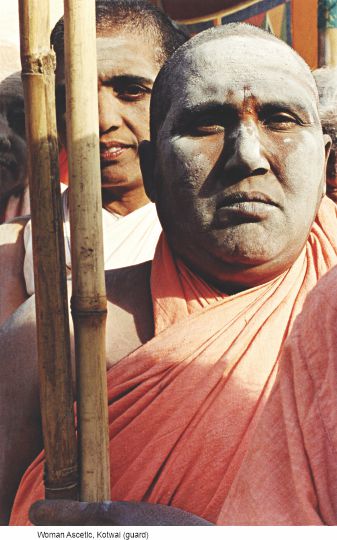
One part of ‘Ganga’s Daughters’ is a rogue’s gallery of larger-than-life portraits. Nine women confront the photographer and acknowledge their collaboration in the construction of their representations, much as their choices of hairstyles and clothing reflect their spiritual paths. The gaze of each is direct, postures are deliberate, the images are reminiscent of genres of self-presentation found in bazaar studio photography. Taken as a whole, this set of portraits emphasizes individual personalities over community, willful idiosyncrasies over collective homogeneity. Most recently, for an exhibition in Paris, Chhachhi has gathered these portraits around the centerpiece of a short animation video, using found images from the early 1900’s, a spectral figure that floats vertically, positing spiritual transubstantiation against the magic of technological entrapment. This central ‘yogini’ posits a self-aware, almost hieratic performance of spiritual power which disrupts and questions the self-conscious nature of the more contemporary portraits. As in other sculpture and installation works, Chhachhi reclaims primitive techniques of reproduction to empower the disenfranchised who may not have access to that which is cutting-edge or state-of-the-art.
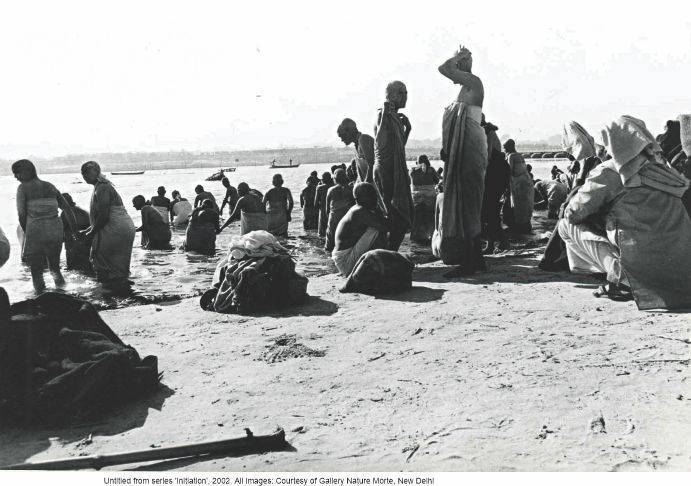
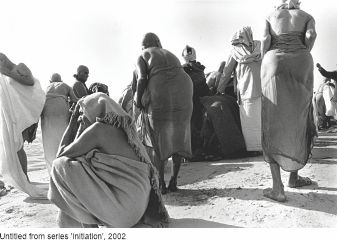
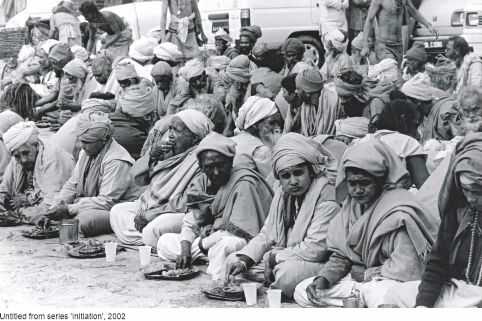
Certainly, the most prodigious part of ‘Ganga’s Daughters’ is a group of some thirty black-and-white photographs christened ‘Initiations.’ This series documents the activities of a three-day process culminating in a single morning when a group of women convened as part of a very much larger gathering and gleaned their own pointedly personal experience from it. Chhachhi’s camera follows them through this collective ritual, from preparation to denouement, yet documents each step almost abstractly, seeing each moment with fresh eyes, as if ‘condensed as a poetic text.’
My own personal interest in the ‘Initiations’ is how they dovetail, seemingly unconsciously, with other genres of photography; photo-journalism, of course, but also fashion photography and the documentation of theatrical events. The photographs present a found scenario as if unmoored from its context and I am reminded of similar spectacles that occur in other cultures, namely the Butoh school of performance art in Japan or the haute-couture runway presentations staged by the fashion designer John Galliano in Paris. My point is that radical subcultures seem to exist in all societies (and Chhachhi’s women are very much a minority subculture within the larger scheme of orthodox Hinduism in India today) and seem to function as a sort of pressure release so that the mainstream status quo may remain undisturbed. What the ‘Initiation’ photographs call into question are our own closely-guarded parameters used to understand such subcultures (positing ‘avant-garde vs. traditional’ or ‘radical vs. conservative) and the exceptions that may obviate such binary paradigms. Here is extreme radicality within the structure of conservatism, and a kind of traditionalism that may appear to be avant-garde to outsiders.
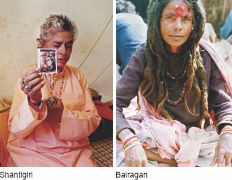
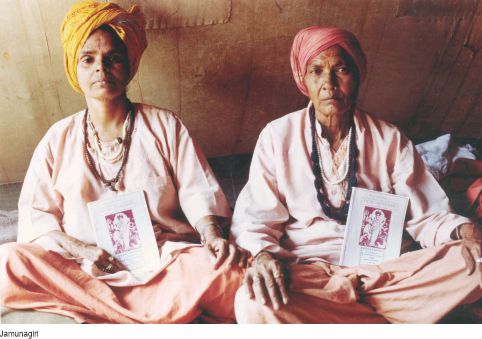
As a group, the photographs assembled as ‘Ganga’s Daughters’ make an attempt at portraiture both individual and collective, covering wide expanses of time with little regard to place (though Chhachhi often includes the names of towns in individual titles, there are no long distance shots of landscape or architecture to properly locate these women). The actions captured could be taking place today or five hundred years ago; these women seem both intimately knowable and hypothetically mythic. With many of the images, Chhachhi has succeeded in creating a picture as densely layered as an epic novel, where ‘harmony, facility and simplicity stand amid dissonance, difficulty and complexity.’ Chhacchi’s camera captures reality but also seems stumped by it. The photographs stand not only as art objects but also as barometers of living history, psychic potential and the records of marvelously realized lives.Peter Nagy is an artist and curator who writes frequently on the subject of contemporary art for a wide variety of publications. He is the director of Gallery Nature Morte in New Delhi
‘Ganga’s Daughters’ is the very concise title that the photographer/artist Sheba Chhachhi has given to an expansive body of images. Chhachhi’s artistic practice, going back more than two decades, encompasses journalistic reportage, documentary constructions, activist propaganda, poignantly personal portraiture, multi-media theatrics, and even revelatory exegesis ‘The complexity of meanings thus produced by interpenetrating forms and…