
in the seams of dhaka research and design
Each year, Philadelphia architects Stephen Kieran and James Timberlake travel with their students from the University of Pennsylvania to Dhaka as part of a unique design research laboratory in which deep investigation is undertaken to stimulate design and planning interventions that can interact dynamically with the urban systems in place and promote positive change.
One of the few constants about Dhaka is that nothing is quite as it seems, or at least nothing today is at it seemed yesterday. Everything is changing. You can stand along a roadside in Dhakshin Khan and watch one landscape being unmade as another is made by thousands of cubic meters of liquified silt, pumped through elaborate laceworks of pipes to terra-form the floodplain in preparation for Dhaka’s expansion. In between this year and last, some 500,000 people have migrated to Dhaka, and it feels as if an entire new city has merged with the one we left behind. We come to expect major infrastructures to appear between our annual visits, and we are no longer surprised when they are just as quickly overwhelmed. Design in this context is what planners refer to as a wicked problem: one in which the boundaries are unclear, the variables are undefined, and successes are unquantifiable.
It is within this ambiguous, and at times ambivalent, context that we have challenged ourselves to situate our design research laboratory. The laboratory is built around a deeply analytical, collaborative, research-based approach that resists the premature presumption of solutions. It is distinct from typical design studios in that problems are not assigned at the outset, and solved singularly; rather, students are challenged to work collaboratively to define their own problem statements out of a thorough and careful analysis of researched data. We understand research not simply to mean data collection but the application of focused analysis, hypothesis, and testing—with the goal of exposing synergies and opportunities for intervention.
During the seven years that our lab has focused on Dhaka and the six trips to Bangladesh that we have taken with our students, the arc of our investigation has changed. Our initial focus was micro-scaled interventions that could be implemented through, for example, the Grameen Bank micro-finance model, which we used to filter the topics of our research and frame the interventions that it yielded. While conducting this early research, we witnessed the need for inquiry at the opposite end of the spectrum: research and design focused at the scale of the city, region, and delta. We have recently begun to focus on the convergence of water and soil, documenting the means and methods used by people to manipulate their flows across the delta in order to understand how these elements impact the topics of human health, food security, shelter, migration patterns, movement, economies (both formal and informal), urban morphology, ecology, environmental degradation, and biodiversity.
We pull and pry at these strands of inquiry until we can isolate and document our understanding of them across scales and over time. Once we can characterize them individually, we then work to understand how they are woven back into the collective knowledge of the studio and the incredibly dynamic and dense network that is Dhaka. At times, this process of weaving, of synthesizing data, yields moments of focus, always partial and more often than not temporary, that help us form insights into the critical networks that have coalesced in and around Dhaka. These insights offer seams within Dhaka’s fabric that we have identified as moments rich for design intervention. The seam is the question of what to design. In most cases, its definition is more difficult to articulate than the design that answers it. Over the years, we have identified more than 30 such seams, each supported by an exhaustive research effort to understand what Dhaka is and to identify a question that in its answering has the potential to be positively transformative.
HYDROLOGICAL URBANISM
Zhengeng Chen (2014)
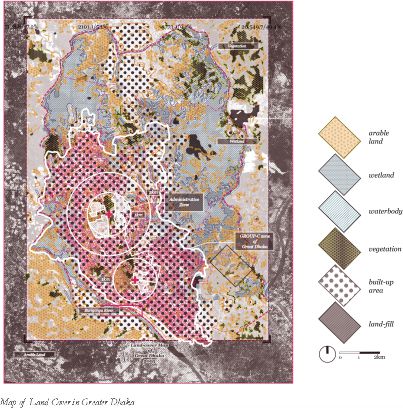
There is a conflict in Dhaka: a territorial pursuit for position that is annually yielded and contested by the waters that flow over and erode the delta and the soils that are carried and deposited to produce the subtle shifts that define the performance of its vulnerable landscape.
This inquiry traced the physical and performance characteristics of soils at different resolutions across the delta to identify their unique abilities to support vegetative cover and their resistance against erosion. Extracted from this data are universal strategies that could be applied to reclaim areas of increased soil degradation in and around Dhaka.
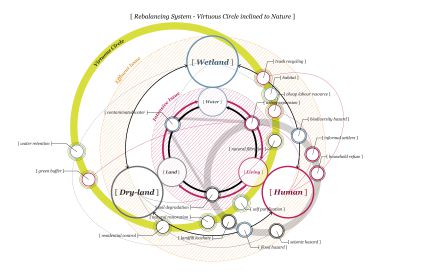
The data was distilled to produce a working taxonomy of landscape programs that can improve the outputs and benefits of a discrete set of hydrological, biological, and geological systems. Depending on the ecosystem services required for a specific situation—water retention or purification, biodiversity rehabilitation, waste recycling, etc.—one can define a design intervention that incorporates the necessary landscape programs outlined within the taxonomy and deploy them against the environmentally degraded situation in question.
A demonstration shows how this method can be used to reclaim an in-filled canal near Hazaribagh and is documented through a detailed phasing plan that deploys these landscape programs over a 15-year remediation period. This includes a 1-year preliminary excavation period followed by 9-year staged restoration period, after which the landscape would be able to support the necessary ecologies needed to rehabilitate the canal over the course of the final 5 years.

NEW SOIL
Mathew Stone (2014)
What does it mean to make new soil? In Dhaka, we have actively observed this process occurring in two ways. One is glaringly visible, involving the industrial dredging, barging, liquefying, pumping and/or trucking of sand and silt from the bottoms of rivers and collecting it into the expansive earthworks that become the “new soil” onto which the city’s expansion eventually extends. The other, while not invisible, is less conspicuous, camouflaging itself amongst the millions of people who participate in the gradual land-filling of Dhaka’s lowlands and canals to create “new soil” that is considered higher value than the hydrological functions previously performed by these landscapes.
The need for new soil is not a recent development in Dhaka but rather a geologic precondition of its existence within the delta. It is an environment dependent on a cycle of flooding in order to maintain a temporary margin of elevational stability—a condition in conflict with modern patterns of urban development that give preference to permanence and security. The processes of “new soil” production in Dhaka are likely to cease as surely as the lands within the Delta are likely to suspend sinking. In the meantime, we must consider how, where and when we create “new soil” so that the landscapes which result are sustainable in the long run and not solely determined by the profits of illegal land grabbers and developers.
This inquiry researched the quality of soil being created in Dhaka and built an intervention around the high organic content found within the city’s waste stream. The design is of a networked compost system with facilities located throughout the city that divert organic waste away from land-filling operations and toward a new composting industry that provides the city with nutrient rich soil. The soil can be used to facilitate urban agriculture as well as applied to sand-filling processes, creating more sustainable landscapes as the city expands.
ENVISIONED ECOLOGIES
Margo Angelopoulos, Mary Carroll-Coelho, Joshua Seyfried (2013)
This inquiry looks at a transect of land that runs along the Dhaka-Aricha Highway connecting the industrial zones of Mirpur to those of Savar. Low-lying areas such as these provide the ideal conditions for the production of one the region’s primary building materials: fired clay brick. Identified by the verticality of the chimneys in contrast to the relentless horizontality of the landscape, these kilns support a complex sequence of events that transform the fluid soils of the floodplain into the stabilized building blocks of the region. Bricks are made by extracting clay from the flood plain adjacent to the kilns, pugging it to remove air, molding it into bricks, and then drying it in the sun. After this initial green stage is complete, the bricks are moved and stacked in the kiln, fired, unloaded, stored and eventually transported to market.
The clay that is extracted in this process is only partially replenished by annual flooding, and as the bricks are fired, so is the soil underneath and adjacent to the kilns. PH levels and organic matter decrease as the sand content of the clay increases. Eventually, the clay is of such poor quality that the kiln shuts down, moves, and repeats the process in a new location, leaving behind a fired landscape that is neither healthy nor productive for its future inhabitants.

By changing the operative structure of the brick industry and coupling it with regenerative ecologies, we can reduce pollution and restore the critical natural processes that help sustain healthy environments and retain the economic productivity of the land. The proposed interventions establish a phased transition to new industrial and dwelling practices that advance air, water, and land remediation as well as personal health. By reusing the existing infrastructure of the brick kilns and optimizing the potential of their transient systems over time, the seasonal and long-term cycle of “Re-mediate, Re-purpose, and Re-activate” introduces new lumber, fish and agriculture industries, new methods and materials for making brick, new approaches to forestation, new plans for water control and water treatment, and a shift to alternate methods of construction and building materials.
Jacob Mans is an architect based in Philadelphia. He has taught at the University of Pennsylvania since 2012 where he has worked with Stephen Kieran and James Timberlake on their Design Research Laboratory investigating Dhaka.
Each year, Philadelphia architects Stephen Kieran and James Timberlake travel with their students from the University of Pennsylvania to Dhaka as part of a unique design research laboratory in which deep investigation is undertaken to stimulate design and planning interventions that can interact dynamically with the urban systems in place and promote positive change. One…