

synthscape a waterborne settlement in the ganges-brahmaputra river delta, c. 2055
A featured team project of the McKinley Futures Graduate Design Studio, University of Washington, Spring 2014: Jared Luther, Alden MacKey, Matthew Rothlisberger, and Monica Sarker, conducted by Daniel Friedman.
“The oceans cover over 70 percent of the planet and are critical to life on Earth. The oceans drive almost every natural system on the planet, including carbon absorption, oxygen exchange, nutrient cycling, temperature regulation, hydrological cycles and other crucial systems. Traditional thought has assumed that the oceans are vast, endless, and capable of absorbing waste and change at any scale. While the oceans are expansive, we now know that this perception is incorrect. Humans are changing the oceans, and the rate of change is increasing. The subsequent impact on humanity and the oceans is staggering.”
—Arup Foresight, s.v. “oceans”
[http://www.driversofchange.com/oceans/].
“Futures studies (also called futurology and futurism) is the study of postulating possible, probable, and preferable futures and the worldviews and myths that underlie them. There is a debate as to whether this discipline is an art or science. In general, it can be considered as a branch of the social sciences and parallel to the field of history. In the same way that history studies the past, futures studies considers the future. Futures studies (colloquially called “futures” by many of the field’s practitioners) seeks to understand what is likely to continue and what could plausibly change. Part of the discipline thus seeks a systematic and pattern-based understanding of past and present, and to determine the likelihood of future events and trends. Unlike the physical sciences where a narrower, more specified system is studied, futures studies concerns a much bigger and more complex world system. The methodology and knowledge are much less proven as compared to natural science or even social sciences like sociology, economics, and political science.”
—Wikipedia, s.v. “futures studies”
[http://en.wikipedia.org/wiki/Futures_studies]
In spring 2014, the University of Washington undertook an advanced graduate architecture studio to explore research-based, speculative design scenarios that envision urban developments constructed on sea-borne platforms, designed in response to the urban and environmental challenges of global climate change, in particular sea-level rise and population displacement. The studio employed a keyword-based framework to guide its investigation of the areas of human activity on which future global equity and prosperity depend—society, health, education, government, economy, science, and urbanization.
The studio brief called simply for a city on water anywhere in the world, fifty years hence. This article reports on one of three scenarios to emerge from the studio; for its site, our team proposed a speculative urban settlement in the outflow of the Ganges-Brahmaputra river delta, partly in response to projected population pressure caused by immigration and displacement. Our proposal features the design and construction of hybrid “synthscapes” that combine carbon fiber with natural vegetation and bamboo in an expansive seaborne urban network, engendering new community morphologies, new systems of water detoxification and management, a new economic base, and environmentally resilient infrastructure that can continuously absorb and support migrating populations.
The Ganges-Brahmaputra river delta is in constant flux, as dynamic and powerful as the rivers themselves. Among external forces that have adversely affected this region are environmentally unsustainable local economies that issue toxic effluence, compounded by the vulnerability of low-lying regions to sea-level rise resulting from global climate change. The fundamental premise of our proposal reverses the typical environment/building relationship: it modulates sediment deposition and generates newbiosynthetic, biomimetic infrastructure. The development responds to the impending cataclysm of global climate change by proposing new ways of building and new types of spatial organizations that provide both social and economic updraft by combining digital technology, local agency, and robust grassroots environmentalism.

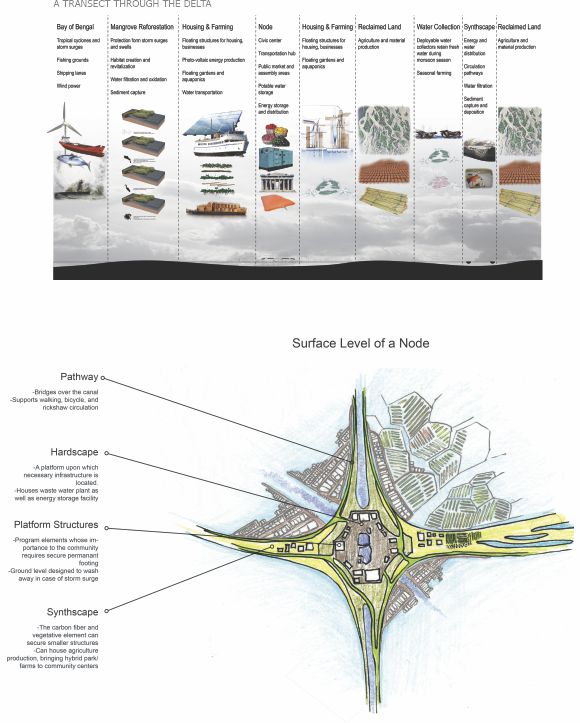
Our proposal seeks to honor the singular qualities of place and space in this region, which are defined by expansive low-lying coastal vegetation and estuarial horizontality. These natural features inspired the composition of our project—flexible, buoyant, low-lying biosynthetic hubs and bridges that create negative spaces of habitable water and reclaimed sediment, a new kind of place, capable of accomodating the increasing populations of climate refugees. The structural logic of the urban infrastructure mimics lessons learned from the role of mangroves, which have been identified as beneficial to climate change mitigation, and which oxygenate of the water Ganges. The ground level platforms of waterborne settlement are designed to wash away in case of storm surge; the carbon fiber and vegetative elements can secure smaller structures and house agriculture production, bringing hybrid parks and farms to community centers. Orthogonal bamboo scaffolding serves as the armature for the assembly of engineered components. Both the architecture and the infrastructure flexes, bends, decays, and grows.

Our project’s “synthscape” is an organic system comprised of highly flexible, adaptable, and resilient urban components. The central hubs integrate housing, ports, markets, and small businesses with waste management and energy infrastructure; a linear network of major and minor canals integrate circulation infrastructure, telecommunications, water, and pedestrian and non-motorized transportation; floating boats and barges support mobile commerce; floating multi-family and single-family homes develop organically in the vertices of the circulation spokes; and a a lily-pad-like system of floating membranes deployed during the monsoon rains channel fresh water into giant bladders held within the spatial voids of giant “synthscape” space frames, expanding the economic base to include the harvesting and export of potable water.
Jared Luther and Matthew Rothlisberger are in the M.Arch program at the University of Washington in Seattle. Monica Sarker and Alden Mackey were also members of the project.
A featured team project of the McKinley Futures Graduate Design Studio, University of Washington, Spring 2014: Jared Luther, Alden MacKey, Matthew Rothlisberger, and Monica Sarker, conducted by Daniel Friedman. “The oceans cover over 70 percent of the planet and are critical to life on Earth. The oceans drive almost every natural system on the planet,…