
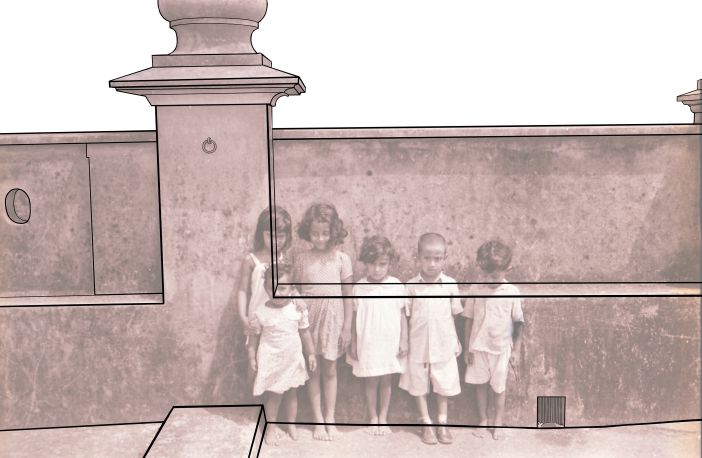
rankin street, 1953
This text accompanies Naeem Mohaiemen’s project ‘Rankin Street, 1953’ based on photographs taken by his father that year. The project was shown at Art Basel (2013), Dhaka Art Summit (2014), and in the ongoing solo show of Mohaiemen’s work, ‘Prisoners of Shothik Itihash,’ at Kunsthalle Basel.
After a few weeks of interviews, the retired officer warmed up. He insisted, from then on, that the day’s interview always ends with lunch. Your auntie made this. You like fish of course? Not too many bones.
Then he would say, sometimes, You are becoming part of the family.
I started wondering why I could not have moments like that with my father. He had only agreed to an interview once, about ten years ago. It had been a small disaster. His answers were short and clipped, basic details from dinner table stories went missing. He insisted on answering in English, which gave the answers a stilted air. On the audio track you can hear my mother interrupt and say: No, that’s not how it happened why are you leaving that part out tell it properly ahha, why are you speaking in English?
Until finally he said to her, You tell the story then.
That is when I knew the interview was over.
Since then, father never agreed to sit for another interview. Just spend time with us, we are not subjects of investigation. He does not think he has any stories to tell. He was an army doctor, who had the bad luck to be posted in West Pakistan right before the war. Not a protagonist, but a hostage to history. I insist that microstories are crucial, but he remains unconvinced.
Later, when I stumble on that box of negatives, it was during the bathetic task of vacating the family home. The developers prevailed, all cousins united on this transaction. The Dhanmondi house had to be surrendered. They told me: You don’t have family, you won’t understand the pressure.
Inside a steel cabinet where house documents were fastidiously stored, was a maroon box. May be steel was the reason ants, termites, and other hazards had not frayed the negatives. Looking at it for the longest time, I thought I had found a way into my father. He bought a camera in 1953, while in medical school. This was his first box of negatives. But it was also the only box; nothing before or after.
When I started scanning them, the first few sleeves were promise followed by disappointment. Cats, cats, so many pictures of cats– the only subject that would willingly pose. I stopped scanning. What if I scanned the whole box and it was only cats?
Cats can be quite political, Yasmeen reminds me. After all, a cat may look at a king.
When I leave Dhaka, things come into sharper focus. Father may not sit still for interviews, but he likes mastering new gadgets. The phone line was crackly, I was impatient (so impatient, what is with children today?), but in the end, he understood how to operate the machine.
In the last week, he scanned 300 images. Now, other things start emerging. More cats, yes (she had a litter, there’s a photo of a box of mini kittens). But also, aunts, nieces, balconies, streets, rickshaws, signboards.
The beach. They went to the beach
Later, father writes: I am not really a professional photographer. I took pictures of what interested me at that time.
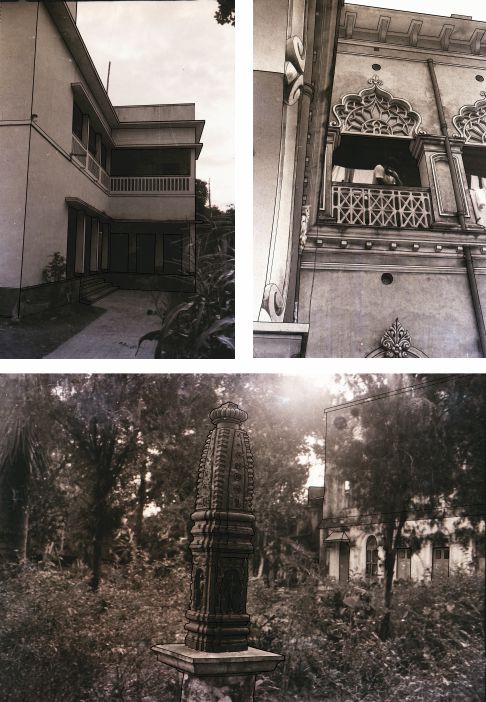
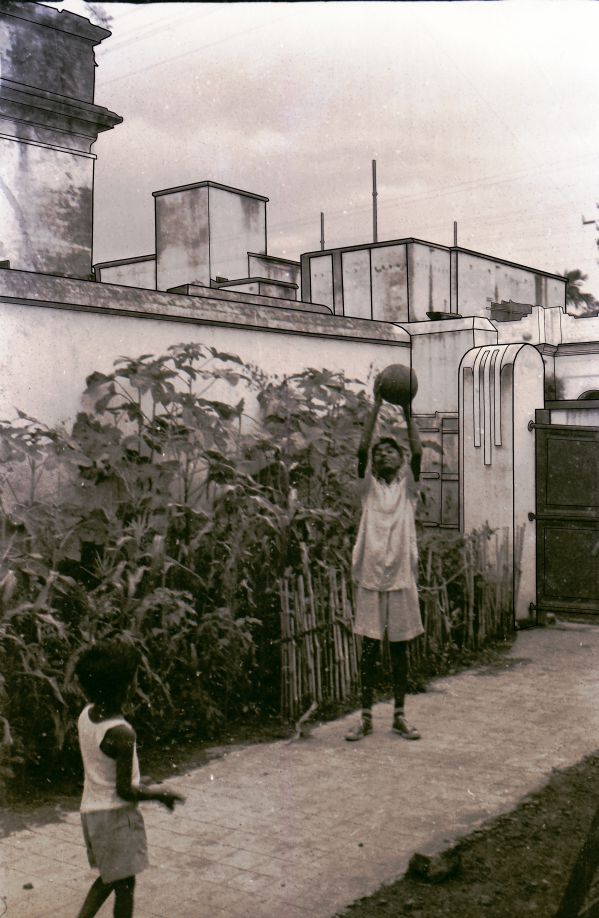
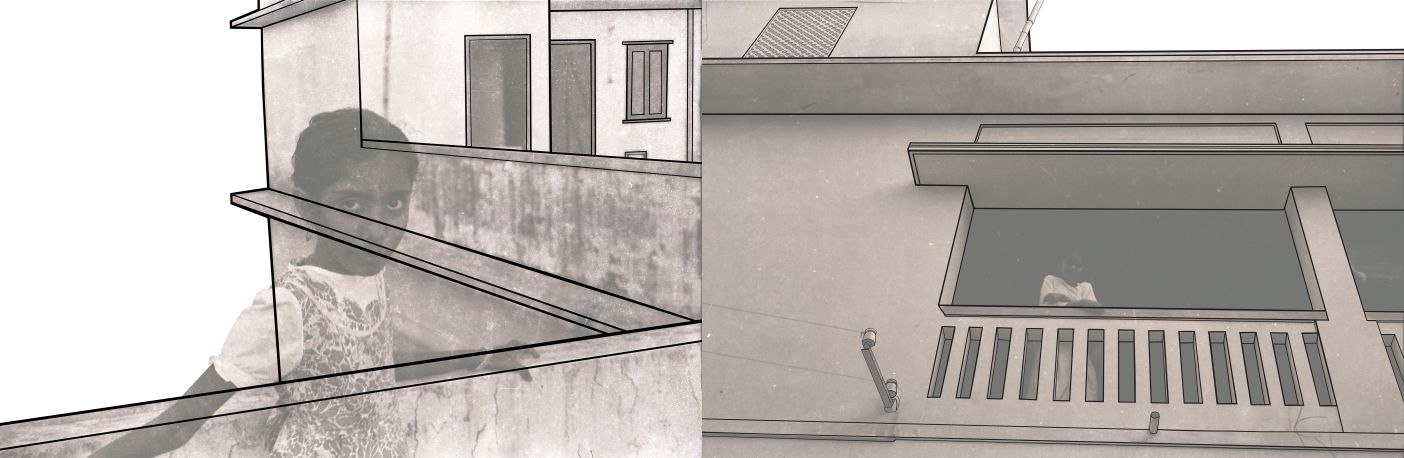
Rankin Street. The rooftop. A clean, clear unobstructed view. The clearest sign that it is 1953. In these first images, there are many roof shots. Either clumsily framed or deliberately akimbo. I cannot tell. Father cannot remember the photos. He remembers this was his first year with a camera. But he cannot remember taking the pictures.
In an ideal context, the one you always read of in magazines and books, he would remember exactly what he was thinking when he composed the photo. This was what I was thinking at this moment. Like that iconic photograph taken in 1958 of Richard and Mildred Loving. The photograph, by Grey Villet, comes with a back story:
In 1958, Richard and Mildred Loving were arrested in a nighttime raid in their bedroom by the sheriff of Caroline County, Virginia. Their crime: being married to each other. The Lovings — Mildred, who was of African-American and Native American descent, and Richard, a bricklayer with a blond buzz cut — were ordered by a judge to leave Virginia for 25 years. Two lawyers took their case to the Supreme Court, which struck down miscegenation laws in more than a dozen states. Asked by one of his lawyers if he had a message for the Supreme Court, Richard said: “Tell the court I love my wife.'”
Father doesn’t recall the details, so I look for familiar faces instead. Besides that cooperative cat, on whom he used up many rounds of film, most of the photos are of my aunts. There were seven sisters and three brothers, all living inside that one house on Rankin Street. There was an eighth sister and a fourth brother, but they died very young. The sort of thing that was common in those days. Tuberculosis, Typhoid, the most common causes.
There is a sharp gap between the sisters. The older ones all studied up to a certain point and then became wives. The younger sisters came of age after 1971. They all went on to have jobs. They became university professors and doctors. One aunt ended up at the World Bank. Well, I don’t know how I feel about that.
These aunts are the ones I see most often these days. We have more to talk about. It feels bad to say that, but it’s the truth. For the older aunts I didn’t grow up, still “babu” in their eyes. Endearing and oddly suffocating.
The Rankin Street house was sold sometime in the 1970s. A greedy city came and swallowed up entire blocks. Seven sisters each got one-seventh of the sale price, a pittance in the 1970s. Three brothers inherited the other house in Dhanmondi. These are the ways the swaps happened.
Father has no stories. He can’t find any negatives after 1953 either. From 1954-1971, everything is gone. During the war, that was the first thing to disappear. In Rajshahi, another old man mournfully talked about his lost diaries.
When father snaps family events now, the images are hopelessly plain, I mourn the loss of his possibilities. Abba, please turn off the flash, I request for the hundredth time. Without flash, everything looks dark, he replies. Then he grumbles. I can see it in his eyes, my son is trying to teach me photography. But maybe, he’s smiling inside.
Yasmeen writes a letter to me. She says: We have to use flash these days. The flash keeps us in the pleasant darkness so the shadows that show our stories, our faces, the worries in our irises, our wrinkles of almost forced smiles – these things are all hidden in the bright light. It is easier to use flash; it is more comfortable. Why not think of comfort when the alternative forces us to face divisions of memories, of properties, of homes, of lives, of children. A life that no one but he who did not use flash in 1953 could ever put together again.
Father says he took all the photos. But there are three where he is inside the frame. Posing with a cousin, lying on a chouki, standing in front of a calendar. April 1953.
Who took this picture? He can’t remember.
Naeem Mohaiemen uses essays, films, and photography to research the “memory wars” of Bangladesh history. His current project, “Prisoners of Shothik Itihash,” is a seven-gallery solo show spanning the years 1947-1977, at the Kunsthalle Basel, Switzerland. His work is in the collection of the British Museum and the Tate Modern.
This text accompanies Naeem Mohaiemen’s project ‘Rankin Street, 1953’ based on photographs taken by his father that year. The project was shown at Art Basel (2013), Dhaka Art Summit (2014), and in the ongoing solo show of Mohaiemen’s work, ‘Prisoners of Shothik Itihash,’ at Kunsthalle Basel. After a few weeks of interviews, the retired officer…