
recent southeast asian art
Southeast Asian art launched into the 1990s with tremendous zeal. It was a period marked by vigorous exchanges, experimentation and new expressions as a result of the artists’ conceptual and intellectual engagements with the social changes in their surroundings in the form of site-specific installations, video as well as performance art. These developments can be attributed to a number of influences; in particular, the return of a group of significant overseas-trained artists from Europe and America who brought home with them a keener awareness of the global processes and discourses in art, and sought to update the traditional paradigms of art-making to suit the regional context
The most compelling voices to have emerged from Southeast Asia during 1990s belong to artists who try to situate themselves within their immediate contexts. In their distinctive temperaments, they engage with concerns such as colonialisation, identity, migration and displacement, power and gender on different emotional or personal levels. Their works reflect the social and political aspirations of their societies; Heri Dono, FX Harsono, Moelyono, Mella Jaarsma, Nindityo Adipurnomo (Indonesia), Wong Hoy Cheong (Malaysia), the late Santiago Bose and Robert Villanueva (Philippines) are among the driving forces to have shaped the course of contemporary art in their respective scenes. Their art has gone against the grain of consensual complacency, exposing uneasy truths about their immediate societies while provoking a reinterpretation and rereading of how we perceive our worlds. Backed by the belief that what they are doing has a real possibility of participating in socio-political change for the better, they are passionate advocates of social conscience and the importance of critical thinking in art making. Through their alternative roles either as educators, activists, intellects, social critics and/or mentors, they have encouraged the younger generation of artists to take on a more proactive stance.
The greater exposure of Southeast Asian art have also resulted in the inclusion of more artists from this region in various international exhibitions namely the Venice Biennale, Sao Paulo Biennale, Kassel Documenta, Bangladesh Asian Art Biennale, Fukuoka Asian Art exhibition, Asia-Pacific Triennial (in Brisbane) and Cuban Havana Biennale over recent years. Furthermore, important exhibitions and publications documenting Asian art from the mid 1990’s onwards have also provided new perspectives for the global audience in understanding and looking at Asian art. Hans Ulrich-Olbrist’s and Hou Hanru’s Cities on the Move (1997-1999), which toured several major cities in Europe—London, Helsinki, Louisiana, Bordeaux, Vienna—and New York and Bangkok, is perhaps the most iconic show of its time. It redefined the framework of an art exhibition and updated the model for the new millennium; the show not only presented works of art but also captured the experience of ‘urban chaos’. In their role as curators, they are akin to two crazy installation artists projecting their grand visions through the show’s spectacular layout (of the exhibition space) and daring juxtapositions of visual art against architecture, urban planning, films and sounds from Asia’s urban landscape.
Recognizing the importance of exchange, the Asian art network had also begun to develop its own forums and events. Art festivals are springing up everywhere (Kwangju, Yokohama, Taipei, Guangzhou, Shanghai, Bangkok and many more) as each nation vies for the position of a serious Asian art capital. In this year alone there will be four major biennales in Indonesia—Jakarta Biennale, Yogyakarta Biennale, Bali Biennale and CP Biennale and two major Japanese art events, the Fukuoka Art Triennial and Yokohama Triennial are scheduled to open this September, followed by the Guangzhou Triennial in November in China. Meanwhile Singapore, which has established itself as the custodian of Southeast Asian art—with a permanent Southeast Asian collection in the Singapore Art Museum—has also hosted a series of major regional exhibitions in the Singapore Art Museum, Sculpture Square and LA-SALLE SIA College of the Arts. And come next year, the Lion City will open its first ever Singapore Biennale.
The Southeast Asian story is underpinned by rapid change. Socio-cultural tensions between the traditional and contemporary, political ferment, and the gargantuan wave of globalization that have overtaken the world are some of the factors which have caused this continual shift of viewpoints and responses. Malaysia’s experience of a peaceful democratic rule is not without its polemics. As we wave our ‘Malaysia Truly Asia’ flag in the face of the world, the question of ethnicity and identity and its complex negotiations continue to figure prominently in the study of Malaysian society. The erasure of its colonial and immigrant past has resulted in a ‘forgetful nation’ which has little sense of history and critical reflexes. The State’s low tolerance for dissent and their draconian measures in dealing with such ‘misbehaviors’ have led to the serious questioning of Malaysia’s judiciary system and civil liberties.
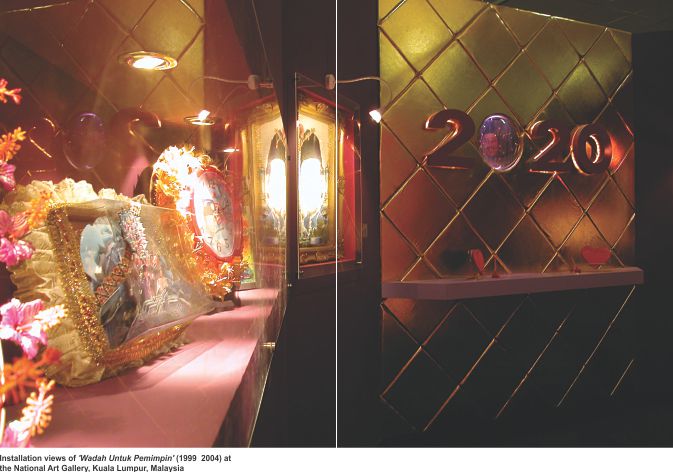
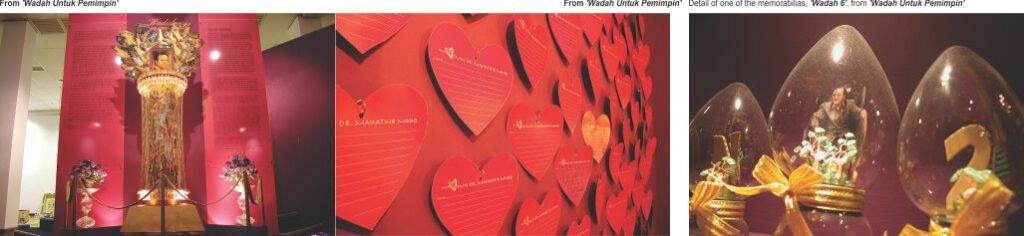
Liew Kung Yu’s ‘Wadah Untuk Pemimpin’ (Gift/Offering to The Ruler) (1999-2004) marks the end of an era in Malaysia. What began as a single ‘offering’ intended for Dr. Mahathir made out of photo-collage and heavy embellishments fashioned after cheesy souvenirs such as a commemorative clock or a table weight grew into an elaborate installation in the form ‘Galeri Perdana’ (The Premier Gallery’s) filled with a series of memorabilia made by Liew to celebrate Dr. M’s twenty-two year rule as the Prime Minister of Malaysia. Members of the public are invited to send ‘love notes’ to Dr. M by completing the following sentence: ‘Saya cinta Dr Mahathir kerana…’ (I love Dr. Mahathir because…). The work is replete with sarcasm and humour. It is a double-edged sword turning the notion of adulation, celebrity and patriotism on its head. Dr. Mahathir, more commonly known as Dr. M, is ‘glorified’ for all that he stands for; grand visions, Malaysia’s National Economic Policies (NEP), the great Malaysia Plans and mega projects. For a nation so set on the future, the race towards development has left its people with thorny issues to deal with. It exposes the ruptures and flaws in the society the leader has sought to change; we’ve progressed no further than becoming a nation with ‘first world infrastructure and third world mentality.’
Malaysian art in recent years has also witnessed a growing number of exciting female artists. Nadiah Bamadhaj, Fariza Azlina Isahak, Nurhanim Khairuddin, Hayati Mokhtar, Yee I-Lann, and newcomer Sharon Chin are among the new generation of serious female artists who are deeply empowered and political in their work. What sets them apart from their Southeast Asian peers is their confidence and attitude; these women take gender equality as a given, and therefore no longer need to self-consciously articulate it.
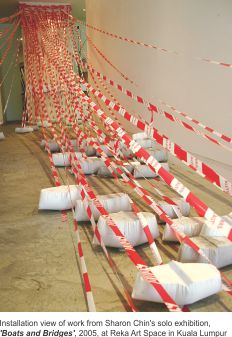
They are cosmopolitan, independent and intelligent; their interests are wide-ranging, taking on weighty issues such as national politics, history and identity to upbeat interpretations of pop culture or personal narratives addressing displacement and
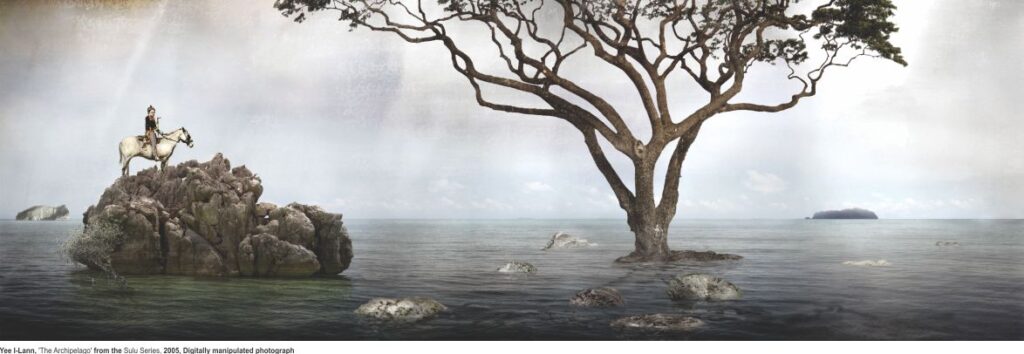
Yee I-Lann’s latest body of digitally-manipulated photographic works, ‘Sulu Stories’ (2005) sees the artist’s return to the shores of her homeland, Sabah and its historical ties with the Sulu Sea. One of the most significant waterways of Southeast Asia, the Sulu Sea is a transient space, intrinsically linked with the flows of peoples and their cultures that have sailed through its waters. Yee’s evocative images of Sulu, digitally woven together through historical archival images culled from the artist’s extensive research as well as her personal snapshots, is the artist’s personal re-telling of its glorious historical past and uncertain future.
Nadiah Bamadhaj’s visceral work is also reliant on current technology to come to fruition. Through a wide range media such as drawing, installation, video and digitally-manipulated photography, her work investigates Malaysia and Indonesia’s historical past, training our attention towards the forgotten events that have shaped our history. Her work questions the subjectivity and inaccuracy of authoritative texts, the manner in which historical evidence and truth has been blurred and reconstructed by state authorities. ‘147 Tahun Merdeka’ (147 Years of Independence) (2004), developed by Malaysian labour activist, Tian Chua, imagines what Malaysia’s institutions would be like 100 years from the time of its conception in 2004. This series looks primarily at Malaysia’s racialised political and economic system, and how this reflects upon education, history, culture, and gender. Based on the fact that a city’s landscape is used as a language of ideology and propaganda, the artist selected architecture and infrastructure around Kuala Lumpur that represent the nation’s ideals.
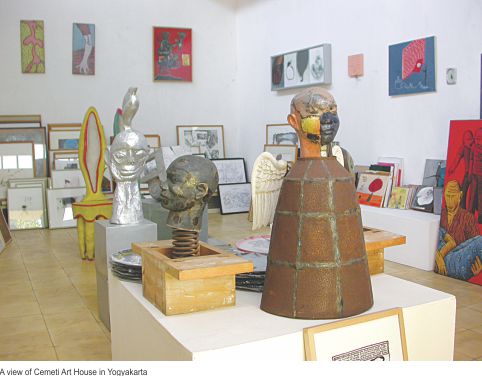
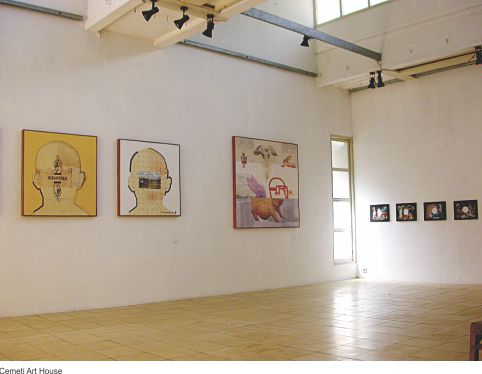
In neighbouring Indonesia which continues to struggle with its violent historical past, political unrest, serious human rights and gender issues, the country’s art has long maintained its kinship with social commentary and protest. Some of the nation’s best artists, so committed in community work and social causes, have forgone the successes of their own careers to do what they feel is best for their communities. Moelyono, FX Harsono, Tisna Sanjaya exemplify the role of the socially responsible and conscious activist-artists. Meanwhile Mella Jaarsma and Nindityo Adipurnomo, artists, husband and wife, and co-owners of Cemeti Art House in Yogyakarta, after 15 years of operation, have become the bastion of independent artists’ initiative for Indonesia and the region. Their track record is impressive if enviable; Cemeti began in 1988 in their tiny living room in the early the 1980’s during the height of the New Order Regime, at a time when the notion of an alternative away from prescribed forms of expression—were few and far between. Their space became a haven for artists who were trying to break away from the conventional mould, and hosted some of the most exciting and cutting-edge works in contemporary Indonesian art. Their dedication to art also went as far as developing related programmes such as art management and critical writing as well as exchange programmes with overseas artists. Artists like Heri Dono, Agus Suwage and many other ‘big names’ in contemporary Indonesian art today have shown at Cemeti Art House during the early stages of their career.
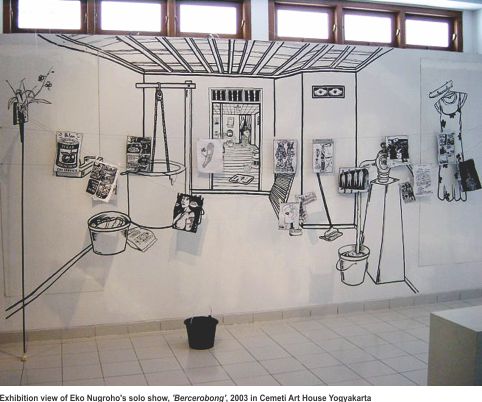
The younger Indonesian artists continue to display a strong sense of independence and resourcefulness in their approach towards art making. While economic conditions may be dismal to those who are starting out, many of them however make up for this lack through inventive and witty solutions. Inspired by the photocopy culture among Indonesian youth culture, Eko Nugroho, a young artist from Yogyakarta began producing a biannual compilation of comics called ‘Daging Tumbuh,’ loosely translated as ‘growing flesh,’ which has been steadily running for the past four years. Publishing is done through the most common medium accessible to most Indonesian youth, the photocopying machine the cheapest and most economical mode of acquiring and duplicating information—and the number of copies produced are dependent to the income generated from the sale of previous issues and public demand. ‘Daging Tumbuh is open everyone who loves comics and loves to draw is welcomed to contribute to the publication, but their work has to be submitted as photocopies, no master copies please,’ the artist says. The influence of comics is also echoed in the artist’s paintings and animated video. In his first solo exhibition, Bercerobong (2003), Eko Nugroho transformed the walls of Cemeti Art House in 3-dimensional comic space. Characters on the walls are communicating with the gallery lights, which have been given their own thought bubble, drawings hung side by side, are in engaged in a permanent dialogue with one another and its surrounding.
Ruangrupa operating out of Jakarta is perhaps one of the most dynamic young artist initiatives around. They are hip media savvy creatures who understand the power of pop culture and are unafraid to question and subvert the implications with daring bravado and wit. In the eyes of many, they are seen as the champion of video art, having successfully organized two major video art festivals, ‘OK Video Art Festival’ which has gained the attention and support of a younger audience. Workshops and documentation projects also figure strongly in their profile. Most of their projects encourage social dialogues between artists and communities, collaborations with like-minded peers in their examination of the impact and effects of Jakarta’s rapid changes upon its people.

The projects initiated by Ruangrupa typify the interests of young emerging artists. Inter-disciplinary collaborations between artists and designers, musicians and performers or community projects with social groups are some of the most common feature among young artist collectives in the region. The subjects they are passionate about are multifarious and difficult to pin down; today’s generation of emerging artists are no longer driven by formal concerns; their engagement is on a local/global level, with concepts and ideas, constantly seeking new ways to express the diversity of their interests. They rely on a plethora of media, to express their ideas and sentiments about their respective milieu. Malaysian artist Vincent Leong’s ‘Love War’ series (2005): ‘Suicide Lovers’, ‘Operation Iraqi Love (O.I.L)’ and ‘Car-boom!!!’ are the artist’s response to the way in which the Iraqi invasion has been portrayed by the media, ‘like entertainment for the rest of us watching from afar,’ he says. It is also about the ‘unreal-ness’ of violence. The viewer’s threshold for watching pain and suffering has been numbed by the daily bombardment of such images, one more violent than the other, just like cartoon shows playing daily in televisions the world over.
Information in the age of technological advancement and globalization is easily accessible and rampant, assaulting the viewer’s attention from every direction. Fight it or embrace it, this sensory overload and excessive media consumption has affected young artists in varying ways. It has caused many to switch off, to introspect, to seek the nostalgic past, the analog days of things handmade and precious, thus resulting in the current revival of ‘retro’ as seen in Bangkok, Kuala Lumpur, Jakarta and Manila. The charm of the mundane or of disengaging entirely from society or seeking refuge in cyberspace are other alternatives chosen by young artists. On the flip side, artists have also turned the other way; those who understand the powers of media are keen to manipulate its potential. The reality of their universe as argued by many young artists has transcended the physical boundaries. The strident polemics of the past hold little connection with their present. Today’s contemporary voice is driven by the urgent need to find empowerment by subverting the status quo and delineating personal spaces through individual narratives, communicating differing obsessions and interests. Whether they are labeled as indifferent, apolitical, or egocentric, it is clear that beneath this diversity and multiplicity, the young artists are bound together in a simple message, declaring: ‘this is where we stand.’
Adeline Ooi is Malaysian independent curator and writer. She divides her time between Kuala Lumpur, Yogyakarta and Manila
Southeast Asian art launched into the 1990s with tremendous zeal. It was a period marked by vigorous exchanges, experimentation and new expressions as a result of the artists’ conceptual and intellectual engagements with the social changes in their surroundings in the form of site-specific installations, video as well as performance art. These developments can be…