
the process artists
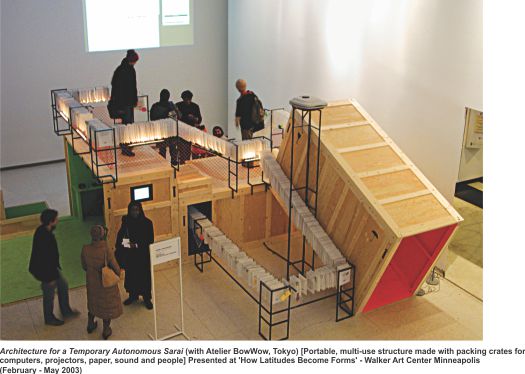
How do ideas originate? Are they a result of conversation or thought? Is an idea always borrowed and, if not, what makes it unique—the process or the stimulus? If art is the articulation of an internal world, how do three individuals coalesce? Is collaborative work more challenging, or less intrepid? These questions are useful when discussing the work of Raqs Media Collective, a New Delhi-based group that has been working together for 14 years. Between the three of them they’ve made, among other things, more than a dozen films; created an archive of some 4000 pictures from more than a dozen countries where they’ve exhibited new media installations; founded Sarai, a space for media practice and research in Delhi; and set up a global forum to discuss free access to internet and information
Raqs is Jeebesh Bagchi, 40, Monica Narula, 36, and Shuddhabrata Sengupta, 37. I met Narula first, in her apartment in South Delhi’s Defence Colony. Disarmingly matter-of-fact, Narula has a take- no- prisoners style. “We’re interested mainly in the juxtaposition of forms,” she said, echoing a Marcel Duchamp utterance from more than 80 years ago. “What do these forms, when placed together, say as a whole, and what do they say on their own?”
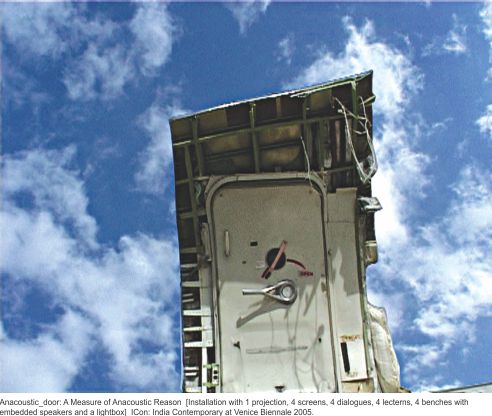
Installation art has had as strenuous a history in India as in the West—its legitimacy, relevance and marketability frequently in doubt. The idea of displaying and viewing found objects, readymade text, and manipulated pictures is considered suspect on many grounds. Where is the art in plied sheets of steel, in used bottles, in a reconstructed kitchen or a porcelain urinal? Why should the viewer practice such compulsive self-indulgence? Why bother to tease out the contrived connections, the unintended meanings? In India, these questions are accompanied by a moral interrogation: Does installation art have the right to exist in a developing nation? The strongest case against it was made by Anjolie Ela Menon, a painter beloved of India’s collecting classes, whose name rings as familiarly in Sotheby’s as it does at the Lalit Kala Academy. Menon said in a 2002 lecture that installation was an art form that belonged only in the affluent societies of the West. “[In India] art itself is an indulgence we can barely afford,” she said. “But to create an art that is doomed to self-destruct in a month’s time is surely not only amoral but against the very nature of what we are.” There are sobering assumptions behind this line of reasoning: the poor cannot have the same equation to art as the rich; in poor nations any kind of artistic process is somehow fraudulent; among the various kinds of art available to a degraded community, paint on canvas has more legitimacy than, say, digital interactive video.
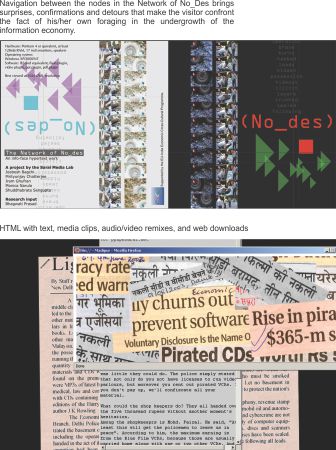
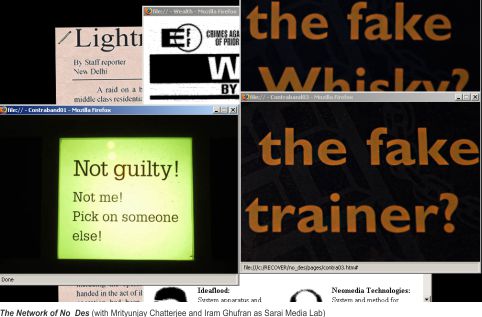
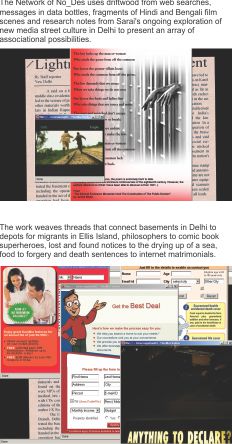
This year, when the British Council hosted a digital film festival in New Delhi, a portion of its premises displayed work by new media artists, including Raqs. The installation, created with two Sarai collaborators, used a laptop and a projector. When a member of the audience approached the computer a guard sitting by the door said, “You are not allowed to touch.” (Incidentally, Raqs has made the untouchability of art the subject of ‘Please Do Not Touch The Work of Art,’ created as email attachments and postcards) The work on display at the British Council was the award-winning ‘The Network of No_Des,’ entered in the 2004 International Symposium on Electronic Art in Tallinn, Estonia. It took some conversation before the guard understood that not only was this particular work of art meant to be touched, it could not be seen in any other way. On the screen was an Indian newspaper article, headlined ‘Lightning Raid in Basement.’ As the viewer moved the mouse around the text, it highlighted clickable words which opened into HTML windows with subtext, media clips, audio/video remixes, and web downloads. These included scenes from Hindi movies; hoary English poetry; faux pop-up windows, American, asking for personal information; a sales pitch for a Japanese product; a collage of reports on piracy, and much more. ‘No_Des’ played on the letters des (which means “native country” in Hindi) and thus suggested a network of nodes beyond nationality and state. Certainly, Menon had not seen ‘No_Des,’ or for that matter, examined any work by Raqs, when she said she had “yet to see an installation in India that achieves rootedness and fidelity to its own sources.” And the guard was amused to hear a popular Hindi dance number in the spotless environs of the British Council.
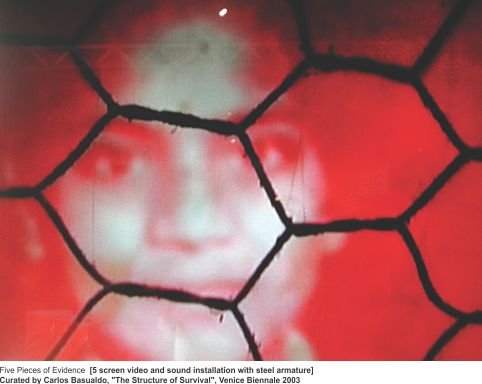
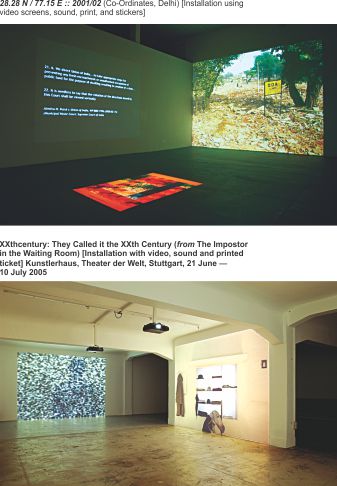
Narula, the photographer of the three, said Raqs had never had a solo exhibition in India. “Isn’t it sad?” she said, “We’re asked for work that is easy to install. And if audience engagement stops with cocktails at the opening, what’s the point? But there it is, we’re not gallery- or sale-friendly.” How do you imagine a space in your house or office dedicated to a small hill of wayward shoes–their shapes adjusted to a human absence—placed in the middle of a room, on one wall a projection of a photograph of a red couch (which you’ll find in Narula’s living room) and the adjacent wall showing a picture of a map, a broken one, resembling an isthmus? Titled ‘Lost New Shoes,’ the installation was part of Citizens, a touring exhibition that took footwear acquired from pirate traders around Delhi to art spaces in the cities of London, Leicester, Newton and Belfast. And then there are the gold-framed paper tablemats on which a map of the world is superimposed with images of used tea bags, cigarette butts, and fishbones above the following caption: ‘ALL THAT CAN BE VALUABLE IS ACCOUNTED FOR. RESIDUES REMAIN, AWAITING ESTIMATION; OCCASIONALLY GLOWING.’ The work—’With Respect to Residue’—was part of the Liverpool Biennial where the group printed 25,000 such mats and placed them in restaurants all over the English city. Raqs, in these works, has taken a variety of cultural references and symbols and decontextualized them. The observer is left to gather his own meaning from the tablemat, the western-centric atlas, the contaminating—or beautifying—images of cigarettes, fish, tea, peanut shells. But creating the connections or stories or theories is entirely dependent on the temperament of the viewer. The selection of media is Raqs’, of course, produced in conversations between the three collaborators, but the surmise is left to us, who are eavesdroppers to these conversations. The critical moment in Raqs’ evolution was, very possibly, the invention of the internet; its members were excited by the idea of a virtual space without boundaries, government, hierarchy. Yet, in a series of articles written more than a decade ago, they found themselves asking questions about the regulation of, and disparities in, access to the internet. They were concerned by the question of intellectual property copyright, which they say is inimical to innovation. In 2000, Raqs, in collaboration with the Center for the Study of Developing Societies, formed Sarai, a hive of techno-cultural production which runs a schedule of more than a dozen monthly lectures, film screenings, discussions and readings by visiting artists from around the world. Sarai awards around 16 fellowships each year to independent researchers who are interested in mapping the city, the movement within it and the laws that govern this movement. Home to a consequential archive of media documentation and criticism, Sarai is unknown to many in Delhi, and in India, and Raqs takes some pride in the untrumpeted nature of its accomplishment. It was also in 2000 that Raqs made a move away from the single-screen narratives of film toward the multi-screen multi-dimensional possibilities offered by new media. “We found the art world an increasingly porous space,” Narula said. “People come in and out of it. There’s the pleasure of meeting people who do interesting work and who find what you do interesting. It was also around that time that the question of what constitutes ‘art’ became flexible.” Rapidly, and with “bloody good chance,” as Narula put it, Raqs became part of an art community, a largely international constituency, based mostly in Europe.
How does Raqs work? “It’s a deeply promiscuous marriage,” Sengupta said at a separate meeting with Bagchi. “We discuss how the text is going to appear. We have petty quarrels. We push each other’s boundaries. Our work is not plotted on one body. It’s fun to have differing consciousnesses. We don’t always work collectively because it’s impossible.”
“But it is cooperative labor,” Bagchi said, “What were the Beatles?”
Raqs recently acquired a work studio in Jangpura, a neighborhood in South Delhi known for its many refugee inhabitants; not an ill-matched location for three migrants: Narula’s father was born in Pakistan and she grew up in Jakarta, and the families of Bagchi and Sengupta come from Bengal. The third-floor walk-up opened to a small room with a square table. Around the table were four chairs, two occupied by Narula and Sengupta, who faced each other. The wall on the right was covered by densely-packed bookshelves with a series of statues—various representations of the Buddha—in the spaces between volumes. Opposite that wall lay a mattress and some cushions. Facing the main door, beyond the table, was a desk and chair, on which Bagchi sat. Each member of Raqs worked on a Mac laptop and mixed English and Hindi effortlessly into their conversation:
Narula: Shuddha, you leave for Plymouth on the 12th.
Sengupta: When do I leave Auckland?
N: At 2pm. There’s a night stop in Kuala Lumpur.
Bagchi: Hey guys, S.’s found a house.
S: Great, we can shoot it.
N: No, it’s blue.
B: What I wanted to say is that the city we live in enacts itself as a theater of transformation and can be seen as a lab.
N: We have the concept of a laboratory then?
S: Did you know 150 New Zealand Dollars amounts to 4,700 Indian Rupees?
N: I didn’t know, baby. Should I send this to those guys?
N: There’s a publication that wants us to write for them.
S: How many words?
B: 6,000 characters.
S: When does it have to go?
N: End of November.
S: A. will have to write it.
N: That’ll take a lot of time. But why did you volunteer to do it? Bollocks.
S: Remember you said you needed someone older?
N: Want to read the Hungarian concept?
B: This time we’ll have to give deadlines to everyone.
N: What are we doing now?
B: Cultural futures. Jadhavpur University. What the popular cinema intimated and what the corporates latched on to is not what we intimated.
S: So we write about what we intimated to highlight the contrast?
B: That’s what I’d planned. First, we’ll have the images and talk about all the ways it speaks to us.
N: Yeah, deconstruct the images.
B: Then the second part will be about how the 90s were intimated to us. About the corporate imagery of decay and of new life. The tension between father and son in movies like Hazaron Khwaishen Aisi, Ghulam and Bunty aur Babli.
N: Why father and son?
B: Generational gap; transition from established areas to the unknown.
N: There is no generational crisis in these movies. And it’s okay to say it but how’re we going to make it show?
B: We will punctuate the 90s through research. We’ll link to the past and…
N: Isn’t it restrictive to look at the 90s that way?
B: Let me read what you’ve written. There are three entry points to the 90s. Most of the corporate discourse…
N: This is interesting as talk but not interesting as image and content juxtapositions.
B: We’ll talk about it.
N: So it’s a separate kettle of fish.
S: We write it the way we see it.
N: The main question being, is Ghayal a metaphor for the 90s? Write a sentence about why else we would call it an illustration of despair.
B: It gave rise to a new historical sensibility.
S: Is there anything else that’s an overlap?
B: The idea of urban decay and the unstable relationship between popular cinema and corporate literature.
S: So a site which is a result of decay is also a stage for production and life.
B: There’s that song in Rangeela where the street guys sing about motor cars and bungalows and…
N: We aren’t going to write about that, are we? So why are you talking about it? We’ve got the first two parts down. Who’s writing the third part?
S: Are we jettisoning the global thing?
N: What’s that got to do with the crisis of the 90s we’re talking about?
B: What you’ve written is too wordy. We need to discuss this.
N: I don’t think you’re very clear about what…
B: I’m talking about intimation.

N: But how is this intimation manifested? You need to flesh it out. Intimation means what? It is the heralding of something, the…
S: It isn’t a prophecy but something imminent.
B: There’s no redemption.
N: Where are you going with this?
B: Look, day-to-day existence is boring.
N: We aren’t talking about boring.
B: This write up is abstract. It’s getting representational.
S: Intimation is representational.
N: One is describing a state that’s no longer there, the state of uncertainty. What’s not here?
B: In Bunty aur Babli…
N: Bunty aur Babli is 2005. That’s 15 years after the time we’re talking about.
B: It’s not just the 90s.
N: Now you are saying it’s not about the 90s. I don’t understand. You’re not saying anything congregated. Ghayal’s trauma is more epic than the trauma in Bunty aur Babli. There is idealism in both but the pragmatism in Bunty aur Babli is much more modern. It’s more 21st century.
B: It’s not a question of moving but of different ways of turning.
N: Where’s the idea of moving away in Ghulam?
B: There’s the idea of dignity, freedom and martyrdom.
S: So we’ve got two or three things going. There’s the despair narrative, the failure of past narrative, coping with the present narrative. I don’t see how we can describe the connectivity.
B: It’s not about the present. It’s asking for different registers.
S: Despair, rejection and pragmatism, and the invention of the self. This is the triangle in the response of…
N: Too simplistic.
S: The third part would be the call to abandon this familiar terrain. And then it’s something you live in, something you deal with, and something you create out of. That’s what Monica and I have written.
B: No, it’s not written like that. The different accounts of the past are not narrated. There is a departure point from which the 90s have to be looked at. There are a lot of unresolved questions. What happens to these images?
S: Now say everything you just said in English and I’ll type it.
B: I’ll write it down.
N & S: No.
N: You write in too cryptic a way.
S: (to N while B writes): You know I went to see G. the other day in prison. They tortured him so much he can’t even hold a pen. And he told me this doctor who came to him said, “Don’t take any of the pills I just prescribed for you. Throw them in the toilet. These guys are fucking with you. None of these medicines are labeled. If I don’t prescribe them, I’ll lose my job.”
N: Jesus.
N (on the phone): Yes I., why don’t you come by Sarai and we can talk there.
S (on the phone): Hi J., yes.
N: That was the Italian TV woman.
N (looking at B’s notes): Check it out Shuddha, he’s written it in real English.
S: Guys, keep 16th December free. We’re meeting J.
S: This looks fine. Shall we send it?
N: No, the English has to be changed.
(B makes tea for everyone.)
N: Let’s send it. Though I think it’s still a bit sketchy.
B: It needs a title.
N: Give it a title, Shuddha.
S: Koi hai? [Anyone there?]
B: They won’t accept it.
S: Then let’s come up with something that has two dashes and a colon.
N: Come up with a title, Shuddha.
S: Kaan kholke sunlo. [Open your ears and listen]
N: Shut up. Look at the abstract. It has nothing to do with listening.
N: We need to do something about C. I don’t want to do it. I don’t like the concept.
B: It could be about the end of publication.
S: We could construct something with the idea of a library.
N: I’m bored with that idea. People go away from the library.
S: W. is eating my head.
B: Let’s not make any more commitments.
N: Let’s think of the title first. The abstract is perfect.
S: Intimations: Soundings of the Popular Cinema of the 90s.
N: No one reads the title.
B: I don’t like ‘Soundings’.
N: I don’t like ’90s’.
S: Soundings of the Cinema of the Now.
B & N: Fine.
N: Let’s send it.
Raqs is into words, the building blocks of idea and action, and this is why ‘Raqs’ is the Persian and Urdu for the motion of the whirling dervish, and ‘Sarai,’ in Hindi, evokes a shelter for the traveling artist; why Raqs sees a global implication in the word nodes; why intimation needs to be explored precisely; why words from one culture resonate elsewhere.
And Raqs does not seem to consider any subject exempt from their purview. Narula talks with as much knowledge about the death rites of Indian sadhus as she does the fate of refugees in the Naru islands of Australia. Sengupta can recite Urdu couplets with the same theoretical fervor with which he explains why some paintings look better as prints than in a museum. Bagchi, the most self-effacing of the three, is as interested in the idea of urban slum dwellers using technology to record their lives as in describing the pleasures of single malt whiskey. Passionate, open-ended text (Sengupta); provocative images and pitiless instigation (Narula); and a unique sensibility (Bagchi) give Raqs’ work its conceptual roundedness.
The members of Raqs may embrace their internationalism more vehemently than their regional identities—in an interview, Sengupta said “I carry an Indian passport, but I doubt that the word ‘Indian’ means more than that to me. It is the name of a nation state, and I do not believe in nation states. I am a person who works in a collective, and lives in a city called Delhi’—but the Indian experience is an important part of their work. They address exactly those concerns that are close to the bone for a developing society – concerns with colonial history and the painful or absurd transitions involved in globalization. For the immediate future, Raqs plans a project that will engage with the idea of the missing person, and with an archive, in London, of letters written by soldiers during World War I. They also hope to start a space to exhibit art that makes room for inclusion. And they will have their first solo exhibition in India at the Nature Morte gallery in New Delhi in August 2006. If all of this is any indication, art in India may be about to free itself from a historical prejudice: it may be ready to open its doors to an audience that is interested in technology and its impact on thought and behavior; to an audience that wants more than comfort food.
Shakti Bhatt is a writer and editor based in New Delhi
How do ideas originate? Are they a result of conversation or thought? Is an idea always borrowed and, if not, what makes it unique—the process or the stimulus? If art is the articulation of an internal world, how do three individuals coalesce? Is collaborative work more challenging, or less intrepid? These questions are useful when…