
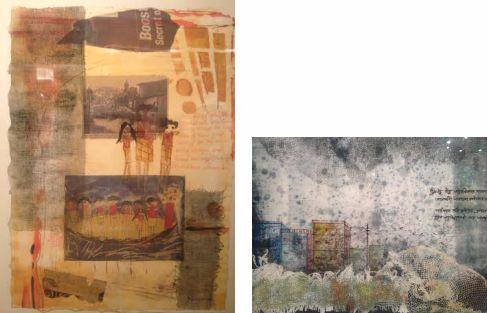
imagining dhaka
A city imagined is not necessarily a city that is not lived. Yet, whenever the topic “imaginary Dhaka” is broached with a varied audience, a common retort is one where imagination is seen as an antithesis to reality making any association between the two seem implausible.
“What is there to imagine about Dhaka? It exists in all its corporeality all right! You imagine things that don’t exist, right?”
“Dhaka is no fairy tale city! It’s real and has real problems. Can we afford to waste our time on something as ancillary as imagination?”
“Dhaka – a whirlpool of confusion, chaos and disorder – is not ideally sensitised to the subtleties of imagination.”
These are some of the common replies I get whenever I broach the topic of an “imaginary Dhaka” to different groups of people. A city imagined is not necessarily a city unlived. But the antithetical position that we generally accord to imagination and reality makes any association between the two seem unnatural. I would like to draw attention to the fact that more than an active relationship between the two, is a “productive transaction”1 is also possible; so much so that it can become constitutive of our urban experiences. Contrary to traditional understanding, imagination is a daily exercise, used as an organizing principle by even the most ordinary city dweller. It gives meaning to the regular experience of city life.
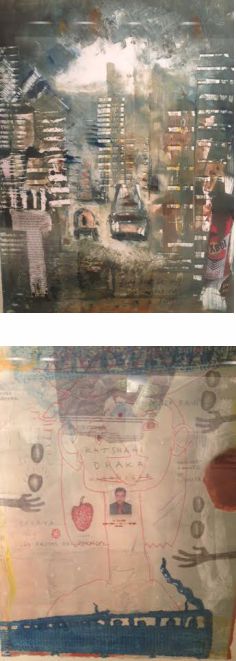
Consider the following: “My wishes are fulfilled coming to the city of Dhaka/ My eyes are gratified by its glittering lights” – a famous movie song from the eighties, sung by two ecstatic migrants upon their first arrival to the city.2 “If you want to make it big you have to go to Dhaka, a city where money floats” – that is a migrant’s imagined Dhaka portrayed in a popular TV play.3 “The city is unpredictable. Once you have left your house, anything can happen and you are never safe out there” – a long time resident feeling in a 2008 TV drama serial.4
The imaginary Dhaka that emerges – a city of modernity, of glitz and glam, a site of opportunity, a dystopian place – is hardly antithesis to the hard city, by which I mean the physical city phenomenologically. Quite the contrary, this city is very much informed by the sociological conundrums associated with the city. However, looked at carefully, one finds no mere mimetic representation of what is experienced. The experience is extended and worked upon by imagination but reified into another construction that eventually becomes the city. This city in turn shapes the collective experiences of all, making it what it is to its dwellers. Thus, the imaginary city can be said to be a telling and rich concoction of one’s cognition, memory, aspirations, dreams, wants, needs, and lived and unlived experiences. In that sense it is not an exaggeration to say that the city we all live in is this city in between, one that is produced in an intersection of many invisible cities and intertwined realities. I strongly believe that this imaginary city, the city of the mind, remains the hidden driving force determining our lives in the city and it is this that holds the clue to understanding why we do things the way we do in this megacity. Let me give some examples of how these imaginary cities are so much a part of the lived Dhaka.
A sense of nostalgia for a lost city engulfs anyone trying to imagine Dhaka. The city is constantly being pitted against what it was and is not any more, i.e. absences. The only way one understands or responds to its destabilizing present is in juxtaposition to the past or a time lost. Think how frequently regular conversations get peppered with sentences like “gone are those days, when things were more affordable.” One can easily substitute the latter half of the sentence with other clauses – such “when people were less commercial,” “life was less stressful,” “the city was more livable,” etc. – things that people “recollect” as once intrinsic to the “city that was.” The nature of association with the past will vary, from the city of antiquity or the more recent national history of independence to one’s personal childhood. In whatever form the past informs any discussion of the city, it blurs the line between times gone by and the present. Thus, Dhaka is placed in a forged continuum with the more comfortable past, not the traditionally understood historical past, but a past that is elliptical, selective, abstracted and decontextualized.
In contrast to such glorious and desirable pasts, references to social life in Dhaka at present are often marked by common generic negative terms – such as “noshto” and “ghune dhora” (Bangla words meaning “rotten,” “corroded” respectively). Such invocation validates the overall moral undertone and suggests a sense of descent from an “ideal state,” which in most cases is symbolized by innocence, simplicity and an anxiety free and relaxed life style.
What is intriguing in all this is that the past figures less as factual history and more as fictional rhetoric, deployed to envision an abstract but possible future in an aspirational city of ordinary dwellers. The bleak present is made negotiable when seen as a phase in that forged continuum with the past. This little act of liberty, inventiveness and fantasy, which may be counter-factual, perhaps is a tactic devised to cope with the madness that is present-day Dhaka.
Another archetypal “other city” that conditions the imaginary Dhaka is the remembered village and to a certain extent mofussil on the provincial city, unadulterated by forces of modernity, and almost mythical in its idyllic qualities. Dhaka is never quite enough in contrast to this ruralized city of beauty, contained in memory, nurtured by nostalgia and often by sheer idealization. This rendition too feeds on difference, partly fuelled by displacement and dislocation, Dhaka’s citizens being largely migrants from different rural parts of the country. Like the city of the past, this spatially distanced other city is also governed by the logic of memory, imagination and nostalgia. Life in the village is often remembered in selective and ideal fragments abstracted from their original contexts. A recurrent recollection of the idyllic village thus includes carefree movements, easy access to neighbourswho were innocent and goodhearted, unrestrained socialising, innocent and good-hearted villagers, and more engagement with the public than the private world. No reference is made to the poverty, lack of work, nosy villagers, and the physical constitution of village houses in clusters with shared facilities that make discreet choices difficult.
More than the credibility of such claims, what matters is the fact that in most instances where the rural is invoked in the urban setting, it is used as a frame, as the available and prominent “other,” to articulate visions, aspirations, and dreams that people nurture about the city, especially those that are still unrealised. Since in Bangladesh in particular and in South Asia in general, the most prominent antithesis to the city still remains the village, the rural becomes an icon for everything positive which Dhaka is perceived to be lacking, or to have lost over time during its transition from a provincial town to the capital and primate city of a densely populated country.
The vision of the village or the ruralised city is also inextricably connected to the myth of the typical villager. In connection to the city’s rural antithesis, people of Dhaka are often seen as unsympathetic, materialistic, self-centred and shallow. The ideal villager – simple, naïve and selfless, someone who has not sold his soul to the materialistic pursuits of life – like an all-pervasive antithesis conditions the way the urbanite is perceived as deficitful – lacking in the scale of morality, sensitivity and often humanity. The perpetuation of this mythic villager-urbanite dichotomy manifests in the decisions and choices the urbanites make in their day-to-day life. One classic example could be how people prefer hiring housemaids from rural areas than urban ones. The thought governing such choices has its roots in the imaginary Dhaka which is believed to affect people negatively once they land here, allegedly making them commercial, cunning and self-serving. Internalizing this self-demonising representation, urbanites themselves prefer the simple and susceptible country bumpkins over the shrewd city slicker.
Not surprisingly, Dhaka is seen as a city that lacks a heart. It is a sweeping generalization no doubt. There are plenty of instances of compassion, sympathy and help extended to strangers in the most unlikely places, just as there are examples of deceitful urbanites exploiting fellow citizens. Yet, lack of trust has become the overriding image of urban life in Dhaka. This lack of trust leading to lack of interaction is not something personal. Rather, it is part of the customary castigation of the urbanite in opposition to the proverbial Good Samaritan, that is the villager. This representation pervades the general air of the city so much so that children in Dhaka grow up on parental advice such as “never eat anything given by a stranger”, or “never talk to a stranger.” The other city in between thus replaces the physical city as a reference point.
Thus, there exists a meaningful transaction between the city of materiality and the other immaterial cities. All three predominant imaginaries of Dhaka discussed above are hinged on moments and experiences that have been experienced either directly or indirectly at some unspecified time and place, the accuracy of which cannot be absolutely determined. What is more important in this regard is that these have been transformed into a construction that forms a formidable part of our urban experience, no less thoroughly lived as the physical city. Dhaka is always conditioned by these other invisible cities5 that are in some ways refracted forms of the actual city and yet removed from it.
A pertinent question at this point would be why do people indulge in such constructions? Can these imaginary cities be deployed to negotiate the present city, which can often be destabilising on its own? Do they generate hope that like alloys can strengthen and hold the material city together and help the dweller cope with, make sense of, and often overcome the overwhelming negativity that forms a considerable part of the urban discourse and life of a city like Dhaka? Also, the very invocation of the other city by the dwellers as a regular exercise is an indication of something amiss. It points to an unease, a jarring movement beneath the mad rush of development, which if taken into account may provide a better hold on the future of the city. It is time we asked these questions and gave these imaginary cities their due place and recognition in the official urban discourse.
REFERENCES
Donald, James. (2000). The Immaterial City: Representation, Imagination, and media technologies. In Gary Bridge and Sophie Watson (Eds.). A Companion to the City. Oxford, Malden: Blackwell. Pp. 46-54.
Tabassum Zaman is an Assistant Professor of Media Studies and Journalism
at the University of Liberal Arts Bangladesh (ULAB). She graduated in English from the University of Dhaka and attained her doctoral degree in Cultural Studies from National University of Singapore.
Images are from the exhibition “Urban Experiences,” from the printmaking and poetry workshops for young artists jointly organized by Bengal Foundation and The American Center, 2014.
A city imagined is not necessarily a city that is not lived. Yet, whenever the topic “imaginary Dhaka” is broached with a varied audience, a common retort is one where imagination is seen as an antithesis to reality making any association between the two seem implausible. “What is there to imagine about Dhaka? It exists…