

h. a. karunarathne profile of a modernist
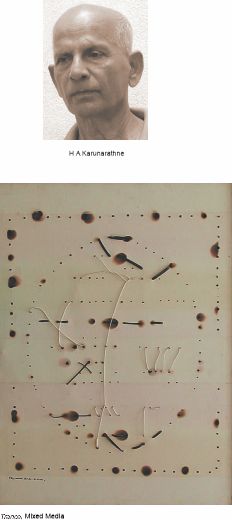
Recent Sri Lankan art history encounters only a few turning points in its evolution. One is when a group of artists instigated modernist thought in Sri Lankan art fusing art concepts of Paris based modernism with local aesthetics and anxieties in the 1940s. The other is when H. A. Karunarathne presented American Abstract Expressionism within a transcendent and spiritual configuration that enticed artists as well as art audiences in the 1970s. A prolific artist, a revered teacher, and an inexhaustible alchemist, Karunarathne’s spectrum of artistic activities includes painting, printmaking, sculpture and murals. In all of his work what is most visible is the fearless and boundless pursuit of experimentation with material and ideas.
‘From True Self come the spontaneous gesture and the personal idea. The spontaneous gesture is the True Self in action. Only the True Self can be creative and only the True Self can feel the real…’ (Winnicott quoted in Kuspit, 1995: 148).
I thought of starting this essay by quoting D. W. Winnicott because his formulation of the psychoanalytic idea of the True Self and the False Self implicitly resembles the aesthetic philosophy of H. A. Karunarathne, the most senior and revered living visual artist in Sri Lanka at the moment. For Karunarathne, a quiet, patient and at the same instant a very determined artist, the act of painting is ‘not to paint but to let it paint’. Through the logic of this statement, which embodies his aesthetic philosophy, he has been able to embark on an artistic quest that consciously removed the derivations and stimuli from the external world and established the canvas as a spiritually heavy embodiment.
Recent Sri Lankan art history has witnessed only a few turning points in the course of its evolution. Since the introduction of the secular tradition of visual art based on the aesthetic premises and ideologies of British Academic art practices adapted to local art discourses in the latter part of the 19th Century, Sri Lankan art experienced its first major epistemic break in the 1940s. In 1943, a group of artists, reacting to the prevailing ideology of painting which pursued a restrictive academism, pseudo-Oriental impersonations and the naturalism of British art, established the 43 Group. Emerging from a background charged with nationalist sentiments and an anti-colonial slant, the 43 Group absorbed most inspirations from avant-garde art movements in Paris and art centres like Shantiniketan in India. The Sri Lankan modernist movement was in the process credited with successfully fusing indigenous draughtsmanship and colour schemes with the idioms of European modernism in an effective way, paving the road for a new hybrid form that was palatable to a nation trying to establish an authentic cultural identity. Although the 43 Group art met its share of resistance in the initial period as in any situation of change, the influence, paradigms and premises of the 43 Group remained intact within modern art in Sri Lanka for a long time.
The next major change in aesthetics and ideology in art was experienced in the 1970s. Karunarathne can be singled out as the sole instigator of this change this time. Born in 1929, Karunarathne had his formal art education in the School of Fine Arts, Colombo, from where he graduated in 1958, majoring in painting and drawing. Trained under the tutelage of well-known art educationalists and artists of the time, such as J. D. A. Perera, David Paynter and Stanley Abeysinghe, Karunarathne was awarded a three-year research scholarship in oil painting and lithography by the Government of Japan in 1957.
His association with the New York School of Painting, which later had important consequences for contemporary art discourse in Sri Lanka, happened during his affiliation with the Pratt Institute in New York in 1965 as a Fulbright scholar. During this time, post- war American art was gaining international attention. Emerging in the 1940s, abstract expressionism, later identified as the New York School of Painting, became the most powerful art movement in the history of American art in the following two decades. By the end of the 1950s and in the early 1960s the New York School of Painting became internationally significant, and influenced many artists all over the world. It was identified as having two major tendencies. One was ‘Action Painting’, concerned with gesture differences and textures of paint, while the other tendency was concerned with colour fields and statements of an abstract image in uniform colour (Arnason 1986: 388). The young Karunarathne was acutely aware of the power and allure of abstract expressionism, which was well established within the New York art scene by the 1960s. He eagerly adopted both tendencies within his art, reinterpreting them within a somewhat different philosophical basis. Upon his return to Sri Lanka he enthusiastically engaged in professing what he had imbibed from his association with the New York School of Painting. This resulted in one of the most influential and widely adopted stylistic movement in Sri Lankan art in the later part of the 20th century.
Until Karunarathne’s intervention in the Sri Lankan art scene with abstract expressionistic art in the 1970s, the major source of influence on local art was still the modernism of the 43 Group that had its point of reference in Paris based avant-garde art. The abstract art of Vasily Kandinsky, Piet Mondrian and Kasimir Malevich influenced Sri Lankan art only during the 1970s and 80s because of the new art of Karunarathne. Until then, Sri Lankan art had remained within a pictorial tradition privileging the figurative and the nostalgic (Weerasinghe 2002).
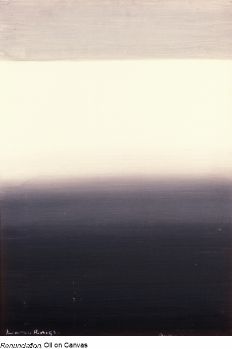
Karunarathne’s confidence and ability to manipulate different surfaces and textures to create atmospheric differences, and his imaginative power show clearly that he is a master of a unique style. He produced canvases that were devoid of figurative motifs and replaced them with equally fascinating colour gradations, abstract shapes and built-up impasto with a combination of paint, found objects and textured surfaces that transformed his art into solid relief. His art has gone through an alchemic process while he remained an enthusiastic and inquisitive alchemist. His constant attempts to synthesize mystical senses, spiritual aspirations and physical gestures in his work have managed to produce an aura that was capable in enticing artists as well as the cultural elite to consume a highly secular artistic product as a very spiritual object.
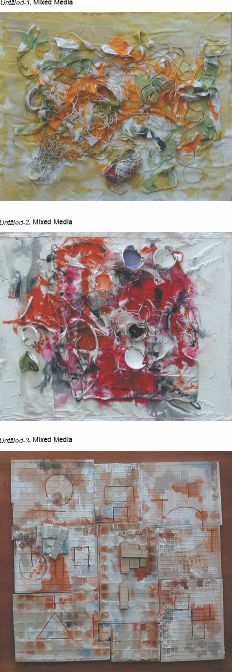
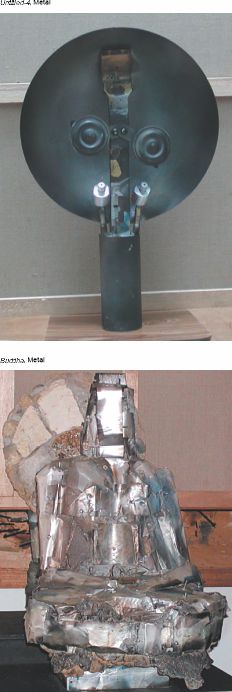
The success of Karunarathne’s inroads into the local art scene with a very foreign art style has as much to do with the way it was packaged as its aesthetics and ideology. Karunarathne was able to contextualize American abstractionist aesthetics within the irresistible cloak of spirituality, in a manner that was very much acceptable to the local cultural elite. Karunarathne declared that painting was a method and process of meditation and an elevated spiritual activity that purifies and calms one’s mind. Therefore, a painting should be executed by letting forms and shapes emerge within the canvas as a result of a deep understanding between the artist and his/her soul. In other words, this unique process of art should not be tarnished by preconceived notions that have direct reference to an outside influence. This way Karunarathne managed to elevate the act of painting to a transcendent act of the highest order (Weerasinghe 2002: 21). The idea of understanding the creative act within a primary process of feeling is similar to the ideas that Winnicot describes in his concepts of True and False Selves. ‘Winnicot’s True Self embodies the experience of the body’ s aliveness and ‘the idea of the Primary process,’ that is, a process ‘especially not reactive to external stimuli, but primary’. The False Self, on the other hand, exists as an organization of reactions to external stimuli. It is entirely a derivative extension of the outer world…(Kuspit: 1995: 148).
If American expressionism is looked at through a study of the aesthetics embodied in Williem de Kooning, Jackson Pollock, Barnet Newman and Mark Rothko, what is evident is an artist’s introversive methodology that has evoked in reaction to post-war social and political chaos (Rosenberg 1966: 37 -44). The crisis of the artist’s position in society and ability to intervene in the face of this socio-political chaos was redirected to an artistic advantage and an excuse for self-absorption. In the process the artist’s endeavor was shifted from the concerns and challenges of society to a struggle between the canvas and self. As a result, artists were able to circulate and negotiate their personal crisis as a social phenomenon. For Karunarathne, abstract expressionism allowed space for a new philosophical approach. Through his idiosyncratic preoccupation with transcendent ideas and hermetic theories of the universe (earthly versus spiritual ones) he formulated a technique for giving expression to a highly abstract and aesthetically challenging paradigm of art making.
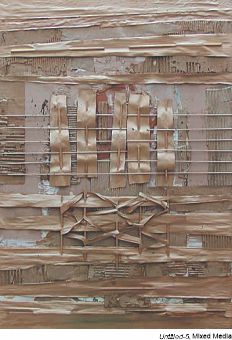
But what is interesting is that the contemplative approach that Karunarathne’s art favoured blends well with the nostalgic preoccupations of the local elite and a middle class faced with urban anxieties. In many ways, the urbanite’s nostalgia also explains the enthusiasm and the vigour with which both artists and viewers accepted his work. Within the local context, perceptions of urbanity are based on notions of migration and displacement and are permeated with connotations of anomie, artificiality, modernity, loss of traditions and the emergence of immorality. These are in fact formulated as oppositional imagery or binary oppositions that construct the village as a natural, organic and harmonious formation with its morality and spirituality intact. Similarly, the induction of influences from abroad leads to constant transformations in the existing social environment and cultural sites, making them unstable. At the same time, to maintain the perceived ‘traditionality’ (a stable entity) in an unstable urban context there is the necessity to invent alternatives more in tune with ‘traditionalists’ present lifestyle with reinvented linkages to a perceived glorious past. On the one hand, those who pressers these alternatives nurse their yearning for their own imagining of a purified heritage and spirituality. In this context, the cultural production of the urbane also provides images with new meaning and new values that are to be consumed and nurtured. The idealized scenes of village life and imagery of beautiful women are popularly executed by many urban artists and consumed by urban art audiences. If such imagery is an attempt by urban artists to provide a sweet pill to forget urban chaos, Karunarathne’s art is an attempt to remove the anxieties of a chaotic reality of the urbane altogether, and to purify and anesthetize the consumer of the impurities that desecrate their morality and sense of being, replacing these with objects of contemplation and meditation. With his ideas of spiritual notions in art, he tries to remind the spectator or the consumer that there is an urban spirituality after all, and that all is not lost.
Karunarathne best work articulates his motivation and his philosophical premises in art making when he declares, ‘I paint when the mood holds me. I do not conceive of a message I wish to point to. Therefore, I cannot pinpoint what exactly inspires me. When the mood arises I paint in what one might say is an act of meditation. To me, it is an act of faith and I stop when I feel it is done—True art is a form of meditation. When the artist is in the right mood for meditation, myriad ideas come flowing into his mind. The canvas is something sacred and pure to the true artist. The canvas is the means that enables the artist to convey the ideas that rise from the depths of his heart. The canvas is not meant to be polluted with meaningless brush strokes harshly rubbed over each other—When I put something on canvas and I feel that no further action of mind is needed to fulfill my objective, I stop the painting and let the viewer seek its meaning’ (Bevon 2004).
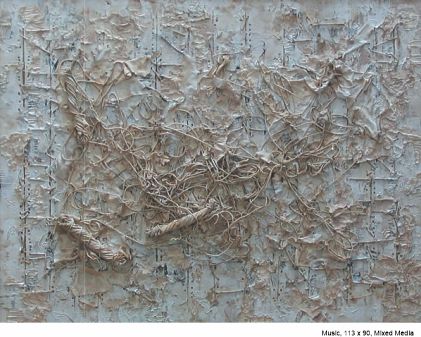
For Karunarathne, an artwork holds a deeper meaning than that represented by its aesthetic value. According to him a ‘painting is not photography. Nor is a work of art meant merely to ornament a room. A true work of art is primarily not meant for the eye. People use their eyes to see the painting, but they should appreciate it with their hearts’ (Bevon 2004).
Karunarathne’s formulations on the relevance of art reminds one of Ernst Cassier’s idea on the subject: ‘He who does not understand these intuitive symbols, who cannot feel the life of colours, of shapes, of spatial forms and patterns, harmony and melody, is secluded from the work of art and by this he is not only deprived of aesthetic pleasure, but he loses the approach to one of the deepest aspects of reality’ (quoted in Verene 1979: 186). In this scheme of things Karunarathne is clearly a committed modernist, spiritualist and secularist in the same instant. But above all, he is a prolific artist whose epistemic break will continue to be felt in Sri Lanka well into the future.
Anoli Perera is an artist, art writer and art manager based in Colombo, Sri Lanka. She is also the managing editor for ArtLab, an art journal published in Sinhala and Tamil
Recent Sri Lankan art history encounters only a few turning points in its evolution. One is when a group of artists instigated modernist thought in Sri Lankan art fusing art concepts of Paris based modernism with local aesthetics and anxieties in the 1940s. The other is when H. A. Karunarathne presented American Abstract Expressionism within…